AI Ecommerce Imagery for Beauty: A Founder's Playbook
Beauty is the hardest category to fake. Shade, skin, and glass punish shortcuts, and shoppers return anything that lies. This playbook, distilled from work Absolutely AI does with beauty founders, covers the workflow, tool landscape, compliance, and measurement framework you need to make AI imagery earn its place on your PDPs in 2026.
Most articles about AI ecommerce imagery for beauty read like affiliate rankings for a handful of packshot tools. That is not what beauty founders actually need. What they need is a repeatable pipeline that survives a shade audit, a returns team, and a legal review. The playbook below is the one we hand ecommerce managers and DTC founders when they ask how a modern AI content agency approaches beauty specifically.
Why beauty is the hardest category for AI imagery
Beauty punishes generic AI in ways furniture, apparel, and homewares do not. Foundation swatches drift half a shade and the return rate climbs. Skin looks plastic under a hero light and the brand looks cheap. Glass bottles refract wrong and the whole packshot reads as fake. Layer on the regulatory environment around before-and-after claims and it becomes clear why competitor listicles quietly skip this category. Anyone comparing this against the broader mechanics of AI product photography should assume beauty needs a stricter pipeline than the default.
The bar to clear is threefold: shade accuracy across foundation, lip and complexion; convincing skin texture with pores, peach fuzz, and subsurface scatter intact; and physically correct refraction through frosted glass, droppers, and gloss caps. Get any one of those wrong and the image reads as AI even if the scene composition is beautiful.
Where AI imagery earns its keep on a beauty PDP
AI is not a wholesale replacement for a beauty shoot. It is a set of image types that each have a best-fit approach. Treating everything as one job is why founders end up disappointed. The table below maps the image slots on a typical PDP to the right technique, and it borrows from the same logic we use when producing AI product photography at scale.
| Image slot | Best-fit AI approach | Notes |
|---|---|---|
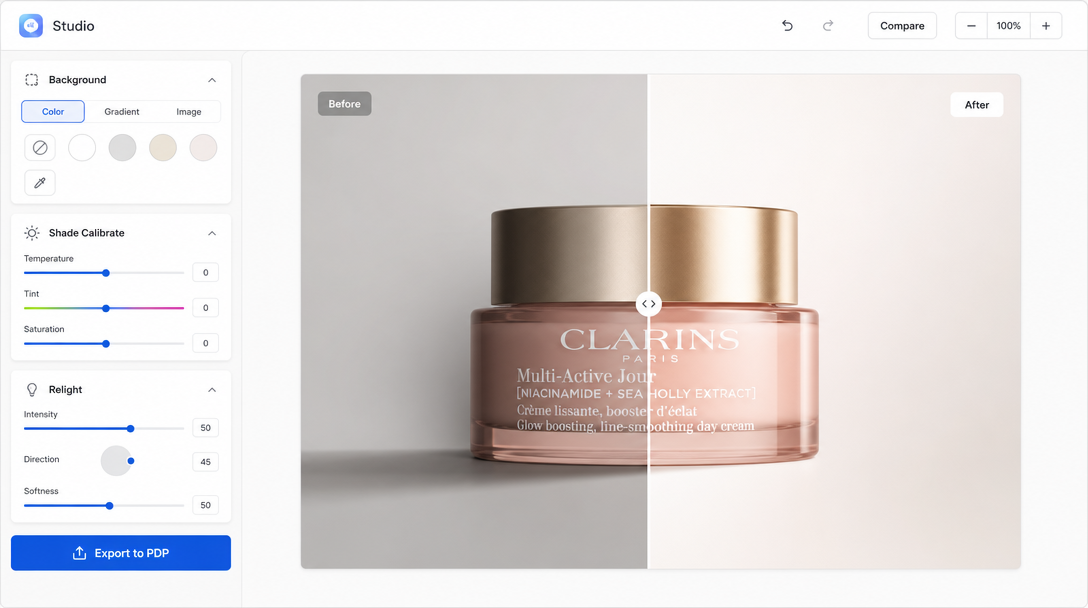
| Hero packshot | Physical shoot, AI relight and background | Real bottle keeps refraction honest |
| Texture and swatch macro | Physical shoot, AI cleanup | AI still fumbles cream and gloss physics |
| Ingredient hero | AI generation with reference anchoring | Botanicals and molecules render well |
| Model-on-skin lifestyle | AI compositing over real packshot | Watch shade match on lip and cheek |
| UGC-style ad creative | AI generation, edit model refinement | Slight imperfection reads more real |
| PDP scroll variants | AI scene generation | Cheap to A/B test seasonally |
| Amazon A+ modules | AI generation with brand palette | Ingredient stories, benefit callouts |
Founders scoping a full catalog rollout should also review our note on AI ecommerce product imagery at scale, which covers volume mechanics that apply here too.
The five-step production workflow
The single biggest change we see when a beauty brand moves from ad-hoc AI to a real pipeline is the acceptance that step one is still a physical shoot. One clean packshot per SKU, done once, unlocks every downstream variant. It is the same principle behind our Shopify ecommerce workflow and it scales cleanly.
- Shoot one clean packshot. White seamless, even light, tack-sharp bottle with label legible. This is the reference anchor for everything after.
- Background and scene generation. Composite the real packshot into AI-generated scenes: marble vanity, wet tile, sunlit windowsill, ingredient-forward still life.
- Model and on-skin compositing. Introduce a diffusion-generated model or a real model plate, then apply the product to skin using an edit model with high input fidelity.
- Shade and finish calibration. Match against a physical reference. Check LAB deltas on foundation, lip, and blush. Adjust in a color-managed workspace, not the AI tool.
- Legal and brand QA. Label legibility, disclaimers on any efficacy shot, diversity of models, brand palette compliance. This step kills more images than any other and that is fine.
Tool landscape in 2026, grouped by job to be done
There is no single tool that does the whole pipeline well for beauty. Grouping by job clarifies where to spend. For a broader tool comparison the review of the best AI product photography tools is a good primer, but beauty deserves a narrower cut.
- Packshot scene tools: Pebblely, Phot.AI, Caspa. Fast, cheap, good for background swaps and vanity scenes. Weak on liquid refraction if the input packshot is soft.
- On-model beauty: Lift, Fotogenic, Monoshoot. Better skin, better on-lip product application. Still needs a human retoucher for hero shots.
- Full brand pipelines: Absolutely AI. Reference-anchored generation, brand palette lock, compliance checkpoints, delivery in the aspect ratios your PDP and paid channels need.
The honest take is that founders under $2M in revenue can run the first two categories themselves. Once catalog complexity and paid volume climb, the coordination cost of stitching tools together outstrips the license fees and a managed pipeline like AI content creation becomes cheaper end to end.
Shade and skin fidelity: preventing the 30% color-mismatch return
Foundation and lip returns cluster around color mismatch. If your AI imagery drifts even half a shade warmer than the real product, the return rate follows. The fix is not a better prompt. It is a color-managed reference board with physical swatches on a neutral card, photographed under known lighting, and a LAB delta check on every hero image before it ships. Our AI ecommerce lifestyle photography notes carry the same discipline into on-model work.
Dedicated pipelines for foundation, lip, and complexion are worth the setup cost because each has a different failure mode. Foundation drifts on undertone, lip drifts on finish (matte reads glossy under AI relight), and complexion drifts on the interaction between product and skin. Treat them separately and audit each.
Staying inside FDA, FTC, and TGA rules
AI does not exempt you from cosmetic advertising rules. If anything it raises the bar because a synthetic before-and-after is easier to produce and easier to challenge. The checklist we run against every efficacy image is short but non-negotiable, and it is one of the reasons founders reach out to us for AI consulting before their first campaign.
- No unsubstantiated efficacy claims. If the image implies 40% wrinkle reduction, you need the clinical to back it.
- Typical-results disclaimers on any before-and-after, clearly legible on mobile.
- Label text must be readable and accurate. AI likes to hallucinate ingredient lists.
- Model diversity across skin tones, ages, and textures. Disclosure where synthetic models are used, per emerging FTC guidance.
- No implied medical claims. Cosmetic is cosmetic.
Measuring lift: PDP CTR, ATC, returns, and paid CPA
The point of all this is commercial, not aesthetic. Beauty brands running lifestyle imagery alongside packshots on Google Shopping see roughly a 125% CTR uplift over packshot-only listings. That number should not be the ceiling of your measurement, it should be the floor. Track add-to-cart rate on PDPs with AI lifestyle above the fold, return rate segmented by which hero image drove the purchase, and paid CPA on ads using AI creative versus your historical studio baseline. The teams doing this well borrow measurement discipline from catalog imagery at ecommerce scale.
When to still book a human photographer
AI has not replaced everything and pretending otherwise burns founders. Book a human for the launch hero, because that image will run for two years and warrants the polish. Book a human for the founder portrait, because trust is the whole point of that shot. Book a human for tactile hero textures such as a whipped body butter dragged across a stone slab, where AI still fumbles the physics. For everything else, an AI pipeline is faster, cheaper, and more flexible, which is exactly the argument we make in AI versus traditional product photography.
Frequently Asked Questions
Can AI accurately render my brand's exact foundation shades?
Only with a reference-anchored pipeline and a LAB delta check on every image. Prompt-only workflows drift too far for foundation and lip.
Is AI imagery legal for cosmetic advertising in the US and Australia?
Yes, provided you follow the same FDA, FTC, and TGA rules that apply to any imagery. Efficacy claims still need substantiation and synthetic before-and-afters need disclaimers.
Do I need to disclose that a model in a beauty ad is AI-generated?
Emerging FTC guidance and platform policy at Meta and TikTok are pushing toward disclosure for synthetic humans in advertising. The safe default in 2026 is a small disclosure line.
How much cheaper is AI imagery than a beauty shoot?
Cost is the wrong lens. The right lens is capability: AI unlocks scene and variant volume that a shoot cannot produce in the same timeline. Founders who lead with cost get a cheap result.
Will AI replace my beauty photographer?
No. It will change what you book them for. Expect fewer, higher-value shoot days focused on hero, founder, and tactile work, with AI handling variants and scenes.
Can AI handle bottle refraction and dropper glass properly?
Only if the input packshot is a real photograph. AI-generated glass from scratch still looks synthetic to a trained eye.
What is a reasonable timeline for a full beauty PDP refresh?
With a physical packshot day already done, a full PDP refresh across hero, lifestyle, ingredient, and A+ modules runs about two weeks through a managed pipeline.
How do I A/B test AI imagery on my PDPs?
Swap the second image in the PDP gallery and measure add-to-cart rate for two weeks per variant. Keep the hero constant so you isolate the lifestyle contribution.
Where to go from here
Beauty rewards operators who treat AI imagery as a pipeline, not a party trick. Nail the packshot, calibrate the shade, respect the regulator, and measure the commercial lift honestly. If you want a managed version of the workflow above, Absolutely AI runs it end to end for beauty brands, from reference board to PDP delivery, with the compliance checkpoints baked in.