AI vs Traditional Product Photography: The 2026 Reality
In 2026, the question isn't which method wins. It's which job each tool is built for. At Absolutely AI we run both a studio and a generation pipeline, and the honest answer surprises most brand teams: AI handles roughly 80% of ecommerce imagery cleanly, while traditional photography still owns the work that earns trust. This article maps where each one belongs.
For the last three years, every comparison post on this topic has been written by an AI tool selling its own platform. The cost numbers tilt one way, the limitations get a single sentence, and the reader walks away with a sales pitch dressed as analysis. We sit in a different seat. Absolutely AI books real studio days for clients and also runs a generation pipeline that produces thousands of variants a week. Both pay our bills, so we have no reason to flatter one over the other.
What follows is the comparison we actually give brand managers when they ask. It covers cost, time, quality, control, the marketplace rules that quietly decide what you can publish, and the hybrid workflow most catalogues should be running by now. If you only read one section, skip to the decision framework near the end.
The State of Product Photography in 2026
Three years of model progress changed the baseline. Diffusion architectures like Flux Kontext, multimodal generators such as Nano Banana (Gemini 2.5 Flash Image), Seedream and Imagen 4 now produce reference-conditioned imagery that holds up to scrutiny on roughly 80% of ecommerce use cases. The remaining 20% still breaks AI in predictable ways, and we'll get specific about that below.
What's genuinely new is reference conditioning. Two years ago you described a product in text and prayed. Today you upload a clean pack-shot, give the model a brand kit and a scene prompt, and get back a frame where the actual product is preserved with high fidelity while the world around it changes. That single capability is what makes the hybrid workflow viable, and it's why this debate has shifted from which method to which job. For a fuller view of how that pipeline runs end to end, see our AI product photography service.
Side by Side: Cost, Time, Quality, Control
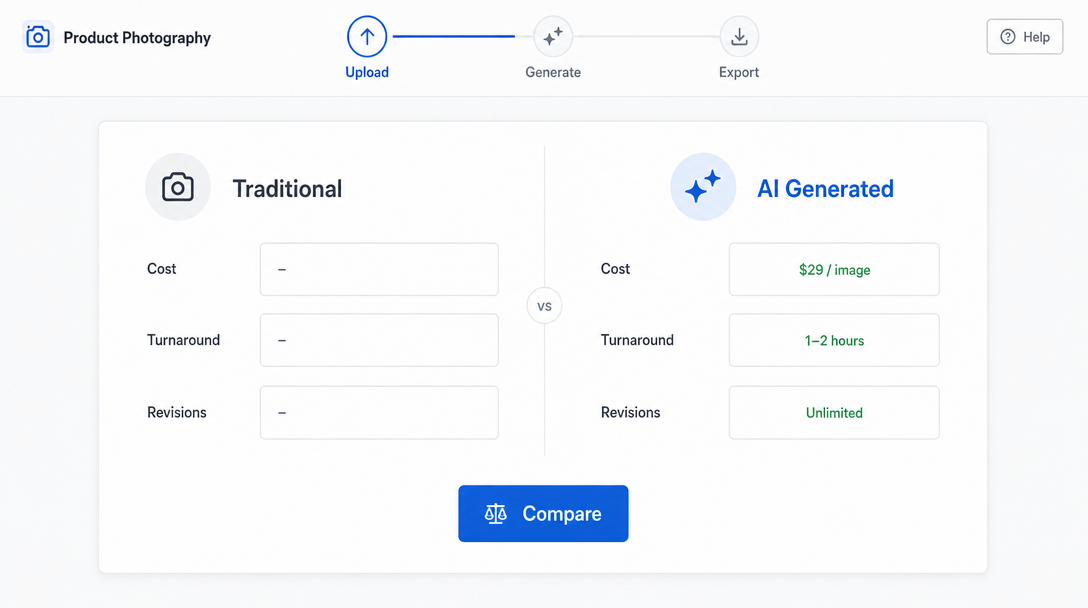
Here is the honest matrix, with numbers from real 2026 projects rather than vendor decks. Studio numbers assume a mid-tier Sydney or Melbourne commercial shoot; AI numbers assume a tuned pipeline rather than a consumer prompt box. Both ranges are wider than you'd think, because both methods scale dramatically with brief complexity. The same comparison logic applies to motion work, which we explore in our AI commercial production breakdown.
| Criterion | Traditional Studio | AI Pipeline |
|---|---|---|
| Per-image cost | $75 to $500 | $0.10 to $15 |
| Turnaround per asset | 1 to 3 weeks | 30 seconds to 2 hours |
| Revision cost | Reshoot or retouch fee | Near zero, regenerate |
| Scalability across SKUs | Linear with crew days | Effectively flat |
| On-model fit accuracy | High, real garment on real body | Improving, still inconsistent |
| IP and likeness rights | Clear, contracted talent | Murky, depends on model and training data |
| Marketplace compliance | Accepted by default | Conditional, see compliance section |
| Provenance and trust | Authentic by capture | Requires disclosure to maintain trust |
The cost gap looks dramatic in isolation, but it stops being the deciding factor once you weight it against the rest of the table. A $300 hero that anchors a six-month campaign is cheaper per dollar of revenue than a $0.40 variant that gets reported by a marketplace. Cost wins the variant fight. It loses the hero fight.
Where Traditional Photography Still Wins
AI hasn't closed the gap on certain jobs, and pretending otherwise burns client trust. We push back when a brief lands in any of these categories and the client wants to skip the studio. The same logic applies when we shape a brand identity system that has to feel earned rather than generated.
- Hero campaign imagery. The single frame that anchors a launch deserves a real shoot. The provenance carries weight even when nobody can articulate why.
- Luxury and jewellery macro. Diamond facets, mirror polish, the way light moves through a sapphire. AI still smudges this, and luxury buyers notice.
- Food with real texture. Steam, oil sheen, crumb structure. Generated food reads as plastic to anyone who cooks.
- On-model fashion fit. AI on-model imagery in 2026 looks plausible, but garment drape against a specific body type, fabric weight, and seam behaviour still tells the truth only when a real garment is on a real person.
- Hands holding the product. The single hardest case for current models. If your shot requires fingers gripping a bottle or holding open a clasp, shoot it.
- Amazon main-image compliance. Amazon's main product image must be a real photograph of the actual item on pure white. AI-generated mains have been pulled in enforcement sweeps across 2025.
Where AI Wins Decisively
The other side of the ledger is broader than most brand teams realise. Anything downstream of the hero, anything iterative, anything that needs to land at media speed, this is where the pipeline pays for itself within a quarter. We see the same pattern when we plan paid-media iteration for AI video campaigns: the hero shoots once, the variants flow.
- Variant and colourway expansion. Shoot one navy hoodie, generate the other twelve colourways without restaging.
- Lifestyle backgrounds. Drop the same pack-shot into a beach, a kitchen, a winter cabin, a rooftop bar. Same product, twenty contexts.
- Seasonal recontextualisation. Your spring catalogue becomes your Christmas catalogue without a second shoot day.
- A/B testing creative. Twenty background variants live by lunch. The winning frame moves to a real shoot if it deserves one.
- Social ad volume. Meta and TikTok eat creative. A pipeline that delivers 200 frames a week at low CPA is the only honest way to feed it.
- Catalogue refresh at scale. Five thousand SKUs restyled to a new brand direction in a fortnight, not a fiscal year.
The Hybrid Workflow Most Brands Actually Need
The framing we use with new clients is short: shoot once, scale with AI. A single well-planned capture day produces the hero assets, the clean pack-shots, and the on-model frames that the model can't fake. Everything downstream runs through image-to-image generation conditioned on those captures. The pipeline we operate inside the content creation system follows this exact pattern.
- Capture. Real studio day. Hero, pack-shots, on-model if needed, hands-on-product if needed. Lit cleanly enough to function as source material.
- Brand kit. Palette, type, environment tone, the specific feel of your category. Locked in advance so generation has guardrails.
- Generation. Reference-conditioned diffusion using the captures as anchors. Every output preserves the actual product geometry.
- QA. Human review on every frame. Reject anything with hand artefacts, fabric collapse, label distortion, or off-brand light.
- Deploy. Tag with C2PA content credentials where required, push to PIM, ship to channels.
That sequence is the bridge between the two worlds. It treats the studio as the source of truth and the pipeline as the multiplier. Brands that adopt it stop arguing about which is better and start arguing about which step in their workflow is the bottleneck, which is a much more useful argument.
Legal, Compliance and Trust Considerations
This is the section every competing article skips, and it's the section that will define what you can legally publish in the next eighteen months. The rules are moving faster than most brand teams have caught up with, and getting them wrong can pull a listing, a campaign, or a launch. We touch on the same regulatory pressure when scoping an AI automation engagement.
- Amazon main-image policy. Main image must be a real photograph. Secondary images allow generated content if it doesn't misrepresent the product.
- Meta paid placements. AI-generated or modified imagery in social and political ads requires disclosure. Commerce ads are tightening through 2026.
- EU AI Act labelling. Synthetic media in commercial communication must be machine-readable as AI-generated. C2PA content credentials are the de facto standard.
- Model release rights. AI-generated humans don't have signed releases. If a face is recognisable or trained on a specific person, you're exposed.
- Deceptive advertising risk. If a generated image shows a product behaviour the real product can't deliver, that's actionable in most consumer-protection jurisdictions.
- Shopper trust. Studies in 2025 found conversion holds when AI imagery is disclosed and drops when shoppers detect it without disclosure. Label it.
A Five-Question Decision Framework
When a brand team asks us where to draw the line, we run them through five questions. The answers point cleanly at a method, or more often at a mix. The same triage applies whether you're scaling stills or planning AI film content for a launch.
- How many SKUs are in scope? Under 50, traditional is viable. Over 500, AI is the only sane base layer.
- Hero or variant? Hero imagery earns a shoot. Variants belong in the pipeline.
- Which marketplaces? Amazon main, real photo. DTC site and Meta, AI welcome with disclosure.
- What's the budget per quarter? Under $20k, AI does most of the work. Over $100k, you can afford to shoot more of the catalogue.
- What brand tier? Mass and mid-market lean AI-heavy. Luxury still leans capture-heavy, with AI quietly extending the catalogue between campaigns.
Frequently Asked Questions
Is AI product photography legal to use on Amazon?
For secondary images, yes, provided the imagery doesn't misrepresent the product. Main images must still be real photographs on a pure white background. Listings have been suspended for synthetic mains during enforcement sweeps.
How much cheaper is AI product photography in practice?
Per asset, between 10x and 100x cheaper. Across a full hybrid workflow including the source shoot, expect a 60% to 80% reduction in total imagery cost over a year, not the 99% figure tool vendors quote.
Does AI imagery hurt conversion?
Not when disclosed clearly. It hurts when shoppers detect it without being told. The honest path is to label generated frames using C2PA credentials and accept that disclosure protects rather than damages trust.
Can AI handle on-model fashion in 2026?
For catalogue and social, often yes. For fit-critical categories or high-end fashion editorial, not yet. Garment drape and fabric weight remain the hardest signals for current models to fake convincingly.
What's the failure mode brands hit most often?
Skipping the capture day and trying to generate everything from a text prompt. The output drifts from the real product, marketplaces reject it, and the brand has to start over with a proper hybrid pipeline.
How long does a hybrid workflow take to set up?
Roughly two to four weeks for a mid-sized catalogue. One capture day, one week to build the brand kit and pipeline, one to two weeks to QA the first batch and tune the model conditioning. After that it runs continuously.
Do we still need a creative director?
More than ever. The pipeline produces volume cheaply, which means the quality bar moves to direction and curation rather than production. The bottleneck shifts from camera to taste.
What about C2PA content credentials?
C2PA is becoming the practical answer to EU AI Act labelling and platform disclosure rules. Embed credentials at export time. Treat it as table stakes, not a feature.
How We Approach It at Absolutely AI
The short version: we shoot what must be shot, then we scale everything else with our concept-explorer pipeline. We run capture days for heroes, on-model, and the categories where AI still slips. We run reference-conditioned generation for variants, seasonal recontextualisation, social volume, and catalogue refresh. We label outputs with C2PA where it applies. If you want the long version, or a hybrid workflow built around your specific catalogue, the place to start is our AI product photography page, then a short brief. Absolutely AI takes both halves of this craft seriously, because the answer to the headline question is almost always both.