AI Storyboards for TVCs: Ship Client-Ready Frames in Days
A 30-second TVC storyboard has traditionally cost three to ten thousand dollars and burned two to four weeks of illustrator time before the client ever saw a frame. That timeline kills the pitch-to-preprod feedback loop. Absolutely AI has spent the last year rebuilding that workflow so agencies and production companies can deliver reference-locked, brand-calibrated frames in a single day, without breaking IP or losing directorial control.
Every TVC pitch lives or dies on the strength of the frames the client sees first. When those frames take three weeks to draw, the creative team ends up defending an idea instead of iterating on it. AI storyboards collapse that window to hours, but only when the workflow respects the specific demands of broadcast: named-talent consistency, product hero fidelity, brand palette lock, and clean cutdowns across every aspect ratio the media plan calls for. This is the piece of the pipeline where a generic tool falls over and a purpose-built AI video workflow earns its keep.
What Counts as an AI Storyboard for a TVC
Not every AI-generated frame deserves the storyboard label. A concept board is a loose visual pitch, six to twelve frames that sell the world of the spot. A shot-planning storyboard is tighter: one frame per beat, with lens, framing and blocking notes for the director. An animatic sits one step further along, cutting those frames to the scratch voiceover and music bed at the correct duration. AI is now credible across all three, and the same reference-locking principles behind AI pre-viz for commercials apply to the earlier storyboard stage.
The stage matters because it dictates the fidelity bar. A pitch board needs mood, energy and a clear narrative arc. A shot-plan board needs accurate lensing and consistent talent across every frame. An animatic needs both, plus timing. Confusing the three is the fastest way to over-invest in frames the client will never approve, or under-invest in the ones the director needs on set.
The TVC-Specific Problems Generic Tools Do Not Solve
Most consumer AI storyboard tools were built for indie filmmakers and YouTube creators. They handle a single character in a single environment reasonably well. TVCs break that model on day one. A hero spot might feature the same talent across eight or twelve frames, moving through three environments, holding the same product from different angles, under different lighting setups. Generic tools drift on face, on wardrobe, on product colour, and on brand palette.
Four failure modes show up repeatedly. Named-talent likeness slips between frames, forcing the illustrator to redraw faces. Product hero shots lose label fidelity, which the brand team catches instantly. Brand palette drifts toward the tool's default rendering, sabotaging the pitch. And the platform-variant boards (broadcast 16:9, social 9:16, sponsor 1:1) come out as disconnected sets rather than one coherent campaign. Solving all four in one pass is what separates an agency-grade AI commercial workflow from a hobbyist tool.

The Workflow, Stage by Stage
The right pipeline keeps the human creative in the seats that matter and lets AI absorb the mechanical drawing time. The stages below are the sequence Absolutely AI runs with agency and production-company partners on live TVC briefs, and they mirror the structure covered in our guide to AI storyboards for brand videos.
- Script and beat sheet. The agency creative or director defines the narrative beats. No AI yet. This is the 10 percent of the job where judgement carries the whole spot.
- Shot list. The director translates beats into shots, with lens, framing, movement and duration. Still a human step.
- Reference lock. Talent reference, product reference, wardrobe reference, location reference and brand palette are loaded once. This is the step that solves character consistency for the rest of the pipeline.
- Prompt-per-frame generation. Each shot on the list becomes a structured prompt against the locked references. First-pass frames land in minutes.
- Director mark-up. The director selects, kills, and adjusts. Frames that miss the beat get re-prompted rather than redrawn.
- Client-facing board. Approved frames get laid out with beat notes, timing and platform variants. This is the artefact the agency pitches with.
- Animatic. If the pitch calls for motion, the same frames get cut to the scratch bed at the target durations.
The critical design choice is where the human sits. The director and agency creative stay in charge of script, shot list and mark-up. AI absorbs the frame-drawing labour in between. For teams already handling this end to end, our AI pre-production for campaigns breakdown shows how the same shape scales across a full campaign brief.
The Tool Landscape for TVC Use
The category is fragmented, and the tools cluster into three honest groups based on what stage of the TVC pipeline they serve best. A useful frame of reference is our comparison of an AI storyboard generator versus a full agency workflow, which digs into where each group breaks down on a real brief.
| Group | Best for | Representative tools | TVC ceiling |
|---|---|---|---|
| Agency pitch board | Fast concept frames for client pitch decks | Boords, Storyboarder.ai, Drawstory | Concept only; drifts on talent and product |
| Director shot plan | Tight, lensed frames for shoot planning | MockFlow, Studiovity, IndieGTM | Solid on layout, weak on rendered fidelity |
| Full pre-viz and animatic | Cut-to-timing motion boards for approvals | LTX Studio, purpose-built agency pipelines | Strong when references are locked upstream |
| Agency-grade end to end | Brief to client-ready boards with brand and talent lock | Quoted per scope after a brief review | Handles all three stages in one pipeline |
Most production companies end up stitching two or three of these together. The stitching cost, in team hours and version-control chaos, is what pushes larger accounts toward a single AI films pipeline that carries references through every stage.
IP, Likeness and Clearance in 2026
Brand-led TVCs push AI-frame liability squarely onto the production company and the lead agency. In 2026 the clearance conversation has three moving parts. First, talent likeness: any recognisable face in a rendered frame needs the same clearance you would need for a live shoot, and the reference image you feed the model needs a clean chain of rights. Second, product IP: rendering a competitor product in the background is a real problem, and rendering your own client's product with the wrong label geometry can trigger a rework. Third, network clearance: some broadcasters now ask specifically whether presented boards are AI-generated, and the honest answer belongs in the deck. Our note on the real cost of AI video ad pre-production covers where these clearance steps land in the budget.
The clean structure is to keep AI frames labelled as pre-viz throughout the approval loop, to use talent-locked references that come from a signed reference shoot rather than the open web, and to route every frame through the agency's usual clearance lawyer before it leaves the building. None of this is new. What is new is that the frames arrive quickly enough that clearance becomes the bottleneck rather than the drawing.
Cost and Time Benchmark
The numbers below are the working benchmarks Absolutely AI sees on live 30-second TVC briefs in 2026. Traditional illustrator figures reflect published industry rates. AI-assisted and agency-grade pipelines are described qualitatively per our pricing policy, and the shape of the trade-off is covered in more depth on our AI agency overview.
| Pipeline | Turnaround for a 30s board | Revision cycle | Best for |
|---|---|---|---|
| Traditional illustrator | Two to four weeks | Days per round | Hero pitches with long lead times |
| Generic AI tool, self-serve | One to three days | Hours per round | Internal exploration, not client-facing |
| Agency-grade AI pipeline | Same day to 48 hours | Same-day iteration | Client pitches, director shot plans, animatics |
| Full pre-viz with animatic | Two to four days | Hours per round | Approvals on complex spots |
A Repeatable Prompt Template for TVC Frames
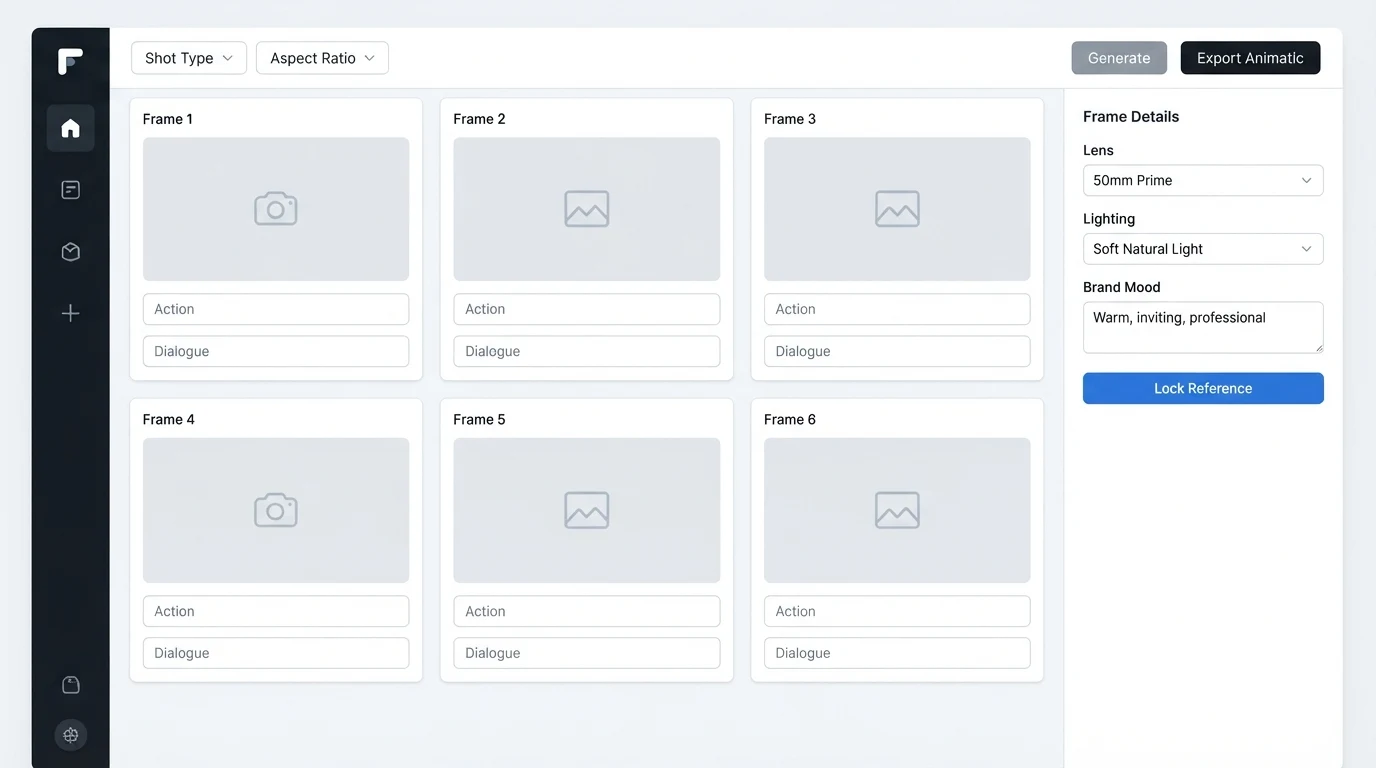
Frame prompts fall apart when they are written as free-form sentences. A structured template forces the same variables to be filled every time, which is what keeps the board coherent across eight or twelve shots. The template below mirrors the discipline used in high-fidelity AI product photography, where reference locking and structured prompting do the heavy lifting.
- Shot type: wide, medium, close, insert, over-the-shoulder
- Lens and framing: focal length, height, angle
- Talent: reference-locked, action verb, expression
- Wardrobe: reference-locked garment, colour, condition
- Product placement: position in frame, label orientation, hero or background
- Lighting: key direction, quality, colour temperature
- Environment: location, time of day, weather
- Brand mood: palette anchor, texture, energy
- Aspect ratio and duration: 16:9 broadcast, 9:16 social, 1:1 sponsor, plus cutdown length
When Not to Use AI Storyboards
There are still briefs where AI frames are the wrong call. Celebrity endorsement spots, where the talent's team controls every image of their client, need a live reference shoot before any generative work touches the pipeline. Regulated categories (pharma, gambling, alcohol, financial services) often carry clearance rules that treat rendered frames as final creative rather than pre-viz, which changes the whole approval flow. Network clearance boards for broadcasters with strict AI-disclosure policies may need a hand-drawn version as the working artefact even when AI supported the exploration. On these briefs the value of a considered AI consulting conversation is usually higher than jumping to production.
Frequently Asked Questions
How long does an AI-assisted TVC storyboard actually take?
For a 30-second spot with a clean shot list and locked references, first-pass frames land the same day and a client-ready board with beat notes and platform variants typically lands inside 48 hours. The gating factor is the shot-list conversation, not the rendering.
Can AI hold a named actor's likeness across a full board?
Yes, when the reference is clean and rights-cleared. A short reference shoot of the talent in neutral lighting gives the pipeline enough to lock face, expression and posture across every frame. Pulling reference from the open web is where consistency and clearance both fall over.
Does the client need to be told the frames are AI-generated?
In 2026 the honest and safer answer is yes. Most agency and network clearance frameworks treat AI-generated pre-viz as a disclosable technique. Labelling frames as pre-viz throughout the approval loop protects the pitch and keeps the clearance conversation clean.
How are the 9:16 and 1:1 cutdowns handled?
The same locked references and shot list generate the platform variants in the same pass, rather than as a separate project. That is the specific gap our overview of AI storyboards for Instagram ads covers in more depth.
Who owns the AI-generated frames?
Ownership sits with the commissioning agency or production company under the standard work-for-hire terms in the master services agreement, with the same reference-rights and clearance obligations that apply to any commissioned illustration. The clearance lawyer signs off the same way they would on a traditional board.
Can this replace a director's shot plan?
No. The director still writes the shot list. AI removes the drawing labour between the shot list and the client-facing board. The judgement calls (which beat carries the spot, which lens sells the product, which cut lands the CTA) stay with the director.
What is the difference between a storyboard and an animatic on this pipeline?
The storyboard is the static set of frames with beat notes. The animatic cuts those frames to the scratch VO and music bed at the target duration. The same references power both, so the animatic is a downstream step rather than a separate build.
How does this compare to a traditional storyboard artist?
The frame-drawing labour compresses from weeks to hours. The strategic work (script, shot list, director's judgement) is unchanged. Our comparison of AI versus traditional production workflows in the product space maps closely onto what happens with TVC boards.
Ship Your Next Pitch Board This Week
If your next TVC pitch is inside a fortnight, the storyboard stage is where the schedule is quietly bleeding. A pipeline that holds talent, product and brand references across every frame, delivers the broadcast and social cutdowns in one pass, and respects the clearance loop is the difference between defending an idea and iterating on it in the room. Absolutely AI runs this workflow with agencies and production companies every week, and the fastest way to see whether it fits your next brief is a short scoping conversation. Start with our AI video overview and bring a live brief.