AI Pre-Production for Campaigns: The 2026 Workflow Blueprint
Traditional pre-production used to eat 30 to 50 percent of a campaign timeline. At Absolutely AI we now compress brief-to-boards from weeks to days, and the shift is changing how agencies staff, price, and pitch creative work. This is not a tool round-up. It is a workflow blueprint for teams shipping paid social, CTV, and DOOH campaigns under real client deadlines.
Pre-production is where campaigns are quietly won or lost. Briefs get misread, moodboards drift from strategy, storyboards arrive after the shoot window closes, and by the time animatics land the client has already changed their mind. The teams pulling ahead in 2026 are not the ones with the flashiest generator, they are the ones who have redesigned pre-pro as a structured, AI-assisted pipeline with clear human checkpoints. For a look at how this thinking plays out end-to-end in motion work, see our AI films practice.
This piece walks through the six-stage workflow we run internally, the tool stack by stage, a worked example for a 30-second social spot, the failure modes nobody talks about, and the governance rules we refuse to bend. It is written from an agency operator's point of view, not a vendor's.
What 'AI pre-production' actually covers
Pre-production is everything between a signed brief and the first frame captured or generated: brief interrogation, strategy, moodboards, character and style references, storyboards, shot lists, casting, location scouting, and previz. AI now plugs into almost every one of those steps, but not evenly. It is genuinely transformative for divergent work (generating options, exploring tone, drafting boards) and mostly unhelpful for convergent work (deciding which option is on-strategy, holding a brand line, negotiating client politics). Our AI consulting engagements almost always start by mapping which of a team's pre-pro steps sit on which side of that line.
The trap most teams fall into is treating AI as a faster horse. They swap a moodboard designer for Midjourney and call it a transformation. The actual gain comes from restructuring the phase itself: fewer sequential handoffs, more parallel exploration, and tighter, more frequent client checkpoints because the cost of iteration has collapsed.
The 6-stage AI pre-production workflow
Here is the pipeline we run on campaign work. Each stage has a defined input, a defined output, and a named human owner. AI accelerates the middle of each stage, humans own the edges.
- Brief synthesis. LLM ingests the client brief, past campaign decks, brand guidelines, and any research. Output: a one-page synthesised brief with tensions, insight candidates, and open questions. Owner: strategist.
- Audience and insight mining. LLM plus research tools to pressure-test the audience hypothesis, surface cultural references, and generate three to five insight territories. Owner: strategist.
- Concept generation and moodboards. Creative team drafts territories, image models generate 40 to 80 reference frames per territory. Output: three concept routes with locked moodboards. Owner: creative director.
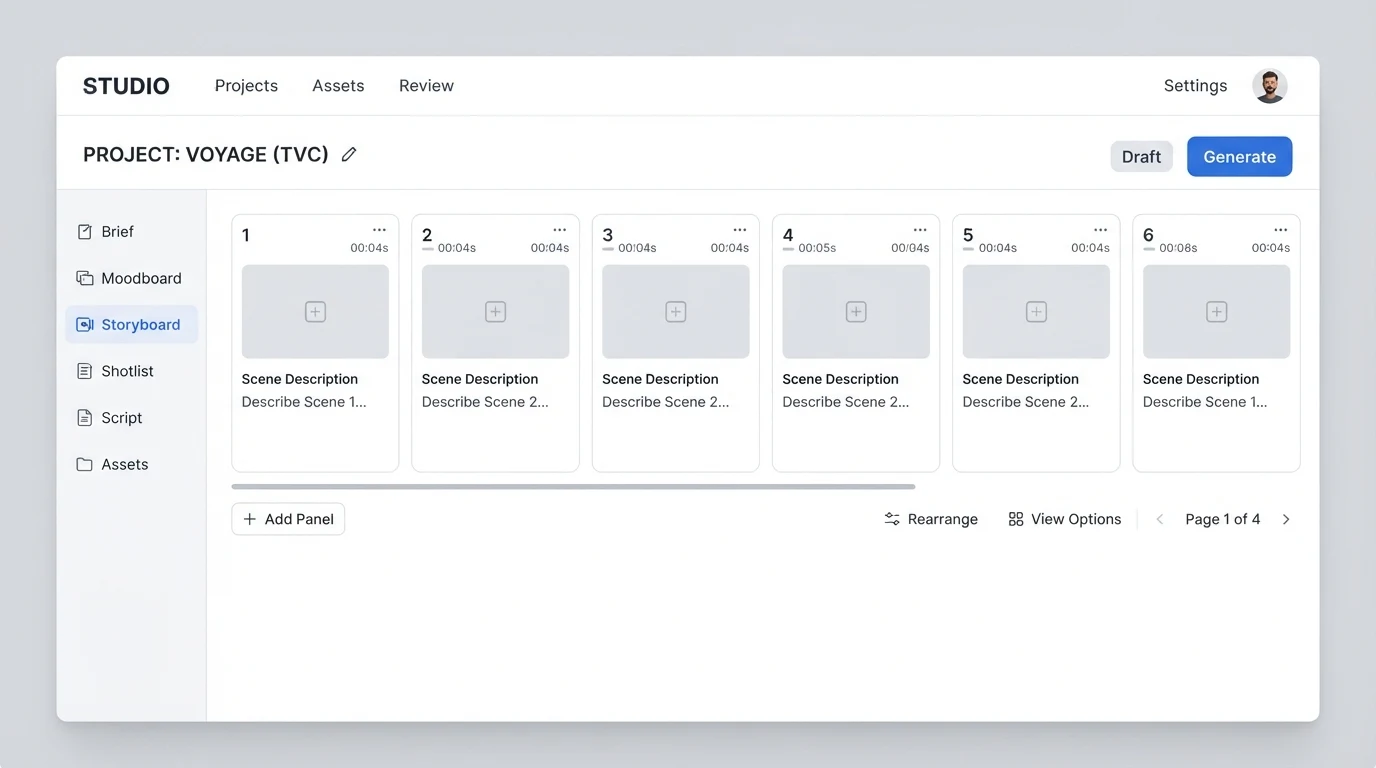
- AI storyboards and animatics. Chosen route goes to structured storyboarding tools, then to video models for 5 to 10 second animatic clips per key beat. Owner: creative director plus editor.
- Style-reference locking. Character sheets, LoRAs, or style references baked so every subsequent frame stays on-model. This is the step most teams skip and later regret. Owner: art director.
- Shotlist and previz handoff. Structured shot list, camera notes, and previz frames handed to the producer for feasibility, budgeting, and scheduling. Owner: producer.

The tool stack by stage
This is opinionated and dated (tools change quarterly), but it reflects what we actually use on live campaigns as of mid-2026. Do not read this as an endorsement, read it as a starting configuration to test against your own workflow.
| Stage | Primary tools | What they actually do well |
|---|---|---|
| Brief synthesis | Claude, GPT | Compressing long inputs, surfacing contradictions, drafting question lists |
| Insight mining | Claude with web tools, Perplexity | Cultural scanning, competitive teardown, quote sourcing |
| Moodboards | Midjourney, Firefly, Ideogram | High-volume style exploration, typographic frames, brand-safe outputs |
| Storyboards | Katalist, Boords, StoryboardHero, Filmustage, Dilogs | Structured panels, character consistency, script-to-board pipelines |
| Animatics | Runway Gen-3, Kling, Google Veo | 5 to 10 second motion tests, camera moves, energy checks |
| Style locking | LoRAs, character sheets, reference libraries | Holding a look across dozens of frames and formats |
The stack matters less than the seams between tools. Our automation work is mostly about wiring these seams so a strategist's brief output lands cleanly in the moodboard tool, and the moodboard selections drive the storyboarding tool without manual re-entry.
A worked example: 30-second social spot, brief to board in 48 hours
The shape of the cadence matters more than any single figure. Boards and animatics go back for review early, before shot generation starts, which is the pattern we apply across most commercial campaign work.
- Hour 0 to 4. Brief lands. Strategist runs LLM synthesis against brief, brand guidelines, and three reference campaigns. Output: one-page synthesised brief with three tension candidates.
- Hour 4 to 8. Internal 30-minute alignment call. One tension chosen. Strategist plus creative director draft three concept routes as one-paragraph descriptions.
- Hour 8 to 20. Art director generates 60 moodboard frames per route in parallel. Creative director curates down to 12 per route. Client receives async Loom walkthrough of all three at hour 20.
- Hour 20 to 28. Client selects route (usually with one tweak). Team locks style references and character sheet.
- Hour 28 to 40. Storyboard tool generates 12 panels for the 30-second cut. Editor stitches animatic with 6-second video clips per key beat. Sound designer drops a scratch track.
- Hour 40 to 48. Internal review, one polish pass, client presentation. Approved boards handed to producer with a full shot list.
The gain is not just speed. Because client sign-off happened at hour 20 on curated moodboards (not week 2 on a PDF), the animatic was already directionally correct. Fewer revision rounds, tighter production budget, better final work.
Where AI breaks the campaign
Every experienced team has been burned by at least one of these. Naming them is the first step to designing around them, and it is a recurring theme in how we approach brand-led AI work.
- Brand consistency drift. Frame 3 looks perfect. Frame 47 has drifted three shades warmer, the character's jawline has shifted, and the product cap is now silver instead of matte black. Style-locking is not optional at campaign scale.
- IP and likeness risk. Generated frames that resemble a real celebrity, a competitor's ad, or copyrighted footage. Legal review is now part of pre-pro, not post.
- Talent likeness. If you plan to cast a real person, do not generate AI storyboards using anyone who resembles a signed talent option. It muddies negotiation and can constitute unauthorised likeness use.
- Client sign-off friction. Clients sometimes assume AI boards are the finished ad. Set expectations at the brief stage: this is a directional artefact, not final craft.
- The 'plausible but wrong' storyboard. AI will confidently generate a shot that is beautifully composed and completely unshootable given the budget, location, or product physics. Producer review at the shotlist stage is non-negotiable.
Governance and the human checkpoints that must not move
The teams shipping the best AI-assisted campaigns are ruthlessly clear about who owns which decision. The rule we run by: AI accelerates generation, humans own judgment. Specifically:
- Strategist owns the brief. LLMs draft it, the strategist signs it. If the brief is wrong, everything downstream is wasted compute.
- Creative director owns the concept. Image models generate options, the CD chooses. No amount of generated volume replaces a taste call.
- Producer owns feasibility. Every AI storyboard is treated as a wishlist until the producer has confirmed it can be shot, licensed, or generated within budget.
- Legal owns risk. IP, likeness, and brand safety review happen before client presentation, not after.
Measuring the gain
Anecdotes are cheap, and the published benchmarks for this are thin enough that no headline figure is worth planning against. Measure it on your own work instead. Track these internally: hours per pre-pro stage, number of concept routes explored, revision rounds to client sign-off, and pre-pro cost as a percent of total campaign cost.
Where this goes next (2026 to 2027)
Three shifts are already visible on the roadmap. First, agentic pre-pro: LLM agents that run stages 1 and 2 autonomously overnight, presenting the strategist with a synthesised brief and three insight territories in the morning. Second, live client co-creation: shared canvases where the client watches moodboards regenerate against their feedback in real time, collapsing the sign-off loop further. Third, model-native brand systems: brands maintaining their own fine-tuned models so every generated frame is on-brand by construction, not by review. Our work on AI storyboards for brand videos is already leaning into the third shift.
Frequently Asked Questions
Is AI pre-production suitable for regulated categories like pharma or finance?
Yes, with tighter governance. The workflow is the same, but legal and compliance sit inside the checkpoints from stage 1, not as a final gate. Style-locking and prompt libraries matter more because approved visual language is narrow.
Do we still need a traditional storyboard artist?
For most campaign work, no. For high-craft film work with complex camera language, character performance, or unusual staging, a human storyboard artist still outperforms AI tools on nuance. Hybrid teams are the norm.
How do we handle client resistance to AI in pre-pro?
Reframe it. AI is a pre-pro accelerant, not a replacement for craft. Show the client where the time actually goes, and be explicit that final production quality is untouched. Most resistance fades once they see the first round of boards on their own project.
What about IP ownership of AI-generated storyboards?
Treat AI-generated pre-pro artefacts as internal working documents, not final deliverables. Contracts should specify that final produced assets are the client's, and that pre-pro exploration used AI tools within the agency's normal working methods.
How much of this workflow can a small in-house team run?
Most of it. A team of two or three can run the full six-stage pipeline on smaller campaigns. The bottleneck is usually taste and strategic judgment, not tool access. Our team training programmes are built for exactly this shape of team.
What's the single highest-leverage tool to adopt first?
An LLM for brief synthesis. It is the cheapest, lowest-risk, highest-impact addition to any pre-pro workflow. Every other tool in the stack works better when the brief going in is sharper.
How do we prevent brand drift across a large campaign?
Lock style references early (stage 5, not stage 7), maintain a shared reference library, and appoint one art director as the single source of truth on visual consistency. Do not let individual creatives generate frames using their own prompt style.
Can this workflow scale to a full campaign, not just a single spot?
Yes, and it scales better than traditional pre-pro. Once style references and character sheets are locked, generating additional formats (vertical cutdowns, DOOH stills, CTV variants) is close to marginal-cost-zero, which is where the real campaign-level economics kick in.
Conclusion
AI pre-production is not a tool problem, it is a workflow problem. The teams winning in 2026 have redesigned the phase around parallel exploration, tight human checkpoints, and structured handoffs, not around whichever generator is trending this month. If you want help building this pipeline into your team, or want to see it run on a real campaign, Absolutely AI's video and campaign practice is the place to start.