AI Product Photography in Brisbane: A 2026 Buyer's Guide
Brisbane brands scaling on Shopify, Amazon Australia and Meta are quietly retiring the two-week studio cycle. AI product photography, run as a directed creative service out of Fortitude Valley, now covers hero packshots, lifestyle sets and seasonal variants without the crew booking window. Absolutely AI is a local creative studio building that pipeline for FMCG, skincare and hospitality clients across South East Queensland.
Search 'product photography Brisbane' and you land in a familiar bind. Studio day quotes in Fortitude Valley and West End climb into serious money for a single shoot, retouching sits on top, and you still need forty SKU variants sized for Shopify, Amazon Australia and Meta placements. For a local FMCG label chasing a national retail window, or a challenger skincare brand keeping pace with a monthly drop calendar, that maths does not work. Absolutely AI is a Brisbane creative studio applying generative imagery with the same discipline a shoot day demands, so brands get campaign-grade product visuals without the traditional cycle.
What AI product photography actually is in 2026
AI product photography in 2026 is not a background remover and it is not a filter. Modern image models such as Flux, GPT-Image, Seedream and Kling can hold a supplied product reference and render it inside a fully art-directed scene: studio still life, lifestyle context, seasonal set dressing, on-shelf mock-up. The technical unlock that mattered most was product fidelity, meaning the ability to keep a bottle, jar or pack looking identical across dozens of variations without warping the label or shifting the silhouette.
The category also stopped being one thing. There are self-serve SaaS tools where you upload a photo and receive a rendered background, and there is directed studio work where a creative team briefs the models against a strategic concept. A walk-through of the underlying workflow shows how reference conditioning and iterative prompting keep the hero SKU intact from frame to frame, which is the difference between a usable pack render and a warped facsimile.
Why Brisbane brands are switching
Queensland has become an unusually crowded creative market. The FMCG scene running out of Brisbane covers craft distilleries, functional snacks, hospitality-driven condiment brands and native-ingredient beauty, and most of them are chasing the same national retail slots. When a challenger brand needs to answer a Coles or Woolworths brief, or scale imagery for an Amazon Australia storefront, the traditional route locks in a studio, a stylist, a photographer, a retoucher and a multi-week turn.
Speed is only half of it. The other half is coverage. A single retail launch in 2026 needs hero packshots for the product page, lifestyle context for the brand site, cropped variants for paid social, and story-format cutdowns for Meta and TikTok. Directed AI ecommerce photography compresses that pipeline into one creative process where the same brief produces every ratio and every context inside a single pass, then iterates without recalling the crew.
What you can (and cannot) generate honestly
Trust in this category is earned by naming the limits upfront. Not every product need is a good fit for generative production, and any studio claiming otherwise is selling a tool rather than a service. The honest capability picture in 2026 looks like this.
| Format | AI product photography | Notes |
|---|---|---|
| Hero packshots on studio backdrops | Strong | Reference conditioning holds label detail well |
| Lifestyle scenes (kitchen, bathroom, outdoor) | Strong | Full art direction over set, light and framing |
| Ingredient and detail macro | Good | Best paired with a real macro plate for hybrids |
| Seasonal variant series from one base scene | Strong | The category's biggest advantage |
| On-model beauty and apparel | Good | Requires careful casting direction and refs |
| Dense small-type labels | Weaker | Type often composited over the render |
| Hands holding products | Weaker | Known failure mode, plan the crop around it |
| Direct hero-to-hero brand comparisons | Weaker | Traditional shoot still wins for comparative claims |
A brand evaluating the category should map each planned asset to this matrix before committing to a pipeline. A capability-first comparison of the current tool landscape covers where each model sits and which combinations tend to work in production.
How we run a Brisbane brief from concept to delivery
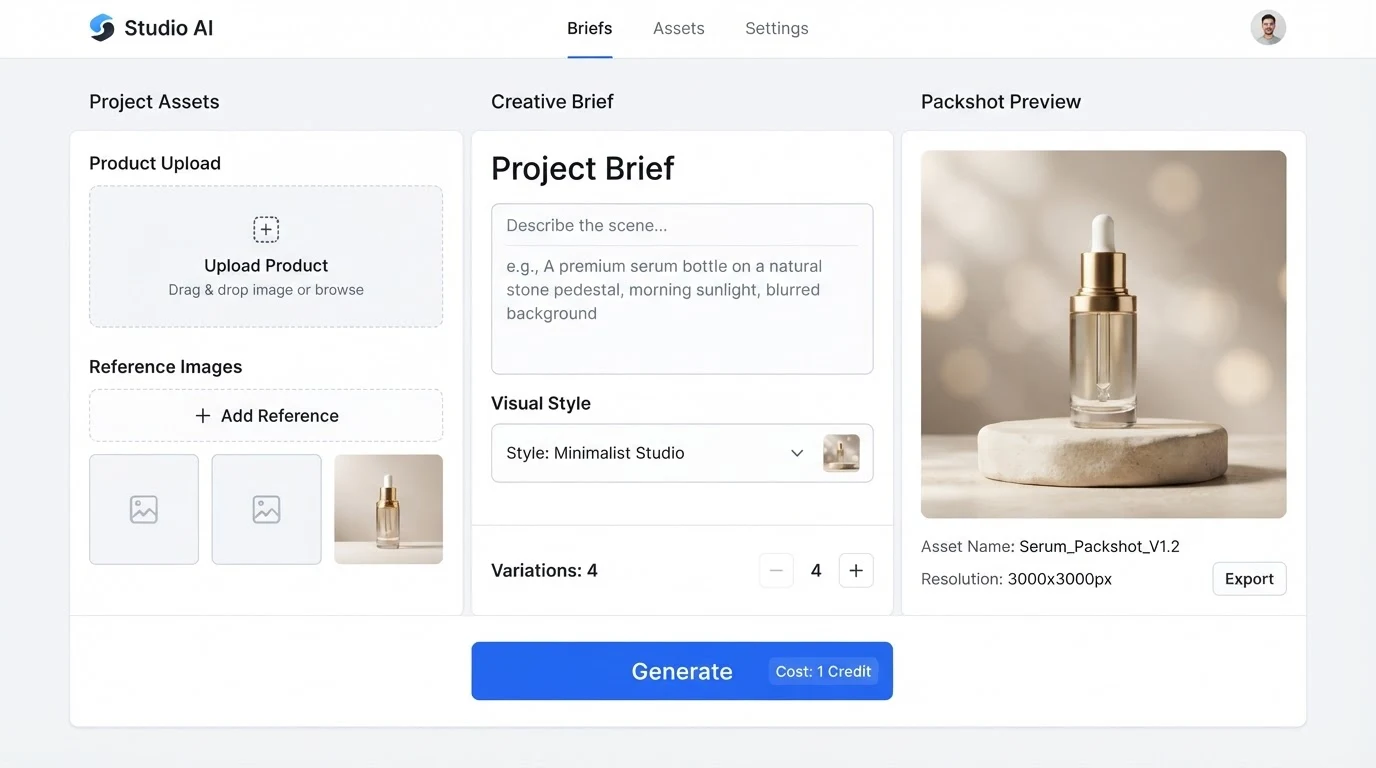
The most common failure mode we see is treating AI production like a self-serve upload. Our Brisbane workflow treats every project like a shoot day. It starts with a written creative brief covering the SKU, the channels, the aspect ratios, the mood references and any brand guardrails. From there the team develops strategic concepts against the brief, refines the chosen direction with the client, then delivers the finished set.
The brief
Everything downstream inherits the quality of the brief. A strong one names the product, the retailer or channel, the audience, the season, the aspect ratios, and the reference imagery for mood. It also names the constraints, because AI brand photography either lifts a brand's identity or flattens it into generic stock, and the difference is usually decided on page one of the brief.
Concepts
Rather than jumping into hero renders, the team produces strategic concept boards against the brief. Two or three visual directions are developed, each with a distinct mood, palette and set logic, and shown to the client before any hero asset is committed. This is the phase that separates directed creative from prompt-and-hope output.
Refinement and delivery
Once a direction is signed off, the chosen concept becomes the master brief for the full variant set. Every aspect ratio, seasonal treatment and channel-specific crop is rendered against the same visual system, then reviewed and refined. Final delivery covers web-ready packshots, ad-ready cutdowns and any composite treatments the retailer requires. Anything a client wants to walk through in person can be reviewed at our Brisbane base.
AI vs traditional product photography in Brisbane
Comparing the two approaches is less about cost and more about what each is actually good at. A traditional Brisbane shoot day still wins when the hero moment demands a photographer's eye on a physical set, when the product has to be interacted with, or when contractual usage rights around a real person are the whole point. Generative production wins when a brand needs volume, variant coverage and speed without a reshoot cycle. A longer treatment of the trade-offs covers when each format earns its place on a media plan.
| Consideration | Traditional Brisbane shoot | AI product photography |
|---|---|---|
| Concept-to-final cycle | Multi-week, calendar dependent | Compressed, no crew booking window |
| SKU variant coverage | Reshoot or re-set per variant | Iterated from the base scene |
| Aspect ratio coverage | Cropped from a single set-up | Native output at each ratio |
| Physical product interaction | Native strength | Handled via reference conditioning |
| Impossible or surreal worlds | Not feasible | Native strength |
| Pricing model | Day rates plus post | Quoted per scope after a brief review |
Use cases we see most from Brisbane brands
The categories that lean into AI product photography earliest are the ones with the tightest SKU-to-time ratios. Craft food and beverage brands scaling on-shelf and Amazon Australia listings are one cluster, and food and drink specialists get most of their value from seasonal set dressing and hero-plate variants without re-plating a dish for every crop.
DTC skincare and supplement brands are another. The pack rarely changes but the editorial world around it needs to. Skincare brand teams use the same base pack render to build a full editorial season, then reset the world for the next drop without touching the product asset again. Tradie tool brands scaling into hardware retail and hospitality operators building menu-board imagery round out the local base.
How to brief an AI product photography project
Getting a strong result from an AI shoot follows the same discipline as briefing a traditional one. The checklist a Brisbane brand should bring into a first conversation with a directed content team looks like this:
- Clean product references from multiple angles, ideally with matched lighting and a plain background
- Every channel and aspect ratio the final assets need to serve, listed once
- Brand guardrails: palette, typography rules for any composited type, tone of voice
- Reference imagery that captures the mood you want, not competitor packshots
- Any legal or claim constraints that affect what can appear in frame
- The internal decision-maker for concept sign-off, named upfront
Frequently Asked Questions
Is AI product photography good enough for national retail packaging imagery?
For hero packshots, lifestyle sets and channel-specific variants, yes. The category is now used by brands producing imagery for major Australian retailers. For comparative advertising against a named competitor pack, or for photography intended to serve as legal evidence of a real event, a traditional shoot is still the right tool.
Will the label on my product stay readable?
Large logo marks and primary label copy hold well with proper reference conditioning. Dense ingredient panels and small legal type are the current weakness and are usually handled by compositing the real label artwork over the rendered pack. This is standard practice, not a workaround.
Can you match an existing brand shoot style?
Yes. If a brand has an existing visual system from a previous studio shoot, that becomes the reference the models are conditioned against. The output slots into the same identity rather than creating a parallel look.
Do you work with Brisbane brands only?
The studio is based in Brisbane and knows the local retail and hospitality market well, which matters for briefs that reference on-shelf context or category norms. Client work across the rest of Australia and internationally is standard.
What file formats and aspect ratios do you deliver?
Deliverables are matched to the channel plan named in the brief. Common outputs include square and portrait crops for Instagram and TikTok, landscape hero for site headers, product-page ratios for Shopify and Amazon, and any bespoke retailer specification the brand needs to satisfy.
How does pricing work?
Pricing is quoted per scope after a brief review. Every project has a different SKU count, channel plan and refinement cycle, so a flat rate would mislead more often than it would help. A short intake conversation is enough to produce a written quote.
For a Brisbane brand weighing a traditional booking against a modern creative pipeline, the real question is not which is cheaper but which reaches the volume, variant and channel coverage your calendar actually needs. Absolutely AI runs AI product photography as a directed creative service out of Brisbane, with an editorial bar closer to a shoot day than a SaaS tool. When a launch, a new drop or a category-wide refresh is on the near horizon, that is the conversation to open.