AI Food Photography for Brands: The 2026 Playbook
Food is the hardest category in AI product photography. Labels hallucinate, sauces look plastic, and glass refracts wrong. Yet CPG, DTC and restaurant marketing teams are shipping AI food creative at scale because the economics and speed are impossible to ignore. This is the brand-side playbook Absolutely AI uses when leads ask how to run AI food photography without breaking their brand system or Amazon compliance.

Food is the hardest category in AI product photography, and most marketing teams learn that the expensive way. Labels hallucinate, condensation reads as plastic beading, and a chocolate bar that looked flawless in Midjourney fails legal review the moment someone zooms in on the nutrition panel. The teams winning with this are not chasing a one-click tool. They are building a brand system where the hero SKU stays sacred and AI generates the world around it. That is the frame we use at Absolutely AI when a food brand walks through the door.
This piece is written for marketing leads at CPG, DTC food and beverage brands, and the restaurant chains that sit next to them on the shelf and in the feed. It skips the tool listicle and the restaurant-menu content, and instead answers the questions a brand director actually asks before signing off on an AI food campaign.
Why food is the hardest category for AI product photography
Every category has its uncanny valley. Fashion has hands, automotive has reflections, and food has all of it at once. A single hero shot might combine matte cardboard, glossy foil, cellophane, glass, whipped cream, ice, and steam, and each of those materials sits on its own physics curve inside a diffusion model. Get one wrong and the whole plate reads as fake.
The single biggest failure mode is text. Nutrition panels, ingredient decks, and front-of-pack claims are legally regulated in most markets, and generative models still cannot render legible small type reliably. That is why brand teams doing serious work almost never let a model invent the pack. They photograph the real product once, then use AI to build the environment. Anything else is a compliance risk, and a good brand system refuses to take it.
Prepared dishes carry a second problem. Humans have thousands of hours of experience eating, so we spot fakes fast. A cross-section of a burger that does not obey gravity, a noodle that loops the wrong way, a sushi rice grain that is too uniform, the eye catches it before the conscious mind names it. Food creative has a lower tolerance for AI tells than almost any other category, which is why concept and moodboard work upstream matters more here than anywhere else.
Two workflows brands must know: AI generation vs AI editing
Every serious AI food program runs on two workflows, not one. Confusing them is where brand teams burn budget and trust. The commercial team should be able to point at any asset and name which workflow produced it.
Full generation is used for lifestyle, scene, and social. The model builds the entire frame, environment, hands, tabletop, backdrop, and lighting. The product inside the frame is not the real pack, it is a stylised stand-in. This is fine for mood-first social, for concept exploration, and for storyboard frames feeding a downstream shoot.
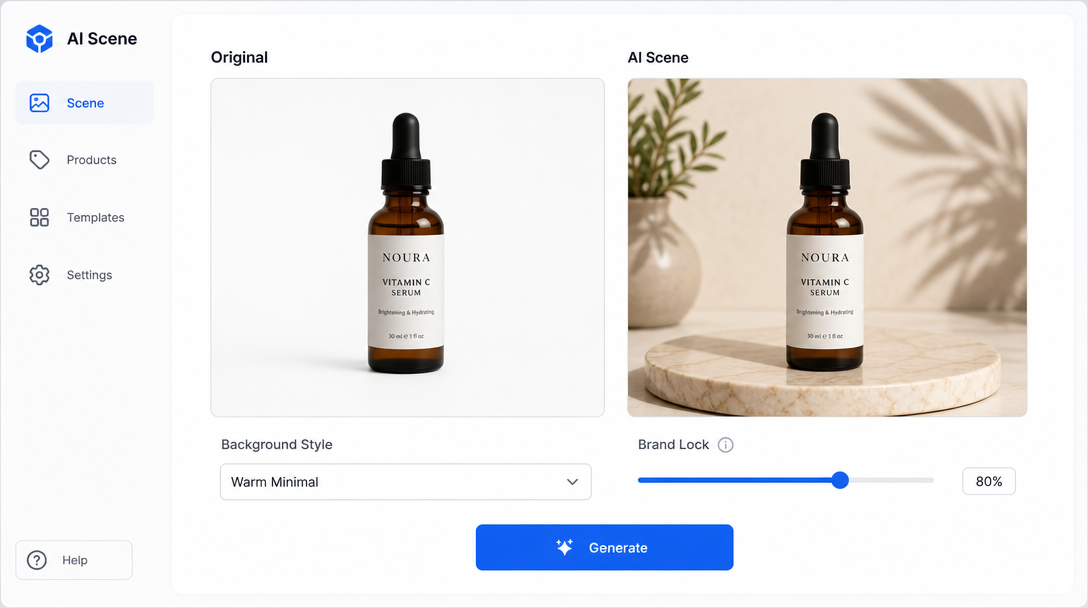
Edit-on-real-photo is used for hero pack shots, PDP images, and Amazon main images. Start with a real, correctly lit photograph of the product, then use AI edit tools to change the background, add propping, insert environment, or extend the frame. The pack itself is never generated, only relit or recomposed. This is the workflow that survives legal review.
| Use case | Workflow | Risk level |
|---|---|---|
| Amazon main image, PDP hero | Edit-on-real-photo | High, must be honest |
| Lifestyle social, seasonal campaign | Full generation | Medium, disclosure recommended |
| Concept, moodboard, storyboard | Full generation | Low, internal use |
| Ingredient story, provenance | Hybrid, real ingredient plus generated scene | Medium |
| Packaging mockup for retail buyer | Edit-on-real-photo | High, buyer trust |

Where AI food photography actually wins for brands
The wins are not evenly distributed. Some briefs are perfect for AI, others are still a photographer's job. A well-scoped content program uses AI where it is strongest and books a shoot where it is not.
- Lifestyle and in-use scenes. Hand pouring cereal, kids at a breakfast table, coffee steaming on a windowsill. AI handles these at a fraction of the cost of casting, location, and food styling.
- Seasonal campaign variants. One hero, twelve seasonal wraps: summer picnic, autumn kitchen, winter cabin, spring garden. Impossible to shoot, trivial to generate.
- Geo and culture localisation. A single sauce hero spun into a Sicilian trattoria, a Sao Paulo balcony, a Bangkok street stall, a Sydney backyard. Localisation is where AI food photography has the highest ROI, and it is still under-used.
- Ingredient stories. Real ingredient photography edited into abstract or narrative scenes for packaging back panels and web storytelling.
- Social-first vertical creative. Every 9:16 frame the platforms now demand, without booking a vertical shoot.
- Catalog consistency across large SKU counts. Thirty or more SKUs styled to a single visual system, week over week, using a locked brand reference set.
Where it still fails, and how to route around it
Every honest playbook lists the failure modes, because pretending they do not exist is what damages brand trust. The teams we work with at our creative studio keep a live list of no-go briefs.
- Legible nutrition panels and ingredient decks. Never generated. Always photographed real.
- Glass, liquid, and ice interactions. Improving fast, but a hero pour shot for a beverage brand still benefits from an edit-on-real-photo approach.
- Hands holding product. Fingers around a can or bottle are the classic tell. Composite a real hand and real pack, then generate the world.
- Culturally specific dishes. Regional cuisines with strong visual conventions are often stereotyped by generalist models. Route these through concept and reference work first.
- Alcohol regulatory imagery. Age gating, no youth-adjacent scenes, no health claims. AI does not know your jurisdiction's rules, so the brand team must.
Marketplace and channel compliance
This is the section most tool listicles skip, and it is the one that gets brands into trouble. A good creative operations partner writes marketplace compliance into the brief, not into a retro.
Amazon requires main images to honestly represent the real product. That means the pack in your main image cannot be an AI hallucination of your pack. Edit-on-real-photo is the only compliant workflow for the main image slot. Secondary lifestyle images have more room, but honest representation still applies.
Meta is tightening ad disclosure norms across 2026. AI-generated or AI-altered creative in political and social issue categories already requires disclosure, and consumer categories are heading the same direction. Brand teams should assume some form of AI disclosure will be standard within the year and build creative that stands up to it.
Shopify PDPs are governed by consumer law in the merchant's jurisdiction, not by Shopify itself. Australian Consumer Law and equivalent frameworks in the UK, EU, and US all require product representations to be accurate. Full-generation hero shots for a PDP are a bad idea. Edit-on-real-photo is safe.
Building a repeatable brand system in AI
The shift that separates enterprise programs from side-project experiments is treating AI like a system, not a tool. Coca-Cola, Mondelez International, and Mars have all run public programs in the last eighteen months that share the same architecture, and it is worth copying inside our brand system builds.
- Reference library. Real product photography, real ingredient photography, brand colour swatches, typography assets, and lifestyle references, all versioned.
- Prompt templates. Written by a creative director, not typed on the fly. Templates lock lighting language, palette, camera language, and mood.
- Brand guideline embedding. The brand book is fed into the workflow as reference, not held in a PDF nobody opens.
- Style locking. A season's creative uses a fixed set of references so the November campaign feels like the October one, and the SKU launch in March feels like the flagship in June.
- Human review at every gate. Concept, storyboard, and final. The model does not sign off, the creative director does.
What it costs versus traditional shoots
The economics are the reason this conversation is even happening. A traditional CPG hero shoot with food stylist, prop stylist, photographer, retoucher, and studio day runs from around one hundred and fifteen dollars per finished image at the high-volume end, up into the thousands per image for hero campaign work. A comparable AI workflow lands closer to ten to fifteen cents per image at the raw generation layer, before creative direction and review time. That is a two to three order of magnitude gap on the unit cost line, which is why the CFO gets interested. A good content operation reinvests that gap into more creative direction, not less.
Most brand teams doing this well run a hybrid model. They shoot the hero pack once, then use AI for every downstream variant: seasonal, geographic, lifestyle, social. The photographer's day rate becomes an upstream asset, not a per-campaign cost. That is the model that scales without eroding brand equity.
The tool landscape for brands specifically
The market has split into four groups, and matching brief to group is half the job. Our product photography practice maps tools to workflows before we recommend anything.
- Enterprise brand studios such as Typeface AI, built to embed brand guidelines and run at agency scale.
- Product preservation tools such as Nightjar, Photoroom, and Pebblely, focused on keeping the real pack intact while changing the world around it.
- Food-native studios such as FoodShot AI and FoodPhoto.ai, tuned specifically to food geometry and lighting.
- Creative concept explorers, where our own workflow sits, combining human strategy with AI generation on concept, moodboard, and storyboard before any hero image is finalised.
A 5-step rollout for brand marketing teams
The teams that fail with AI food photography usually skip straight to generation. The teams that succeed run a proper rollout, and a decent creative operations partner will insist on it.
- Audit assets. Catalogue every real pack shot, every ingredient photo, every brand guideline document. Know what you already own.
- Define brand-locked prompts. Write templates for lifestyle, seasonal, ingredient, and social. Lock lighting, palette, and mood language.
- Run a pilot SKU line. Pick one product family, run it through the full workflow, publish, measure.
- Review legal and marketplace. Sit with legal and channel leads. Confirm what ships on Amazon, Meta, and PDPs, and what does not.
- Scale. Only once the pilot passes review, roll it out across the catalogue with the reference library locked.
Frequently asked questions
Is AI food photography legal on Amazon?
Full-generation hero images that invent the pack are not compliant with Amazon's main image policy, which requires honest representation of the real product. Edit-on-real-photo workflows, where the pack is a real photograph and only the environment is generated, are compliant. Secondary lifestyle images have more room but the same honesty principle applies.
Will customers reject AI food creative?
Research through 2025 and 2026 shows customer tolerance depends on category and context. Lifestyle scenes are accepted at high rates. Hero pack shots and PDP main images are not. The rule of thumb is that AI is trusted for mood and context, and distrusted for product truth.
Can we use AI for packaging mockups?Yes, and it is one of the strongest use cases. Real pack die-lines edited onto AI-generated shelf, retail, and lifestyle scenes give buyer teams and category managers a shipping-ready mockup at a fraction of the traditional cost.Do we still need a photographer?
Yes, once. The hero pack shot, the ingredient library, and the brand reference set all still benefit from a real photographer. What changes is the frequency. A brand might shoot flagship assets once a season and use AI for every campaign in between, rather than booking a shoot per campaign.
What about video and motion food creative?
Motion is where the next twelve months of AI food creative will land. Storyboard-first workflows, where humans design the frames and AI executes them, are already producing usable results for social and PDP video. Full autonomous video generation is not yet at brand standard, but it is closing fast.
How does localisation actually work?
Take a locked hero pack shot, write a prompt template per market that fixes the local scene, lighting, and cultural cues, and generate a variant per country. One shoot becomes twelve markets, and each market gets creative that feels native rather than translated.
How do we brief this to a partner?
Bring the real pack, the brand book, the campaign objective, and a shortlist of reference imagery. A good partner will run concept and moodboard work before any final image is generated, because the brief is where AI food photography is won or lost.
The bottom line
AI food photography is not a replacement for craft. It is a way to buy more craft per dollar, if the brand system is built properly. The hero pack stays sacred, the world around it becomes cheap and infinite, and the creative team stops arguing about production budgets and starts arguing about ideas. That is the shift the brands winning in 2026 have already made. If your team is ready to run this properly, Absolutely AI builds the brand system, the reference library, and the concept workflow that keeps your food creative on-brand at AI speed.