AI Product Photography for Skincare Brands: The 2026 Operator Playbook
Skincare is the hardest category to shoot well and the most expensive to reshoot. Glass bottles catch every light, cream textures need real slip, and label copy is legally binding. This guide from Absolutely AI is a vendor-neutral playbook for skincare marketing leads: which AI workflows actually ship launch-ready assets, which tools to pair, and where you still need to book the studio.

Every skincare marketing lead has the same file open somewhere: a spreadsheet of forty SKUs that all need a hero shot, a texture macro, a lifestyle frame, and an on-model application shot, in three aspect ratios, refreshed each quarter. Traditional studio production tops out at roughly a dozen finished images per shoot day, and reshoots for a new claim or a repackaged bottle mean going back to the beginning. AI product photography is the pressure valve, but only when it is set up with the specificity skincare demands. This piece walks through the workflows, tools, and controls that separate a usable asset from a legal problem, drawing on the same operator process Absolutely AI uses for beauty and personal-care clients.
Why skincare is the hardest category for AI product photography
Skincare packaging punishes generative models in ways electronics or apparel do not. Frosted glass and translucent PET catch and refract light unpredictably, so a model that renders a shampoo bottle beautifully will still hallucinate the inner liquid line on a serum. Metallic caps and foil labels reflect the environment, which means every restage has to solve for a plausible reflection map. Cream and gel textures need real subsurface slip, and generative models often produce something closer to plastic. On top of that, label copy is legally binding: an ingredient list, a batch code, or a claim like "SPF 30" cannot be softened, misspelled, or partially rendered without regulatory exposure.
Then there is skin itself. On-model application shots for a hand cream or a serum drop require realistic fingers, nail beds, and skin-tone continuity across a campaign that will feature dozens of hands and faces. Older models still miscount fingers; newer ones nail anatomy but lose the exact product in the frame. Solving these problems is a workflow question more than a tool question, which is why the tool-brand blogs that dominate this search rarely translate into shipped catalogues. For a broader primer on the underlying process, our explainer on how AI product photography works covers the base mechanics.
What 'good' looks like in 2026
The visual bar for DTC skincare is set by a small number of brands whose imagery every buyer has already internalised. Glossier keeps things soft, warm, and human, with products photographed as if left on a bathroom shelf. Drunk Elephant pushes saturated colour blocks and clinical clarity. The Ordinary strips everything back to lab-white minimalism, letting typography and packaging carry the identity. Any AI pipeline you build has to be able to hit at least one of these registers cleanly, and ideally switch between them without drifting.
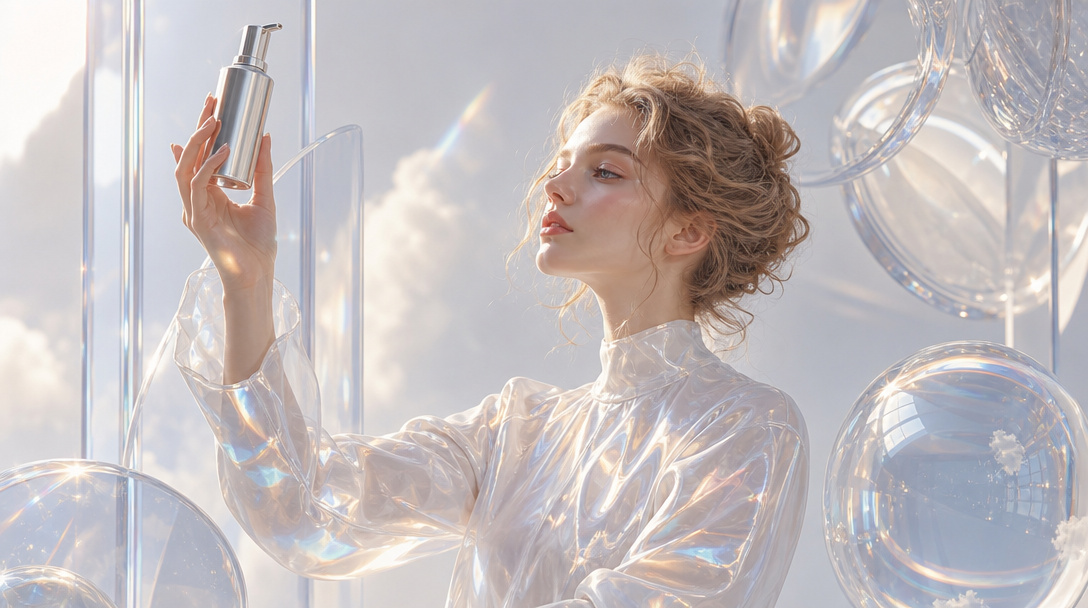
In practice, every skincare SKU needs four canonical shot types before it can support a launch. A hero on colour, usually a PDP frame with generous negative space for overlays. A texture or ingredient macro, showing the pump of serum on a spatula or a botanical detail near the bottle. A lifestyle-in-bathroom frame, warm and lived-in, that supports paid social and email. And an on-model application shot, hand or face, that carries the emotional payload of the category. Miss any of these and the launch feels underweight.
The two AI workflows that actually work
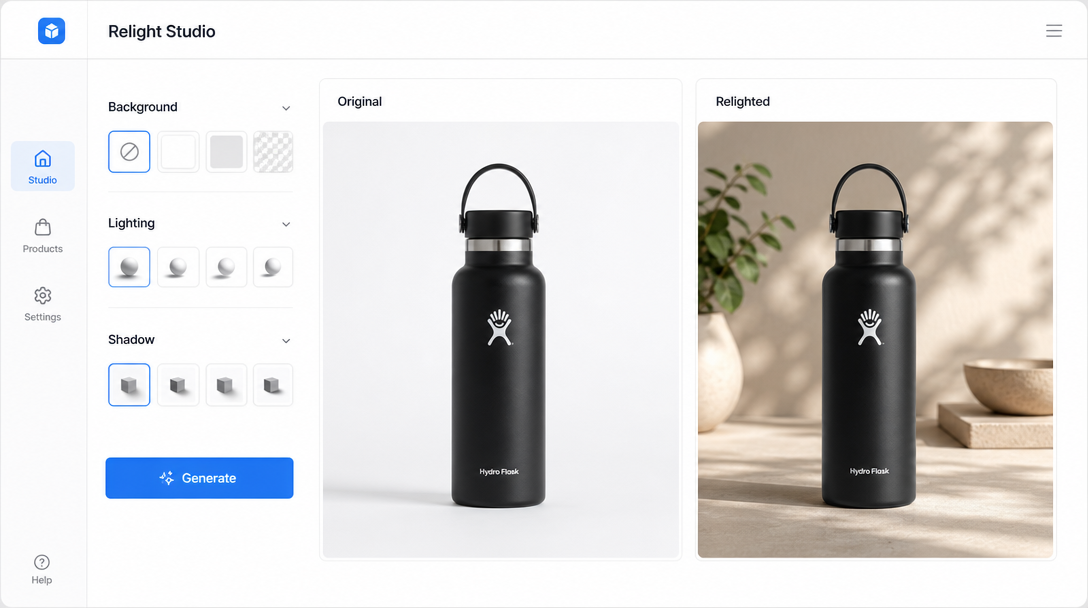
There are only two workflows worth building a skincare pipeline around, and they answer different briefs. The first is a photograph-plus-restage flow: shoot the real bottle once on a neutral background under even light, then use AI to place that exact bottle into dozens of backgrounds, seasons, and campaign contexts. This is the workflow that protects label accuracy, and it is the one most beauty brands should default to for anything a customer will see on a product page. Our comparison on AI versus traditional product photography unpacks where each excels.
The second is fully generative, where the bottle itself is invented from a text prompt or a reference. This is the right workflow for concepting, moodboards, seasonal campaign exploration, and any frame where the product is small in composition or heavily out of focus. It is not the right workflow for a PDP hero. Most teams that get burned by AI in skincare have used a generative-only flow where a restage flow was called for, and shipped a bottle whose label reads convincingly at thumbnail size and gibberish at retina zoom. Our piece on rights and IP in AI product photography is worth reading before you commit either way.
Tool landscape compared
The tool market has stratified into three layers, and a good skincare pipeline uses one from each rather than betting on a single vendor. Our long-form best AI product photography tools review covers the full landscape, but the skincare-specific view is narrower.
| Tool | Pricing model | Best for in skincare | Watch-outs |
|---|---|---|---|
| Photoroom | Subscription | Batch background replacement on shot-and-restage flows | Reflections on frosted glass can flatten |
| Flair.ai | Subscription | Scene composition with a locked product reference | Skin realism on hand shots is inconsistent |
| Pebblely | Subscription | Fast PDP hero variants with clean backgrounds | Limited control on complex lighting |
| Blendnow | Subscription | On-model composites for lifestyle frames | Requires strong reference discipline |
| Nano Banana / Seedream / Midjourney | Subscription or credit | Concepting and moodboards, on-model beauty exploration | Do not rely on for label-accurate PDP work |
| Absolutely AI | Quoted per scope after a brief review | End-to-end catalogue pipelines with QA and rights handling | Booked engagements, not self-serve |
Head-to-head comparisons like Pebblely versus Photoroom versus an agency are useful once you have decided which layer of the stack you actually need to own in-house.
Prompting for skincare
A reusable prompt template saves more time than any single tool choice. The structure that works for skincare covers six blocks: subject description with exact product name and packaging, surface material the product sits on, lighting recipe, background material or environment, camera and lens equivalent, and a negative-prompt list. Treating this as a template rather than a bespoke prompt per SKU is what lets a marketing lead brief a producer once and get consistent output across a launch.
- Subject: 30ml amber glass serum bottle with dropper cap, minimalist cream label, batch code visible
- Surface: honed travertine slab, warm neutral
- Lighting: soft north-window light through a gradient scrim, gentle falloff into shadow
- Background: plaster wall in oatmeal, out of focus
- Camera: 85mm equivalent, f/4, shallow but not clinical
- Negative prompt: warped label, extra fingers, distorted typography, plastic-looking cream, doubled cap, illegible text
The negative prompt block is doing most of the heavy lifting on the failure modes skincare cares about, and it should be maintained as a growing library that every operator on the team pulls from.
Preserving brand identity with a product passport
The single control that separates a brand from a stock library is what we call a product passport: a locked reference set for each SKU consisting of a clean front, a three-quarter angle, a top-down of the cap, and a close crop of the label. Every generation for that SKU is conditioned on this passport, whether the tool calls it a reference image, an IP-adapter, or a product lock. Without a passport, you will ship a catalogue where the cap thread count subtly changes across images and the label kerning drifts, which reads as amateurish even when no single frame is obviously wrong.
The passport also protects rebrands and pack refreshes. When a formula changes or a bottle redesigns, you swap the passport and regenerate the affected assets, rather than reshooting a season. This is the discipline that makes AI product photography a durable operating capability rather than a one-off shortcut, and it is central to how we run AI brand photography engagements.
The QA checklist before anything goes live
No skincare asset should reach a product page without a specific checklist run against it. The four categories that matter are label integrity, anatomy, category-specific realism, and regulatory copy.
- Label integrity: brand name spelled correctly, ingredient list legible, batch code and volume readable at full resolution
- Anatomy: five fingers per hand, natural nail beds, realistic skin tone continuity across campaign
- Category realism: cream has slip and highlight, serum has meniscus, glass has believable refraction
- Regulatory copy: any claim visible in frame (SPF value, dermatologist-tested, TGA or FDA references) matches the approved artwork exactly
The regulatory line is the one that turns a design problem into a legal one. A generated bottle that reads "SPF 30" when the approved artwork says "SPF 30+" is a labelling issue in most jurisdictions, and the fact that it was a generated image is not a defence. Build the check into your approval flow the same way you would for print artwork.
Cost and time benchmarks
The honest benchmark for a 12-SKU launch is roughly two operator weeks from locked passports to a delivered library covering all four canonical shot types in three aspect ratios each, versus four to six weeks and multiple studio days for the equivalent traditional shoot. The cost delta is real but is not the reason most brands make the switch: the reason is iteration speed. A new claim, a new campaign colourway, or a new territory-specific pack can be regenerated in hours rather than triggering a reshoot. For a market-specific view, our AI product photography cost in Australia piece has more detail; pricing for an AI ecommerce photography engagement with us is quoted per scope after a brief review.
Where AI still fails and you should book the studio
An honest playbook has to name the frames AI is not ready for. Founder portraits are one: a real portrait of a real founder for a press kit is not something to generate. Texture swatches with real slip, where a customer is being sold the sensory experience of the product, still shoot better in a studio with a hand model and a macro lens. The press-kit hero frame that will run in Vogue or Allure is another: art directors on that side of the fence can spot a generated bottle instantly, and it is not worth the reputational risk. The right operating stance is a hybrid pipeline, and our work in AI commercial production is built around that principle.
A 30-day rollout plan for a skincare brand
The rollout that works for most 10 to 20 SKU catalogues runs on a four-week cadence. Week one is passport creation: shoot every SKU on a neutral background under even light, at four angles, and archive the reference set. Week two is prompt library and style lock: build the six-block template for each of the four canonical shot types, and lock a house lighting and colour recipe against a moodboard the brand has signed off. Week three is generation and QA at scale, running the full catalogue through the passport-locked pipeline and the four-category QA checklist. Week four is integration: uploading to the PDP, wiring the same assets into paid social and email, and briefing the ongoing refresh cadence.
The teams that succeed treat this as an operating rhythm rather than a project. A monthly refresh cadence keeps the catalogue feeling current without ever triggering another full shoot day, and the passport library becomes the most valuable creative asset the brand owns. For adjacent categories, the same rhythm is covered in our pieces on AI product photography for supplements and AI food photography for brands.
Frequently Asked Questions
Can AI product photography handle translucent skincare packaging?
Yes, but only through a shot-and-restage workflow where the real bottle is photographed once and then restaged. Fully generative flows still struggle with the inner liquid line on serums and the refraction on frosted glass.
Is it legally safe to use AI-generated images with regulatory copy on them?
Only if the copy in the generated image exactly matches the approved artwork, verified in a QA pass. A generated claim that differs from your approved labelling is a labelling issue, not a design one.
Which tool is best for a small skincare brand starting out?
Most small brands get furthest by combining a batch background tool like Photoroom or Pebblely with a scene composition tool like Flair.ai, and reserving generative base models for concepting rather than PDP output.
How do we keep the same bottle looking identical across dozens of images?
Build a product passport for each SKU: clean front, three-quarter, top-down of the cap, close crop of the label. Condition every generation on this reference set.
Can we use AI for on-model application shots?
For lifestyle and paid social, yes, with careful anatomy QA. For hero campaign frames that will run in premium press, a hybrid approach with a real hand model still produces stronger results.
How long does a full 12-SKU catalogue take to migrate?
Roughly four weeks end to end on a well-run pipeline: one week for passports, one for prompt and style lock, one for generation and QA, one for integration.
Do we still need a photographer at all?
Yes, for the passport shoot, founder portraits, and any hero frame going into premium editorial. AI absorbs the volume work; the studio absorbs the frames that carry the brand.
What is the biggest mistake skincare brands make with AI imagery?
Using a fully generative flow for PDP heroes and shipping bottles whose labels look plausible at thumbnail and fall apart at retina zoom. Restage from a real photograph for anything a customer will scrutinise.
Closing
Skincare rewards operators who build systems rather than chase tools. A locked product passport, a six-block prompt template, a four-category QA checklist, and a monthly refresh rhythm will outperform any single-vendor pipeline, and will keep your catalogue feeling like a brand rather than a stock library. When you are ready to build that pipeline as an operating capability rather than a project, Absolutely AI runs end-to-end engagements for beauty and personal-care brands, from passport creation through to launch-ready assets and ongoing refresh.