AI Graphic Design Agency in Australia: A 2026 Guide
Australian brands evaluating creative partners in 2026 face a choice: a traditional design studio bolting AI onto an unchanged workflow, or an AI-native agency built around the hybrid model from the ground up. Absolutely AI sits in the second camp, pairing generative tools with senior art direction. This guide explains how the hybrid model works, when it fits, and what to look for in a local partner.
The Australian creative market has split in two over the last eighteen months. On one side sit traditional design studios adding Midjourney licences to an unchanged workflow. On the other sit AI-native agencies that redesigned the whole production pipeline around generative tools, with senior art directors steering every brief. Picking between them matters because the output looks similar in a portfolio shot and feels very different in production.
What an AI graphic design agency actually does
An AI-native design agency uses generative platforms like Midjourney, Adobe Firefly, and Figma's generative tools as the concepting layer, then finishes the work in Photoshop, Illustrator, and Figma with human art directors making every creative call. The AI compresses the exploration phase; the humans own the brand decisions. For a deeper look at how this shift is reshaping the industry, see how AI is changing graphic design.
What this is not: a freelancer typing prompts into ChatGPT and resizing the output in Canva. The hybrid model requires a specific tool stack, a trained team, and a creative director who understands both generative prompting and classical design principles. Without the senior layer, you get fast slop. With it, you get studio-grade work at a different cadence, which is the thinking behind our social ad creative service.
Most briefs we see split into three buckets: performance ad variants for Meta and TikTok, product and lifestyle imagery for ecommerce, and brand-aligned social content at scale. Each benefits from AI concepting in different ways, and each still needs human finishing before it hits a channel. The variant generation side is where volume lives, and where the hybrid model earns most of its hours back.
When AI design is the right call, and when it is not
AI design shines when the brief needs volume, variation, or exploration of worlds you cannot photograph. Performance creative is the canonical fit because the format rewards testing many concepts to find the few that scale. Product concepting is another natural fit because art directors can iterate hero compositions without booking a reshoot, which is how our AI product photography service is structured.
AI is less suited to a handful of jobs that still belong on a traditional desk. Hero brand identity systems, where every mark has to carry across typography, print, signage, and digital, need a classically trained designer owning the whole system. Complex typographic work and some print production need specialists. Illustration with a specific hand-drawn voice still often reads better from a human illustrator. An honest agency will tell you which category your brief falls into before taking the money.
The middle ground is where most briefs live. Campaign extensions, moodboards, concept exploration, social at scale, ecommerce imagery, and marketing collateral all benefit from the hybrid approach. For brand-level visual work that sits in this middle, our brand photography service handles the imagery layer end to end.
How the Absolutely AI pipeline works
Every project opens with a brief and a brand profile. We pull the brand's existing guidelines, moodboards, product shots, and competitive context into a structured document that becomes the creative brief for every subsequent asset. If a brand lacks a clear visual system, we build the profile first, because AI tools without a brand spine produce the generic look that gives the category a bad reputation.
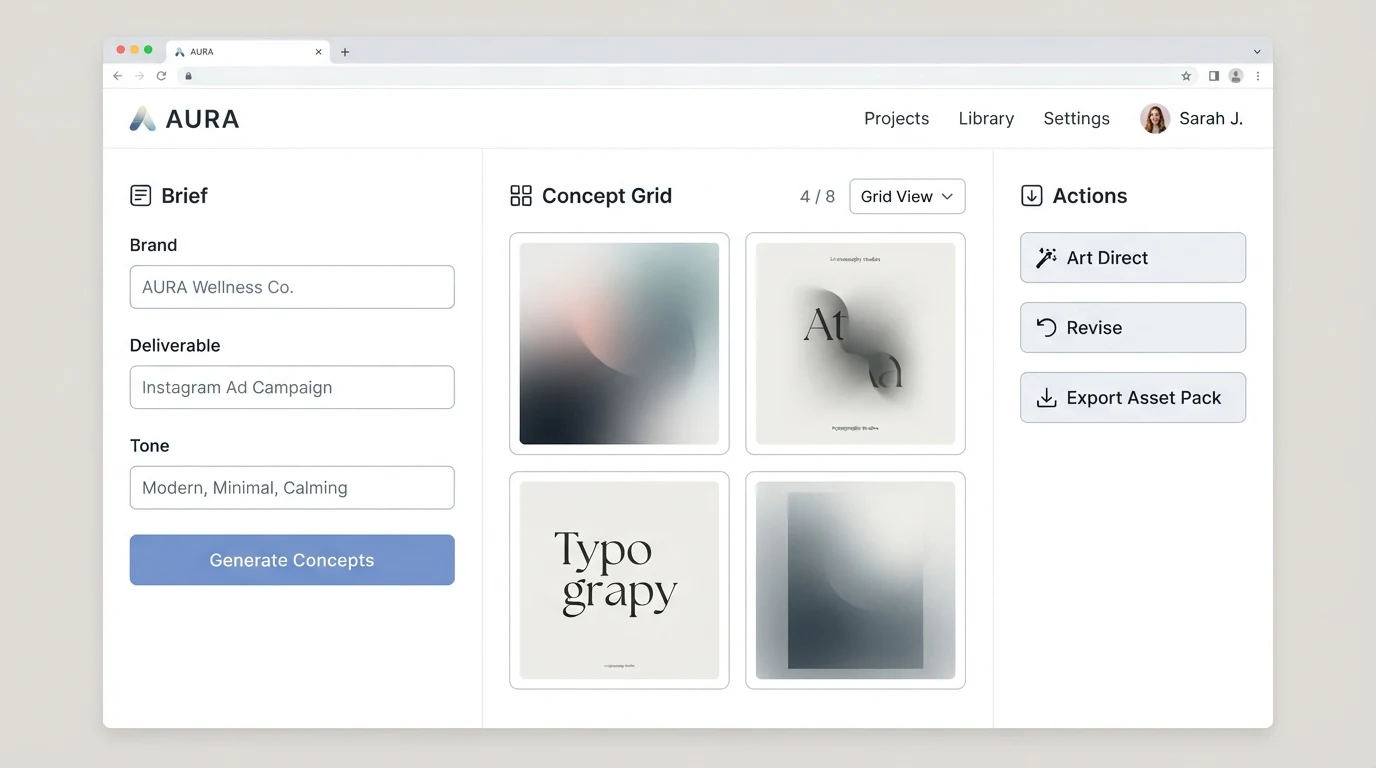
Concept exploration happens next, usually across multiple generative platforms depending on the brief. The art director writes the prompts, reviews the grids, and curates the directions worth developing. We typically present a concept exploration round across several visual directions, each anchored to the brand profile. The comparison between this and classical photography workflows sits in our traditional versus AI product photography breakdown.
Human finishing is where the work earns its keep. Chosen directions move into Photoshop and Figma, where art directors fix hands, retouch skin, correct colour, adjust composition, and conform assets to every aspect ratio the channel needs. Final deliverables ship as layered files, pre-sized exports, and brand-asset packs that drop into the client's existing production stack. Pipeline detail for the broader content side lives in our content creation service.
What to expect from AI design pricing in Australia
The honest answer is that pricing varies more than it used to. Traditional day rates and retainer models still exist, but the unit economics of AI-assisted work have scrambled the old pricing bands. Most Australian studios now quote per scope rather than per hour, because an hour of senior art direction on an AI pipeline produces far more usable output than an hour of pre-AI work. The tooling side of that economic shift is covered in our pricing breakdown for Figma Weave.
At Absolutely AI, pricing is quoted per scope after a brief review. We look at the deliverable list, the brand complexity, and the timeline, then come back with a scoped quote. Retainer arrangements suit brands with ongoing creative demand across social, ad, and ecommerce channels; project pricing fits one-off campaigns. Either way, the quote covers senior art direction, not just AI output. Start a scope conversation through our contact page.
How to choose an AI graphic design agency in Australia
Six criteria matter more than the rest when you are vetting a partner. The first is tooling: ask what sits in the stack beyond ChatGPT. A real AI-native agency will name specific generative platforms, specific finishing software, and specific workflow tools. Vagueness here is the warning sign. The position our studio takes on tooling and process is laid out in the agency overview.
The second is senior creative direction on every brief. Ask who the art director is, how often they touch the work, and what their background is. AI tools reward classical taste more than classical taste rewards AI tools, so the bar on the human layer should be higher than the bar on the generation layer. The third is Australian time zone and cultural fluency, which matters more than it sounds when the brief includes local references, local talent, and local market context.
The fourth and fifth are the IP position and the revisions model. Ask who owns the final work, what the agency's stance is on training-data provenance for the tools they use, and how revisions are structured. The sixth is proof. Portfolio depth, specific case detail, and willingness to walk through a live pipeline on a discovery call all tell you whether the agency actually works this way or just markets it. The primer on AI design agencies covers these criteria in more depth.
How Absolutely AI compares to other Australian design studios
The Australian market has a small group of studios serving this category, each with a different position. Superside runs a global marketplace model with AI-enabled subscriptions, Juicebox and Blackbox Design lean classical with AI tooling added, Clearwater sits in the mid-market with a blended offer, and Absolutely AI runs an AI-native hybrid with senior art direction on every project. The table below sketches the differences.
| Studio | Model | Location | Pricing approach | Best for |
|---|---|---|---|---|
| Absolutely AI | AI-native hybrid, senior art direction on every brief | Australian owned, Australian time zone | Quoted per scope | Brands wanting cinematic creative at AI speed with human taste |
| Superside | Global marketplace, subscription creative | Distributed, follow-the-sun | Subscription tiers | Enterprise teams with constant creative throughput |
| Juicebox | Classical studio with AI augmentation | Melbourne | Project and retainer | Brand identity and classical campaign work |
| Clearwater Agency | Mid-market blended agency | Sydney | Project and retainer | Mid-market brands needing a broader marketing mix |
| Blackbox Design | Classical design studio | Sydney | Project pricing | Traditional brand and print work |
None of these studios is wrong for every brief. Picking the right one comes down to how AI-native the work needs to be, whether a dedicated senior art director on your account matters, and whether local time zone and cultural fluency are relevant. For brands weighing the deeper comparison between generative design tools, our Figma Weave alternatives roundup covers the tooling side.
Frequently asked questions
Who owns the final work produced by an AI design agency?
Ownership structures vary by agency and by the generative tool in the stack. The right conversation to have with any studio is whether final deliverables transfer to the client, which tools were used in production, and what each tool's commercial terms say. For a strategic view on how brands structure these decisions, our consulting service covers the rights, workflow, and adoption side of moving to an AI creative pipeline.
Which generative tools does Absolutely AI use?
The stack shifts as the field moves, which is part of the point of hiring an AI-native agency. The current layer includes Midjourney for exploration, Adobe Firefly where commercial-use provenance matters, Figma for layout and iteration, and the standard Adobe suite for finishing. The Figma Weave versus Flora breakdown covers the design-tool side of the stack in detail.
How does AI design handle revisions compared to traditional studios?
Revisions tend to run faster because the exploration phase is cheaper to iterate. A direction that would have cost a reshoot in a classical workflow can be re-rendered and refined in the same session. The human finishing layer still takes real time, which is where senior art direction keeps revision cycles grounded in brand strategy rather than endless prompt tweaking. See our marketing agency service for how revision cycles are structured on retainer work.
Can AI-generated assets be edited in Figma, Photoshop, or Canva?
Yes. The output of the generative layer is a raster or vector asset that flows into standard design software for finishing, layout, and brand application. Clients receive layered files and brand-asset packs that work in their existing stack. The Figma Weave versus ComfyUI piece explains how different tool chains integrate with downstream software.
Is the work done remotely or on site?
Most work runs remotely because the pipeline is digital end to end, but on-site workshops, brand sprints, and in-person creative sessions are available when the brief warrants them. Being Australian-owned matters here because workshops in Sydney, Melbourne, or Brisbane do not require international travel or awkward time-zone handoffs.
How does AI design fit with video and film projects?
Graphic design, AI film, and AI animation share more of a pipeline than they used to. Many briefs cross between still imagery and motion, which is why our AI film service works from the same creative-direction layer as the design work.
Picking an AI graphic design partner in Australia comes down to how AI-native the work needs to be, who the art director is, and whether the agency can honestly tell you when AI is the wrong call for a brief. If that sounds like the kind of conversation your brand needs, Absolutely AI runs an AI graphic design practice built around exactly that question.