How AI Is Changing Graphic Design in 2026
AI hasn't replaced graphic designers. It has collapsed the cost of exploration, shifted the job from making the asset to making the right decision, and forced studios like Absolutely AI to rebuild their workflows around judgment, systems, and speed. The question isn't whether AI belongs in your design process anymore. It's whether your process reflects that it already does.
Walk into any working design studio in 2026 and the tools on screen look nothing like they did two years ago. Midjourney open in one tab, Figma in another, Nano Banana refining a hero, Firefly cleaning a background, Runway extending a still into a five-second loop. The output volume is up. The headcount isn't. And the conversation has quietly moved from "can AI do graphic design" to "how do we stop it from making everything look the same." That is the real story of AI graphic design right now, and it is the shift most articles are still refusing to name.
The 2026 state of play
Adoption is no longer the interesting number. Studios we speak to report 40 to 60 percent faster turnaround on standard deliverables since embedding generative tools into production, and the tasks that used to eat a junior designer's afternoon (moodboards, colourway variants, background removal, upscaling, silhouette cleanups) are now default-AI. Where the tools still fail is exactly where they failed in 2024: typography inside images, exact brand colour matching across a set, hands and hardware, multi-panel narrative consistency, and layout hierarchy that respects reading order.
That gap is the entire commercial opportunity. AI has closed the distance on the middle 70 percent of design labour and left the top 15 percent (taste, brand fit, art direction) and the bottom 15 percent (final production polish, accessibility, print prep) mostly untouched. Agencies that understood this early rebuilt around it. Most in-house teams are still using AI like a slightly faster stock library, which is why their brand systems are quietly drifting.
Six shifts happening right now
The shifts below are not predictions. They are already priced into how the better studios quote, staff, and deliver work in 2026.
- From execution to curation. The designer's day is now dominated by selection, editing, and direction, not construction from a blank artboard.
- From one comp to fifty variants. Clients expect breadth. Presenting three routes reads as under-explored when the tools can produce fifty in an afternoon.
- From stock to generated imagery. Bespoke on-brief visuals now cost less than a Getty licence, which has quietly killed the stock-photo layer of most brand systems.
- From static deliverables to living design systems. Files handed over as endpoints are being replaced by systems the client can extend with AI themselves.
- From Figma-only to prompt-plus-Figma hybrid. Prompting is now a first-class design surface, not a novelty adjacent to the real work.
- From portfolio of assets to portfolio of decisions. The defensible portfolio in 2026 shows judgment: why this route, why not the other forty-nine.
The new AI-native design stack
No single tool wins the workflow. The interesting question is how they compose. A working 2026 stack usually looks something like the table below, moving left to right from ideation to handoff. Each layer plays to one strength and passes to the next.
| Stage | Tools in use | What the human still does |
|---|---|---|
| Ideation and moodboarding | Midjourney, Ideogram, DALL-E | Sets the reference axis, edits taste, kills the obvious |
| Composition and hero imagery | Adobe Firefly, Google Nano Banana, Midjourney | Directs framing, negative space, brand alignment |
| Refinement and edits | Nano Banana, Firefly generative fill, Photoshop | Fixes hands, typography, brand colour, product accuracy |
| Layout and system | Figma AI (Buddy), Canva AI | Hierarchy, accessibility, responsive rules |
| Motion and extension | Runway, Kling, Sora | Story beats, pacing, brand-safe motion language |
| Handoff and code | Anima, Figma dev mode | Component logic, tokens, engineering QA |
The mistake most teams make is picking one tool and forcing every stage through it. The studios producing the strongest work in 2026 treat this as a pipeline of specialists, and the designer's job is knowing which tool to reach for at which second. That instinct is now more valuable than any single-tool proficiency, and it maps closely to how we structure content production for clients running high-volume programs.
What an AI-native designer's day actually looks like
Take a real brief: a launch campaign for a challenger skincare line, three hero images plus fifteen social cutdowns, two week turnaround. In 2022 that is a full studio month. In 2026 it looks like this, and the value the human adds shows up in the same places every time.
- Morning of day one: art director writes the prompt spine (subject, palette, lens, mood, negative prompt) in plain English. Midjourney runs 200 exploration frames while the director drafts the brief for the writer.
- Afternoon of day one: director curates 12 keepers, kills 188. This is the single highest-leverage hour in the whole project. See our breakdown of how AI product photography works for the same principle applied to ecommerce.
- Day two: keepers move into Firefly and Nano Banana for hero-grade refinement. Human fixes the bottle silhouette, the exact brand green, the hand holding the pipette. Nothing else.
- Day three: Figma layouts built against the hero set. Buddy handles the fifteen social ratios; the designer owns hierarchy, type, and accessibility.
- Day four: Runway extends two heroes into short loops for paid social. Director approves the motion language, not the frames.
- Day five onward: revisions, brand QA, handoff. The remaining nine days are for the parts AI is still bad at, which is where the client actually feels the quality.
The pattern is consistent. AI compresses the middle. The human owns the top and the tail. Teams that try to automate the top or the tail end up shipping work that looks generated, and clients can feel it inside three seconds.
The skills that suddenly matter more
Every skill on the list below existed before 2023. What has changed is their weighting inside a designer's actual job. Prompt fluency (writing precise, referenced, negative-aware briefs) is now as fundamental as knowing your way around the Pen tool. Taste, once treated as a soft skill, is the entire deliverable in a world where anyone can generate a thousand competent images. Art direction language matters because you have to describe what you want to a machine that has no context. Design-system thinking matters because output is now infinite and consistency is the only defence. Brand voice translation, motion literacy, and accessibility close the list, and every one of them is a place where senior judgment beats junior speed. This is the direction our own consulting engagements keep pushing in-house teams toward.
The risks nobody is talking about
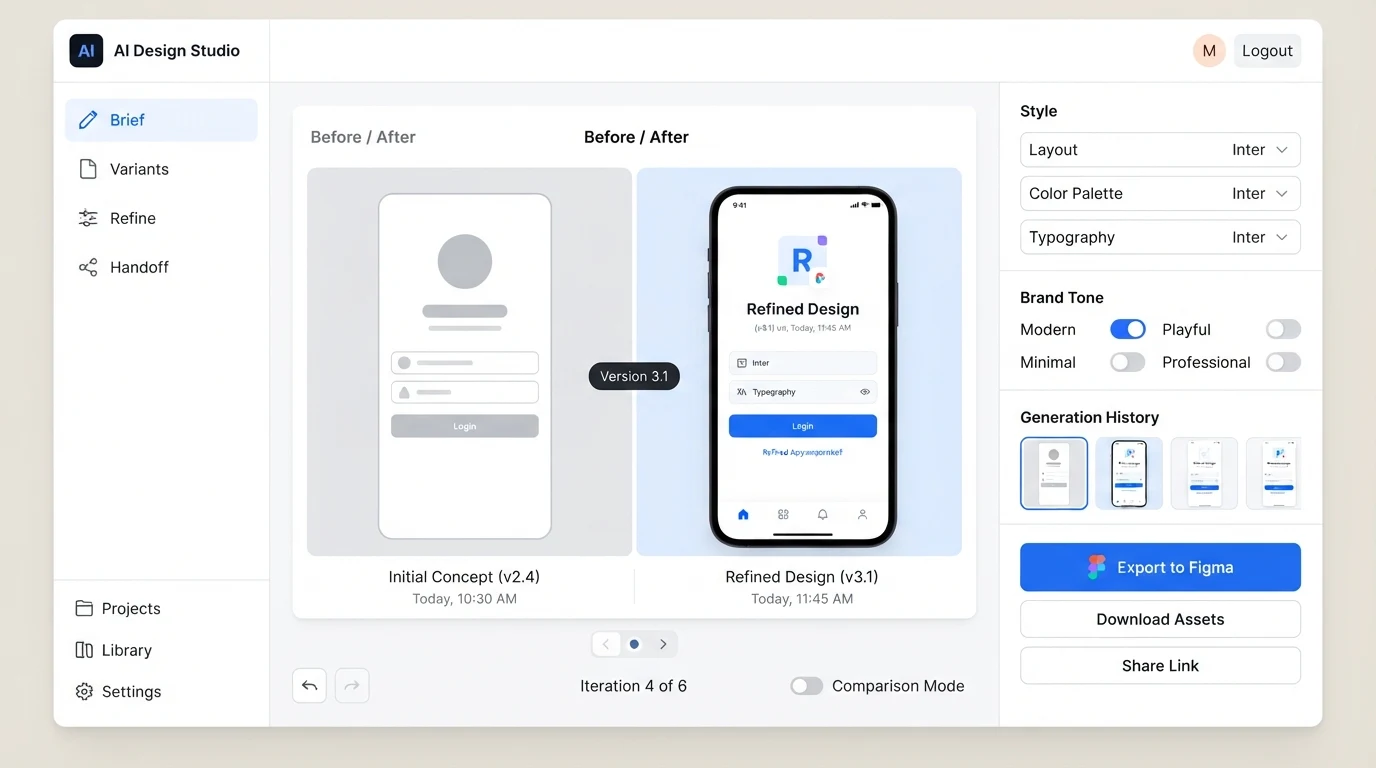
Sameness is the risk hiding in plain sight. When every studio prompts the same tools with roughly the same references, the aesthetic centre of gravity collapses. The 2026 version of "corporate Memphis" is already visible: soft gradients, generic dimensional glass, iridescent ribbons, floating product shots against pastel voids. Studios that don't build proprietary reference libraries and fine-tuned brand models will produce work indistinguishable from their competitors within twelve months.
Brand drift is the second one. The moment a marketing manager, a junior designer, and a founder can all generate on-brand-ish imagery, the brand system starts to fray at the edges. Most in-house teams don't notice until the drift shows up in a quarterly audit, at which point six months of collateral has to be pulled and rebuilt.
Provenance and copyright is the third, and it is no longer hypothetical. The Getty Images versus Stability AI case, the ongoing Adobe indemnification carve-outs, and the training-data disclosures now required in the EU have turned client contracts into a legal surface designers actually have to understand. Firefly's commercial safety guarantee is doing a lot of work here, which is why it dominates client-facing production even when the raw output isn't the best on the market.
What this means for agencies and in-house teams
Pricing models are moving off hourly and onto scope and outcome, because hours no longer correlate with value delivered. Team shapes are inverting: fewer producers, more directors, and a new role that barely existed in 2023 (the prompt-and-systems lead who sits between design and engineering). Creative briefs are getting shorter on execution detail and longer on decision criteria, because the executional question has collapsed into a prompt while the decision question has expanded.
For agencies, the winning shape in 2026 is small, senior, and system-heavy. For in-house teams, the winning shape is one strong director who owns brand fit and a lean group of AI-native generalists who ship. Studios still staffed around 2022 assumptions (heavy on mid-weight production, light on direction) are the ones quietly losing pitches, and it shows up first in their social ad and campaign work where volume needs are highest.
Where it is heading
Three moves are already visible in the studios and platforms setting the pace. Brand-aware generation is the near-term one: fine-tuned models trained on a single client's assets, colours, and voice, so every generation lands closer to on-brand out of the gate. Agentic design workflows are the medium-term one: the designer briefs an agent, the agent runs the pipeline described above end to end, and the human reviews at checkpoints instead of steering every step. On-brand model fine-tuning as a productised service is the third, and it is where the next generation of design studios will make their margin.
Frequently Asked Questions
Is AI replacing graphic designers?
No, but it is replacing certain kinds of graphic design work. Repetitive production tasks, variant generation, moodboarding, and background editing are being automated. Art direction, brand fit, and design systems thinking are more valuable than ever. The role is compressing at the middle and expanding at both ends.
What AI tools do professional graphic designers actually use in 2026?
Most working studios run a stack rather than a single tool. Midjourney and Ideogram for ideation, Adobe Firefly and Google Nano Banana for commercial-safe refinement, Figma AI for layout and systems, Runway for motion, and Anima for handoff. Very few teams get by on one tool alone.
Can AI keep a brand's visual identity consistent?
Not reliably out of the box. Off-the-shelf models drift across a set and struggle with exact brand colours and typography. Consistency in 2026 comes from disciplined prompting, reference libraries, and increasingly from fine-tuned brand-specific models. Without those guardrails, drift is guaranteed.
What are the legal risks of using AI-generated design work commercially?
The main risks are training-data provenance, similarity to copyrighted works, and client indemnification. Adobe Firefly leads on commercial safety guarantees, which is why it dominates client-facing production. Most agencies now include AI-usage clauses in their contracts specifying which tools were used and where liability sits.
Does AI-generated design actually look different from traditional design?
Yes, if you know what to look for. Untuned AI work has a recognisable aesthetic (soft gradients, floating subjects, generic dimensionality) that reads as generated inside a few seconds. Studios producing work that doesn't read as AI are the ones investing in curation, edits, and brand-specific models rather than shipping raw output.
How much faster is an AI-native design workflow?
Studios report 40 to 60 percent faster turnaround on standard deliverables. The gains concentrate in ideation, variants, and refinement. Strategic direction, final production polish, and stakeholder revisions are unchanged, which is why the ceiling on speed lands around that range rather than higher.
What should an in-house design team change first?
Start with the workflow, not the tool. Map which tasks are middle-execution (automatable) versus top-and-tail (judgment). Build a reference library, agree a small stack across the team, and rewrite briefs so they describe decision criteria rather than executional steps. Tools without a workflow just produce faster mediocrity.
Is prompt engineering a real skill for designers?
Yes, in the same way that briefing a photographer or an illustrator is a real skill. Writing precise, referenced, negative-aware prompts is now core craft. Designers who treat it as clerical work produce clerical output. Designers who treat it as art direction produce work worth paying for.
The takeaway
Graphic design didn't get replaced. It got restructured. The designers doing the best work in 2026 are the ones who stopped defending the old workflow and started rebuilding it around judgment, systems, and speed. If your team is still using AI as a faster stock library, you are already behind the studios treating it as an entire production layer. Absolutely AI works with brands and in-house teams to design workflows that actually reflect the 2026 stack, and if that sounds like the conversation you need to be having, our AI graphic design team is the place to start.