What Happened to Sora, and What Brands Should Use Instead
Sora is gone. OpenAI announced the shutdown on March 24, 2026, closed the consumer app on April 26, and will cut the API on September 24. The $1B Disney deal and 200+ character licensing framework collapsed under copyright backlash. If your brief was built around Sora, Absolutely AI has mapped the brand-safe replacements worth briefing instead, ranked by legal exposure rather than output quality alone.
Sora is gone. OpenAI announced the shutdown on March 24, 2026, with the consumer app sunset April 26 and the API dark on September 24. The headline numbers tell the story: a $1 billion Disney partnership and a 200-character licensing framework collapsed in under six months. The question for brand teams is not what killed it. The question is what to brief instead, and how to pick a model that will not force the same migration again in a year. This piece ranks the alternatives by brand-safety exposure, not output quality, because that is the question a marketing director actually has to answer.
What happened to Sora, in one scroll
The timeline matters because the cause of death is also the vendor-selection criteria. Here is how the six months played out, condensed into the moments that shifted the ground for anyone briefing AI video for brands.
- Late 2025: Sora 2 launches with photoreal character consistency and a surprise opt-out copyright policy, meaning rightsholders had to actively flag characters to prevent generation.
- Early 2026: Japanese animation trade groups demand the opt-out model be reversed. Ronald McDonald, Nintendo characters and Studio Ghibli pastiches flood social feeds. The IP-flood becomes a daily news cycle.
- February 2026: OpenAI flips to opt-in licensing. The 200-plus character framework with Disney, pitched as a $1 billion partnership, is paused.
- March 24, 2026: Shutdown announced. OpenAI cites a strategic pivot to world simulation and robotics research.
- April 26, 2026: Consumer app sunsets. Users have a 30-day window to export generations.
- September 24, 2026: API sunsets. Any production pipeline still routing through Sora endpoints breaks.
Why it really died
Three forces, not one. First, the copyright flip. Opt-in licensing is dramatically more expensive to operate than opt-out, and once the Disney framework stalled, the economics of a photoreal model trained on recognisable IP stopped working. Second, compute cost against softening demand: Appfigures install data showed Sora's consumer momentum peaking in the first weeks and sliding through Q1. Third, OpenAI's own strategic pivot. Enterprise coding revenue and world-simulation research now carry the model economics; a consumer video app at Sora's compute profile does not.
The lesson is not that AI video is unsafe. The lesson is that any model trained on scraped recognisable likeness is now a legal liability masquerading as a creative tool. Cease-and-desists have landed against Midjourney, Minimax, Seedance and Character.AI through 2025 and 2026. Disney, NBCUniversal and Warner Bros Discovery are the named plaintiffs. The precedent is set and the tool landscape has to be read through that lens from here on.
What this means for brand marketers
Here is the angle most ranking pages miss. Sora's death is not a product failure story. It is a signal that opt-out IP training is finished as a commercial model, and that selection criteria for brand-safe AI video have permanently shifted. A year ago a creative director picked a model on output quality and price. In 2026 the first filter is indemnification: will the vendor stand behind you if a plaintiff names your campaign in a filing?
That reframes the shortlist. Veo 3.1 moves to the top not because the output is objectively best in every category, but because Google ships enterprise indemnification. Runway moves up because its commercial licensing is explicit and audited. Open-source models like Wan 2.5 become interesting again precisely because self-hosting a known-provenance model is defensible in a way that a black-box API trained on scraped footage is not. The brief-level question is risk, not resolution.
The brand-safe replacement shortlist
Four categories, one pick each, chosen by the deliverable type a brand team is actually briefing. This is not a 20-tool dump. Each one earns its place on legal clarity first and quality second.
Google Veo 3.1 is the enterprise default. Native audio, strong character consistency, and the only major model shipping with contractual indemnification for enterprise accounts. Brief it for hero spots, flagship launches, anything that will sit on a paid-media buy. This is the pick when the campaign is public-facing and the brand has a legal team that will read the terms. See our breakdown of the brand-video landscape for how Veo compares in real production.
Runway Gen-4 is the creative-agency workflow pick. Commercial licensing is explicit, the editing suite is mature, and the model handles stylised cinematic output better than any of the enterprise options. Brief it for campaign work with a specific art direction, music video adjacencies, or anything where the creative team needs to iterate inside the tool rather than just prompt and export.
Kling 3.0 or Hailuo 02 is the social-cost pick. Faster, cheaper per generation, strong for vertical and square aspect ratios. The licensing is less bulletproof than Veo or Runway, so brief these for internal review cuts, A/B creative on paid social, and content where the exposure window is short and the IP risk is low. Not the pick for TVC-grade hero work.
Wan 2.5 is the open-source self-host option for IP-sensitive internal work. Pre-vis, internal training content, pitch decks, R&D visualisation. The appeal is control: you run it on your own infrastructure, you know what trained it, and nothing leaves your network. Brief it when the output never goes to a public channel but the sensitivity is high.
Honourable mentions, worth testing but not a default: Seedance 2.0 (ByteDance, strong motion but ongoing IP scrutiny), Vidu (good for stylised 2D), Dream Machine (fast ideation, lighter licensing).
| Model | Best for | Indemnification | Licensing clarity | Brand-safety tier |
|---|---|---|---|---|
| Veo 3.1 | Hero spots, paid-media campaigns | Yes (enterprise) | High | A |
| Runway Gen-4 | Agency creative, stylised work | Partial | High | A |
| Kling 3.0 | Social cuts, short-window content | No | Medium | B |
| Hailuo 02 | Vertical social, batch creative | No | Medium | B |
| Wan 2.5 | Internal, pre-vis, IP-sensitive | N/A (self-host) | High (controlled) | A for internal |
| Seedance 2.0 | Motion-heavy ideation | No | Low | C |
The 5-question brand-safety checklist before you commit
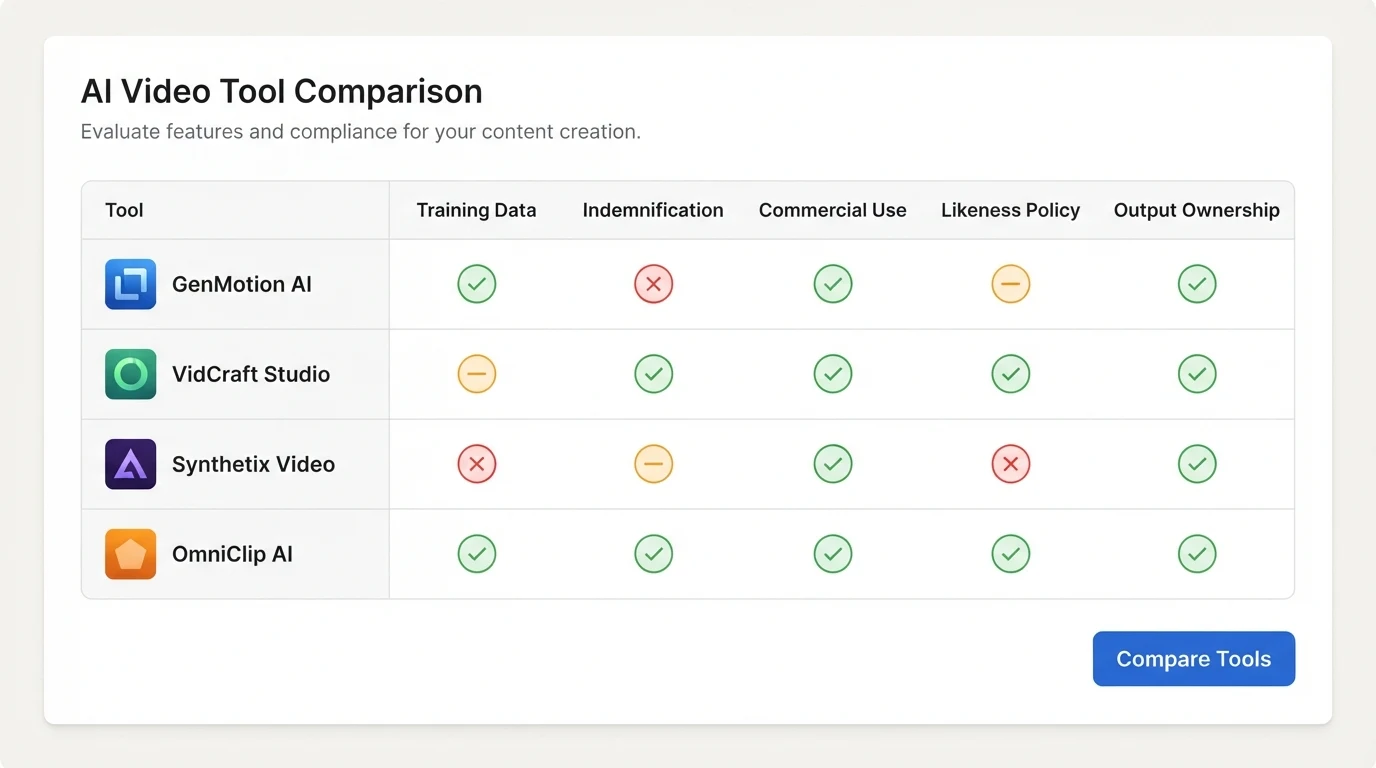
Before any model goes into a production pipeline, the brief owner needs clean answers to five questions. These are the questions a legal team will ask when a campaign gets flagged, so it is cheaper to answer them upfront. Our consulting work with brand teams starts with this exact filter.
- Training data provenance. What was the model trained on? Is there a published statement, an audit, or at minimum a licensing framework? A vendor that cannot answer this clearly is not a candidate for public-facing work.
- Indemnification clause. If a rightsholder sues your brand over a frame generated by this model, does the vendor cover you? Enterprise contracts from Google and Microsoft now include this. Most consumer APIs do not.
- Likeness policy. What is the vendor's position on generating recognisable people, characters, or brand marks? A permissive policy is a liability. A strict one is a feature.
- Commercial-use terms. Is commercial use explicitly permitted at your subscription tier? Several models restrict commercial output to higher plans, and the fine print changes often.
- Output ownership. Who owns the generated frames? Can you register copyright? Can the vendor claim a licence to use your output in their training data? Read this clause before signing.
How to migrate a Sora workflow this week
If your team was mid-pipeline on Sora, here is the four-step plan to run before the September 24 API cutoff. The window on consumer-app exports already closed, so API-side migrations are now the priority.
- Export every Sora asset you can still retrieve via the API and archive the raw files alongside the prompts, seeds and parameters. Prompt libraries are the real asset, not the generated clips.
- Re-prompt your hero work in Veo 3.1. Expect the first batch to feel different: Veo handles motion and audio natively, so prompts written for Sora's style need rewriting for Veo's grammar. Budget two days of prompt-engineering time per hero shot.
- Rebuild social batches in Kling or Hailuo. For high-volume social cuts where the clip lifespan is a week, the cost-per-generation on these two is where the economics work. Build a lightweight approval loop so legal signs off on the batch, not the individual clip.
- Lock a self-host backup in Wan 2.5. Even if you never run production through it, having an on-infrastructure fallback means the next vendor shutdown does not break your pipeline. This is the lesson of Sora: platform risk is now a planning input.
Frequently Asked Questions
Is Sora coming back?
No signal of a return. OpenAI's public positioning is that generative video is now part of the world-simulation research track, not a consumer product. If a Sora-branded tool reappears, assume it will be a different product with different licensing.
Can I still use the Sora API after September 24?
No. The API sunsets on September 24, 2026. Any production pipeline routing through Sora endpoints will stop returning generations on that date. Plan the migration as a hard cutover, not a gradual transition.
Is image generation in ChatGPT affected?
No. The ChatGPT image generation feature is a separate product line and continues to operate. The sunset covers Sora-branded video endpoints only.
What about Sora 2 Pro on OpenRouter and third-party aggregators?
Third-party routes depend on OpenAI's API staying live, so the September 24 cutoff applies to them too. Aggregator access does not extend the lifespan of the underlying model.
Which alternative is closest to Sora's native output quality?
Veo 3.1 for photoreal and cinematic work, Runway Gen-4 for stylised and art-directed output. Neither is a drop-in substitute, which is why the migration plan budgets prompt-engineering time.
Should we wait for Sora 3 or a successor?
No. Waiting is the most expensive choice because it keeps your pipeline frozen on a sunsetting platform. Migrate now and treat the next OpenAI video product as a candidate alongside the others, not a presumed default.
Where this leaves brand teams
The Sora shutdown is the clearest signal yet that the AI video market is sorting into tiers by brand risk, not by output quality. The models worth briefing in 2026 are the ones with clean training data, explicit commercial terms, and contractual indemnification for the campaigns you put on paid media. Everything else is a scratchpad. If you need help running the selection, migrating a live pipeline, or stress-testing a vendor's licensing against your legal team's requirements, Absolutely AI works with brand teams on exactly this problem.