Australian Consumer Law and AI Generated Ads: An Operator Guide
AI generated ads are standard practice for Australian brands in 2026, but there is no AI-specific advertising law in this country. The Australian Consumer Law applies the way it always has, and section 18 reaches synthetic imagery as easily as it reaches a studio photograph. Absolutely AI works alongside brand and legal teams on AI creative, and this is the operator's view: what the ACL says, where AI ads fail, and how to ship safely.
Every Australian marketer shipping AI generated creative is asking the same question: what are we actually allowed to put in an ad? There is no AI-specific advertising statute in this country. The creative shipping into Meta, TikTok and CTV is governed by the Australian Consumer Law in Schedule 2 of the Competition and Consumer Act 2010, and the ACCC has signalled all year that generative tooling does not reset the obligations.
There Is No AI Advertising Law, But the ACL Already Applies
The myth doing the rounds is that AI output lives in a legal grey zone. It does not. Treasury's October 2025 final report on AI and the Australian Consumer Law concluded that the ACL is generally well-suited to AI-driven conduct, which means the regulator view is settled: existing law applies, no carve-outs are planned, and the burden sits on advertisers rather than the tooling vendors. Operators planning an AI marketing program should treat that finding as the baseline.
What that means in practice is simple. The same misleading conduct rules that caught a touched-up studio photograph a decade ago catch a diffusion-model composite today. The ACCC does not need to prove the ad was made with AI. It needs only to prove the overall impression was misleading or likely to mislead, measured against the ordinary and reasonable member of the target audience.
What Sections 18 and 29 Actually Cover
Section 18 is the open-textured catch-all. It prohibits conduct in trade or commerce that is misleading or deceptive, or likely to mislead or deceive. There is no fault element and no intent requirement. The advertiser's state of mind is irrelevant: if the ad conveys an impression that is wrong, the ad is unlawful, regardless of whether a human art director, a stock photographer or a text-to-image model produced the frame.
Section 29 is more specific. It bans false or misleading representations about the standard, quality, grade, composition, style, model, history, use or benefits of goods or services, and about sponsorship, approval, performance characteristics, testimonials, place of origin and price. Section 29 is where most AI product imagery gets into trouble, because a prompt that beautifies an item in ways the real item cannot deliver is a representation about standard and quality.
Neither section requires the ACCC to prove consumers were actually misled. The threshold is likely to mislead, which Australian courts interpret against the least sophisticated plausible viewer in the target audience.
When an AI Generated Ad Crosses the Line
The practical test is whether the image depicts features, quality or benefits the product does not actually have. A moisturiser rendered with a flawless gloss the real formula cannot produce, a food shot with an invented texture the delivered meal cannot replicate, a chair rendered with proportions larger than the physical SKU: each is a section 18 and section 29 risk. The skincare and personal care categories are particularly exposed because consumer expectation of the final product is formed almost entirely from the pack shot.
AI chatbots deployed as sales agents raise the same risk from the other direction. If a brand's chatbot hallucinates a feature, a shipping time or a refund policy, that representation is attributable to the business, not to the model vendor. The ACCC has already flagged chatbot output as advertiser-owned conduct.
AI-washing is the emerging third category. Overstating that a product uses AI, or that AI delivers a specific benefit, without substantiation, is the same pattern the ACCC has prosecuted in greenwashing cases. Treasury's October 2025 report called this out specifically.
Penalties, in Real Numbers
The corporate maximum penalty for a breach of section 18 or section 29 is the greater of three figures: $50 million, three times the value of the benefit the business obtained from the conduct, or where that benefit cannot be determined, 30% of the body corporate's adjusted turnover during the breach period. For individuals, the maximum is $2.5 million per contravention.
You will see $100 million cited in news coverage of ACCC matters. That figure comes from stacking multiple contraventions or applying the turnover formula at scale: it is not the statutory headline. Brief the CFO on the real formula, not the rounded media number. Beyond fines, the ACCC can seek injunctions, corrective advertising orders, non-publication orders and compliance program orders.
Employsure and Why Automation Is Not a Defence
ACCC v Employsure in the Full Federal Court is the precedent that most directly maps onto AI ads. Employsure ran Google Ads that gave consumers the impression it was a government agency or affiliated with one. The ads were automatically generated through keyword insertion. The court held that the automated mechanism did not insulate the advertiser: the business chose the templates, the keyword lists and the publishing settings, and was responsible for the output. Keyword-insertion-driven ads were held to breach sections 18 and 29.
Transfer the reasoning to generative creative pipelines. The business chooses the model, the prompts, the brand training set, the review workflow and the publishing destination. If the output misleads, the AI did it is not a defence. Disclaimers in small type, after the misleading impression has already formed, are generally weak under Australian law and will not retroactively cure a bad hero image.
Google Inc v ACCC in the High Court separately clarified that a pure platform acting as a publisher of third-party ads will not usually be liable under section 18 for the advertiser's representations. That is a shield for the ad networks, not for the brand or the agency that supplied the creative.
ACCC Enforcement Signals in 2025 and 2026
In October 2025 the ACCC commenced Federal Court proceedings against Microsoft Australia over Copilot-related subscription conduct. The matter is still before the court, but the filing is a clear signal that the regulator is prepared to litigate AI-adjacent consumer conduct against major vendors.
Treasury's final report on AI and the ACL, released the same month, declined to recommend AI-specific amendments and endorsed existing enforcement. Read alongside the ACCC's multi-year greenwashing campaign, in which it has published explicit guidance on substantiation and lifecycle claims, the pattern is clear. Expect the greenwashing playbook, substantiation files, documented methodology and no vague superlatives, to be applied to AI-washing claims in the next enforcement wave.
Disclosure: Is an AI Label Required?
There is no general law in Australia requiring an AI generated label on advertising creative. Ad Standards is reviewing whether to add a general misleading-content rule to the AANA Code, but as of this writing no mandatory disclosure obligation exists for commercial AI imagery.
South Australia's deepfake political advertising ban is the only hard rule on the books, and it is tightly scoped to election communications. Voluntary disclosure, a short created with AI line in the caption or on the asset, is not legally required but is useful evidence that an ordinary consumer would not have been misled about the nature of what they were looking at. For commercial AI creative aimed at broad audiences, voluntary labelling is a cheap risk-reduction move.
A Pre-Flight Checklist for AI Generated Creative
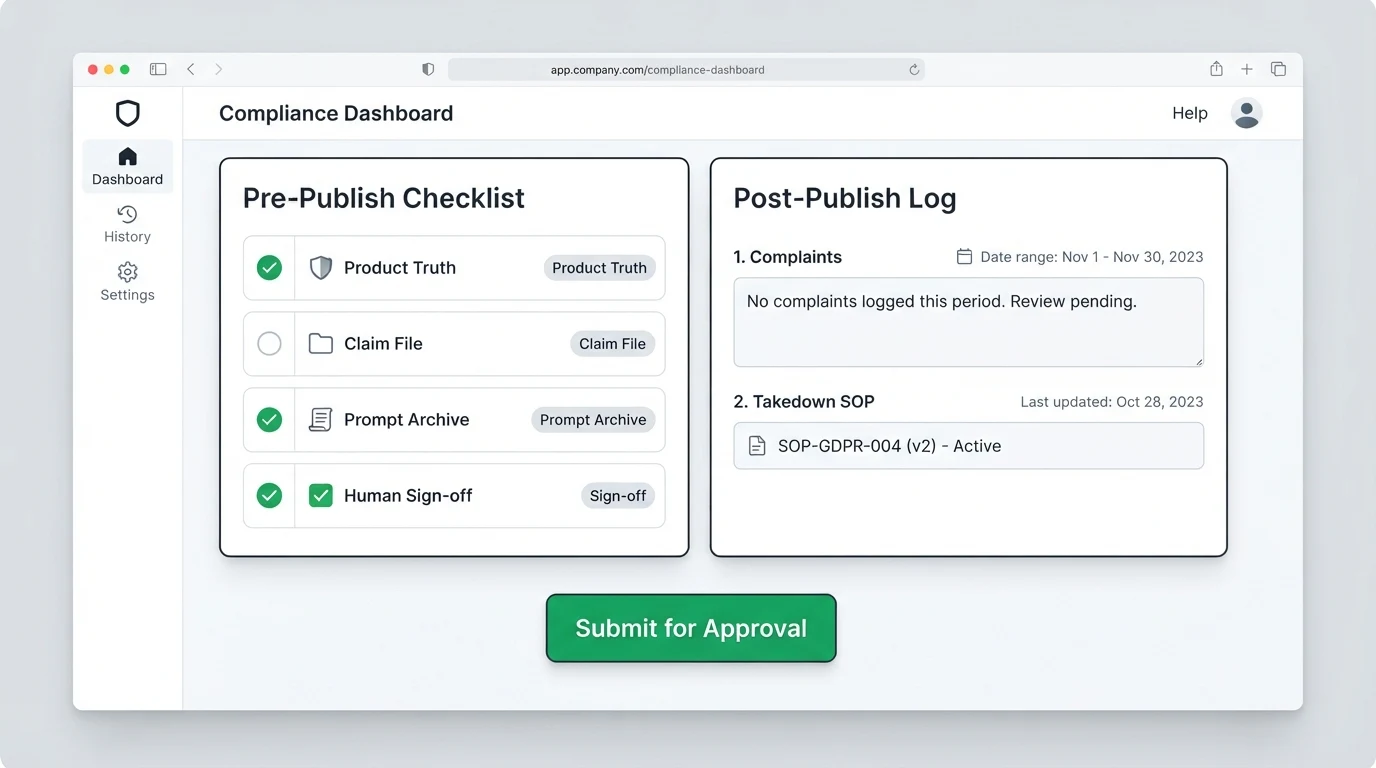
Operators need a working checklist, not a doctrine lecture. The following nine-step process is what a disciplined review looks like before an AI ad hits publish:
- Product-truth check. Hold the final frame next to the physical product or the shipped service page. Any feature, finish, texture, size or benefit visible in the image must exist in the delivered product.
- Claim substantiation file. Every verbal claim in the ad, from clinically proven to fastest to the only, gets a dated document in the brand's compliance folder with the underlying evidence.
- Prompt and output archive. Save the prompt, the seed, the model version and the final asset. If a regulator asks how the creative was made, the archive is your answer.
- Human sign-off. Named reviewer, dated approval, stored alongside the archive. This is the single most useful artefact in an ACCC response.
- Ordinary-consumer test. Show the ad to three people outside the project. Ask what they think the product does and what it looks like in real life. If their answers do not match reality, the ad fails.
- Disclosure call. Decide whether to label the creative as AI generated. Default to yes for anything photoreal.
- Agency and client sign-off. Who holds the section 18 risk if this ad misleads? Document the answer in the scope of work.
- Complaints log. After publication, log every consumer complaint, with a response timeline.
- Takedown SOP. Document who can pull the asset, from which channels, within what window, if a complaint lands.
Where the ACL Overlaps With Other Regimes
Section 18 is not the only exposure. The Privacy Act 1988 applies when AI generated creative uses a recognisable likeness, voice or biometric characteristic of a real person without consent. Defamation applies to synthetic depictions that lower a real person's reputation. Copyright applies both to inputs through training imagery and to outputs where the model has reproduced a protected work.
The Voluntary AI Safety Standard, published by the federal government, is non-binding but is the closest thing Australia has to a national baseline for responsible AI use in business. Running your AI creative pipeline against those guardrails is a useful second check once the ACL review is done.
What To Do Before Your Next AI Campaign Goes Live
A short action list for the week before launch:
- Audit every hero asset against the physical product. Pull anything that fails the ordinary-consumer test.
- Build the substantiation file for every verbal claim in the campaign.
- Lock the prompt and output archive. Store with the campaign brief.
- Confirm named human sign-off, with a date, for each asset.
- If the campaign is high-reach or contains comparative claims, run it past a trade practices lawyer before publication.
Frequently Asked Questions
Is there a specific law in Australia that governs AI generated ads?
No. Australia has no AI-specific advertising statute. The Australian Consumer Law, specifically sections 18 and 29 of Schedule 2 of the Competition and Consumer Act 2010, applies to AI generated creative the same way it applies to any other advertising. Treasury's October 2025 report confirmed the government has no plans to add AI-specific amendments.
Do I have to label my ads as AI generated?
Not under current federal law. South Australia bans AI generated political advertising, but there is no equivalent commercial rule. Ad Standards is reviewing a general misleading-content provision for the AANA Code. Voluntary disclosure is useful evidence that consumers were not misled about what they were seeing.
If the agency made the AI ad, is the brand still liable?
Yes, usually both. The brand that publishes the ad is responsible for its representations. The agency can share liability where it was knowingly involved in the misleading conduct. The Google High Court case shields a pure platform publisher but does not shield a creative agency that supplied the brief and the output.
What is the biggest penalty for a misleading AI ad?
For a body corporate, the greater of $50 million, three times the benefit obtained from the conduct, or 30% of adjusted turnover during the breach period. For an individual, $2.5 million per contravention. Media coverage sometimes rounds to $100 million, which reflects stacked contraventions rather than the statutory headline.
Does the ACCC care if my intent was innocent?
No. Section 18 has no fault element. If the ad is likely to mislead the ordinary consumer, the ACCC can act. The Full Federal Court in Employsure confirmed that automation and keyword-driven mechanisms do not insulate the advertiser from the output.
How do I audit an existing AI campaign for ACL risk?
Line up every published asset against the physical product or service. Pull anything that shows a feature, finish or benefit that does not exist in the delivered version. Build the substantiation file for every verbal claim. Document the sign-off trail. If anything looks exposed, pause the asset while legal reviews.
The practical takeaway is that AI generated advertising in Australia sits under ordinary consumer law, enforced hard, with the burden on the brand and the agency rather than the model vendor. For teams planning their next campaign, Absolutely AI sits inside the creative workflow with senior creative direction that treats product-truth and substantiation as part of the brief, not a compliance afterthought. The regulator view is settled: ship accordingly.