What Is an AI Design Agency? A 2026 Definition With Examples
The phrase gets used for two completely different businesses, and buyers keep hiring the wrong one. This piece from the team at Absolutely AI separates AI-accelerated creative studios from AI-native product design agencies, walks through what each actually does day-to-day, and gives you a decision framework for when to hire one, when to stay with a traditional agency, and when a freelancer with Midjourney is enough.
Search "AI design agency" and you will get a ranked listicle before you get a definition. That is a problem, because the phrase covers two very different businesses that solve different problems for different buyers. This guide from Absolutely AI gives you the plain-English definition first, then the split, then a decision framework, so you know what you are actually shopping for before you read anyone's top-ten list.
The short answer
An AI design agency is a creative or product design firm that uses generative AI models as a core part of how it produces work, not as a novelty add-on. In practice that means two very different things. Some agencies use AI to accelerate the making of brand assets, imagery, films and campaigns for clients. Others design the interfaces of AI products themselves, chat surfaces, agents, adaptive UX. Same phrase, opposite services, and the confusion between the two is why so many first briefs go to the wrong door. For a broader overview of the creative-lane version, see our page on AI graphic design.
The two flavours of AI design agency
The cleanest way to think about it is scope. An AI-accelerated creative studio uses generative tools to compress the brief-to-delivery timeline for traditional creative deliverables. An AI-native product design agency designs software experiences whose core loop is a large model. The overlap is small, and the teams involved usually cannot swap seats. If you want the creative-studio version rendered in commercial work, our AI commercial page shows what that lane looks like in production.
| Dimension | AI-accelerated creative studio | AI-native product design agency |
|---|---|---|
| Primary output | Brand identity, campaign imagery, films, social creative, ecommerce assets | Product UI, agent flows, prompt surfaces, adaptive UX systems |
| Core tools | Midjourney, Flux, Stable Diffusion, GPT-image, video models, human art direction | Figma, prototyping frameworks, model integrations, evals, front-end handoff |
| Team shape | Creative directors, art directors, motion designers, AI-fluent producers | Product designers, UX researchers, AI engineers, prompt designers |
| Pricing model | Project-based or monthly retainer, quoted per scope | Sprint or engagement-based, quoted per scope |
| Typical client | Marketing and brand teams inside consumer, DTC, entertainment, cultural brands | Product and engineering teams inside AI-first software companies |
Absolutely AI sits firmly in the first column. When people arrive here asking "what is an AI design agency", nine times out of ten they want brand and campaign work, they just do not know the vocabulary yet. If that is you, our writeup on how AI is changing graphic design is a good next stop after this one.
What an AI design agency actually does day-to-day
The buzzwords hide a fairly boring truth: the pipeline still starts and ends with a human creative director, and the model is a fast, fluent brush somewhere in the middle. A well-run studio follows the same rhythm every project, only compressed. You can see the shape of this on our AI branding page, which walks through a full brand build in the AI-accelerated form.
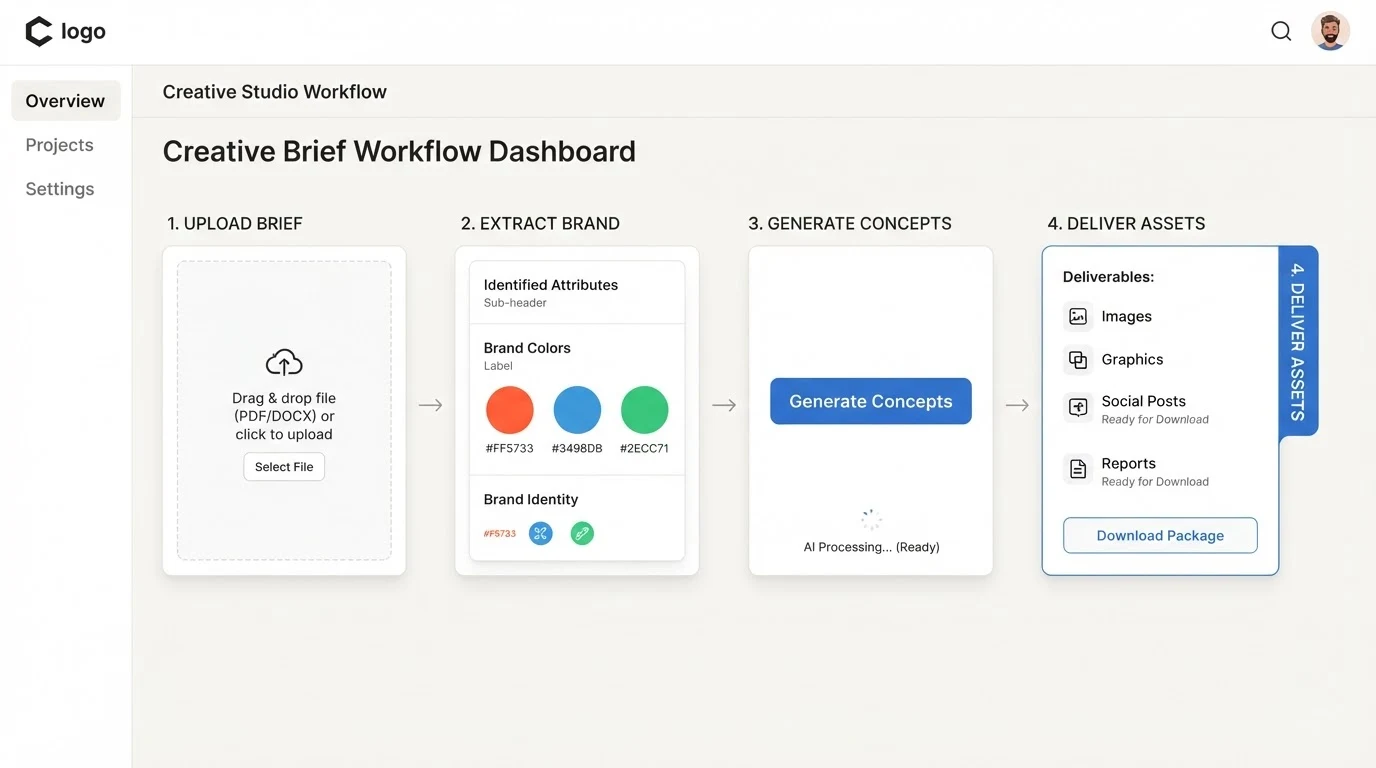
- Brief intake. Live conversation, a written brief, references, an audience, a channel plan, a deadline. Nothing here is different from a traditional agency.
- Brand extraction. The creative director codifies the brand into something a model can respect: palette, type, mood, forbidden looks, hero references. This is the step most Midjourney-reseller shops skip, and it is why their work looks generic.
- Concept generation. The model does its job. Midjourney and Flux for stills, GPT-image for text-in-image work, video models for motion. The right studio runs many variants, not one.
- Human art direction. A director selects, kills, remixes, retouches. This is where an AI social ad creative agency earns its fee, not in the prompting.
- Iteration. Client feedback runs against the same brand system, so the second round is closer, not sideways.
- Delivery. Final files, aspect ratios, motion cuts, source references, usage notes.
The single most important sentence in that list is number four. A generative model without art direction produces plausible mush; the studio's real product is the taste layer on top, and the pipeline that keeps that taste consistent across hundreds of outputs. Our AI consulting practice exists partly to help in-house teams build that same layer internally.
AI design agency vs traditional agency vs freelancer with AI tools
Three viable options exist for a brand that needs creative work in 2026, and they are not interchangeable. The decision comes down to volume, taste ceiling, and how much brand consistency the work has to hold.
| Criterion | AI design agency | Traditional design agency | Freelancer with AI tools |
|---|---|---|---|
| Speed | Fast, concept-to-delivery in days for most work | Slower, tied to shoots, physical production, longer approval cycles | Fast on small jobs, bottlenecks on scale |
| Pricing model | Project-based or retainer, quoted per scope | Retainer, day rates, production budgets | Hourly or per-piece |
| Taste ceiling | High when senior creative direction is applied on every project | High, defined by the agency's reel | Ceiling is one person's taste on that day |
| Revision behaviour | Cheap and fast, model iterates against a fixed brand system | Expensive, reshoots and re-edits | Cheap but inconsistent across rounds |
| Brand consistency at scale | Enforced by the pipeline and directors | Enforced by senior creatives and a style guide | Fragile past a handful of assets |
| IP and usage | Handled contractually, ask before signing | Handled contractually, well-understood | Varies wildly, read every contract |
A freelancer with Midjourney is a perfectly good answer for a one-off launch tile or a founder's LinkedIn header. A traditional agency is still the right answer when the work genuinely needs a location, a talent, and a physical camera. An AI design agency is the right answer when you need cinematic quality, brand-calibrated output, and every aspect ratio your channels demand, at a cadence a shoot cycle cannot match. Our AI brand photography page shows what that looks like when the deliverable is a full campaign wardrobe.
Signs of a real AI design agency versus a Midjourney reseller
The barrier to entry looks low from the outside, so the market has filled up with shops whose entire offering is a Midjourney subscription and a Notion page. A few things separate the real thing from the reseller, and they are worth checking before any first call.
- Proprietary workflows. The studio should be able to describe its brief-to-output pipeline in specific steps, not vibes. If the answer is "we prompt it and send you the best one", keep walking.
- Brand-consistency systems. Ask how they keep a brand looking like itself across a hundred generations. Good answers involve style references passed into every generation, custom LoRAs, hero-image locks, and a director who culls off-brand outputs before the client sees them.
- Art direction on top of generation. A senior creative should sit above the tools. If the pitch deck talks about models but never about directors, the taste ceiling is set by the model, which is not a ceiling you want.
- Custom-trained models where they matter. Not every job needs a LoRA, but any agency doing serious brand work should know when to train one and when not to.
- Structured brief-to-output pipelines. Repeatability is the whole game. A reseller can produce one good image; a studio can produce fifty that all belong to the same brand.
You can gut-check most of this from the portfolio in ten minutes. If the reel looks like a Midjourney feed with logos slapped on, it is a reseller. If the work reads as the brand's work first and the tool's work second, you are looking at a studio.
What it costs
Pricing is one of the least honest sections on most competitor pages, so here is the shape of the market without pretending otherwise. The creative-studio lane, brand identity, campaign imagery, films, ecommerce and social creative, typically runs on project-based or monthly retainer arrangements, with the number set by scope, output volume, and how much senior direction the work needs. The product design lane runs on longer engagements tied to a product roadmap. At Absolutely AI, creative work is quoted per scope after a brief review, and you can start that conversation from the contact page. For a longer read on how creative pricing shakes out in adjacent categories, see AI product photography cost in Australia.
When you should, and shouldn't, hire an AI design agency
The decision is less about the technology and more about the shape of the work. A short framework:
- Hire one when you need cinematic imagery at a cadence physical production cannot match, when you need every aspect ratio your channels demand, when the concept lives in a world you cannot shoot, or when brand consistency across dozens of pieces matters more than any single hero shot.
- Stay with a traditional agency when the job needs a real location, a real talent, and a real camera as the point of the exercise, or when the deliverable is fundamentally about capturing something that already exists in the physical world.
- Use a freelancer with AI tools when the job is small, one-off, and does not have to survive contact with a brand system across a full campaign.
The honest answer for most consumer brands in 2026 is a mix. Physical production for the anchor shoot, an AI design agency for the extensions, iterations, and channel-specific cuts, and freelancers for the odd extra tile. If you are trying to work out which parts of your calendar sit where, our AI marketing agency page describes the mixed-model version.
Frequently asked questions
Is an AI design agency the same as an AI marketing agency?
No, though the venn overlaps. A marketing agency starts from channels, media plans, and performance targets. A design agency starts from craft, brand, and deliverables. Some studios do both under one roof; most do one well and outsource the other.
Will AI replace designers?
Not the good ones. The tools have raised the floor of what a decent designer can produce alone, and lowered the moat around anyone whose only skill was operating specific software. Taste, direction, and the ability to hold a brand together across many outputs are what the market pays for now, and no model has replaced any of those yet.
How do AI design agencies handle brand consistency?
Good ones build a repeatable system: a set of hero references passed into every generation, a locked palette and type direction, sometimes a custom-trained LoRA for the brand's world, and a director who culls off-brand outputs before anything reaches the client. Consistency is a pipeline discipline, not a prompt trick.
Do we own the outputs?
Ownership and usage rights are a live area, so treat them as a contract question, not an assumption. Ask any studio you are considering to state in writing what you own, what usage is granted, and how they handle the underlying model licences. Send that question to us at contact and you will get a clear answer for your scope.
How is this different from just using ChatGPT or Midjourney ourselves?
The tools are cheap; the taste layer, the brand system, and the repeatable pipeline that sits on top of the tools are the actual product. Buying a saw does not make you a carpenter, and this is closer to carpentry than most people expect.
Where this leaves you
The short version: an AI design agency is either a creative studio that uses generative tools to make brand work faster and richer, or a product design firm that designs the interfaces of AI software. They are not the same business and they do not compete for the same brief. Once you know which one you actually need, the shortlist gets a lot shorter. If it is the creative lane, Absolutely AI works there every day, and you can see the shape of it on our AI graphic design page.