AI UGC-Style Video Ads for Paid Social: A 2026 Playbook
AI UGC-style video ads became the default paid-social creative unit in 2026, and most buyer's guides still read like affiliate roundups. This piece treats AI UGC as a creative testing engine, not a novelty generator: how to brief it, how to launch it, how to measure it, and where it quietly fails. Absolutely AI wrote it for performance marketers who already run paid social.
Video now accounts for the majority of paid-social ad spend, and the cost of producing a new creative variant has collapsed to the price of a few API calls. That shift reshaped the brief: creative teams no longer ship three polished hero cuts and hope, they ship forty hook variants on Monday and let the auction decide by Friday. The format that absorbed most of that velocity is the AI UGC-style ad, a vertical video combining an AI avatar or voice with creator-coded framing, caption-first delivery, and a product cutaway. For a deeper look at how that creative velocity reshapes paid-social workflows, see our breakdown of how to scale ad creative with AI.
What Makes an AI UGC-Style Ad Actually Work
The creative conventions of UGC are more rigid than they look. A functional AI UGC ad hooks in under two seconds, usually with a face-forward direct-address line or a pattern-interrupt visual. It frames vertically at 9:16 with the subject centred in the safe area, leaves the top third clean for platform chrome, and leans into imperfection: handheld jitter, uneven lighting, a messy kitchen in the background. Captions carry the narrative because most users watch muted, and the audio bed follows UGC conventions rather than brand-film ones, think room tone and a trending TikTok sound rather than a licensed track.
Avatars that read as presenters tank. Avatars that read as a specific person with a specific opinion win. The brief should name the archetype before it names the product, and the script should sound like someone recommending a thing to a friend, not reading a value proposition. The same instinct that governs good AI UGC-style content for brands applies here: the ad has to feel found, not placed.
The 2026 Tool Landscape, Grouped by Job
Flat rankings of AI UGC tools age badly because the category keeps splitting. It is more useful to group by job-to-be-done, because most performance teams end up running two or three tools in parallel rather than standardising on one. The grid below is how we think about the shortlist in late 2026.
| Job to be done | Representative tools | Best for |
|---|---|---|
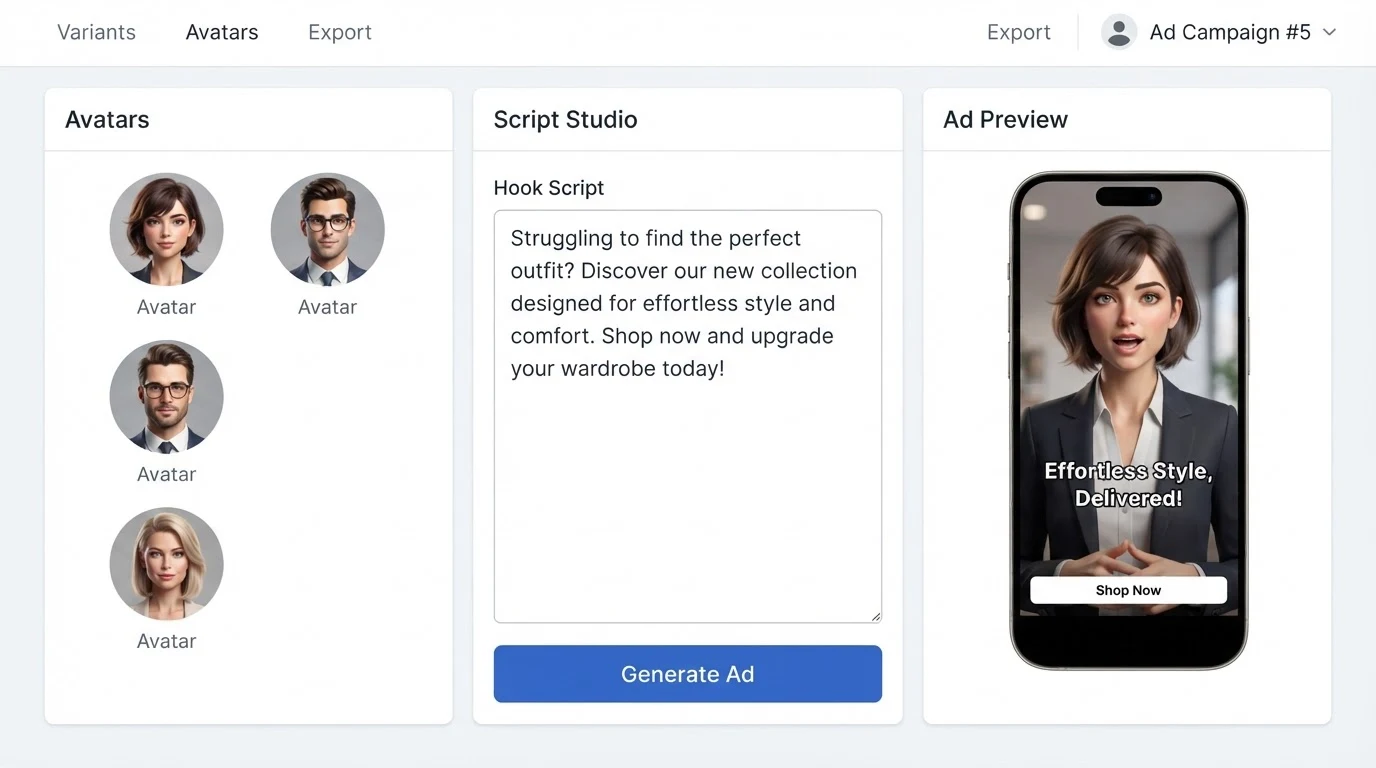
| Script-to-avatar engines | Arcads, HeyGen, Captions AI | High-velocity hook testing with a stable avatar library |
| Product-URL-to-ad engines | Creatify AI, Bandy, AdStellar | Catalogue-wide ad generation for DTC with hundreds of SKUs |
| Raw-UGC enhancers | VEED, Captions eye-contact | Teams that already shoot real UGC and need to polish fast |
| Full-stack generate-and-launch | AdStellar, UGCads.ai, Tagshop | Lean teams that want briefing, generation, and Meta launch in one flow |
The right stack depends on where your bottleneck actually is. If you have a strong creative strategist but no production capacity, a script-to-avatar engine like Arcads clears the queue fastest. If you have a huge catalogue and need variant coverage per SKU, a product-URL engine wins. If your pain is launch logistics, a full-stack platform saves the account manager hours. We help clients choose and wire these together inside our AI social ad creative work rather than defaulting to a single vendor.
The Creative Testing Workflow That Actually Scales
Velocity without a kill framework is just expensive noise. The workflow that holds up at scale looks less like a creative process and more like an experimental protocol. The sequence below is the one we see land consistently on both Meta Advantage+ and TikTok Spark Ads.
- Brief one angle, not one ad. Pick a single value proposition, pain point, or audience insight. Everything downstream is a variant on that angle.
- Write ten hook variants. Mix formats: question hook, stat hook, pattern-interrupt hook, controversial-opinion hook, demo-first hook. The hook is the only thing that matters at the top of the funnel.
- Generate three avatars per hook. Vary demographic, delivery style, and setting. That gives thirty creatives per angle, cheap.
- Launch into one ABO or CBO campaign on Meta, or Spark Ads on TikTok. Hold targeting constant so the creative is the only variable.
- Kill at thresholds, not at hunches. Thumb-stop ratio below 30% at 1,000 impressions, hook rate under 20%, or CTR under 1% after $50 spend. Kill without sentiment.
- Scale winners vertically before horizontally. Raise budget on the winning creative before you clone it into new audiences.
The variant matrix matters because it makes failure legible. If every avatar on hook three underperforms, hook three is the problem. If every hook on avatar two underperforms, avatar two is the problem. Flat creative dumps hide that signal. The same discipline applies when you port the format across platforms: our notes on AI ad creative for Meta and AI ad creative for TikTok cover platform-specific hook conventions in more detail.
Where AI UGC Quietly Fails
The honest version of this playbook includes the categories where AI UGC underperforms. Finance and health creative hit uncanny-valley resistance because the viewer needs to trust the speaker, and a synthetic presenter triggers scepticism exactly when you need confidence. Founder-led brands lose their asymmetric advantage the moment the founder is replaced by an avatar, the whole point was that it was them. Testimonial-heavy categories (coaching, premium services, considered purchases) read as fabricated because, structurally, they are.
Platform policy is the second failure mode. Meta's synthetic-media labelling and TikTok's AI-generated-content label are now enforced on obvious AI avatars, and the label itself depresses CTR in some audiences. The compliance workflow needs to disclose by default and A/B test disclosed-versus-undisclosed only where policy allows. Creative fatigue is the third: AI UGC fatigues faster than human UGC, often inside a million impressions, because the avatar library is finite and audiences pattern-match quickly. The planning solution is a bigger refresh cadence, not better creative.
Measuring Incrementality, Not Just In-Platform ROAS
In-platform ROAS flatters AI UGC because the format drives high click-through from scroll-stopping avatars, and attribution windows credit those clicks generously. The question that matters is incremental revenue, and the measurement stack is standard: Meta Lift studies for brands with enough spend, geo-holdouts (hold out a matched market and compare to a treatment market) for everyone else, and MMM for brands that already have the data pipeline. We lean on geo-holdouts most often because they work at mid-market spend and do not depend on platform-reported numbers.
The outcome that keeps surfacing is that AI UGC is highly incremental at the top of the funnel and much less incremental at the bottom. It is winning net-new attention, not converting warm audiences. That reframes the budget split: AI UGC into prospecting, human creative into retargeting and brand.
When to Bring Back a Human Creator
The hybrid workflow outperforms either pure approach. Use AI UGC to prototype hooks at volume, identify the winning angle and avatar archetype, then brief a real creator to shoot that exact script. The AI phase is market research; the human phase is scale. Three cases should always route to a human creator from day one: bottom-of-funnel retargeting where trust is the gate, founder-led brands where the founder's face is the asset, and testimonial-category products where the viewer needs to believe the speaker had the experience.
The reverse hybrid also works. Shoot one hero piece with a creator, then use AI enhancers for the forty variants, swapping backgrounds, re-cutting hooks, and localising captions. That path preserves the trust signal of a real face while giving the creative team variant velocity. For brands that want to stay close to the creator side, our guide to AI UGC-style content for brands covers the briefing patterns in depth.
A 90-Day Rollout Plan
Standing up this workflow inside an existing performance team usually takes a quarter. The pace below is the one that holds up across the brands we have moved onto AI-led creative without breaking account performance.
- Week 1: shortlist and setup. Pick one script-to-avatar engine and one full-stack platform. Define kill thresholds in writing. Create the hook matrix template.
- Weeks 2 to 4: velocity test. Ship thirty variants per week against a single angle. Hold targeting constant. Log every kill reason.
- Weeks 5 to 8: scale winners. Raise budget on winning creatives, port them cross-platform (Meta to TikTok or vice versa), run the first geo-holdout.
- Weeks 9 to 12: hybridise. Brief real creators to shoot the top three AI-identified angles. Run AI variants against human variants in-market. Set the ongoing refresh cadence.
By day ninety the team has a creative engine, kill thresholds that everyone trusts, an incrementality baseline, and a decision rule for when to bring in a human. That is the output, not the volume of ads shipped.
Frequently Asked Questions
How is an AI UGC-style ad different from a traditional brand video?
Brand video optimises for finish and consistency. AI UGC-style ads optimise for scroll-stop and relevance. The format is vertical, caption-first, imperfect-looking, and designed to be killed and replaced inside a week, not run for a quarter.
Do I need to disclose that an ad uses AI?
Both Meta and TikTok require labelling for synthetic or AI-generated media depicting realistic people. Policies evolve, so check each platform's current rules before launch and default to disclosing when uncertain. For a service-level view, our AI social ad creative page outlines how we handle compliance in client workflows.
Which platform does AI UGC perform better on, Meta or TikTok?
Both work, but the hook conventions differ. TikTok Spark Ads reward native-feeling, trend-aware creative; Meta Reels and Advantage+ reward slightly more polished UGC with clearer value propositions. Build hooks for each platform rather than cross-posting.
How many AI UGC variants should I test per week?
A healthy cadence is twenty to forty variants against a single angle, with kill thresholds enforced at $50 to $100 spend per creative. Below ten variants you are not testing; above fifty you are usually diluting signal.
Does AI UGC replace shooting with real creators?
No, it rebalances the stack. AI UGC is strongest for prospecting, hook discovery, and localisation. Human creators are still the right choice for bottom-of-funnel, founder-led, and testimonial-category work. The highest-performing teams run both.
What is a reasonable thumb-stop ratio to aim for?
Thirty percent is the industry rule of thumb for a passing creative, and strong AI UGC hooks regularly land in the forty to fifty percent range. Below twenty-five percent the creative almost never recovers downstream.
How quickly does AI UGC fatigue?
Faster than human UGC. Expect noticeable fatigue inside one million impressions on a single creative, sometimes sooner on narrow audiences. Plan a weekly refresh cadence rather than monthly.
Can AI UGC work for considered-purchase categories?
Partially. It can run top-of-funnel awareness and problem-aware hooks, but the conversion-driving creative in considered-purchase categories almost always needs a real human to carry trust. Treat AI UGC as the top of a funnel that hands off to human-led bottom-of-funnel work.
Where This Lands
AI UGC-style video is now the base layer of paid social, and the teams winning with it are the ones treating it as a testing protocol rather than a shortcut. The playbook is boring on purpose: brief one angle, generate thirty variants, kill ruthlessly, scale winners, measure incrementally, and hand the bottom of the funnel back to a human. That is how Absolutely AI runs AI social ad creative for performance teams who already know what good looks like and want the velocity to prove it in the auction.