AI Copywriting Agency: What to Expect From Process and Risk
Hiring an AI copywriting agency sits at an awkward edge of the market. The pitch sounds compelling: more copy, more variants, shorter lead times. But very few agencies describe the week-to-week work, where real time savings land, or where you will still be editing. Here is a buyer-side explainer, written from inside the model Absolutely AI already runs for brand clients.

Marketers evaluating an AI copywriting partner usually arrive at a shortlist call with the same gap in their notes: they know the output sounds faster and cheaper, but no one has described the shape of the actual work. This guide covers the engagement, the deliverables, how pricing is typically structured, the red flags that signal a thin AI reseller, and the questions worth asking on a sales call. The team at Absolutely AI ran this breakdown because every discovery conversation starts in the same place.
What an AI copywriting agency actually is
An AI copywriting agency is a creative team that produces written content using generative models as the first-draft engine, paired with human editors, strategists and brand voice specialists who shape, correct and sign off the output. It is not the same thing as a traditional copy shop staffed entirely by human writers, and it is not the same as a solo freelancer running prompts in ChatGPT and billing you for the result.
The reputable version of the model is hybrid. A senior copywriter still owns the brief, the voice, and the final edit. A model does the generative middle. Agencies that have invested properly maintain prompt libraries, brand voice documents, and retrieval systems that feed the model existing brand language so each draft lands closer to the mark. For brands already working with a creative partner, this often sits alongside the broader remit of an AI marketing agency.
The engagement process, week by week
Expect a four to six week ramp before output stabilises. The first week is discovery and voice capture. A good agency will pull your existing copy, interview a founder or marketing lead, and build a voice document that names the tone, cadence, forbidden words, and reference examples. Without this step, the model has nothing to anchor to and every draft reads like default AI prose.
Week two is prompt and style guide construction. The agency builds reusable prompts for each deliverable type, landing pages, emails, ad variants, SEO articles, and tests them against your voice document. Week three begins generation and the first client review. Expect three to five drafts per piece. The first draft is almost never the one that ships; the second or third usually clears the bar.
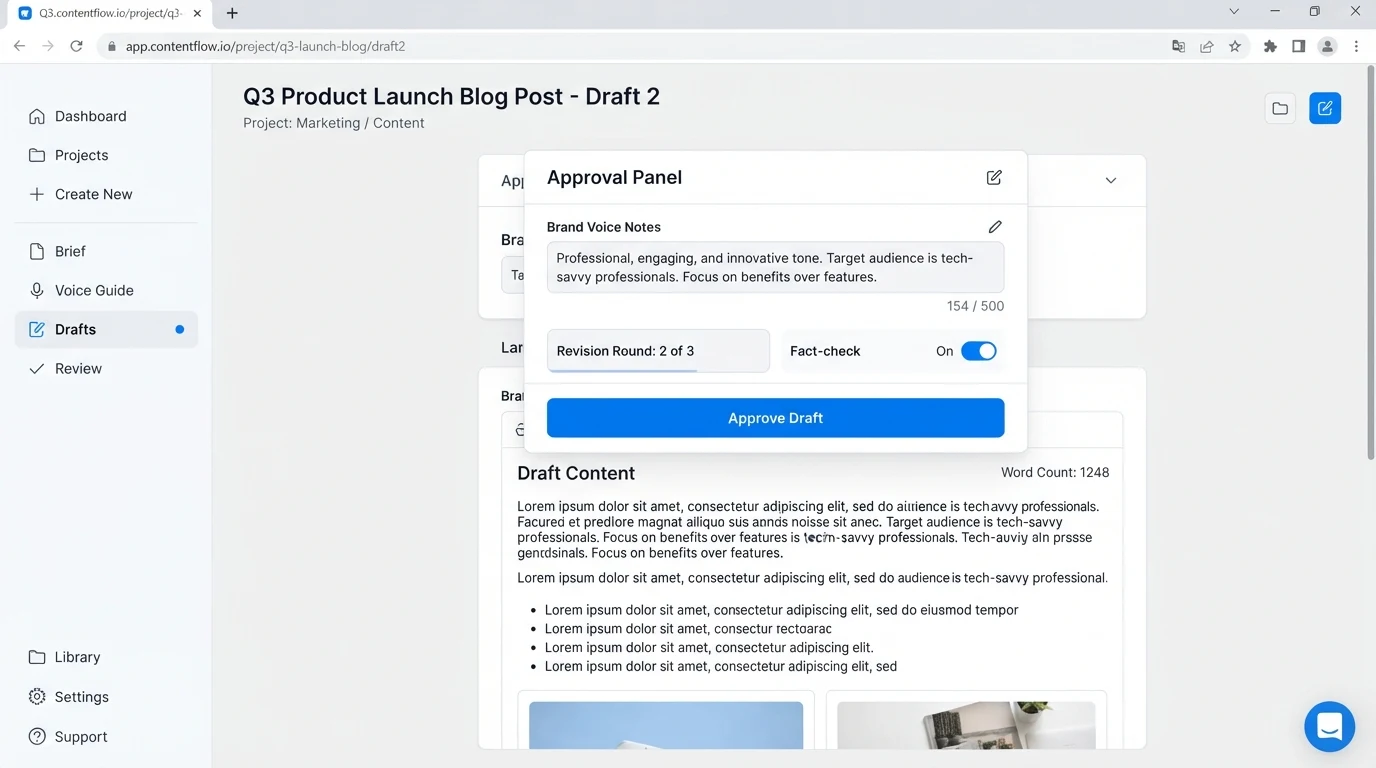
By week four, the loop is tight. The agency generates, edits, fact-checks, and routes for your approval on a repeatable schedule. Content moves out the door at a cadence that would be hard to match with a traditional retainer, provided the brand voice document and prompt library were done well in weeks one and two. For a direct comparison of pace and overhead, see our note on AI content agency versus freelancer.
Deliverables you should expect
A content retainer should name the exact deliverables and their monthly volume. Common deliverables include landing pages, lifecycle email sequences, Meta and Google ad variants, SEO articles with full briefs, product descriptions, social captions, and newsletter copy. Volume depends on the tier, not on the model doing the heavy lifting.

A mid-sized retainer should cover a mix of long and short form, with revision rounds included. Larger retainers add strategy, conversion copywriting for landing page variants, and A/B test ideation. If the proposal does not state unit counts, revision caps, or what triggers scope creep, that ambiguity will become a billing argument later. For paid-social-heavy briefs, see our note on AI content for DTC brands.
What AI genuinely speeds up vs where it adds time back
The marketing pitch tends to oversell the time saving. Generative models do speed up the production of a first draft, especially for high-volume formats like ad variants, meta descriptions, and product copy where the structure is well understood. They are also fast at reformatting the same message for different channels.
Where AI adds time back is on judgment calls. Brand nuance, legal and compliance sign-off, voice calibration, and anything that touches a sensitive customer promise all take as much human time as before, sometimes more because the editor is now checking an output they did not write. Industry reporting on marketers using AI copy tools has repeatedly found that most teams still edit moderately or heavily before publishing. That editing time is where the margin on cheap-sounding AI content quietly disappears.
Quality signals and the AI beige problem
The common failure mode is what practitioners call AI beige: copy that is technically correct, grammatically clean, and completely interchangeable. It is the default voice of an unprompted model, and it kills conversion because it reads like every competitor already saturating the feed.
Good agencies beat AI beige with four interventions. They train the model on a brand's existing voice using retrieval-augmented generation against a corpus of past copy. They maintain a prompt library tuned to the brand, not a generic template. They put a senior human editor on every piece before client review. And they build the brief around a point of view, not a product feature list. Any one of these alone is not enough; the stack is what produces copy that sounds like you and not like the model.
Pricing models to expect
Three structures dominate the market: per-piece, monthly retainer, and performance-based. Per-piece suits brands with sporadic needs or a specific campaign. Monthly retainers suit brands running an always-on content programme where volume is known. Performance-based pricing, tying fees to conversion, traffic, or revenue targets, is less common and usually caps upside for the agency, which means it tends to attract juniors rather than senior editorial talent.
Agency pricing in this space is typically quoted per scope after a brief review, which is standard for work this bespoke. Treat quotes with blanket flat rates with scepticism; copy with a specific brand voice is not a commodity unit. What a proposal should always break out: included revision rounds, strategy and brief work, SEO research if applicable, and the point at which additional pieces trigger an upcharge. For reference points on structuring a brief, see our note on hiring an AI content agency.
Red flags when shortlisting
A shortlist filter saves weeks of discovery conversations. Red flags include no named human editor in the proposal, no fact-check or compliance SOP, no brand voice document in the first two weeks of engagement, unlimited revisions (which almost always signals a low initial quality bar and an exhausting feedback loop), no originality or plagiarism screening on long form, and vague intellectual property terms around who owns the output and whether your inputs train a shared model.
Also watch for agencies that cannot explain their model stack or refuse to disclose which systems process your data. Enterprise buyers are now asking this question routinely, and reputable agencies have a straight answer ready. If a prospective partner cannot describe the data path in plain language on the first call, that is a procurement problem waiting to surface in your legal review.
Ten questions to ask on the sales call
Bring these to every shortlist call. The quality of the answers will separate serious partners from thin AI resellers quickly, and most can be answered in under a minute by an agency that actually runs the model it is selling.
- Who is the human editor on my account and what is their background?
- How do you capture and maintain our brand voice?
- How many revision rounds are included and what triggers an additional charge?
- Do you run originality or plagiarism checks on long-form content?
- Which models do you use and does our content or input data train any shared system?
- Who owns the output copy, in what format, and when?
- What is the kill fee if we end the engagement mid-cycle?
- How often do you report, and on what metrics?
- What is your scale ceiling before quality drops?
- Can you show me three before-and-after drafts so I can see the editor's hand?
Is an AI copywriting agency right for you?
The decision usually comes down to three variables: content volume, brand sensitivity, and in-house capacity. Brands running high volume with moderate brand sensitivity, performance ads, product descriptions, SEO articles at scale, see the strongest fit. Brands with highly sensitive voice requirements and low volume (luxury positioning, regulated finance, healthcare) may be better served by a traditional human copywriter supported by AI tools in-house.
The middle case, a growing brand with mixed volume and no dedicated in-house writer, is usually where an AI copywriting agency wins. You get senior editorial oversight without hiring a full creative team, and the production cadence lifts without ballooning headcount. If that profile sounds like you, a short audit of your current content is the fastest way to pressure-test whether a partnership makes sense. The team at contact us can walk you through a scoped review.
Frequently Asked Questions
How is an AI copywriting agency different from a traditional copy agency?
The core difference is the production stack. Traditional agencies draft entirely by hand; AI agencies draft with models and edit by hand. The strategy, voice capture, and final edit still require a senior human. The volume ceiling is higher and per-piece production is faster, but the editorial judgment is the same.
Will AI-written copy hurt our SEO?
Google's guidance is that content quality is judged on usefulness and originality, not on how it was produced. Thin, generic AI copy performs badly; well-briefed, well-edited AI-assisted copy with original research performs comparably to its all-human equivalent. The failure mode is the content, not the tool.
Who owns the copy an AI agency produces?
In a well-written contract, you do, on delivery or on invoice payment. Ask explicitly. If the proposal is vague on ownership, or ties ownership to a subscription staying active, treat that as a red flag.
How much editing should I expect to do on my end?
Light touch-ups on an experienced agency's output. If you are rewriting every second sentence, the brand voice capture was done badly or the editor at the agency is not senior enough. This is a repair conversation, not a workflow you accept.
Can an AI agency match a specific brand voice?
Yes, if they invest in the voice document and the prompt library. The agencies that cannot match voice are the ones running generic templates against every client. Ask to see examples from brands with distinctive voices in their portfolio.
What is a realistic turnaround on a landing page?
Faster than a traditional retainer, slower than an impulse prompt. The first draft lands quickly; the ship-ready version comes after voice calibration and review rounds. Agencies that promise same-session landing pages are selling you a first draft, not a finished one.
Do AI agencies work with regulated industries?
Some do. Expect a slower engagement, a mandatory legal review step on every piece, and a narrower set of permitted claims. If the agency has no compliance SOP, they are not the right partner for regulated work.
How do I compare agencies on an apples-to-apples basis?
Hand the same brief to each shortlist agency and ask for a sample draft. The difference in output will tell you more in a day than six discovery calls. A good agency will accept a paid sample brief rather than hiding behind a polished pitch deck.
Closing thought
An AI copywriting agency works when the process is clear and the human stack behind the model is visible, and fails when either is hidden. The brands getting the strongest results are treating these partnerships like any other serious creative hire: tight brief, named editor, specified deliverables, clear ownership. If you want to pressure-test a shortlist or compare it against the model Absolutely AI uses on its own briefs, start with a scoped audit rather than a blank-slate pitch meeting.