AI Ad Creative for TikTok: The 2026 Practitioner's Guide
TikTok ads burn out two to three times faster than Meta ads, which means the winning brands are shipping more creative every week, not fewer. AI ad creative is how they keep pace without losing the native, un-polished feel the algorithm rewards. At Absolutely AI we build these testing engines for brands, and this guide walks through the tools, workflow, prompts and compliance rules that actually move CTR in 2026.

TikTok's creative fatigue window is roughly three days. Meta will happily run the same static for three weeks before performance craters, but TikTok's algorithm punishes repetition inside a working week. The brands winning on the platform in 2026 are not the ones with the biggest production budgets, they are the ones shipping fifteen to thirty new variants a week. Scaling ad creative with AI is the only economically sane way to feed that volume without collapsing into template soup.
Why TikTok Punishes 'Ad-Shaped' Ads
The core aesthetic on TikTok is still UGC: shot on phone, sound-on by default, face to camera, hook landed inside the first second. Anything that looks like a traditional TV spot, or worse a repurposed Instagram Reel with bars top and bottom, gets suppressed before it reaches enough people to matter. The platform's ranking model reads polish as an ad signal, and ad signals depress organic amplification.
The one-second hook rule is not marketing folklore, it is measurable in the hold-rate curve. TikTok's own Creative Center data shows retention drops of forty to sixty percent between second one and second three on ads that open with a logo, a product beauty shot, or a slow zoom. Ads that open with a face, a question, or a pattern-interrupt hold two to three times longer. That is the bar, and it is why vertical video built for the feed matters more than production value.
Creative fatigue compounds the problem. A hook that worked on Monday will be shown to overlapping audience segments by Wednesday, and by Thursday your CPM has doubled. The response is not better creative, it is more creative. Volume with taste is the operating model, and AI is how mid-sized brands compete with the in-house studios that used to be the only ones who could sustain it.
What 'AI Ad Creative' Actually Means on TikTok in 2026
The category is a mess of overlapping tools, so it helps to split it into four functional flavours. Understanding which flavour a tool belongs to tells you what job it does and what it cannot do.
- AI avatars and synthetic UGC actors. Creatify and Arcads sit here. You write a script, pick a face from a library of licensed avatars, and the tool renders a face-to-camera read in seconds. Best for volume testing of hook variants where the message matters more than the messenger.
- Product-to-video URL-to-ad tools. Zeely and Pencil crawl a product page, pull imagery and copy, and assemble a rough 9:16 ad. Useful as a first draft or a placeholder while you brief better creative.
- Script and b-roll assemblers. Lapis and AdCreative.ai take a brief and stitch together stock footage, on-screen text and licensed music. Fast, but the ceiling is low and outputs skew generic.
- TikTok's native Symphony suite. Generate with AI inside Ads Manager, plus the standalone Symphony Creative Studio, handle script writing, avatar rendering and creative refresh directly against your Business Account. Free tier is generous, and everything is pre-cleared for the AIGC label.
None of these tools replaces a creative director. What they replace is the middle layer of production, the part where a brief becomes fifteen rough cuts. Once you accept that framing, the workflow starts to make sense. Our social ad creative studio uses a stack that touches three of these four flavours per campaign.
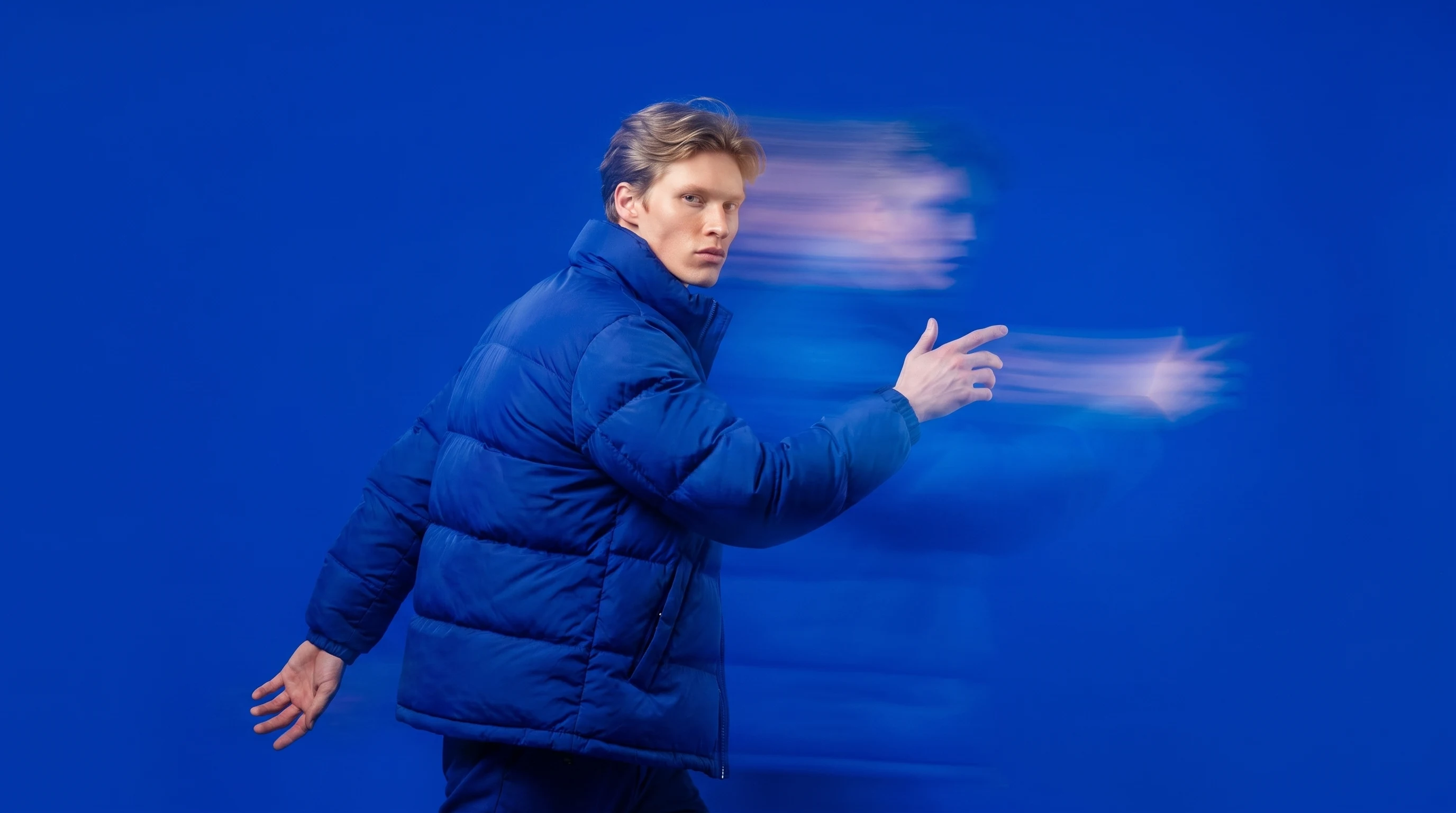
The AI TikTok Ad Workflow, End to End
The mistake most brands make is treating AI as a one-shot generator. Prompt, output, post. The teams pulling three-to-five ROAS on TikTok run a repeatable weekly loop that looks closer to a factory line than a creative session.
- Brief. One page, one product, one audience, one desired action. Include three competitor ads that are currently working and one line on what the offer is.
- Hook ideation. Generate twenty hook variants against the brief. Not five. Twenty. Most will be dead on arrival and that is the point.
- Script. Trim to the five to eight strongest hooks and write a fifteen to twenty second script for each. Native cadence, one idea per script.
- Render. Push scripts through avatar tools or brief a real creator. Mix synthetic and human in the same test where possible.
- Captions and sound. Auto-caption in CapCut, layer a trending or evergreen commercial sound, cut to under twenty-two seconds.
- Export and label. 9:16, sound-on, AIGC toggle on if any avatar or generative footage is used.
- Ship, measure, kill. Launch as an ad group of five to ten variants, read the hook-rate and hold-rate after two days, kill the bottom half, iterate the top.
Run that loop weekly and you build a creative library of one hundred to two hundred variants per quarter, with real performance data attached to every hook shape. That data compounds. By month three you are not guessing which openers work for your category, you know. This is the muscle we build inside client teams during AI content consulting engagements.
Eight Tools Worth Testing in 2026
The tool market moves fast, but the following eight have earned their place in a serious TikTok creative stack this year. Read this as a shortlist to test, not a leaderboard. Pricing is described qualitatively because the tiers shift constantly.
| Tool | Best for | Weakness | Pricing model |
|---|---|---|---|
| TikTok Symphony | Native workflow, AIGC-compliant by default | Avatar library still narrow | Free tier inside Ads Manager |
| Creatify | Fast avatar UGC at volume | Lip-sync drift on longer scripts | Subscription, per-render caps |
| Arcads | Most natural avatar delivery on market | Higher cost per render | Subscription tiers |
| Pencil | URL-to-ad first drafts | Output feels templated | Subscription |
| Lapis | Script plus b-roll assembly | Stock-heavy aesthetic | Subscription |
| AdMove | Animating static product photography into 9:16 | Limited motion vocabulary | Credit-based |
| Zeely | Ecommerce speed drafts | Shopify-shaped, weak elsewhere | Subscription |
| AdCreative.ai | Volume static and short-form drafts | Weakest on native TikTok feel | Subscription tiers |
If you are choosing between synthetic UGC and hiring creators, the honest answer is both. We covered the trade-off in more depth in our piece on AI UGC style content for brands. Synthetic wins on speed and variant volume, human creators win on trend velocity and cultural specificity.
Hooks, Formats and Prompts That Actually Convert
The format is doing most of the work. A generic script inside a proven format will out-perform a clever script inside a tired one. These are the five hook shapes we see winning most consistently across categories in 2026, with prompt templates you can lift straight into an avatar tool or an LLM.
Problem-agitate
Opens on a specific pain, twists the knife for six seconds, resolves with the product. Prompt template: Write a fifteen-second TikTok script in first person. Open with the sentence 'If you [specific pain], stop scrolling.' Agitate the pain with two concrete examples. Introduce [product] as the fix. End with a soft CTA.
POV
Framed as 'POV: you just discovered...' or 'POV: your [role] finally...'. Feels native because the format is native. Prompt template: Write a POV-style TikTok script from the perspective of a [target persona] who just tried [product] for the first time. Open with 'POV:' and a specific scenario. Keep it under twenty seconds, sound-on, one idea only.
Listicle
'Three things I wish I knew before...' or 'Five reasons [category] is [claim]'. Works because it promises a payoff structure the viewer can count down to.
Seven-day experiment
'I tried [product] for seven days, here is what happened.' Retention hook is baked in because the viewer wants the result. Best for products with a visible outcome.
Side-by-side comparison
Split-screen or before-after. Works exceptionally well for beauty, home, and DTC categories where the transformation is visible in-frame.
Rotate through all five formats inside the same weekly test. If one hook shape dominates for four weeks running, you have found your category's native format, and you should be running two-to-one variants of it against the rest.
Testing at Volume Without Killing Brand
The reason most brands avoid high-volume creative testing is a reasonable fear of brand drift. If you ship thirty variants a week, at least a few will land off-tone. The answer is a creative matrix with locked brand rails and free variables.
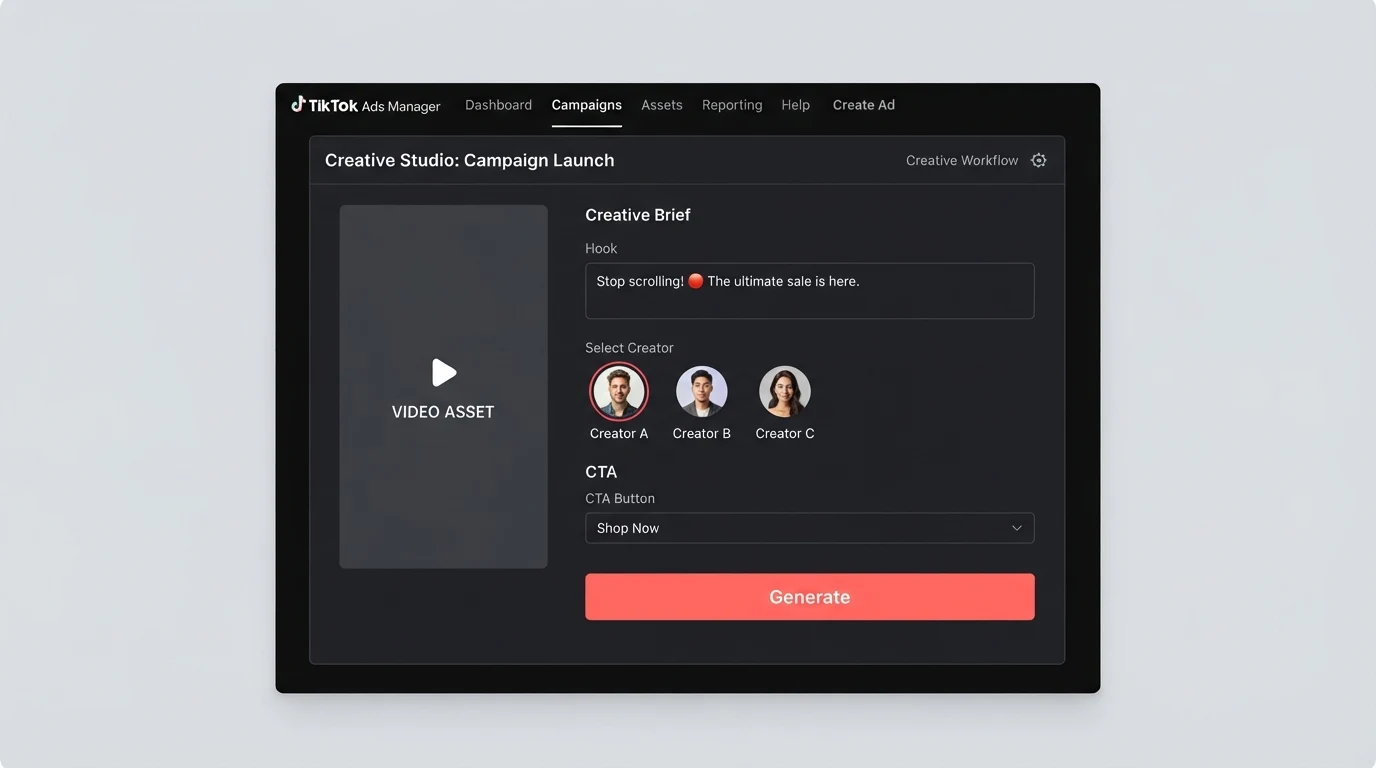
A standard matrix looks like five hooks by three avatars by two CTAs, which produces thirty combinations from a single briefing round. Lock the brand rails, colour, logo placement, voice-of-brand phrases, tagline, then let the variables run. Read hook rate at three seconds and hold rate at fifteen after forty-eight hours, kill the bottom half, and re-shoot the top half with tighter variations. We explore this loop in more depth in our companion piece on testing ad creative at scale.
The signals worth watching on TikTok Ads Manager are hook rate (video views at three seconds divided by impressions), hold rate (six-second views over impressions), and CTR. Cost per acquisition lags too much to be a creative-level metric inside a three-day fatigue window. Kill on hook rate, scale on CTR, ignore CPA until the account level.
Compliance, Disclosure and the AIGC Label
TikTok's synthetic-media policy tightened in 2025 and is now enforced by machine review on upload. Any ad that features an AI avatar, an AI voice, or generative b-roll must have the AIGC content label toggled on. Failure to disclose does not just risk removal, it degrades reach on the ads that survive because the classifier flags them as low-trust.
The practical rules are straightforward. If any human likeness in the ad was generated or heavily altered by AI, label it. If a real creator is on camera and only the b-roll is AI, label it. If AI wrote the script but a real person performed it, you do not need the label. When in doubt, label. The reach penalty for labelling honestly is smaller than the penalty for getting caught not labelling.
Avatar likeness is the other live risk. Reputable tools (Arcads, Creatify, TikTok Symphony) license their avatars with commercial-use rights. Cheaper tools sometimes do not, and using an unlicensed likeness in a paid ad is a fast route to a takedown and a legal letter. Verify the licence chain before you scale spend behind any avatar.
Where AI Still Fails, and a Human Is Cheaper
Three places AI creative still loses to a real creator in 2026. Cultural nuance and slang that shifts weekly. Humour that depends on timing, self-awareness, or the specific delivery of a specific person. And live trends, where the audio, the meme format and the visual reference all need to be current inside a seventy-two hour window.
The decision framework we use with clients is simple. AI for volume, iteration, and evergreen. Human creators for the tentpole hero, the trend-jack, and anything that needs to feel of-the-moment. A healthy TikTok account runs both, roughly seventy percent AI-assisted for testing volume, thirty percent human creator for the hero content that carries the brand voice.
Frequently Asked Questions
How many AI ad variants should I ship per week on TikTok?
For a brand spending two to twenty thousand a week on TikTok Ads, target fifteen to thirty new variants weekly. Below fifteen, you cannot outpace creative fatigue. Above thirty, you cannot read the data cleanly.
Do AI avatars perform worse than real creators on TikTok?
On average, slightly. The gap has narrowed to roughly ten to twenty percent on hook rate in 2026, and disappears entirely on hold rate once the viewer is in. The volume advantage of AI usually outweighs the per-ad performance gap.
Will TikTok penalise ads that use the AIGC label?
No. The label itself does not reduce reach. Undisclosed synthetic media does, and the classifier is accurate enough that hiding it is a losing bet. Label honestly and focus on creative quality.
What is the cheapest AI stack to start with?
TikTok Symphony inside Ads Manager, CapCut for editing and captions, and one paid avatar tool such as Creatify. That combination will get most brands to a testable weekly loop under two hundred a month in tool cost.
Can I use AI creative inside Spark Ads?
Yes, provided the original organic post is compliant with the AIGC label and the creator (or your Business Account) authorises the Spark code. AI content flows through Spark Ads exactly like human content once labelled correctly.
How long before an AI TikTok ad hits creative fatigue?
Three to five days at meaningful spend. The fatigue curve is a function of frequency inside the target audience, not of the ad's origin. Synthetic and human creative fatigue at roughly the same rate.
Should I brief the AI or write the script myself?
Brief the AI for volume ideation on hooks and openers, then re-write the winning scripts by hand. The mid-workflow rewrite is where brand voice gets protected and where the difference between generic and specific gets made.
How does AI TikTok creative compare to AI creative for Meta?
Different formats, different fatigue windows, and different aesthetic ceilings. We covered the platform-level differences in our piece on AI ad creative for Meta.
Where to Take This Next
AI ad creative on TikTok is not a tool problem, it is a workflow problem. The brands winning have built a weekly loop, a matrix, a labelling discipline, and a clear split between what AI handles and what a real creator handles. Everything else is downstream of that. If you are ready to build the loop rather than just test the tools, Absolutely AI builds and runs TikTok creative engines for brands that need to ship at platform speed without losing the taste that makes the work worth watching.