How to Scale Ad Creative With AI: A 2026 Playbook
Meta's Andromeda and TikTok's Symphony have quietly moved the entire performance lever off targeting and onto creative volume. Scaling ad creative with AI in 2026 is not a prompt trick, it's a production system. This guide from Absolutely AI walks through the angle discovery, batch generation, testing structure, and iteration loop that actually feeds those algorithms at $10k, $100k, and $1M monthly spend.
Targeting is a solved problem. In 2026, Meta's Advantage+ Shopping Campaigns and the Andromeda ranking system, alongside TikTok's Symphony suite, decide who sees your ad better than any media buyer can. What they cannot decide is what the ad looks like, and that is why scaling ad creative with AI has become the defining performance skill of the year. The teams winning right now, including the studios we build alongside at Absolutely AI, are not generating more images. They are running a disciplined loop.
That loop has four moving parts: mine angles from your winners, batch generate variants against brand references, test with structure that survives volume, and iterate the winners on a fixed rotation. Miss any one and you get either brand drift or a graveyard of untested assets. This piece breaks down each stage with real cadence numbers, kill rules, and the automation layer that ties it together.
Why Creative Is the Last Controllable Variable
Andromeda, Meta's deep-learning ranking model rolled out through 2025, evaluates thousands of creative signals per impression and rewards diversity at the ad-set level. Advantage+ campaigns then auto-allocate spend to whichever variant is winning that hour. The practical consequence is that a single hero ad, no matter how good, decays inside two weeks. TikTok's Symphony works the same way, favouring accounts that ship native, high-variance creative on a weekly cadence. For an inside look at how this shift is reshaping ad creative production, the fatigue curves are steeper than most brands realise.
The math follows the spend tier. At $10k per month, four to six fresh Meta variants per week is enough to stay ahead of fatigue. At $100k, you need 25 to 50 new variants weekly plus 10 to 20 TikTok-native cuts every 7 to 14 days. At $1M and up, the number climbs past 100 weekly and creative becomes a full production line. No human team writes, shoots, and edits that volume without AI in the pipeline.
| Monthly ad spend | Meta variants / week | TikTok variants / 14 days | Angles in rotation |
|---|---|---|---|
| $10k | 4 to 6 | 3 to 5 | 3 to 4 |
| $100k | 25 to 50 | 10 to 20 | 8 to 12 |
| $1M+ | 100+ | 40+ | 20+ |
The Four Pillars of an AI Creative Scale System
Before we get into tooling, understand the shape. Pillar one is angle discovery, the qualitative work of decomposing what already sells. Pillar two is batch generation, the AI-heavy step where you turn each angle into 10 to 40 executions. Pillar three is a testing structure that keeps signal readable when you ship at volume. Pillar four is winner iteration, the ruthless remix loop that compounds ROAS over quarters. Skipping angle discovery is the most common failure and the reason most AI creative pipelines plateau after month two.

Step 1: Mine Winners for Angles
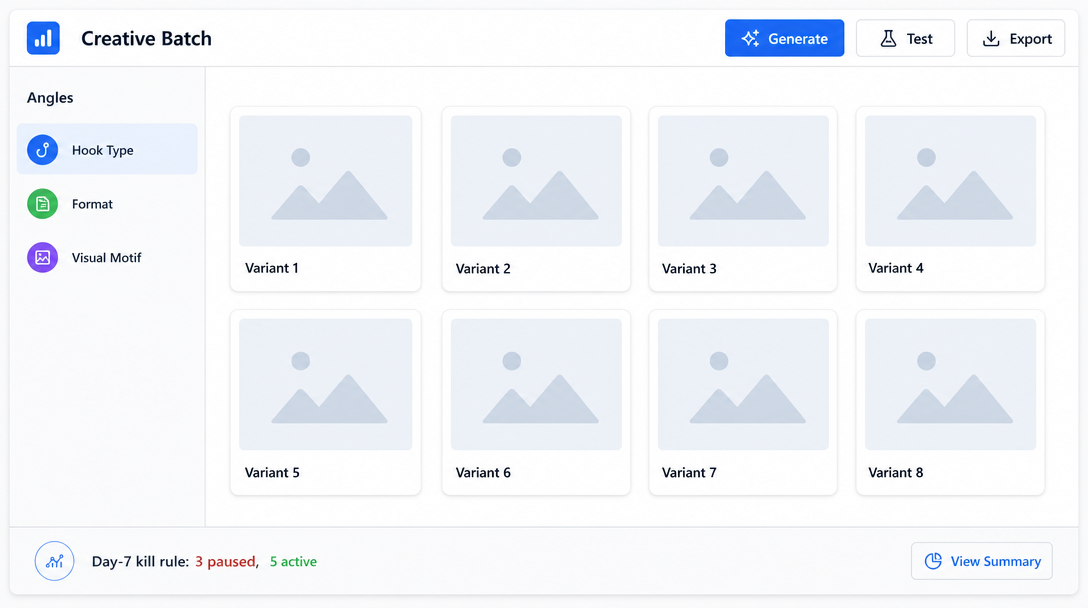
Pull your top 10 ads by ROAS over the last 90 days from Meta Ads Manager and TikTok Ads Manager. For each one, decompose it into four attributes: hook type (statistic, question, pattern-interrupt, testimonial), format (static, carousel, UGC-style video, motion graphic), copy angle (problem-solution, social proof, transformation, aspirational identity), and visual motif (product-in-hand, lifestyle scene, before-after, abstract product world). Log these into an angle library, a simple spreadsheet with one row per attribute combination that has proven to work.
This library becomes the input to everything downstream. If "question hook + UGC vertical + problem-solution copy + kitchen setting" is your best-performing combo, you now know to generate 15 variants against that exact scaffold rather than starting from a blank prompt. Teams working on AI UGC-style content should keep a separate angle library per placement, because what wins on Reels rarely wins on Shorts.
Step 2: Batch Generate With AI
Batch generation is where most brands mistake tool choice for strategy. The stack matters less than the discipline. For static and stylised imagery, Midjourney and GPT Image 2 dominate. For motion, Runway Gen-4 and Sora handle short-form cinematic cuts, while ElevenLabs generates voiceover at UGC-level naturalism. Workflow tools like Wireflow, n8n, and Make chain these together into a single pipeline. Our own commercial production workflow uses a similar stack under the hood.
The critical habit is prompt scaffolding anchored to brand references. Never send a bare prompt. Every generation call takes three inputs: the angle spec from your library, a locked style reference image (or a written style guide fragment), and a variant instruction ("generate 4 executions: 2 anchored to reference, 2 in an alternate world"). This 4-grid exploration pattern gives you controlled diversity, which is exactly what Andromeda rewards. For product-heavy brands, this is the same discipline outlined in our breakdown of how AI product photography works at scale.
To prevent brand drift at 50-plus weekly variants, lock three things across every generation: colour palette (as hex values in the prompt), one recurring visual motif (a lighting style, a prop, a framing rule), and a typography system applied in a post-generation compositing step rather than inside the image. This separation is what lets a consistent brand system survive high-volume creative.
Step 3: Testing Structure That Survives Volume
Shipping 50 variants a week is worthless if you cannot read the results. The structure that works is one-ad-set-per-angle, CBO enabled, with a starting budget of $15 per day per ad set. Every ad inside the set follows a strict naming convention: angle_hookType_format_variant_v1. This lets you filter reports by any attribute and see which variable is actually driving lift.
Kill rules matter more than launch rules. Cut any ad after day 7 if it has under 1000 impressions and CTR below 0.8 percent, or if CPA is more than 2x your account average with statistical significance (roughly 30-plus conversions). Duplicate and scale any ad that hits 1.5x account-average ROAS with at least 50 conversions. These thresholds are what separate a systemised creative operation from a spray-and-pray one.
Step 4: Iterate Winners on a 14-Day Rotation
Every 14 days, pull your top three ads and remix them along one axis at a time. Swap the hook while holding format and visual constant. Port the winning static into a 6-second Reel. Take the best Reel and cut it to 9:16 TikTok-native with a different opening frame. This is where AI compounds. A single winning angle can spawn 30 to 40 profitable descendants over a quarter, and the cost of generating each descendant is minutes rather than days.
Platform-native matters here. Meta Reels rewards fast cuts and on-screen text in the first 0.5 seconds. TikTok rewards a slower, more conversational hook and a face on camera within the first 2 seconds. YouTube Shorts rewards vertical framing with a mid-frame focal point that survives the UI overlay. Do not export one master and crop. Generate placement-specific variants from the same angle spec, a discipline covered in our AI video production workflows.
Automating the Loop With APIs and MCP
Most posts stop at "use ChatGPT to write your copy". The real leverage is a ship-to-Meta pipeline. The pattern we run for clients through creative consulting engagements uses n8n or Make as the orchestrator, calling the Wireflow API (or a Midjourney/Runway equivalent) for generation, pushing outputs to R2 or S3 for hosting, and using the Meta Marketing API to auto-upload creative into named ad sets with the naming convention already applied.
An MCP layer sits on top so a creative director can prompt "generate 20 variants of angle 7 for the winter launch" in natural language and have the entire pipeline execute. This is not future-tense. It is running in production at several DTC brands right now, and it is what makes 100-variants-per-week economically sane for the team behind it.
Common Failure Modes
- Prompt sameness. Ten variants that all use the same base prompt with adjective swaps read as one ad to Andromeda. Vary hook, format, and motif together, not just adjectives.
- Brand drift. Solved by locking palette, motif, and typography as described above. Audit every batch against a reference sheet before shipping.
- Over-generation without testing discipline. Shipping 200 variants into three unnamed ad sets tells you nothing. Ship 40 with structure instead.
- Ignoring platform-native formats. Cropped horizontals on TikTok tank hook rate. Generate per placement.
- No kill discipline. Losing ads left running cannibalise budget from winners inside Advantage+. Kill weekly.
A 30-Day Rollout Plan
- Days 1 to 5: Audit top 10 ads, build angle library, lock brand reference sheet.
- Days 6 to 12: Stand up generation stack (pick one image tool, one video tool, one orchestrator). Generate first batch of 20 variants across four angles.
- Days 13 to 20: Launch structured tests with naming convention and $15/day CBO ad sets. Monitor daily, kill on day 7.
- Days 21 to 30: Identify first winners, remix on the 14-day rotation, begin building the automated ship-to-Meta pipeline.
Realistic benchmarks after 90 days of running this loop, drawn from client work in the AI video and creative space: CPA down 20 to 40 percent, CTR up 30 to 60 percent, and variants shipped per week up 5 to 10x versus the prior baseline.
Frequently Asked Questions
How many ad variants do I actually need per week?
At $10k monthly spend, 4 to 6 fresh Meta variants weekly. At $100k, 25 to 50 plus 10 to 20 TikTok cuts every 14 days. At $1M+, 100+ weekly. These are floors, not ceilings, and they scale with placement diversity.
Which AI tools are best for ad creative in 2026?
For imagery, Midjourney and GPT Image 2. For motion, Runway Gen-4 and Sora. For voice, ElevenLabs. For orchestration, Wireflow, n8n, or Make. The stack matters less than the discipline around angle libraries and testing.
How do I keep brand consistency across 50+ variants a week?
Lock three things in every prompt: hex-coded colour palette, a recurring visual motif (lighting or framing rule), and a style reference image. Apply typography in a post-generation compositing step rather than baking it into the AI output.
When should I kill an underperforming ad?
Day 7 if impressions are under 1000 and CTR under 0.8 percent, or if CPA is more than 2x account average with 30+ conversions of data. Duplicate and scale ads hitting 1.5x average ROAS with 50+ conversions.
Does Advantage+ still need creative diversity if it auto-optimises?
Yes, more than ever. Andromeda's ranking model rewards ad sets with high creative variance because it gives the algorithm more signal to allocate against. Feeding it one hero ad starves the model.
Can AI creative match the performance of traditional UGC?
For mid-funnel awareness and consideration placements, yes, and often at 10x the volume. For deep-funnel trust-building, blended pipelines (AI hooks and cutdowns with real founder or customer footage) still win.
How do I automate the pipeline end-to-end?
Chain generation tools via n8n or Make, push outputs to cloud storage, and use the Meta Marketing API to auto-upload into pre-named ad sets. An MCP layer on top lets a creative director trigger batches in natural language.
Where does human creative direction still matter?
Angle discovery, brand reference locking, kill decisions, and iteration selection. AI executes; humans decide what to execute. Skipping the human layer is what produces generic, indistinguishable batches.
Scaling ad creative with AI in 2026 is a production system, not a prompt. Build the angle library, lock the brand references, ship with a naming convention, kill on schedule, and iterate winners every 14 days. The teams doing this are pulling CPA down and volume up in the same quarter, and the gap between them and everyone still hand-crafting one hero ad a week is widening every month. If you want a partner to stand up the loop end-to-end, from angle audit through automated ship-to-Meta pipeline, Absolutely AI runs this workflow in production for performance brands across Australia and beyond.