AI UGC-Style Content for Brands: A Playbook That Converts
AI UGC is having its moment, but most brands are burning budget on uncanny avatars that get scrolled past in two seconds. At Absolutely AI we treat AI UGC as a paid-media asset, not a content novelty, and the difference between a hook-rate of 8% and 32% comes down to briefing, casting, and edit discipline. Here is the honest playbook.

Every brand marketer we speak to in 2026 is asking the same question: can AI UGC replace the $250-a-post creator roster, and if so, how do we brief it without ending up with a robotic avatar that Meta down-ranks? The short answer is yes for specific formats, no for others, and the winners are treating it as a testable content system rather than a magic button. This piece walks through the exact workflow we use with clients on our AI content creation engagements.
What AI UGC-Style Content Actually Means
AI UGC-style content is short-form video, usually vertical 9:16, built around an AI-generated or AI-lipsynced presenter that mimics the raw, phone-shot aesthetic of real creator content. It sits between three things it is not: real creator UGC (a human posting on their own account), polished brand video (studio-lit, scripted, on-message), and pure AI film (fully generated worlds). The whole point is that it looks like a person in their kitchen holding your product, and that visual grammar is what earns the algorithmic reach on TikTok and Reels. For a longer view on where generative video sits in the wider stack, our team's notes on AI film production cover the adjacent workflows.
Why Brands Are Moving on It Now
The unit economics are the headline. A single creator brief with usage rights typically runs $150 to $300 per asset in Australia, plus two to three weeks of coordination. AI UGC lands the equivalent asset in hours at a fraction of the per-variant cost, which means testing 20 hooks against one product becomes financially rational for the first time. Industry benchmarks put UGC-style creative at roughly 4x the click-through rate of polished branded ads and around a 29% lift in conversion, and those numbers hold up when the AI version is edited well. The catch is that badly executed AI UGC underperforms even bad human UGC, so the savings only bank if the craft is there.

Where It Works and Where It Flops
Format selection is where most brands go wrong on their first attempt. AI UGC has a clear zone of competence and a clear zone of failure, and the difference is whether the format requires physical product handling or high emotional register.
| Format | AI UGC Fit | Why |
|---|---|---|
| Vertical talking-head review | Strong | Static frame, avatar handles it, script does the work |
| Problem-solution hook | Strong | Short, punchy, no product manipulation needed |
| Unboxing | Medium | Works with cut-in B-roll of real product, avatar reacts |
| Before/after | Medium | Fine for hair, skin, ambient results; poor for physical demo |
| High-emotion testimonial | Weak | Uncanny valley kills the trust that testimonials trade on |
| Product demonstration | Weak | Hands, angles, and real interaction are still tell-tales |
| Long narrative | Weak | Avatar micro-expressions fatigue past 15 seconds |
The rule we give clients: if the format's persuasion comes from what the presenter says, AI UGC works. If it comes from what the presenter does with the product, book a real creator or shoot it properly. Our AI commercial production team runs this triage on every brief before a render kicks off.
The Production Stack
There is no single tool that does this end-to-end well. The stack we run in production has four layers, and the value is in how they hand off to each other rather than any one platform.
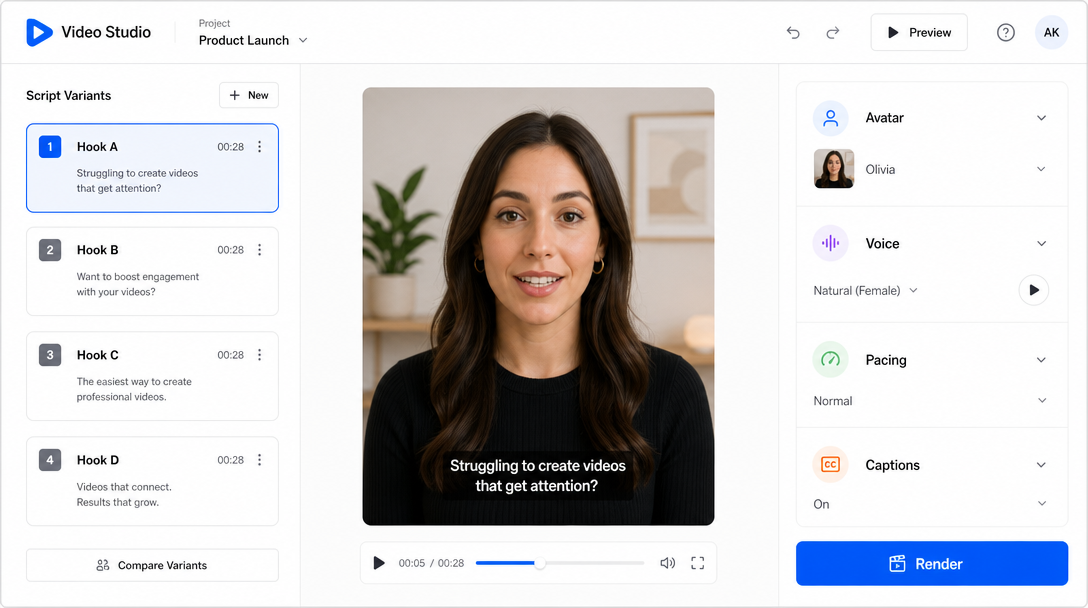
- Avatar and lipsync layer: HeyGen for polished corporate-leaning avatars, Hedra for more natural micro-expressions, Arcads for creator-library breadth with built-in ad templates.
- Voice layer: ElevenLabs for voice cloning and emotion tuning, with careful attention to pacing because default TTS reads too fast for authentic UGC cadence.
- Script and hook engine: a hook bank of 30 to 50 opening lines per product, split-tested weekly, feeding into structured script variants (hook, problem, product, proof, CTA).
- Edit and caption layer: a human editor in CapCut or Premiere adds B-roll cutaways, imperfect handheld reframes, ambient room tone, burned-in captions, and the platform-native caption style that signals authenticity.
Skipping the human edit layer is the single biggest reason AI UGC fails. The render is 70% of the way there; the last 30% is where it either passes as UGC or gets clocked in two seconds. Brands running this in-house often underestimate this step, which is why our AI consulting engagements usually start with a workflow audit.
A Brief-to-Post Workflow You Can Actually Run
Here is the sequence we use on client accounts. It is deliberately paid-media shaped because AI UGC only makes sense if you are testing variants at volume.
- Write a hook bank of 30 to 50 openings tied to the top three customer pain points.
- Draft 10 script variants combining the strongest hooks with a consistent problem-product-proof-CTA structure.
- Cast three to five avatars across age, gender, and vibe, matched to the audience segment.
- Select ElevenLabs voices and set pacing 10 to 15% slower than default for UGC cadence.
- Render at 9:16, 1080x1920, keeping shots to 8 to 12 seconds max per avatar clip.
- Hand to a human editor for B-roll insertion, real product cutaways, captions and audio polish.
- Ship 8 to 12 variants per week into Meta Advantage+ and TikTok, tagged for hook, avatar and script.
- Kill anything below a 25% 3-second view rate after $200 spend; scale winners.
Getting Past the Uncanny Valley
Uncanny valley is a solvable problem, but only if you stop trying to hide it and instead lean into the imperfections that real UGC has. The tricks that work: cast avatars in the mid-tier of realism rather than the hyperreal top tier (perfect skin reads as fake faster than pleasant-average skin), slow voice pacing until it breathes, add faint ambient audio like a fridge hum or distant traffic, reframe the render slightly off-centre with a subtle handheld wobble, and cut on motion every 3 to 5 seconds so no single avatar shot lingers long enough to trigger the tell.
Disclosure, Platform Policy and Brand Safety
This is the section competitors mostly skip, and it is where brands get burned. Meta requires AI-generated or significantly AI-edited content depicting people to carry an AI-content label under their 2024 policy, enforced more strictly through 2025. TikTok's AIGC label is mandatory for realistic AI-generated content and its algorithm actively down-ranks unlabelled synthetic media it detects. The FTC endorsement guides in the US, and the ACCC's parallel guidance in Australia, treat any implication that a real person is endorsing your product when they are not as misleading conduct, and that applies squarely to AI avatars styled as customer testimonials.
What this means in practice: label the content, avoid framing AI avatars as named customers with fabricated stories, and keep claims tied to product truth rather than avatar-mouth testimonials. The formats that survive this scrutiny are demonstrative and educational rather than testimonial, which happens to also be where AI UGC performs best commercially. Our AI branding team builds these guardrails into every client playbook.
Measuring It Like a Paid Channel
Treat every AI UGC asset as a paid-media unit, not a piece of content. The metrics that matter, in order: hook rate (3-second view / impression), thumb-stop ratio, click-through rate, conversion rate, and cost per net-new customer. Set the baseline from the human UGC you have already run, then judge AI UGC against your own numbers on the same metrics rather than against a published benchmark. If it sits well below that baseline after two weeks of testing, the problem is almost always the hook or the avatar casting, not the AI itself.
When to Still Hire a Real Creator
AI UGC is not a full replacement, and pretending otherwise costs brands trust. Real creators still win decisively in high-trust categories like health, finance and parenting, in demo-heavy products where handling is the sell, and where the creator's own community and comment-reply engagement is part of what you are buying. The right posture is a mixed roster: AI UGC for volume testing and top-of-funnel variants, real creators for the trust-heavy hero pieces and community activation.
A 30-Day Rollout Plan
Week one: build the hook bank, cast three avatars, lock the script structure, set up Meta Advantage+ and TikTok campaign shells with proper labelling. Week two: render and edit 12 variants across three hooks and three avatars, ship into test budget of $50 per asset per day. Week three: read hook rate and thumb-stop, kill the bottom half, iterate on winning hooks with fresh variants. Week four: scale the top two or three winners to full budget, brief a real creator for the trust-heavy hero piece to run alongside. Total spend for the test phase sits around $3,000 to $5,000 in media plus production, which is roughly the cost of two traditional creator shoots.
Frequently Asked Questions
Is AI UGC allowed on Meta and TikTok?
Yes, with mandatory AI-content labelling. Both platforms require disclosure for realistic AI-generated depictions of people, and TikTok's algorithm actively demotes unlabelled synthetic content. Label it, and it runs normally.
How much does AI UGC cost per asset?
Tooling costs run $30 to $80 per finished asset across avatar rendering, voice, and editor time. Add media spend for testing. The saving versus a $250 human creator asset is real but only banks if the edit craft matches.
Can I use AI avatars as fake customer testimonials?
No. FTC and ACCC endorsement rules treat implied endorsements from non-existent people as misleading conduct. Keep AI UGC demonstrative and educational, not testimonial with fabricated names and stories.
Which AI avatar tool is best?
There is no single winner. HeyGen for polish, Hedra for natural micro-expression, Arcads for ad-native templates. Most production stacks use two of the three depending on the format.
Why does my AI UGC look uncanny?
Usually three causes: avatar cast too hyperreal, voice pacing too fast, and no human edit layer adding B-roll, ambient audio and handheld reframes. Fix those three and 80% of the uncanny signal disappears.
How many variants should I test?
Ship 8 to 12 per week minimum. The economics of AI UGC only work if you are testing at volume, killing losers fast, and scaling the top 10 to 20%.
Does AI UGC replace human creators?
Not entirely. It replaces the volume-testing tier of creator work. High-trust categories, physical demonstrations and community-driven activations still need real creators. The right roster is mixed.
How long until I see results?
Two to three weeks of proper testing to identify winning hooks and avatars. Full scale performance reads in four to six weeks. Anything faster is a hunch, not a result.
The Take
AI UGC is not a shortcut and it is not a novelty. It is a new paid-media asset class with its own craft, its own failure modes, and its own disclosure regime, and the brands winning with it are the ones treating it with the same rigour they apply to any performance channel. If you want a partner who runs this as a system rather than a tool experiment, Absolutely AI builds and manages AI UGC programs end-to-end through our AI social content engagements, from hook bank to media testing.