AI Video Ads for Meta and TikTok: The 2026 Playbook
Meta and TikTok both ship native generative suites now, so the real question has shifted. It is no longer whether AI can make an ad, but how a performance team builds a creative system that beats the native tools on hook rate and return on ad spend. This is the playbook Absolutely AI uses when shipping AI video ads across both platforms, written for marketers who need volume without losing the editorial bar.

Meta reports more than a million advertisers now use its generative creative tools every month, and TikTok's Smart+ has become ByteDance's answer to Performance Max. For most brands, this is the moment the question stopped being whether to use AI for paid social and started being how to use it well. The teams winning in 2026 are not the ones using the most tools, they are the ones who treat AI video as a creative system rather than a shortcut, and that is the lens Absolutely AI applies to every paid social build.
Why AI video ads are now table stakes
Meta Advantage+ Creative can now animate a static product shot into a looping video, swap backgrounds, generate variants and auto-select winners inside the ad set. TikTok Symphony Creative Studio does the equivalent on the ByteDance side, with Symphony Avatars for talking-head UGC and Symphony Remix for recutting existing footage into native formats. These tools are getting better every quarter, and the floor on paid social creative has risen with them.
What that shift actually means is simple. If your competitor is shipping twenty creative variants per week using the native suites and you are shipping two, the auction will punish you regardless of how pretty your two are. Volume is a hygiene factor now, and scaling ad creative with AI is where most brands are focusing their 2026 creative ops.
What good looks like on each platform in 2026
Both platforms have converged on vertical video as the primary format, but the detail still differs enough to matter. Shipping one asset into both channels without respecting those differences is the fastest way to burn budget on ads that technically render but never earn attention.
| Spec | Meta (Reels / Stories) | TikTok |
|---|---|---|
| Primary aspect | 9:16 vertical, 1:1 for feed | 9:16 vertical only |
| Hook window | First 3 seconds, 6s to clear safe zone | First 2 seconds, sound-on by default |
| Length sweet spot | 6 to 15 seconds for Reels | 9 to 15 seconds, up to 60 for narrative |
| Sound-on expectation | Mixed, captions mandatory | Sound-on, captions still recommended |
| Native creative tool | Advantage+ Creative, Image Animation | Symphony Creative Studio, Smart+ |
| Disclosure | AI content label on synthetic imagery | AI-generated content disclosure required |
The practical takeaway is that TikTok rewards energy in the first two seconds and tolerates a longer narrative pay-off, while Meta rewards a cleaner, more produced hook that reads with the sound off. A single master cut rarely performs well on both, which is why vertical video content built for AI pipelines is where most of the production efficiency actually comes from.
The four-layer AI ad stack we use
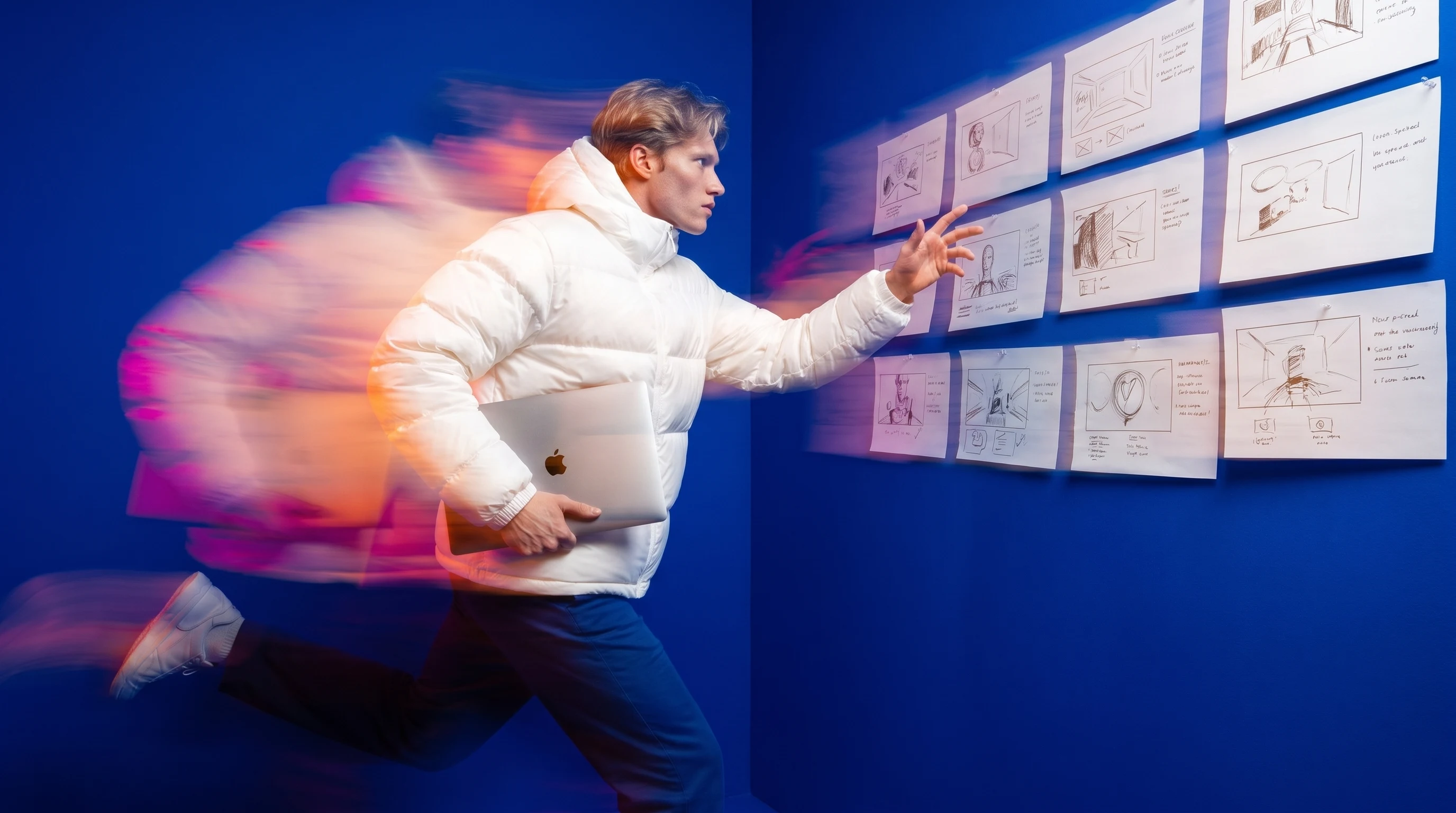
Thinking in layers rather than tools is what keeps a creative system from drifting into a Frankenstein pipeline. Each layer has a job, and swapping a tool inside a layer should not require rebuilding anything downstream. Our standing stack looks like this.
- Ideation and scripting. Claude or ChatGPT, briefed on the brand guidelines, the product truth and the hook formula library. Output is a numbered list of twenty concept lines, not polished scripts.
- Asset generation. Flux for stylised imagery, Nano Banana for product shots with reference control, GPT Image for text-behind-subject compositions. The goal is a clean plate the motion layer can push.
- Motion. MiniMax Hailuo for cinematic push-ins, Runway Gen-3 for character and camera moves, Kling for longer narrative shots. Each clip is generated at the shot's real length, not stretched in post.
- Assembly and UGC overlay. CapCut and Creatify for the UGC-style voiceover and caption pass, Symphony Remix when the final home is TikTok. This is where editorial judgment separates native-looking content from obvious synthetic output.
The layer discipline matters more than the specific tools. We swap individual models in and out monthly as new versions ship, but the structure stays fixed, which is what makes the pipeline something a brand team can actually operate rather than a bespoke build that falls over the first time a model is deprecated.
Hook formulas that actually convert
Hook rate is the single most predictive metric for whether an ad will scale, and AI makes it cheap to test twenty openers against one body. These are the five hook patterns we return to most often, and each one maps to a different buyer psychology.
- Pattern-interrupt opener. A visual that does not look like an ad in the first frame, often an AI-generated impossible scene that resolves into the product by second three.
- Problem agitation UGC. A talking-head avatar or AI voiceover naming the exact friction the product solves, delivered in the register of a creator, not a brand.
- Product reveal via animation. A still hero shot animated into the hand, into use, or into context using Image Animation or Hailuo, letting the product itself be the hook.
- Social proof overlay. A review quote or metric rendered as kinetic text over a product-in-use clip, cutting the gap between claim and evidence to a single frame.
- Curiosity gap. A line that teases a mechanism rather than a benefit, forcing a second-watch to resolve. Works harder on TikTok than Meta.
The common thread across all five is that the hook is where the AI stack earns its keep. Shooting twenty live-action openers for a single body would blow a quarter's budget, but generating twenty AI openers against a shared body is a day's work, and it is how our AI UGC-style content for brands gets to statistical significance faster than traditional UGC can.
Platform-native versus third-party: when to lean in and when not to
The native tools are extraordinary for scale, but they come with trade-offs that most agencies will not tell you about because the trade-offs cost the brand, not the agency. Advantage+ Creative and Symphony both optimise inside their own walled gardens, which means the creative they produce is tuned to perform on that platform and reads oddly off it.
Native wins when the ad is single-platform, the brand is comfortable with the platform aesthetic, and the volume demand is so high that human iteration cannot keep up. Third-party wins when the brand needs cross-platform asset reuse, when creative control over typography and colour accuracy matters, or when the campaign has to sit alongside other brand work without looking like a different company made it. For most of our clients, the honest answer is a hybrid: a third-party master cut shipped into both platforms, with Advantage+ and Symphony generating ten variants each on top.
Volume and testing framework
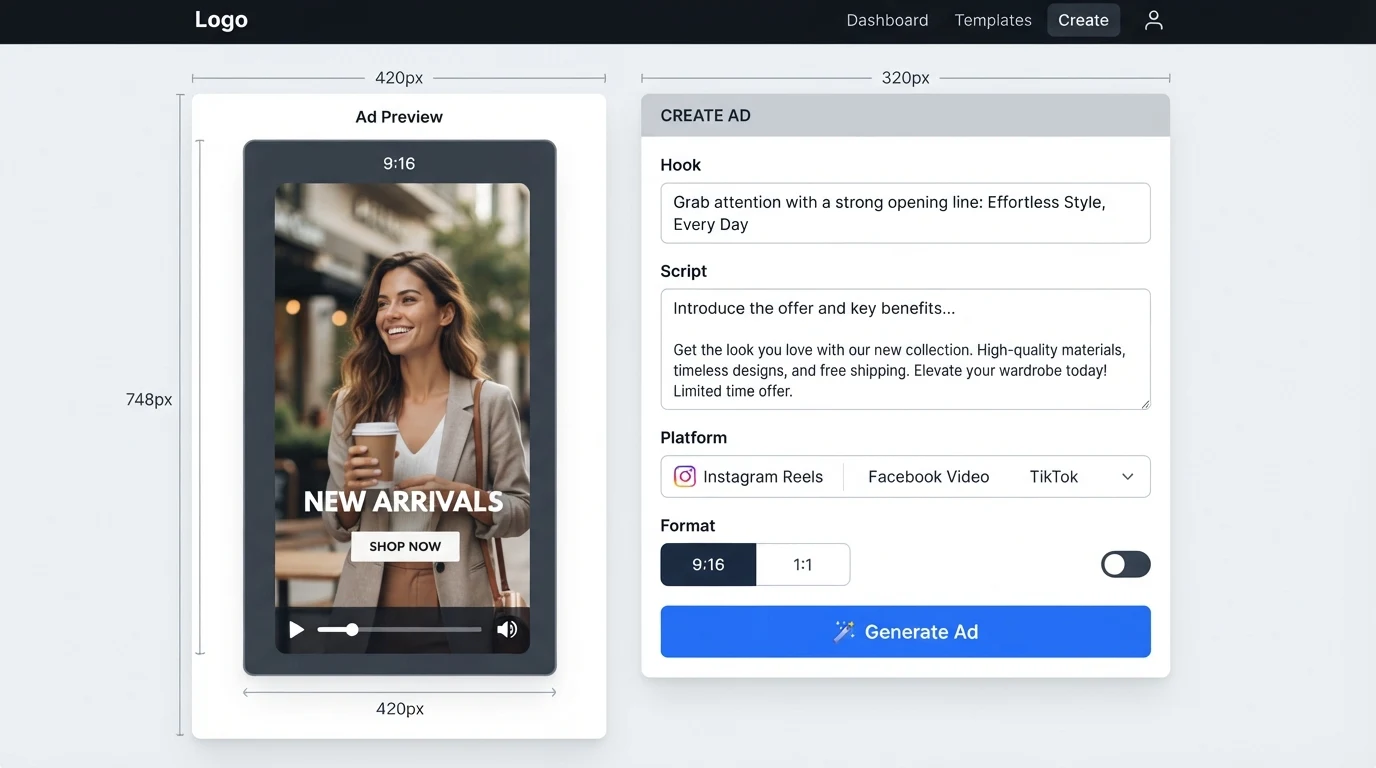
A disciplined test framework is what turns a pile of AI assets into a learning engine. The one we run on paid social builds has three rules: twenty variants per concept, iso-test only one creative lever at a time, and read the diagnostics every seventy-two hours before deciding anything. Reading Meta's creative diagnostics inside Ads Manager is a specific skill most teams underinvest in.
The diagnostic to prioritise differs by platform. On Meta, hook rate (3s video plays over impressions) is the fastest signal, followed by hold rate (15s plays over 3s plays) for creative that passes the first filter. On TikTok, the equivalent signals are 2s view-through and 6s view-through, with thumbstop ratio closely tracking hook rate. If hook rate is weak, the problem is the opener. If hold rate is weak, the problem is the body. Diagnosing which lever to iterate on is what separates testing from spending.
Compliance, disclosure and brand safety
Both platforms now require disclosure of AI-generated creative under specific conditions, and the rules keep tightening. Meta's AI content label is applied automatically when the platform detects synthetic imagery or when the advertiser self-discloses, and Meta expects disclosure on any ad that depicts a realistic person, place or event that did not actually exist. TikTok's AI-generated content disclosure applies to any realistic synthetic human or scene, enforced through both automated detection and manual review.
The practical risk is less about getting caught and more about the uncanny-valley failure mode. A synthetic avatar that looks nearly human but moves wrong will tank hook rate faster than any policy violation. Our rule of thumb is that stylised AI reads as creative, photoreal AI needs to be either flawless or clearly labelled, and anything in the uncertain middle gets rebuilt. Brand safety and performance are the same conversation.
Case walkthrough: eight ads, one product, one day
A recent build we ran for a consumer product gives a concrete sense of the pipeline. The brief was eight paid social ads for a single SKU, two hook patterns tested against two body treatments, split across Meta Reels and TikTok. The ideation layer produced twenty concept lines by lunchtime. Asset generation delivered four hero plates in the next two hours, each tuned to the product's lighting and material truth.
Motion ran overnight across Hailuo and Runway, producing sixteen candidate clips which we triaged down to eight the following morning. Assembly and the UGC voiceover pass finished before end of day, with captions, platform-native end cards and the required AI content disclosure baked in. The eight ads went live inside a single testing cohort, and the hook rate winner emerged within seventy-two hours. The same build on a traditional production timeline would have been a two-week shoot plus post, and this is what paid-social teams mean when they talk about AI ad creative replacing stock-driven workflows.
Frequently asked questions
How much does an AI video ad actually cost to produce?
It depends on complexity, aspect-ratio count and how custom the brand treatment is. Rather than quote a figure, we scope every build against the number of concepts, variants and platform cuts the campaign actually needs. Pricing is quoted per scope after a brief review, and the honest answer is that cost per ad falls fast as volume rises.
What is the best tool for a small budget?
If a brand is self-serving on a tight budget, the native suites are the right starting point. Advantage+ Creative inside Meta Ads Manager and Symphony Creative Studio inside TikTok Ads Manager will produce usable creative from a product shot and a short brief. The ceiling is lower than a custom stack, but the floor is high enough to run a real test cohort.
Can AI replace UGC creators entirely?
Not for every brand. Synthetic UGC-style content is now good enough to carry mid-funnel paid social, and we ship a lot of it, but creator partnerships still outperform synthetic UGC for brands where community and trust are the whole proposition. The right answer is usually both, with AI covering the volume and creators covering the authenticity-heavy executions.
Will Meta or TikTok penalise ads built with AI?
No, provided the disclosure rules are respected. Both platforms are actively promoting their native generative tools, and neither is penalising advertiser-generated AI creative in the auction. What they do penalise is undisclosed synthetic humans and anything that violates existing community guidelines, and those rules apply the same way they would to live-action creative.
How many variants should we actually ship per concept?
Our standing recommendation is twenty variants per concept for the first learning cohort, then narrower iteration on the winning lever. Fewer than ten rarely gives a clean signal, and more than thirty tends to split spend too thinly to reach significance inside a reasonable window.
What about cross-platform asset reuse?
This is where third-party stacks earn their keep. A master cut generated outside the native tools can be versioned for Meta, TikTok, YouTube Shorts and connected TV from the same asset base, which is impossible when the creative lives inside Advantage+ or Symphony. If a campaign has to run on more than one surface, build outside the walled garden and port in.
Where this leaves a 2026 paid social team
The brands winning on Meta and TikTok right now are the ones treating AI video as creative operations, not a tool decision. Volume is the baseline, hook rate is the scoreboard, and the editorial bar is what separates ads that scale from ads that burn. If a paid social team wants that system built or audited, Absolutely AI runs it end to end, from concept through platform-native delivery, with senior creative direction on every build.