AI Storyboards vs Traditional Storyboards: What Actually Changes in 2026
AI storyboards win on speed and iteration. Traditional storyboards win on emotional nuance and directorial voice. Most working studios now blend both, and the interesting question is no longer which one to pick but where each belongs in the workflow. Here is the operator's view from an agency that ships both every week, with real numbers, honest failure modes, and the hybrid pipeline that quietly became the standard.
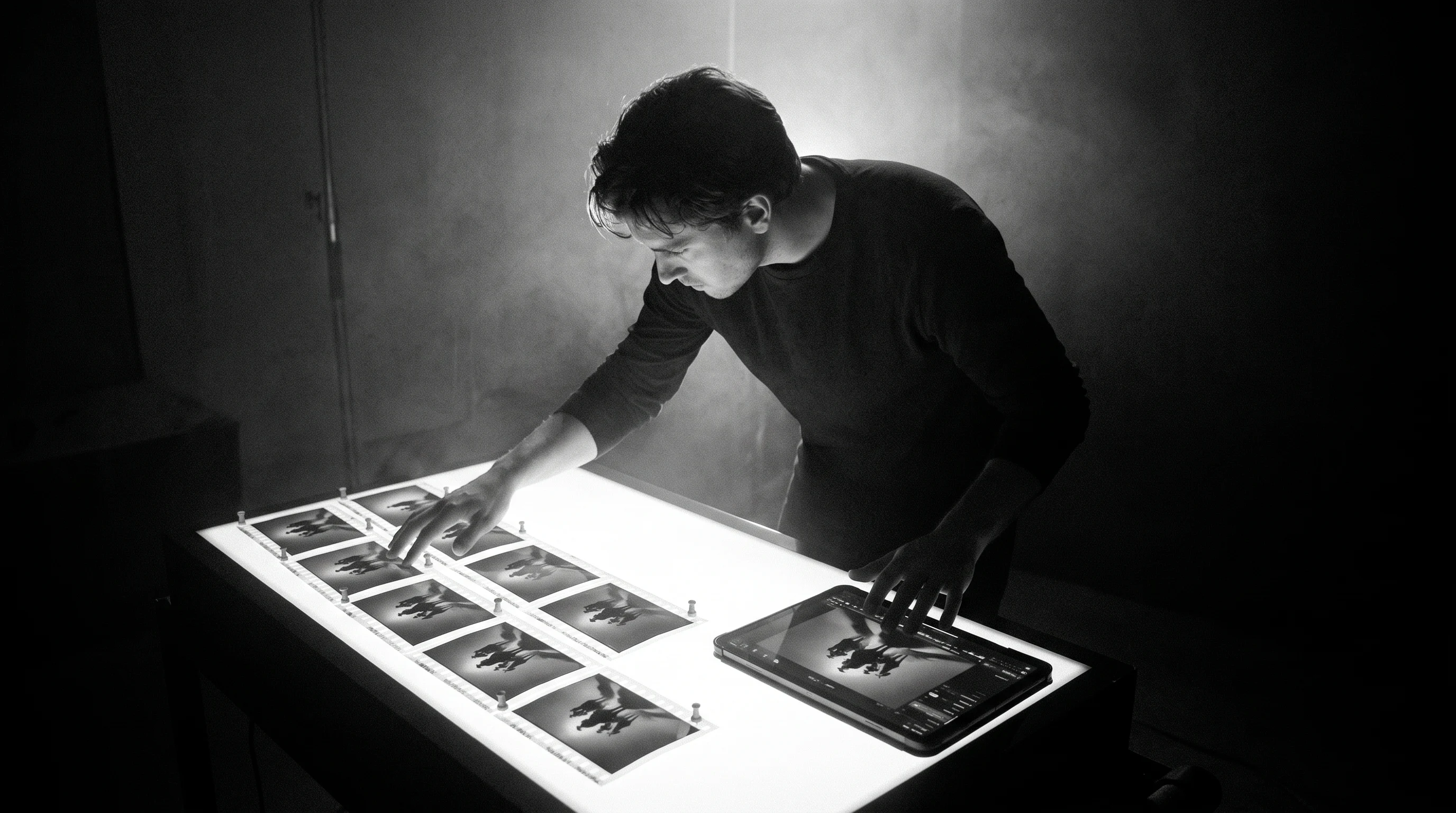
The choice between AI storyboards and traditional storyboards is no longer binary, and pretending it is has become the fastest way to lose a week of production time. At Absolutely AI we work on both sides of that line every week, and the pattern is consistent: AI handles coverage, exploration, and client-round variants; a human artist still owns the hero frames and any shot where feeling has to survive the translation from script to screen. This piece lays out what actually changes when you swap methods, where each approach genuinely earns its place, and how to decide for your next project.
The short version:
- AI storyboards: best for pitch decks, alt-shot exploration, pre-viz, and client-round variants.
- Traditional storyboards: best for emotionally loaded scenes, unusual camera language, and any project where the board itself is a deliverable.
- Hybrid workflow: best for almost every commercial project shipping in 2026.
What we mean by traditional storyboards
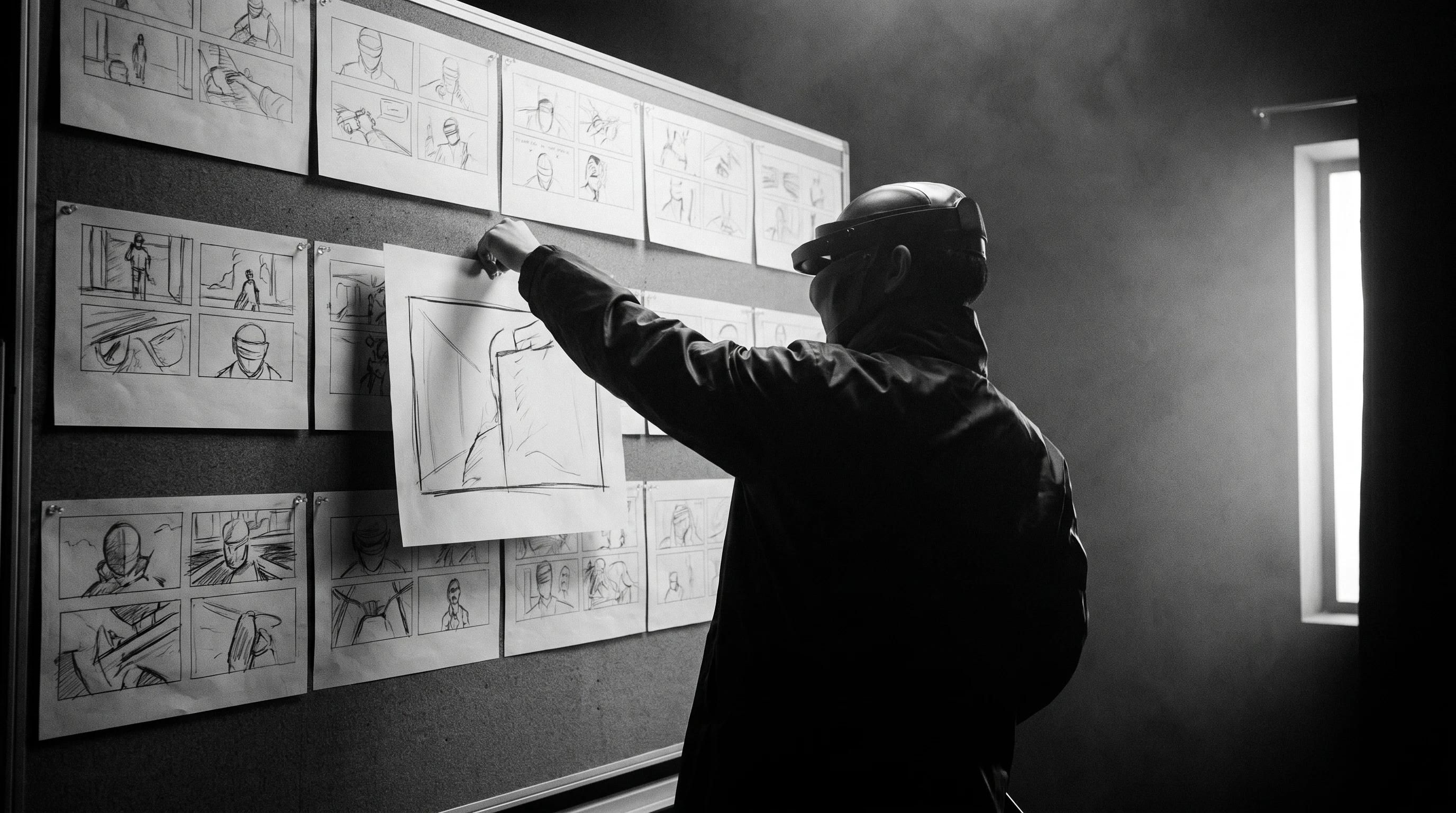
Traditional storyboards are hand-drawn or digitally illustrated frames produced by a storyboard artist working from a script, shot list, or director's brief. Turnaround is typically days to weeks, and rates land somewhere between $75 and $300 per frame depending on rendering level, from thumbnail roughs through to fully coloured, camera-accurate boards. The artist brings interpretation: they read the scene, propose framing, and translate intent into image. That interpretive layer is exactly what AI still struggles to replace, and it is why traditional boards remain the reference standard for scenes that live or die on feel.
What we mean by AI storyboards
AI storyboards use text-to-image models like Midjourney, Adobe Firefly, and Leonardo.Ai, video-native tools like Runway and Sora frame exports, and purpose-built platforms such as Storyboarder.ai, Katalist, Boords AI, and LTX Studio. You feed them a script or a beat sheet and they return shot-by-shot frames in minutes. Purpose-built tools add script breakdown, character consistency locks, and aspect ratio presets. The result sits somewhere between a mood frame and a pre-viz plate: expressive enough to sell an idea, rarely tight enough to shoot from without a human pass on top.
Side-by-side comparison
The table below is calibrated against how these methods actually perform on live commercial work, not against tool marketing. Ratings are relative, not absolute.
| Criterion | AI storyboards | Traditional storyboards |
|---|---|---|
| Turnaround time | Minutes to hours | Days to weeks |
| Cost per frame | Very low, tool subscription only | Mid to high, artist day rate |
| Revision cost | Near zero, re-prompt | Real, artist time per round |
| Style consistency | Good with locked references | Excellent, one hand holds the pen |
| Character consistency | Improving but still fragile | Reliable |
| Emotional nuance | Limited | Strong |
| Camera and shot control | Approximate | Precise |
| Client presentation polish | High out of the gate | High but slower to arrive |
| IP and ownership clarity | Ambiguous, tool-dependent | Clear, work-for-hire |
| Learning curve | Low to use, high to master prompting | Low for clients, high for the artist |
Where AI genuinely wins
The clearest AI wins are in the fuzzy front end of a project. Pitching three visual directions in an afternoon instead of three weeks. Exploring alt-shots and framings before you commit an artist to hero frames. Building pre-viz plates for a treatment so a client can see the film in their head before signing. Killing bad ideas cheaply, which is the single most valuable thing pre-production can do. If your pre-viz for a commercial normally takes a fortnight, doing it in a day changes the shape of the whole project because you get real feedback earlier, when it is still cheap to act on.
AI also shines on client-round variants. Swap the location from a warehouse to a rooftop across all forty frames and you have a new deck by lunch. That kind of turnaround was structurally impossible with traditional boards, and it changes how clients participate in the pre-production conversation.
Where traditional still wins
Traditional boards still own emotionally loaded scenes: the beat where a character breaks, the reveal, the quiet moment before the punch. AI can approximate the composition but rarely lands the read. They also own unusual camera language, anything a director is trying to invent rather than reference. Prompt-driven images tend toward the mean of their training data, which means the frames feel familiar. That is helpful for coverage and lethal for originality.
Any project where the storyboard itself is a deliverable, licensed merchandise, animation bibles, published art-of books, obviously belongs with a human artist. So does anything requiring a specific artist's line as part of the brand.
The hybrid workflow most studios have quietly adopted
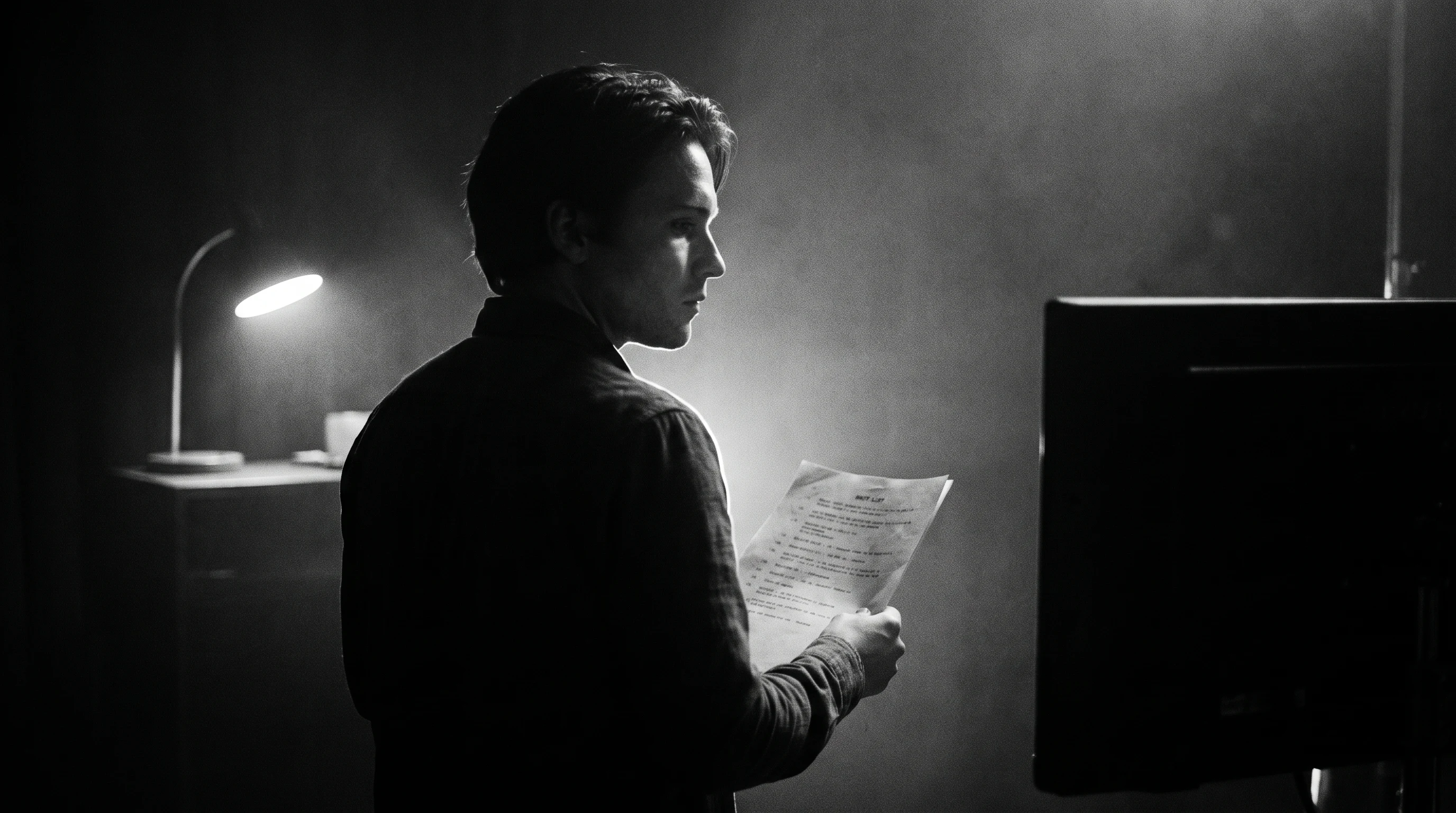
The pipeline that has settled in across serious commercial shops looks like this:
- Script breakdown: a human reads the script, marks beats, and defines the shot count.
- AI first pass: an operator generates coverage frames across the whole board in one afternoon, exploring blocking and framing options.
- Director selects and marks up: the director picks the frames that work, kills the ones that do not, and annotates the hero shots that need lifting.
- Human artist tightens hero frames: an artist redraws or heavily overpaints the five to ten frames that carry the film emotionally.
- AI variants for client rounds: alt locations, wardrobe swaps, and time-of-day variants are generated on demand as the client walks through the boards.
The result is a set of boards that reads with the polish and consistency of a fully illustrated deck, produced in a fraction of the time, with the emotional weight still carried by a human hand where it matters. This is roughly the shape our AI pre-production for campaigns takes when the deadline is tight and the creative bar is high.
Cost math on a real 60-second commercial
Take a typical 60-second commercial with 40 boarded frames. On the traditional path, 40 frames at roughly $150 each is around $6,000 and about two weeks of calendar time, plus revision rounds. On the hybrid path, a purpose-built tool subscription plus one day of artist polish on hero frames lands closer to $1,400 and about two days end to end. The delta is not really the dollars. It is the two weeks of calendar time you can now spend on shot list refinement, location scouting, or an extra client round that catches a problem before it hits the shoot day. A single avoided reshoot easily pays for the entire pre-production budget on either path.
The failure modes nobody advertises
Character drift is the big one. Ask any text-to-image model for the same character across 40 frames and by frame 20 you will have a subtly different person, even with reference locks. Purpose-built tools handle this better but not perfectly. Hands are still unreliable. Lighting tends toward a generic cinematic look regardless of what you asked for, which becomes obvious when you cut ten AI boards together and notice they all share the same soft key from camera left.
Prompt-shaped composition is the subtler failure. AI frames tend to centre the subject, respect the rule of thirds, and reach for the same handful of lens choices. If your board looks like every other AI board that week, you have a problem, because so does the film it produces. Finally, IP and licensing on AI-generated boards remains ambiguous enough that any board that will appear in a public deliverable, an Instagram ad for example, needs a licensing review before it ships.
How to choose for your next project
The decision tree is shorter than it looks:
- Pitch deck or internal treatment: AI, full stop. The board exists to sell an idea and will never be seen again.
- Shoot-ready boards for a commercial or short film: hybrid. AI for coverage, human artist for hero frames and any emotional beat.
- Animatic for a TVC or brand film: hybrid, weighted toward AI for the first cut and human polish for the final.
- Storyboards as a client deliverable: traditional, with AI reserved for exploration behind the scenes.
- Animation bible or published art: traditional, no exceptions.
Frequently Asked Questions
Do agencies still hire storyboard artists in 2026?
Yes, and the good ones are busier than ever. What has changed is the shape of the brief. Artists are being hired to lift hero frames and interpret the beats that matter, not to draw every frame of coverage. It is closer to a creative director role than a production role.
Can AI storyboards be used commercially?
For internal use, treatments, and pitch decks the answer is almost always yes. For boards that appear in a public deliverable, licensing terms vary by tool and are worth reading before the project starts. Purpose-built platforms tend to be clearer on commercial rights than general text-to-image models.
Which AI storyboard tool is best for directors versus advertisers?
Directors tend to prefer tools with strong camera and shot control, LTX Studio and Katalist among them. Advertisers gravitate toward Boords AI and Storyboarder.ai for their client-friendly presentation layer and script breakdown workflow. Midjourney and Firefly remain useful for pure mood exploration.
How well do AI tools handle character consistency now?
Much better than a year ago, still not perfect. Purpose-built storyboard tools with character locks are usable for most commercial work. General text-to-image models require reference workflows and still drift over long boards.
Will AI replace storyboard artists entirely?
Not for the work that matters. The scenes that carry a film emotionally still need a human eye, and clients still pay for that eye. What is disappearing is the middle of the workflow, the coverage frames that nobody remembers.
How much time does the hybrid workflow actually save?
On a typical commercial the calendar time drops from around two weeks to two or three days. The active human hours drop less dramatically because the artist is still doing the hero frames, but the compression on total elapsed time is the real win.
What about Celtx and other script-first tools?
Celtx and similar script-first platforms are increasingly integrating AI storyboard generation directly into the script breakdown flow. It is a sensible place for the technology to live because the script is already structured, so the AI has better context to work from.
The bottom line
The interesting shift in 2026 is not that AI storyboards have arrived. It is that the hybrid workflow has quietly become the default for serious commercial work, and the studios still arguing about it are the ones losing pitches to the ones who moved on. If you want to see the hybrid pipeline in action on a real brief, Absolutely AI can walk you through how a recent commercial went from script to shoot-ready boards in three days.