AI Video Ad Production for Brands: A Buyer's Playbook
Brands used to choose between fast paid social and cinematic hero films. That trade-off is closing. AI video ad production, run by a creative team that knows what a great commercial actually looks like, gives marketing leads polished films, UGC-style hooks, and localised cutdowns from a single brief. This is the buyer's playbook we hand marketing directors when they ask how Absolutely AI approaches the shift.
The last twelve months have collapsed the distance between an idea and a rendered commercial. Text-to-video models produce shots that a year ago would have cost a location day. But the brands winning with this stack are not the ones using it as a shortcut. They are treating AI as production capacity and putting the creative judgement above it, which is where the buyer's guide below starts.
What 'AI video ad production' actually means in 2026
AI video ad production is not one tool. It is a stack of models and craft decisions strung together by a creative director. On the model side, brands are working with text-to-video systems like Runway Gen-4, Google Veo 3, and OpenAI Sora 2 for generative footage, with ElevenLabs and equivalents for synthetic voiceover, and traditional NLE tools for the edit and grade. Our own AI video services sit on top of that stack rather than replacing it.
The more important distinction sits above the tools. Self-serve generators produce clips from a prompt and hand them back unedited. AI-native production partners treat the model output as raw footage, then apply the same discipline a commercial shoot would: art direction, casting-equivalent decisions on synthetic performers, sound design, and a colour pass. Our AI marketing agency practice sits firmly in the second camp.
Where AI video wins for brands right now
Not every ad brief benefits equally. AI video is currently strongest where physical production is expensive relative to the payoff: high-volume paid social, testable variants, and worlds you cannot practically shoot. It is weakest where a real face and a real story carry the concept. Our AI content creation pipeline is built around the strongest zones.
| Use case | Why AI video fits | Approach |
|---|---|---|
| DTC product demos | Camera moves, lighting, and repeatable product beauty | Model-generated shots composited with live product footage |
| UGC-style paid social | Synthetic performers can hit tone variants faster than a casting call | Prompt-driven creator shots plus real audio |
| Hero brand films | Worlds and eras that cannot be built practically | Model-generated hero shots, editorial edit and grade |
| Localised cutdowns | One master concept, many markets and languages | Automated aspect swaps plus synthetic voiceover |
| Always-on testing | High variant count without a reshoot | Prompt variants across models, human curation |
The pattern is that AI video ad production earns its place when the brief needs volume, iteration, or a world you cannot build. Where a category demands a real testimonial or a licensed likeness, physical production still wins, and hybrid work sits between them. AI films is the space where those blends usually land.
The realistic cost and timeline math
The honest answer is that AI video shifts where cost lands, it does not vaporise it. Model runs and edit time replace crew, location, and talent day rates. But concepting, brand governance, rights clearance, and creative direction still take real hours, and the good work still lives or dies on those hours. When a partner quotes a huge saving without describing the creative process, that is usually a signal the creative process is missing. Our AI consulting scope covers how we frame work by outcome instead of shot count.
Timelines compress most on iteration, not on the first cut. A first-round concept still needs the same strategic thinking a shoot brief would need. Where the sprint gets faster is in the second and third rounds: revising a shot no longer means a reshoot day, and localised cutdowns no longer need a fresh edit session per market. That compounding is where the case builds, and scaling ad creative with AI is where the volume advantage shows up in the media plan.
A production workflow that actually ships
A workflow that delivers commercial-grade output looks less like 'type a prompt, get an ad' and more like the traditional production pipeline with AI slotted into the middle. The stages we use, in order:
- Brief and strategy. Product, audience, performance goal, brand guardrails, deliverable matrix.
- Moodboard. Reference frames and film language before any prompt is written.
- Prompt-storyboard. Shot list translated into structured prompts per model, tested against the moodboard.
- Model runs. Multiple generations per shot across whichever model handles that camera move or subject best.
- Human edit. Colour, cutting rhythm, sound design, music, and voiceover.
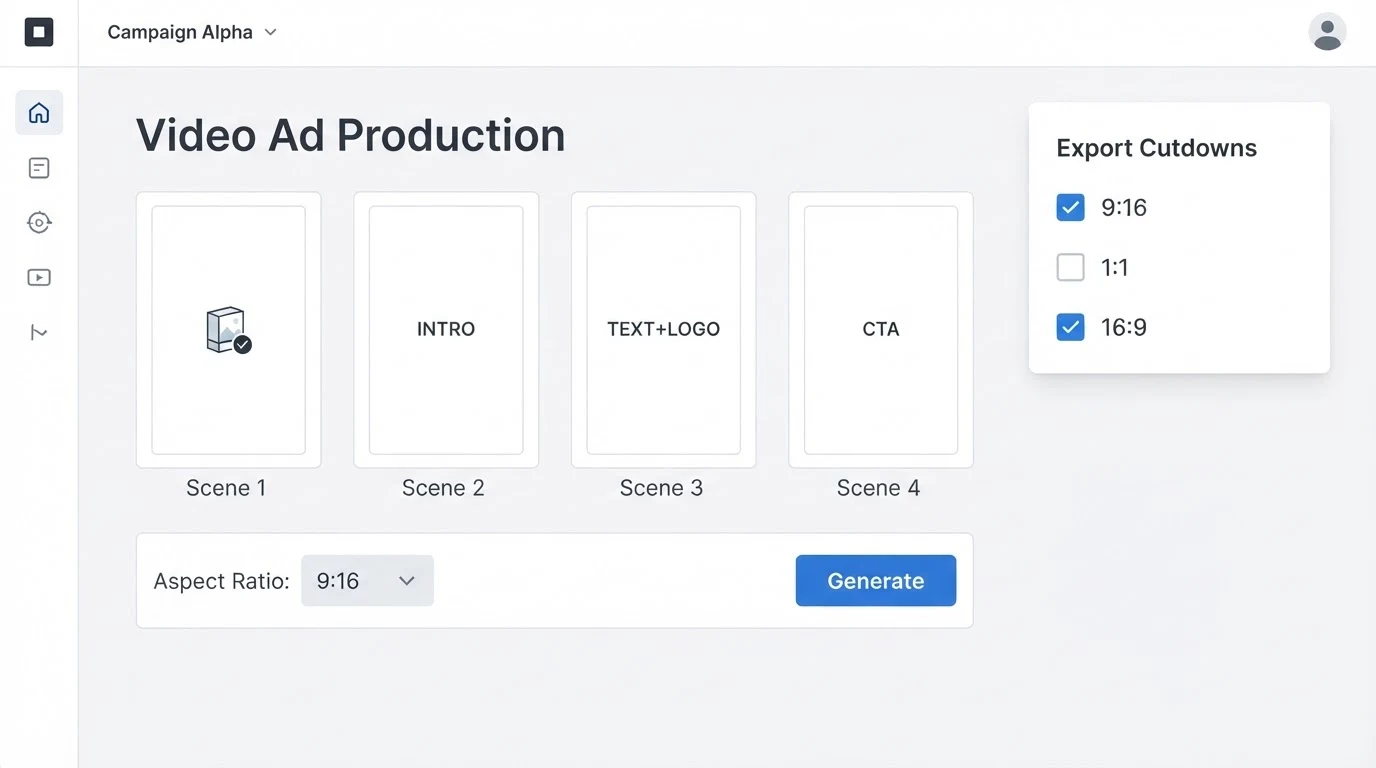
- Cutdowns. 9:16, 1:1, and 16:9 renders sized for each platform's paid delivery, not just letterboxed.
The creative director role is the load-bearing piece. Without one, a stack of tools produces stock-feeling output. Our AI commercial practice covers that lead role explicitly.
How to brief an AI video partner
A tight brief is worth more than any specific model choice. Answer these six questions before the first prompt is written:
- Product context. What it is, what problem it solves, what physical or performance detail matters on camera.
- Audience insight. One-line description of who the ad is aimed at and what they currently believe about the category.
- Performance goal. Whether this concept is optimised for thumb-stop, view-through, or considered click.
- Brand guardrails. Palette, typography, tone, and any category rules the campaign has to respect.
- Reference frames. Three to five stills or clips that describe the film language, not the story.
- Deliverable matrix. Which aspect ratios, durations, and versions the paid plan needs on day one.
A brief that covers these six points can go straight into a prompt-storyboard. A brief that skips them produces revisions AI speed cannot fix, because the speed lives inside the pipeline, not inside the strategy. Our take on AI branding starts from the guardrails, not the tool.
Quality control: avoiding the AI slop tell
The gap between commercial-grade AI video and 'AI slop' is almost always caught in review, not in generation. The tells are consistent: hands and fingers that flicker between frames, eye-lines that drift off camera during a hold, motion tearing on high-detail textures, uncanny facial micro-expressions on close-ups. A trained reviewer catches these in a single pass.
The remediation choices matter as much as the detection. Some shots are worth regenerating on a different model that handles that motion better. Some are worth compositing a live-action element into the AI plate. Some are worth cutting entirely. A partner that treats every shot as fixable inside the same model will ship the slop version. Our writeup on AI UGC-style content for brands covers how this shows up in social work.
Legal, rights, and platform disclosure
AI video ad production sits in a rights environment that changes month to month. Meta, TikTok, and YouTube now require creators and advertisers to label AI-generated or significantly altered content in specific cases, and paid delivery can be affected if the label is wrong or missing. Training-data provenance for the underlying models is also a live question, particularly where a synthetic performer approaches a real person's likeness.
We do not publish rights guarantees on a marketing page because the correct answer depends on the shot, the market, and the platform. If your brief involves a recognisable likeness, a regulated category, or a market with strict advertising standards, that conversation belongs in scoping. Start on our contact page and we will map the rights questions before any generation begins.
In-house vs. agency vs. hybrid
There is no universal right answer. The decision usually turns on three variables: monthly output volume, the sharpness of your brand system, and how much creative direction you already have in the building.
- In-house. Best for brands running high-volume always-on paid social with a mature brand system and at least one creative lead who can direct model output.
- Agency-led. Best for hero campaigns, complex worlds, and brands that need creative direction as part of the deliverable rather than just execution.
- Hybrid. Common in practice: an agency partner delivers concepts, hero renders, and the master creative system, and the in-house team handles cutdowns and variant testing.
For most mid-market brands, the hybrid shape is what actually scales, because it puts senior creative direction on the concept without bottle-necking the always-on channel. Our AI agency overview covers what that shape looks like end to end.
Frequently Asked Questions
Can AI video ad production replace a full shoot?
For most paid-social briefs, yes. For hero campaigns anchored on a real spokesperson or a licensed likeness, no, and the strongest work in that zone is a hybrid where AI extends a live-action shoot rather than replacing it.
Which models are you using right now?
The honest answer is 'whichever model wins the shot'. Runway Gen-4, Google Veo 3, and OpenAI Sora 2 all have different strengths on camera language, human motion, and product beauty, and part of the job is testing each shot across models. We stay tool-agnostic on purpose.
How do platform AI labels affect paid delivery?
Meta, TikTok, and YouTube each have their own disclosure rules for AI-generated or altered content, and enforcement is tightening. In practice the label rarely hurts performance when the creative is strong, but a mislabel or a miss can cost delivery. We build labelling into the brief rather than the final QA.
How do you keep quality above the 'AI slop' line?
Creative direction on every shot, multi-model testing per beat, and a review pass focused specifically on the tells: hands, eye-lines, texture motion. Shots that fail review get regenerated, composited, or cut, never smoothed over.
Do you work with in-house teams that already have some AI capability?
Often. The hybrid shape is common: we lead concept and hero renders, the in-house team runs variants and cutdowns. Our AI consulting engagement covers that handover explicitly, including brand-guardrails documentation.
Which platforms is this strongest on right now?
Meta and TikTok are where AI video is currently earning its keep, because the format rewards volume, iteration, and hook variance. See our writeup on AI ad creative for Meta for the platform-specific detail.
How long does a first project usually take?
Scope-dependent. The realistic gate is the brief and the creative direction, not the render. A brief that answers the six questions above moves quickly; a brief that skips them takes as long as any traditional project.
The takeaway
The shift is not that AI made video ads cheap. The shift is that a creative team with the right stack can now put cinematic-grade commercial work, UGC-style social, and always-on cutdowns on the same brief without switching partners. That is the space Absolutely AI builds in, and if you want to see where that lands on paid social specifically, the AI social ad creative agency page is the closest overview of how we run it.