AI Ad Creative Testing at Scale: The Operating System
Running three ads a week and calling it testing is over. The brands winning paid social in 2026 are pushing 50 to 200 variants weekly, mining winners with AI, and reading signal through a disciplined loop. At Absolutely AI we help growth teams build that operating system without drowning in slop. Here is how the loop actually works.

Meta's algorithm now expects 15 to 25 fresh ads per ad set before it can find a winner, and the growth-stage brands beating CPA benchmarks are pushing 50 to 200 new variants weekly. The old cadence of three hero concepts a month is a losing game. What separates the teams that turn AI generation into compounding performance from the ones spraying AI slop is a repeatable operating loop, and that loop is what we teach inside our AI consulting engagements.
What 'At Scale' Actually Means in 2026
Scale is not a vibe, it is a number. For an early-stage DTC brand, 20 to 50 net-new creative variants per week is the floor for the algorithm to actually learn. For growth-stage accounts spending north of $500k monthly, 100 to 200 variants a week is closer to the reality. Scale accounts running Meta Advantage+ Shopping campaigns often need 300+ assets in rotation just to feed dynamic creative optimization without cannibalising winners.
The trap most teams fall into is confusing volume with variation. Ten iterations of the same hook in ten aspect ratios is not ten tests, it is one test in ten wrappers. Real scale means genuine variation across the four testable dimensions: hook, visual concept, format, and offer. Scaling ad creative with AI only compounds if each variant carries a distinct hypothesis.
The Four-Stage AI Creative Testing Loop
Every high-functioning creative team we work with runs the same closed loop. It is not a funnel, it is a wheel that spins weekly. Break any stage and the whole thing stalls.
- Mine. Extract patterns from your top 10 performers over the last 30 days. Which hooks are stopping the scroll? Which visual archetypes are converting? Which formats are winning where?
- Generate. Feed those patterns into structured AI generation briefs across hook, visual, format, and CTA. This is where AI content creation earns its keep, but only with a real brief.
- Launch. Push variants into structured tests: isolation first, then dynamic creative optimization, then scale. Never all three at once in the same ad set.
- Read. Pull the signal, translate it into next week's generation prompts, and feed it back into the mining stage.
The loop only works if the output of stage four becomes the input of stage one. Most teams treat creative testing as a linear campaign brief, which is why their AI generation gets less effective over time instead of more. The signal has to feed the prompt, or you are just producing decorative volume.

Testing Frameworks That Survive AI-Scale Volume
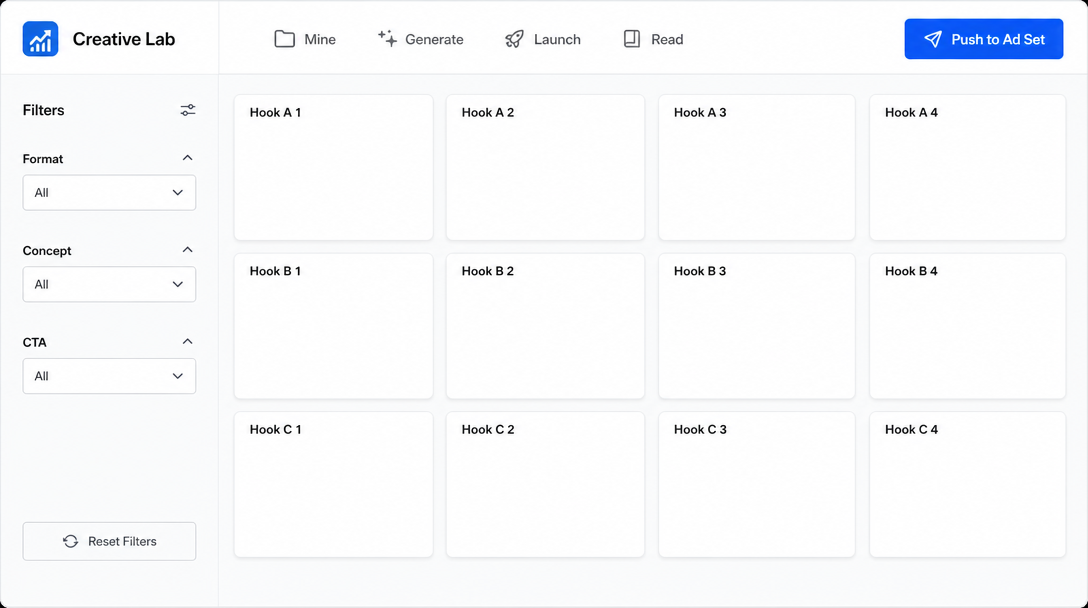
When you ship 100 variants a week, sloppy campaign structure destroys signal faster than any algorithm change. The framework we lean on for growth-stage brands is a modified 3-3-3: three concepts, three hooks per concept, three formats per hook. That gives you 27 variants per weekly test, which is enough for the algorithm to learn and small enough for a human to actually read.
The rules that make 3-3-3 work at AI volume are unforgiving. Isolate one variable per ad set. Run CBO at the campaign level for winners and ABO at the ad set level for tests, because ABO gives every variant a fair shot at spend. Set a budget floor of roughly 10 times your target CPA per ad set, and hold the test window for at least 72 hours before you cull. If you kill ads on day one CTR, you will kill your winners.
Dynamic creative optimization comes after isolation, not instead of it. DCO is a scaling tool, not a discovery tool. Once you have found a winning hook and a winning visual through isolation, feed them into DCO to find the best combination at scale. Doing it in reverse is how brands end up with beautiful dashboards and mediocre CPAs.
The AI Generation Stack
There is no single tool. There is a stack, and knowing what each layer is genuinely good at is the difference between a scalable pipeline and a demo reel.
| Layer | Best-in-class 2026 | What it is actually good for |
|---|---|---|
| Static image | Midjourney, gpt-image, Ideogram | Hero visuals, lifestyle, on-brand product scenes |
| Video | Runway, Sora, Kling, Veo | 6 to 12 second hook loops, B-roll, motion variants |
| UGC-style | Arcads, HeyGen, Captions | Talking-head hook variants at volume |
| Copy | Claude, GPT | Hook permutations, CTA variants, ad headlines |
| Orchestration | AdCreative.ai, Pencil, Omneky, n8n | Brief-to-batch pipelines, brand governance |
The layer most teams underweight is orchestration. Generating 100 assets is easy. Governing them, deduplicating near-identical outputs, and pushing the survivors into Meta Ads Manager with the right naming taxonomy is where the pipeline actually breaks. Whether you build it in n8n or buy a SaaS, orchestration is not optional above 50 variants a week.
Humans still beat AI at three things: originating a genuinely new concept, casting real faces for UGC that converts, and holding brand voice under pressure. Everything downstream of those three is fair game for automation. The teams treating AI as a replacement for creative direction are the ones producing the AI slop the algorithm is now actively suppressing, and it is why we treat brand governance as a first-class input to every generation pipeline we build.
Reading Signal Without Fooling Yourself
The metric that kills more winning ads than any other is day-one ROAS. Attribution windows post-iOS 14 mean early ROAS reads are noisy garbage for 48 to 72 hours. The metrics that give you early, honest signal are further up the funnel: thumbstop rate (3-second video views over impressions), hook rate (25% video views over impressions), and hold rate (75% completions over 3-second views).
A variant with a 30% thumbstop and a 12% hook rate is telling you the creative is working even if ROAS is still forming. A variant with a 6% thumbstop is telling you to kill it regardless of what the CTR says. CTR is the most-referenced and least-useful metric in the stack because it is polluted by curiosity clicks that never convert.
At the campaign level, MER (marketing efficiency ratio: total revenue over total ad spend) is a more honest scoreboard than platform-reported ROAS. Meta will always claim credit it does not deserve. MER keeps the whole team focused on what actually hit the bank account, and it is the number that should decide when a winning creative concept gets promoted from test into a full commercial production.
Common Failure Modes
- Near-duplicate spam. Ten prompts, one idea. Fix it by writing hypotheses before you write prompts.
- CTR worship. Killing ads on click-through rate before thumbstop and hook data mature.
- Premature culling. Ending tests before statistical significance. Under 1,000 impressions per variant, you have noise, not signal.
- DCO cannibalisation. Running DCO ad sets alongside isolation tests in the same campaign, so budget flows to the wrong learnings.
- Brand drift. Ungoverned generation prompts producing on-trend but off-brand output. See how brands are solving this with structured AI UGC-style pipelines.
- Volume without variation. Shipping 100 assets that test one idea.
A Weekly Cadence That Works
The cadence below is what we run inside three-person growth pods managing $200k to $2M monthly ad spend. It flexes up or down with team size, but the shape holds.
- Monday: Mine. Pull last week's performance. Identify top 10 by MER, bottom 10 by thumbstop. Write the pattern brief for the week.
- Tuesday and Wednesday: Generate. Run the brief through the stack. Aim for 40 to 80 variants across three concepts. Human review kills 30 to 50 percent before launch.
- Thursday: Launch. Push survivors into structured tests. Naming taxonomy locked. Budgets set to CPA floor times 10.
- Friday to Sunday: Read. Rolling thumbstop and hook rate reads at 24, 48, and 72 hours. No ROAS-based decisions until 72 hours.
- Friday PM: Synthesise. Winners promoted to DCO. Losers documented with why. Notes feed Monday's mining.
Build Versus Buy
Building the stack in n8n with direct Midjourney, Runway, and Meta Marketing API calls costs roughly 40 to 80 engineering hours upfront and around $200 a month in API fees. It gives you total governance over prompts, deduplication logic, and naming taxonomy. It is the right call if you are running above 100 variants a week or if brand voice is a non-negotiable.
Buying an orchestration SaaS like AdCreative.ai, Pencil, or Omneky costs $500 to $2,000 a month and gets you running in a week. It is the right call under 50 variants a week or when you do not have engineering capacity. The wrong call is buying a SaaS then fighting its opinions on brand and taxonomy, which is where most churn happens.
Frequently Asked Questions
How many ad variants per week do I actually need?
Floor is 15 to 25 per ad set for the Meta algorithm to learn. Growth-stage brands should aim for 40 to 80 net-new per week. Below that, you are undertesting.
What is the single most important metric for early creative reads?
Thumbstop rate at 24 to 48 hours. It is the least-polluted signal that the creative is doing its job before ROAS data matures.
Should I use AI for the concept or just the execution?
Execution first. AI is exceptional at variation, format, and volume, and mediocre at originating a genuinely new concept. Human-led concept, AI-led execution is the reliable split.
How do I stop AI from producing off-brand creative?
Governance at the prompt layer. Brand voice tokens, banned words, reference image locks, and a human review gate before launch. Ungoverned generation is where AI slop enters the funnel.
Is Dynamic Creative Optimization a replacement for structured testing?
No. DCO is for scaling known winners into combinations. Structured isolation testing is for discovering what the winners are. Doing DCO first gives you fast, confident, wrong answers.
How long should a test run before I cull?
Minimum 72 hours and 1,000 impressions per variant. Below that, you are reading noise. Thumbstop under 10% by 24 hours is the only safe early-kill signal.
What is a realistic team size for this cadence?
A three-person pod (media buyer, creative strategist, generation operator) can sustainably run 60 to 100 variants per week. Below that, one person plus a good orchestration stack.
Do I need a video model, or is static enough?
Above $100k monthly spend, video is not optional. Meta's Reels and Advantage+ placements reward video, and thumbstop rates on well-made video routinely double static equivalents.
What To Run This Week
Pick one campaign. Pull your top 10 performers by MER. Write a one-page pattern brief covering the three hooks, three visual archetypes, and three formats you want to test next. Generate 27 variants against it. Launch them Thursday in an ABO campaign with three ad sets and a budget floor at CPA times 10. Read thumbstop at 48 hours, hook rate at 72, and only then look at ROAS. Do this for four weeks and the loop starts compounding. When you are ready to industrialise the whole system, Absolutely AI builds this operating system with growth teams end to end.