AI Black Friday Ad Creative: The 2026 Playbook
Black Friday 2026 will be won on volume and velocity of creative, and AI has quietly moved from novelty to the default production layer for every serious Q4 advertiser. At Absolutely AI we see the same pattern each year: the brands that scale through November are the ones launching dozens of fresh concepts in October before CPMs spike. This is the workflow, the angles, the prompts and the guardrails that separate winning AI creative from the stuff that gets scrolled past.

Walk into any top-spending Meta account the week before Cyber Week and you will find the same thing: a creative library that has doubled in size since the first of October, built by a team of two or three people leaning on AI for the heavy lifting. The economics are simple. Q4 CPMs inflate sharply as every advertiser bids into the same windows, creative fatigue sets in faster than at any other point in the year, and the only sustainable response is a cadence of fresh concepts that no traditional production pipeline can match. This is the problem AI ad creative was built to solve.
What 'AI Black Friday Ad Creative' Actually Means in 2026
The term has stretched to cover four distinct production layers, and conflating them is the first reason brands underwhelm with their output. Separating the layers lets you pick the right tool for each job rather than hoping one platform does everything well.
- AI image generation: hero shots, lifestyle scenes, flat lays and background plates produced from prompts, often anchored to reference imagery of the actual product.
- AI video: short-form motion built from a single image, a storyboard or a text brief, used for reels, stories and vertical placements.
- AI copy: hooks, headlines and primary text generated to pair with each visual angle, versioned across launch, reminder and last-call phases.
- Dynamic personalization: Meta Advantage+ and dynamic product ads that recombine your creative inventory against audience and catalog signals in real time.
The brands that win Black Friday treat these as a stack, not a single workflow. The image layer locks product fidelity, the video layer adds motion for feeds that reward it, the copy layer carries the offer, and the personalization layer multiplies the matrix across every variant. Meta's own ad creative patterns make this stacking explicit in Advantage+ shopping campaigns.
The Five Ad Angles That Convert on Black Friday
Volume without angle variety is just noise. Every ranking Black Friday creative we have audited over the last three seasons fits one of five archetypes, and the best accounts rotate through all five rather than hammering one.
1. The Deal Stack
A clean product hero with the offer stacked as separate textual layers: headline discount, bundle sweetener, free shipping line. The AI generates the hero and the environment; the text overlay stays in a template so the offer can be swapped daily without regenerating pixels.
2. Scarcity Countdown
A vertical format with the product in motion, overlaid with a time or stock counter. The AI handles the cinematography; the countdown is a live layer so you can version launch day, mid-sale and final hours from the same base asset.
3. Gifting UGC-Style
A pastiche of the authentic unboxing or giftwrap moment, warm lighting, hands in frame, imperfect composition. The brands pulling this off are leaning on AI UGC-style content to produce the volume creator budgets cannot cover in Q4.
4. Bundle Reveal
A flat lay or hero that unveils what is in a limited edition set. The AI composes the arrangement from reference images of each product; the copy layer carries the saved amount and the bundle name.
5. Founder POV: 'The Only Sale All Year'
A talking-head style vertical, either real founder footage with AI backgrounds or fully synthetic in brand-safe cases. The angle positions the sale as rare and considered rather than discount-at-all-costs.

The Production Workflow That Actually Scales
Scaling creative through October without the output turning generic takes a repeatable pipeline. The brands we work with lock these five steps and run them in parallel across every angle.
- Brand kit lock-in: colour palette, typography, product reference library and tone of voice loaded into the prompt system before anyone generates anything. This is the single biggest determinant of whether the output looks like your brand or like stock.
- Prompt structure: every brief follows the same skeleton: subject, lighting angle, colour temperature, composition, mood. Freeform prompts produce freeform output.
- Reference image anchoring: real product photography or packshots passed in as visual references so the generator renders your product, not a hallucinated version of it.
- Four-grid exploration: two concepts anchored tightly to the reference, two that push the setting or styling further. The disciplined-plus-exploratory split is where the best winning ads come from.
- Human offer-text overlay as a separate layer: never bake the price, the percentage off or the promo code into the generated pixels. The offer lives in a text layer so you can version it without a new render.
That last rule is the one most teams get wrong, and it is the difference between a creative library that bends with your sale and one you have to rebuild every time merchandising changes the offer. For brands running their full BFCM programme through AI content creation, offer-layer separation is non-negotiable.
The Tool Stack, Ranked by Job
No single tool wins every job. The strongest Q4 stacks pick the best tool for each layer and accept the overhead of moving assets between them.
| Job | Best-in-class tool | Why |
|---|---|---|
| Hero product imagery | Midjourney, Flux | Highest aesthetic ceiling, strong reference control |
| Packshot and ecommerce angles | Pebblely, Fashn.ai | Purpose-built for product fidelity |
| Lifestyle and editorial | Midjourney, DALL-E | Composition and atmosphere |
| Fast iteration and variants | Stable Diffusion, Flux | Open weights, cheap at volume |
| Programmatic ad units | AdCreative.ai, Pencil | Template-driven output at scale |
| Short-form video | invideo, Picsart | Reel and story-ready output |
| Dynamic personalization | Meta Advantage+ | Recombines inventory against signals |
Pair the stack with the agency vs tool decision early, because what you choose shapes how your October calendar looks.
A Prompt Library You Can Lift Today
The prompts below follow the subject-lighting-colour-composition-mood skeleton. Swap your product and brand references in; keep the structural scaffolding. Reusable prompt discipline is what lets a small team scale across scaled ad creative without the output drifting off-brand.
- Hero shot: 'Product centred on a seamless cream backdrop, soft directional top light at 45 degrees, warm colour temperature, symmetrical composition with generous negative space, premium editorial mood.'
- Lifestyle moment: 'Product held in frame by hands, shallow depth of field, late afternoon window light, neutral colour palette, rule-of-thirds composition, intimate everyday mood.'
- Gifting flat lay: 'Overhead flat lay on linen surface, product arranged with ribbon and tissue paper, soft diffused daylight, warm neutrals, grid composition, considered-gift mood.'
- Countdown reel still: 'Product in motion against a seasonal interior scene, cool evening light with warm practical fixtures, deep tones, dynamic diagonal composition, urgent anticipation mood.'
- UGC pastiche: 'Handheld perspective of product at arm's length, uneven window light, authentic colour cast, loose composition slightly off-centre, candid afternoon mood.'
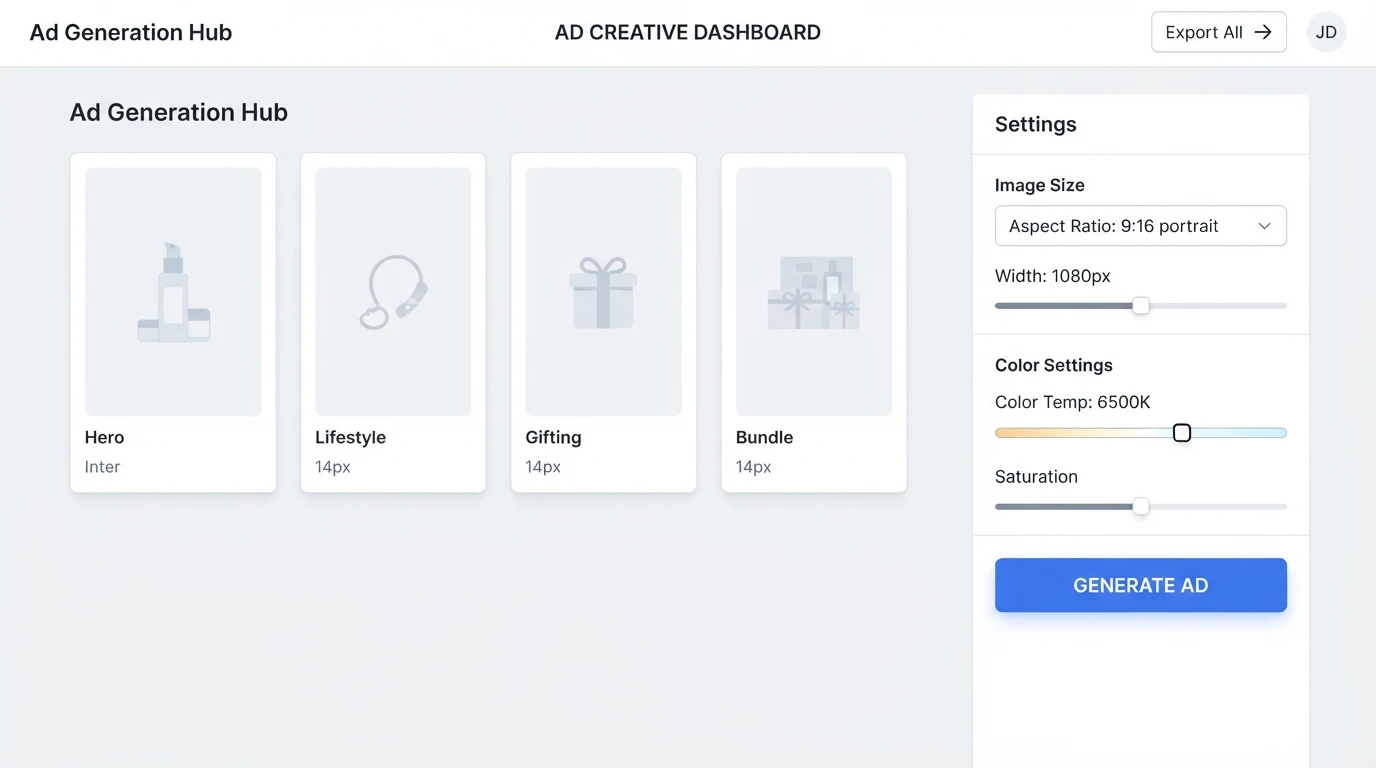
The Accuracy Guardrail Nobody Talks About
Black Friday is the most legally scrutinised window in the retail calendar. Promotional claims are checked, stock levels are inspected and ad copy is screenshotted by competitors. Three guardrails keep AI creative out of trouble.
- Never bake pricing or percentage off into the generated pixels. Offers change. Pixels do not. Version the overlay, not the render.
- Keep launch, reminder and last-call variants versioned cleanly. Each phase of the sale needs its own creative set with a clear naming convention so you can pull a variant mid-flight.
- Run a legal and stock-availability review before publishing. If a bundle sells out, the ad depicting it comes down. If a claim is softened, the overlay changes before the render reposts.
Measuring What Works and Iterating Fast
Volume without a testing cadence is just a bigger pile of mediocre creative. The rhythm the strongest accounts run during BFCM looks like a three-five-three loop: three days of learning on a fresh batch, five concepts in rotation at any time, three days to kill or scale. Any concept at one and a half times target CPA by day two gets paused. Winners get fed back into the generator as new reference material for the next wave of variants.
This is where AI compounds. A human creative team iterating on a winner produces two or three variants a day; an AI pipeline with the winner as a reference produces twenty, with controlled variation on lighting, framing and setting. The judgment stays human, the throughput becomes machine.
The Seven-Day Pre-BFCM AI Creative Sprint
If you are reading this with a week to go, run this calendar. If you are reading it earlier, stretch it across four weeks and double the output in each phase.
- Day 1: lock brand kit, product references and the five angle briefs.
- Day 2: generate four-grid exploration against all five angles. That is twenty concept starts.
- Day 3: shortlist the strongest grid per angle, generate three variants of each. Fifteen production-ready images.
- Day 4: convert the four strongest stills into motion for vertical video placements.
- Day 5: build the copy matrix: launch, reminder and last-call variants for every asset.
- Day 6: legal and merchandising review, bake the overlays, upload to the ad account.
- Day 7: structure the campaign for Advantage+ with the inventory ready to recombine, then launch into learning mode.
Frequently Asked Questions
Does AI ad creative actually outperform traditionally produced creative on Black Friday?
In isolation, no. The win is not AI versus traditional, it is cadence and variety. AI lets a small team run the volume and angle rotation that beats fatigue through Q4, which is what moves the metric.
How do I keep AI output on brand across hundreds of variants?
Lock the brand kit, product references and prompt skeleton before anyone generates anything, and treat every prompt as a template, not a freeform brief. Discipline at the input is what gives you consistency at the output.
Should I use AI for the product itself or just the environment?
Anchor the product with real reference imagery or packshots passed to the generator. Use AI for the environment, the lighting and the composition. Hallucinated products are the single biggest reason brands lose trust in AI creative.
How do I handle offer changes mid-sale?
Separate the offer from the pixels. Pricing, percentages and promo codes live in text overlays on top of the generated image, so when merchandising adjusts the offer you swap the overlay, not the render.
What about brand-safety risks from AI imagery?
Review every piece of output against a published brand-safety checklist before it goes live: no hallucinated logos, no accidental lookalikes of other brands, no claims rendered into pixels, no distorted hands or faces in hero placements. The scrutiny of Black Friday makes this non-optional.
Can I run the whole BFCM programme on AI creative alone?
Most brands run a hybrid: hero campaign assets are produced traditionally or with heavy human direction, while the long tail of variants, placements and iteration runs on AI. The ratio tilts further toward AI every year.
How early should I start generating?
Early October at the latest, so you launch into November with a tested creative library rather than learning in the window where CPMs are already inflated.
What is the one thing most teams get wrong?
Baking the price into the pixels. Everything else is recoverable; a creative library you cannot re-version in a day is a liability through the fastest-moving sale of the year.
Closing the Loop
Black Friday rewards the brands that treat creative as a system, not a shoot. The angle archetypes give you variety, the prompt skeleton gives you consistency, the offer-layer separation gives you speed, and the testing cadence gives you compounding returns on your winners. If you want a partner that runs this pipeline end to end for Q4, Absolutely AI builds the full AI social content programme for brands that need to show up at BFCM scale without losing the editorial bar their customers already expect.