AI Product Photography Cost in Australia (2026 Guide, in AUD)
Every AI product photography price list on the internet is quoted in USD, with no GST, no local context, and no honest comparison to what a Sydney or Melbourne studio would actually charge. This guide from Absolutely AI fixes that: real AUD figures for 2026, side-by-side with Australian studio rates, plus the hidden costs nobody puts on the landing page.
If you have tried to budget for AI product photography in Australia this year, you already know the problem. Every pricing page is in USD, most tools bury the commercial licence in a higher tier, and no one is honest about the hours of prompt iteration and hand-fixing that sit behind a "$1 per image" headline. This guide from Absolutely AI breaks down what AI product photography actually costs in AUD in 2026, what a traditional Australian studio charges for the same shot list, and where the money quietly leaks in between.
The short answer: what AI product photography costs in Australia
For most Australian brands in FY26, AI product photography lands in one of three price bands depending on how much creative direction you want wrapped around the tool. DIY per-image generation is cheap on paper, subscriptions get you volume, and an AI-native agency sits at the top of the range because it includes art direction, QA, and brand guardrails.
| Model | Typical AUD price | What you get |
|---|---|---|
| DIY per-image (Pebblely, SellerPic, Caspa) | $0.50 to $5 per image | Raw generation, you handle prompting, QA, licensing check |
| Subscription tools (Snappr, FoodShot AI, Rewarx) | $30 to $450 per month | Volume credits, some templating, USD billed with FX and GST layered on top |
| Agency-managed AI | Quoted per finished asset | Concept, art direction, brand-safe prompts, retouching, commercial licence |
All figures above are AUD ex-GST. Most global tools bill in USD, so at the July 2026 rate of roughly 0.66 USD per AUD you are paying about 15 percent more than the sticker price once GST is added on the Australian import. Budget accordingly on your BAS forecast.
How AI product photography pricing actually works
There are four pricing shapes in the market right now, and knowing which one you are buying is the difference between a $200 monthly line item and a $2,000 surprise. Subscriptions bundle a credit pool per month, credit-based tools charge per generation, per-image tools charge per download, and agency-run creative production charges per finished asset regardless of how many attempts it took.
The trap is what a "credit" or a "generation" actually buys. On most platforms one credit gets you a grid of four low-res options, and upscales, edits, or variations each cost another credit. A quoted price of 0.50 AUD per image often becomes 3 to 4 AUD by the time you have upscaled the winner and paid for two edit passes. Tools like Midjourney, Adobe Firefly, and Google's Imagen family all follow this pattern, and it stacks quickly across a campaign shot list.
Commercial licence is the other gotcha. Free and hobby tiers on almost every tool prohibit commercial use, which matters the moment the image runs on Amazon Australia, Shopify, Meta, or a printed catalogue. Read the licence before you brief a designer, and if in doubt talk to an agency that owns its licensing stack so the risk is not sitting on your marketing team.
AUD price bands by use case
Not every product shot has the same production floor. A white-background packshot for a marketplace listing is a solved problem, a hero campaign image for a homepage is not, and the pricing across the market reflects that gap. The table below is what Australian brands report quoting and paying in the first half of 2026, sourced from public rate cards on comparable AI product photography platforms.
| Use case | AUD per image | Notes |
|---|---|---|
| Marketplace white-background (Amazon, Shopify, eBay) | $0.50 to $2 | Highly automated, minimal art direction |
| Lifestyle and scene composites | $2 to $8 | Templated scenes, background swaps, some manual QA |
| Ghost mannequin and virtual try-on | $1 to $5 | Fashion and apparel, tool-specific |
| Ingredient and detail macro | $5 to $15 | Higher failure rate, more prompt iteration |
| Hero campaign imagery (agency delivered) | Quoted per project | Concept, retouching, commercial licence, revisions included |
The two ends of that range are not the same product. A 1 AUD marketplace image is a commodity output; a campaign hero is a directed piece of brand photography that happens to be produced with AI. Confusing the two is how brands end up with 400 flat marketplace shots and no homepage image worth using.
AI vs traditional Australian product photography, side by side
The honest comparison is not "AI is cheaper", it is "AI and a studio are two different tools for two different jobs". A traditional Sydney or Melbourne product shoot in 2026 sits in these bands, based on published rate cards and quotes we see clients bring in when they engage our agency team.
- Freelance or emerging Australian product photographer: $300 to $800 per half-day session, usually 10 to 20 finished images.
- Mid-tier commercial photographer: $1,200 to $2,500 per day, plus retoucher fees at $80 to $150 per hour.
- Studio hire alone (Alexandria, Collingwood, Fortitude Valley): $500 to $800 per day for a lit product bay.
- Food and hospitality stylist day rate: $600 to $1,200 on top of the photographer.
Run the maths on a real 20-SKU brief. Traditional route: one mid-tier photographer at $2,000, half-day stylist at $600, retoucher for a day at $800, studio at $700. That is $4,100 for one look per SKU, roughly $205 per finished hero. AI route through an agency-managed pipeline: the same 20 heroes with three variations per SKU included, so 80 usable assets rather than 20, quoted as one scoped project. The AI route wins on volume and turnaround; the studio wins when the product's tactility or the founder's face has to be in frame.
The hidden costs nobody quotes you
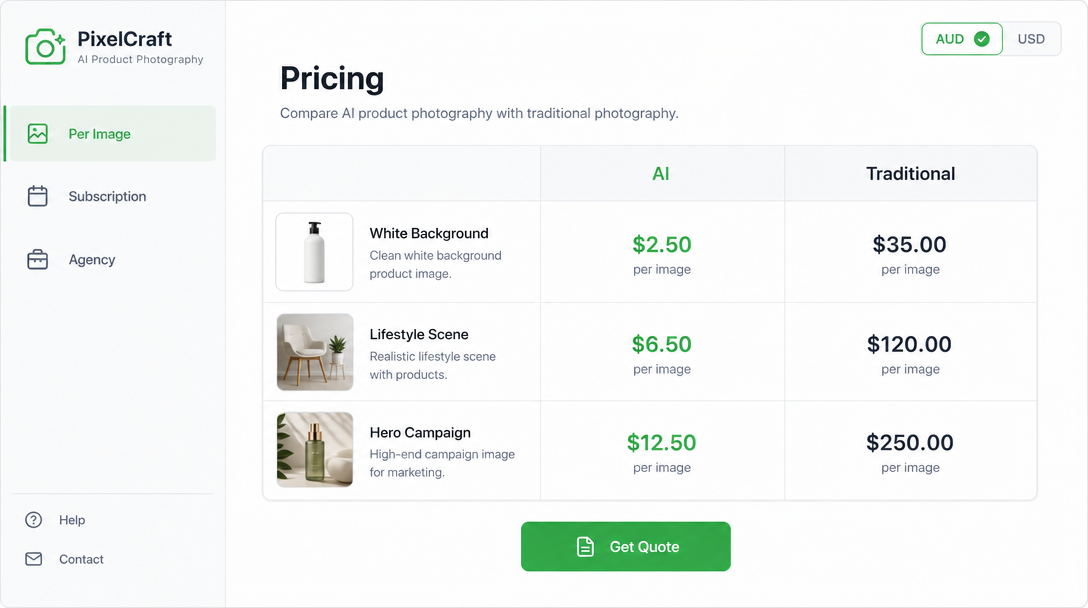
The sticker price on any AI tool ignores the labour that turns a raw generation into an on-brand asset. In practice, most in-house teams underestimate this by a factor of three, which is what makes the DIY route feel deceptively cheap until the quarter's marketing report lands.
- Prompt iteration: 20 to 40 minutes per hero shot for a non-specialist, closer to 5 minutes for a trained operator.
- Hand, limb, and label fixes: budget 15 to 30 minutes per image where a person interacts with the product.
- Retoucher time to production-clean an image: $60 to $120 per shot at Australian freelance rates.
- Brand-guideline drift: the quiet cost of an image that looks fine in isolation but sits wrong next to the rest of the feed.
- Licensing and provenance checks on training data, particularly for regulated categories like health, alcohol, and finance.
At $80 per hour of internal marketing time, a "$2" image can quietly cost $50 to $80 finished. That gap is where an AI product photography agency earns its margin: the per-image price is higher, but the fully loaded cost including your team's hours is usually lower.
What Australian brands are actually paying
A few anonymised snapshots from FY26 client work and briefs we have costed through our branding studio, to give a sense of real spend rather than list prices.
- DTC skincare brand, 40 SKUs, monthly refresh: hero plus lifestyle plus ingredient macros every month, replacing a previous studio spend of $9,000 per quarter.
- Hospitality group, 6 venues, seasonal menu photography: a full menu refresh across all venues, replacing a $12,000 studio brief.
- Fashion ecom, 120 SKUs per drop: ghost mannequin, three lifestyle scenes, and social crops for every SKU.
- Homewares brand, catalogue and social: around 300 assets across formats every quarter.
When to still hire a human photographer in Australia
An honest AI agency will tell you when not to use AI. Founder portraits for a PR profile, tactile texture where the material has to be sold on touch, food styling for print where the shine on a sauce is the whole story, and editorial shoots for magazines that will not accept AI imagery still belong with a human photographer. If any of those describe your brief, budget for the traditional route and add AI-generated social cutdowns around it.
How to budget for AI product photography in FY26
Treat AI product photography as a marketing expense line, not a tools line. It is fully deductible in Australia when used for business, GST is claimable if you buy from a registered Australian supplier, and offshore SaaS is handled under the standard imported-services rules on your BAS. Speak to your accountant, but the practical takeaway is that agency-managed AI billed in AUD with a tax invoice is the cleanest treatment for most SMEs, and one reason clients move from DIY tools to an Australian agency.
For volume planning, the honest rule of thumb is that the budget follows cadence and breadth: a growing DTC brand refreshing content weekly sits well below a multi-brand retailer, and a campaign launch is scoped as a one-off brief rather than folded into the monthly line. Marketplace policies also matter: Amazon Australia and Shopify both permit AI product imagery provided it accurately represents the product, while Meta and TikTok ads are increasingly rejecting images with obvious AI tells such as extra fingers or melted labels, which is another reason QA and retouching matters more than raw generation cost.
Frequently Asked Questions
Is AI product photography tax deductible in Australia?
Yes, when used for business purposes it is a deductible marketing expense. GST is claimable on AUD invoices from registered Australian suppliers, and offshore SaaS is handled through the imported-services rules on your BAS. Confirm with your accountant.
Do I own the AI-generated images?
It depends on the tool's licence. Most paid commercial tiers grant you a commercial-use licence to the outputs, but almost no jurisdiction, Australia included, grants copyright on purely AI-generated images. Agency-delivered work usually assigns rights via the service agreement.
Can I use AI product images in Meta and TikTok ads?
Yes, but both platforms are tightening enforcement in 2026. Images with obvious AI artefacts, incorrect product details, or misleading claims are being rejected or throttled. Cleaner, brand-accurate imagery clears review reliably.
Do Australian marketplaces allow AI imagery?
Amazon Australia, Shopify, eBay Australia, Catch, and MyDeal all permit AI-generated product imagery provided it is accurate and non-misleading. Some regulated categories such as health, therapeutic goods, and alcohol have stricter substantiation rules.
Is AI cheaper than a Sydney or Melbourne photographer?
On volume yes, on singular hero imagery not always. The break-even point for most brands is around 30 to 40 SKUs; below that a half-day studio session is often more efficient, above it AI wins clearly on cost per finished asset.
How long does an AI product shoot take?
An agency-run 20-SKU brief typically turns around in 3 to 5 business days including revisions, versus 2 to 3 weeks for a comparable traditional shoot once scheduling, shooting, and retouching are included.
What is the cheapest legitimate AI product photography option?
For DIY marketplace shots, Pebblely, SellerPic, and Caspa sit around 30 to 50 AUD per month for a few hundred credits. For commercial-grade brand work, an agency retainer is cheaper per finished usable image than any DIY tool once your team's hours are counted.
Do I need a photographer at all in 2026?
For product-only imagery, increasingly no. For founder portraits, editorial features, tactile texture, and print food photography, yes. A blended model with a photographer for hero moments and AI for volume is where most Australian brands are landing.
Getting the numbers right for your brand
The real answer to "what does AI product photography cost in Australia" is that it costs whatever you decide to invest in creative direction on top of the raw tool. The tools themselves are close to a commodity; the difference between a throwaway marketplace image and a campaign hero is the brief, the QA, and the brand thinking wrapped around it. If you want a costed proposal against your actual FY26 shot list, in AUD, with GST invoiced locally, Absolutely AI quotes per project rather than per credit, so you know the finished number before the first render lands.