AI Christmas Ad Production for Australian Brands: 2026 Playbook
When Mirakl's 'Santa Quits' dropped and Coca-Cola doubled down on its AI-remade 'Holidays Are Coming' for a second year, Australian marketing teams stopped asking whether generative AI could carry a Christmas campaign and started asking how fast they could ship one. Absolutely AI has been running these pipelines for local brands facing a Q4 deadline, and the honest answer is four to six weeks, not a year. This playbook is the operator's version: timelines, model stack, local creative traps, and what to brief.
Australian marketing teams are walking into Q4 with a window that keeps shrinking. The run from Melbourne Cup through Black Friday and into Boxing Day used to be bookended by a traditional TVC shoot locked in by August. In 2026 that calendar has collapsed, and generative AI is why. Absolutely AI runs this work as a repeatable four to six week pipeline for brands that need a hero spot, cutdowns for Meta and TikTok, and OOH stills, all shipped from one creative brief. The frame is simple: AI Christmas production is no longer a novelty slot, it is a commercial production discipline with its own craft.
Why Australian Brands Are Moving to AI for Christmas 2026
The proof points landed fast this year. AiCandy's fully AI-generated Mirakl film 'Santa Quits' showed a narrative holiday spot could be built end-to-end in generative tools and still carry a joke. Coca-Cola returned with a second-year AI remake of 'Holidays Are Coming' after absorbing the lessons from the 2024 backlash. Closer to home, Telstra's 'Free Calls to Santa' work with OMD Sydney leaned on generative AI for execution inside a broadcast campaign, which quietly normalised the approach for Australian media buyers.
Three forces are pushing local brands onto this track. Media costs for Q4 are up and planners want more variants per dollar, which traditional production cannot deliver without a bigger shoot budget. Second, the Australian Christmas window is physically short, with talent, locations and post houses booking out from September. Third, boards have seen the Coca-Cola CMO quote circulating about a one month turnaround at a lower cost per spot, and they want the same conversation with their marketing agency.
What an AI Christmas Ad Actually Costs vs a Traditional TVC
Pricing conversations get muddy fast, so start with the shape rather than the number. A traditional 30 to 60 second Australian Christmas TVC is a multi-month build: pre-production, a shoot week, talent, locations, grade, sound, finish. The AI pipeline replaces the shoot and most of the location and talent cost with generation and selects, and keeps the edit, grade, sound design and clearance work intact. That last point matters: readers often assume AI collapses the entire budget, when in reality the back half of post still looks like a conventional project.
The hidden costs are where briefs go wrong. Coca-Cola generated roughly 70,000 clips to land its final cut, which is the real signal: generation is cheap per second, but selects, prompt iteration and continuity work are not. Music licensing, voice talent (or a licensed synthetic voice from ElevenLabs), colour grade and final mix all remain line items. For a realistic scoping conversation on an Australian spot, see our breakdown on AI commercial vs traditional TVC cost. Absolutely AI quotes per scope after a brief review rather than publishing a rate card, because the variance between a single hero film and a full 9:16 and OOH matrix is enormous.
The 4 to 6 Week Production Pipeline
This is the shape we run for Australian Christmas work. It assumes the brand arrives with a product, a rough proposition and a media plan, and leaves with broadcast, social and OOH masters.
- Week 1 — Strategic brief and concept exploration. Brand bible intake, hero product references, must-avoids, moodboard, three concept directions presented as still frames and a written treatment.
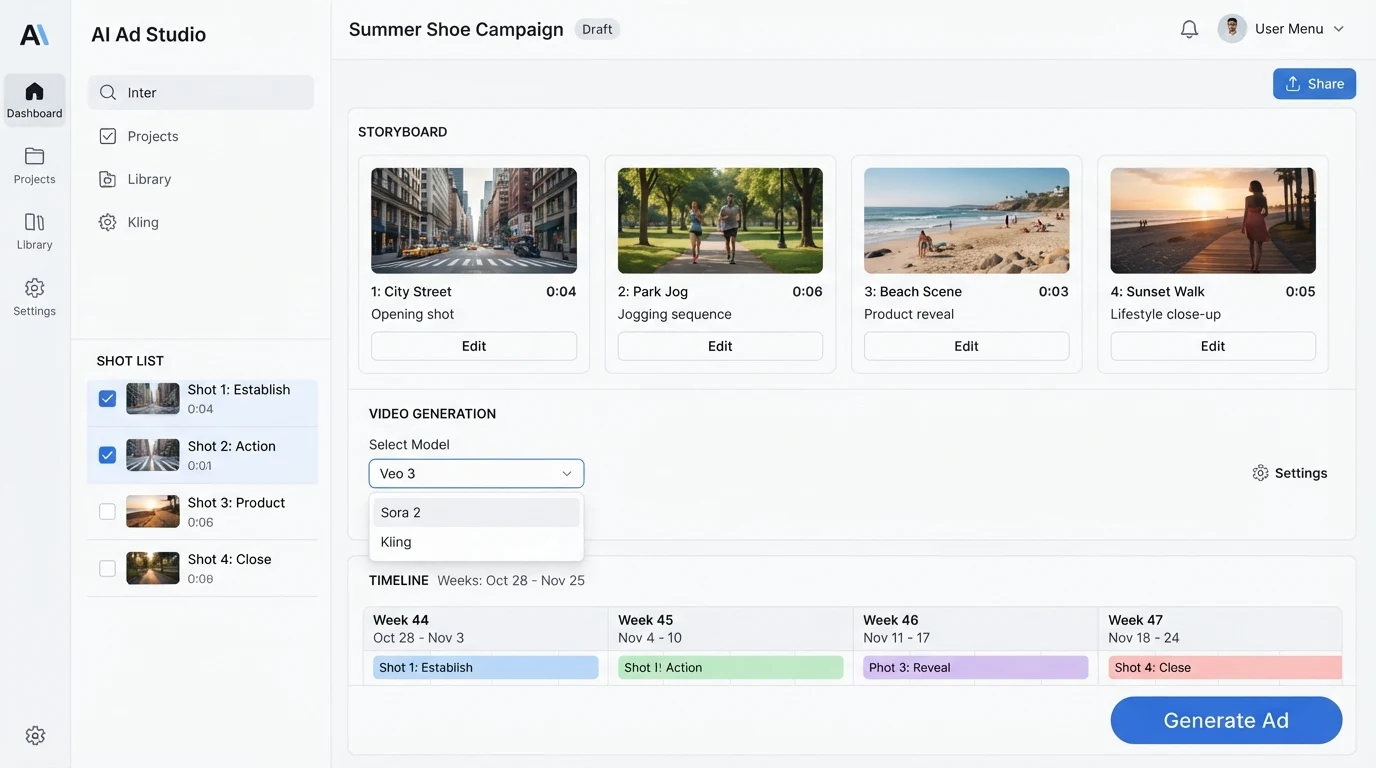
- Week 2 — Storyboard, shotlist and engine selection. Chosen concept locked, shot-by-shot storyboard built as AI stills, model stack decided per shot type, voice and music direction briefed.
- Weeks 3 to 4 — Generation and selects. Hero shots generated in Veo 3 and Sora 2, stylised sequences in Kling or Runway Gen-4, stills for OOH in Nano Banana or Flux. Daily selects review with the client.
- Week 5 — Edit, grade, sound design, music clearance. Offline cut, VO record (human or licensed synthetic), score composed in Suno or commissioned, final grade for broadcast delivery.
- Week 6 — Delivery specs. Broadcast TVC master, YouTube 16:9, Meta and TikTok 9:16 cutdowns, OOH stills, radio edit if required, all captioned and QC'd for AANA review.
Four weeks is the aggressive version, used when the brief is tight and the brand has strong existing assets. Six weeks is the honest version when the campaign includes bespoke music, a licensed voice and a full OOH matrix. Teams that try to compress below four weeks usually blow the selects phase and ship a spot with continuity errors, which is the single most common failure mode in AI commercial production.
Choosing Your Model Stack for a Christmas Spot
No single model wins every shot. The craft is matching the engine to the shot type, which is where generalist tools and generalist operators lose quality. The current working stack for Australian Christmas work looks like this:
| Shot type | Primary engine | Why |
|---|---|---|
| Hero cinematic (talent, product, narrative beats) | Google Veo 3 | Camera motion, lighting consistency, native audio bed, best for broadcast finish |
| Stylised or hyperreal sequences | OpenAI Sora 2 | Stronger on abstraction, physics-defying moments, dream sequences |
| Kinetic transitions and effects | Kling or Runway Gen-4 | Faster turnaround on short beats, better for VFX plates |
| Stills for OOH and key art | Nano Banana or Flux | Resolution and prompt adherence for print finish |
| Score and sound design | Suno (score), licensed catalogue (sync) | Original composition with clear rights trail |
| Voice and narration | ElevenLabs licensed voices or human VO | Pick licensed synthetic for scale, human for hero |
The combination matters more than any single model. A broadcast spot with Veo hero shots, a Kling-driven title sequence and Nano Banana stills, cut together with a Suno score and ElevenLabs VO, reads as one piece of craft because the AI film pipeline treats each engine as a department rather than a replacement for the whole crew.
The Australian-Specific Creative Traps
The default aesthetic every US-trained model falls back to is a snow globe. North American references dominate the training data: snow, pine, fireplaces, red barns, puffer jackets. Australian Christmas is the opposite: beach, backyard, cricket, mangoes, lamingtons, 35 degree heat. Operators who prompt lazily get a spot that looks like it was made for Minnesota, and Australian audiences notice immediately. Prompting in local signifiers from the first storyboard, not as a late-stage patch, is the fix.
The second trap is uncanny-valley talent. The Coca-Cola 2024 backlash was not about using AI, it was about the trucks and the crowd reading as off. Faces, hands, product labels and crowd shots are still the hardest surfaces for generative video. The working rule on our set is simple: if a shot needs a clean human face at full resolution, either build it as a stylised sequence where the aesthetic absorbs the imperfection, or shoot a live-action plate and composite. Pretending the model will land it is how campaigns ship with uncanny energy.
The third trap is compliance. The AANA Code of Ethics applies to AI-made ads exactly as it applies to live-action, and the industry is converging on clear AI disclosure norms for broadcast and social placements involving synthetic humans or synthetic voices. Build disclosure into the brief at concept stage, not at delivery. For a deeper look at local considerations, see our notes on AI commercial production in Australia.
What to Brief Your Agency (or In-House Team)
A lean marketing team can run this process well if the brief is tight. The handover kit we ask for on day one is short and specific:
- Brand bible. Logo files, type system, colour values, tone of voice document, product photography and any existing brand film references.
- Hero product references. Clean cut-outs, front and three-quarter views, dieline or 3D if the product features in-shot.
- Must-avoids. Competitor visual territory, retired taglines, flagged talent likenesses, cultural references the brand has moved away from.
- Delivery specs. Broadcast standard required (if any), social aspect ratios, OOH dimensions, caption format, closed captioning needs.
- Media plan. Where the work is running, which placements are hero versus cutdown, and the first-air date for scheduling backwards.
- Legal contact. Who inside the brand signs off on music clearance, voice licensing and AI disclosure wording.
The quality of this kit is the single biggest predictor of whether a six week pipeline ships on time. Teams that arrive with half of it usually lose a week to intake. If you want a reference frame for what good looks like, our note on lessons from Coca-Cola's AI Christmas work covers the brief-side mistakes publicly.
Frequently Asked Questions
Is it legal to run an AI-made ad in Australia?
Yes. Australian advertising law does not prohibit AI-generated content. The usual consumer law, intellectual property and AANA Code obligations apply the same way they would to live-action work, which means truth in advertising, respect for talent likeness rights and appropriate disclosure. Specific legal, licensing and rights questions should go to a qualified adviser; our team can introduce one via contact.
Do we need to disclose AI use?
The industry is converging on clear disclosure where synthetic humans or synthetic voices appear in broadcast or paid social placements. Expectations vary by platform and by the degree of synthesis, so the pragmatic answer is to design disclosure wording into the campaign at concept stage, agree it with the brand's legal contact, and treat it as a creative asset rather than a sticker added at delivery.
How many revisions should we budget for?
Fewer than people assume. Generation is cheap, but changes that cross the storyboard (a new scene, a reshaped narrative) are expensive because they ripple through selects, edit and sound. We budget two full revision rounds at offline edit stage and treat concept-level changes as a scope reset. The best protection against revision bloat is a tight concept lock in Week 1.
Can we use real talent likeness?
Only with the talent's written consent and a licence that covers synthetic replication. The industry is moving fast on this, and the safe default is: cast a real person for hero human shots and composite, or use clearly stylised AI-generated people where no specific likeness is implied. Trying to replicate a public figure without a licence is a legal and reputational trap.
Can one agency run both the hero film and the social cutdowns?
Yes, and it is the preferred model. Running the hero and the social ad creative through one team keeps the aesthetic consistent across placements and avoids the version-control nightmare of hand-offs between a TVC house and a social shop. One brief, one model stack, one delivery.
What is the latest sensible start date for a Christmas 2026 campaign?
Working backwards from a mid-December first-air date, a six week pipeline wants a locked brief by the first week of November, and a four week aggressive version can push to mid-November if the brand assets are ready on day one. Later than that and the window closes.
Christmas 2026 is the first year where an Australian brand can honestly treat AI production as a dependable Q4 option rather than an experiment. The craft is in the pipeline discipline, the model stack and the local creative instinct, not in any one tool. If you want to run a Christmas spot on this timeline, Absolutely AI builds this work for Australian brands and agencies.