AI Visual Identity Generation: How Agencies Build Full Brand Systems in Hours
AI visual identity generation has moved past the logo-maker era. In 2026, a full brand system, marks, type, palette, imagery direction, motion and voice, can be explored and codified in days rather than months. At Absolutely AI, we treat the models as executors and the creative director as the conductor, which is the only way the output holds together as a real identity.
Every week another founder asks whether they can skip the brand agency and let an AI tool spit out a logo. The honest answer is that the tools have raced ahead of the workflows, and the gap between a Midjourney mark and a working brand system is where most projects fall over. This piece unpacks how a modern AI branding pipeline actually runs, what it delivers, and where humans still have to hold the pen.
What AI Visual Identity Generation Actually Means in 2026
The phrase covers a lot of ground, so it helps to separate the layers. A logo maker like Looka or Tailor Brands generates a mark and calls it done. A visual identity generation workflow, by contrast, produces a full stack: primary and secondary marks, type pairings, a color system with tokens, imagery direction, motion principles and a voice framework. It is closer to what a traditional branding studio delivers, only compressed and iterated at machine speed.
The distinction matters commercially. A logo is a component; an identity is a system that a marketing team can actually run against across every channel. Agencies that treat AI as a logo shortcut end up shipping the same thing a $49 tool would, which is why the difference between an AI content studio and a traditional studio lives in the systems layer, not the render layer.
The Core Stack Doing the Work
No single model handles the whole job. A working pipeline blends generative models with system tools, each picked for what it is genuinely good at.
- Midjourney: still the strongest tool for exploratory concept exploration, moodboards and imagery direction. Weak on typography and vector output.
- DALL-E and GPT Image: better at rendering legible text inside an image and following tight compositional instruction, which makes them useful for mocks and applied identity work.
- Adobe Firefly: the commercial-safe generator, and the one plugged into Illustrator and Photoshop for vector cleanup and retouch.
- Ideogram and Flux: strong on typographic experimentation and stylised wordmarks, useful in the early exploration phase.
- Figma AI and Typeface: system-layer tools for token generation, component variants and applied brand output at scale.
- Luma Creative Agents and Project Fizziona (Coca-Cola x Adobe): enterprise-grade systems that lock a fine-tuned brand model behind guidelines so downstream teams cannot drift.
The stack is not the interesting part, though. The interesting part is the workflow that sits on top of it, which is where an AI creative agency earns its keep.
The Agency Workflow We Actually Run
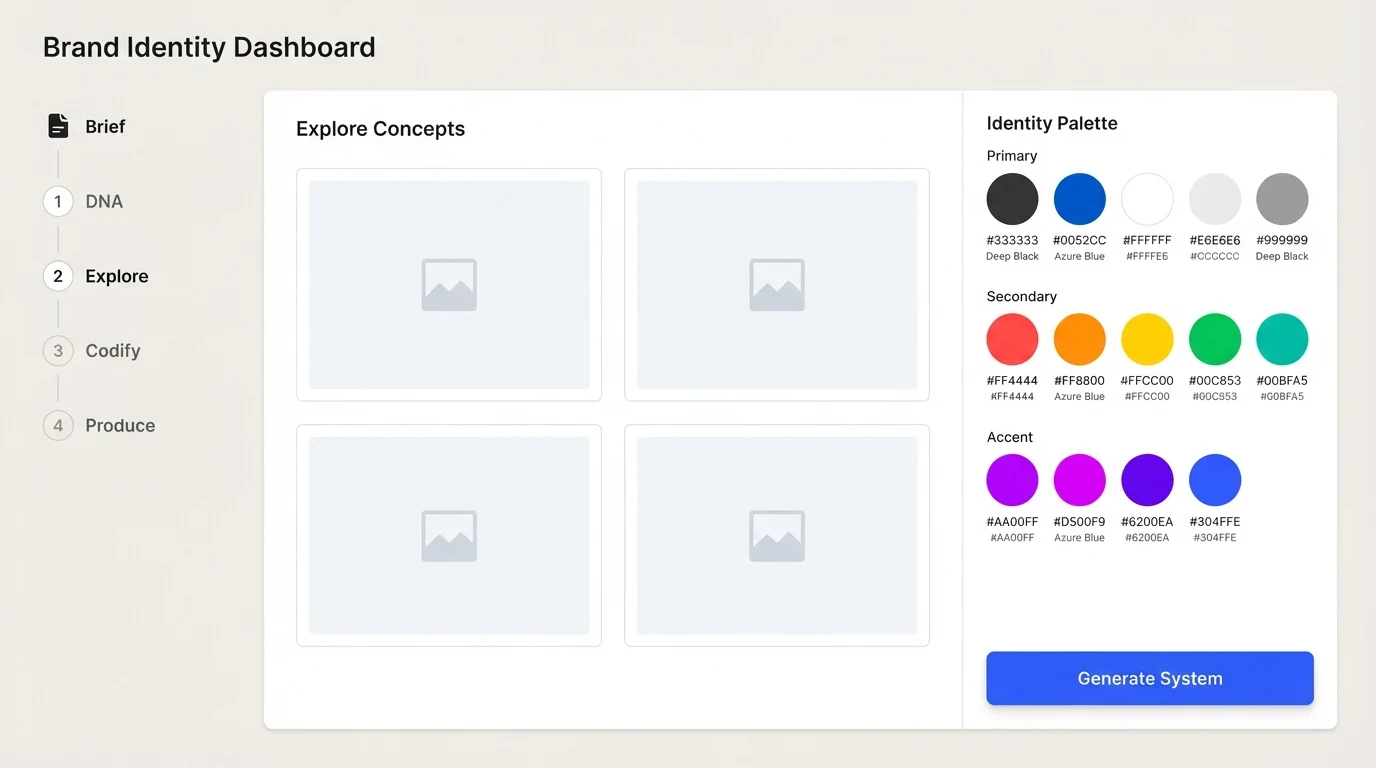
The pipeline we use for identity work is a five-step loop. It is the same shape a traditional branding studio would recognise; the difference is the volume of exploration inside each step and the speed of the handoffs.
- Brief intake and interrogation. Positioning, audience, competitive set, business goals, tone. No model input yet. This is the strategy layer and it is entirely human, because the models cannot decide what the brand is for.
- Brand DNA extraction. The brief compresses into a short DNA document: three tone anchors, five reference brands to lean toward, five to actively avoid, and a written point of view. This document becomes the prompt substrate for every downstream generation.
- Concept exploration at volume. Fifty logo directions, thirty type pairings and twenty palettes in the first afternoon. This is where AI genuinely changes the economics. A traditional studio shows three routes; we show thirty and then ruthlessly cut.
- System codification. The chosen direction is broken into design tokens, usage rules, do and dont examples, and a live component library. This is the step most AI-only shops skip, and it is why their output does not survive contact with a marketing team.
- Asset production and channel adaptation. Every deliverable a launching brand actually needs, rendered against the locked system across every aspect ratio and channel a modern brand runs on.
Humans direct, models execute, guidelines enforce. That is the entire operating model, and it is what separates identity work from novelty generation, in the same way a full agency differs from a solo freelancer on ongoing content.
Solving the Brand Drift Problem
Consistency is the unsolved gap in most AI branding work. A model that produced a perfect hero image on Monday will produce something 20 percent off on Wednesday, and by the end of the quarter the identity has quietly dissolved. Four techniques hold it together in practice.
- Design tokens. Color, spacing, radius, type scale and motion values live in a machine-readable file that both humans and models reference. When the token changes, everything downstream changes with it.
- Reference image locking. Every generation call passes a fixed set of style references so the model is anchored rather than freewheeling.
- LoRA and style fine-tunes. For larger brands, we train a small style adapter on the approved identity so the base model can only produce output within the brand envelope.
- Human QA loops. A senior designer reviews every batch against the guidelines before anything leaves the studio. This is not optional.
The Coca-Cola x Adobe Project Fizziona rollout is the clearest proof point in the market. They fine-tuned a house model on decades of brand assets and put it behind a guidelines gate, so agencies and internal teams can generate on-brand work without a human approving every frame. That is the direction serious identity systems are heading.
Timeline and Cost Reality
The comparison people actually want to see is against a traditional 12-week branding engagement. Here is how the phases map.
| Phase | Traditional studio | AI-assisted workflow |
|---|---|---|
| Discovery and strategy | 2 to 3 weeks | 2 to 3 days |
| Concept exploration | 3 to 4 weeks, 3 routes | 1 to 2 days, 30+ routes |
| Refinement and system | 3 to 4 weeks | 2 to 3 days |
| Guidelines and asset production | 2 to 3 weeks | 1 to 2 days |
| Total elapsed | 10 to 14 weeks | 5 to 10 working days |
| Pricing model | Fixed-fee project | Quoted per scope after a brief review |
The compression is real but it is not free. It requires a strategist and a creative director who can move at the pace the tools allow, which is a different hiring profile from a legacy studio. For teams weighing this against ongoing content work, our breakdown of AI content retainer structures covers how the same operating model extends past the launch.
When Not to Use AI Identity Generation
There are three situations where we advise clients to slow down or route around the AI path entirely.
- Heavily regulated industries. Pharma, financial services and defence carry mark-approval processes that were not written with generative tooling in mind. The friction is not worth the speed gain.
- Heritage rebrands. If the equity in the existing identity is measured in decades, the risk of subtle drift from a generative pipeline outweighs the exploration benefit. Human hands on every curve.
- High trademark-risk marks. Any wordmark or symbol destined for aggressive IP protection needs a clearance-first workflow. Generative tools trained on the open web are the wrong starting point.
For everyone else, and that is the majority of DTC brands, B2B challengers and new ventures, the workflow described above is now the default path, which is one reason DTC brands are consolidating around AI-native creative partners.
Frequently Asked Questions
Can AI generate a full brand identity or just a logo?
A properly structured workflow can produce a full identity: marks, type system, color tokens, imagery direction, motion principles and voice framework. Off-the-shelf logo makers cannot; they stop at the mark. The difference is the system layer and the human direction wrapped around the models.
Which AI tools are used for visual identity work?
Midjourney and Flux for exploration, DALL-E and Firefly for applied and text-in-image work, Ideogram for wordmarks, Figma AI and Typeface for system output, and enterprise stacks like Luma Creative Agents or a Fizziona-style fine-tune for consistency enforcement at scale.
How is brand consistency maintained across AI-generated assets?
Four layers: machine-readable design tokens, locked reference images passed into every generation call, LoRA or style fine-tunes trained on the approved identity, and human QA against the written guidelines. Skip any of those and drift creeps in within weeks.
How long does an AI-assisted identity project take?
Five to ten working days end to end for a launching brand, versus 10 to 14 weeks for a traditional studio engagement. The compression comes from exploration volume and faster handoffs, not from cutting the strategy phase.
Is AI-generated brand work commercially safe to use?
It depends on the tools. Firefly and enterprise fine-tunes offer commercial indemnity; open-web-trained models do not. Any mark destined for trademark registration should go through a clearance workflow before it is finalised, regardless of how it was generated.
When should we not use AI for brand identity?
Heavily regulated industries, heritage rebrands where the existing equity is decades old, and any project where the mark carries high trademark or IP risk. In those cases, the speed gain does not offset the workflow friction or the drift risk.
Do we still need a creative director if AI does the generation?
More than ever. The models produce volume; someone still has to interrogate the brief, extract the DNA, cut ruthlessly through the exploration and hold the line on quality. Without a director, an AI branding pipeline produces thirty variations of the wrong thing very quickly.
What does an AI branding engagement actually deliver?
A written strategy and DNA document, a locked visual system with tokens, a full guidelines document, a component library, and a first wave of applied assets across the channels the brand is launching on. In other words, everything a marketing team needs to run against on day one.
Visual identity generation is no longer a novelty layer bolted onto a branding project; it is becoming the default operating model for teams that want to move at market speed without giving up craft. If you are weighing a launch or rebrand and want to see how this pipeline runs against a real brief, Absolutely AI runs the workflow end to end as an AI creative agency, from strategy through to the applied system.