The AI Brand Identity Design Process: A 7-Stage Workflow
AI has collapsed the production side of identity design, but the strategic ten percent at the front and the taste judgment at the back are still what make a brand feel like a brand. At Absolutely AI we treat identity work as a hybrid process where AI accelerates divergence and humans own strategy, selection, and systemisation. Here is the seven-stage workflow we actually use.
Most articles about AI branding pitch the technology as a magic shortcut: feed a prompt, receive a logo. That framing misses what identity work actually is. A brand identity is a decision system, not a picture. The picture is the easy part, and that is the part AI is good at. The decisions are the hard part, and those still belong to humans. The workflow below is the one our studio runs when we take on an identity brief, and it leans on AI branding tools to compress weeks of production into days without compressing the thinking.
Why the identity process changed in 2026
Three years ago an identity engagement ran twelve to sixteen weeks: discovery, two rounds of concepts, a round of refinements, system build, and a guideline document. In 2026 the production stages compress to two or three weeks, but the strategy stages have grown, not shrunk. The reason is simple: when you can generate a hundred logo marks in an afternoon, the brief is the only thing stopping you from drowning. See our overview of what an AI branding agency actually does for the broader context.
The other shift is from linear to cyclical. Identity used to be a project with a launch date. Now it is a living system that re-tunes itself against campaign performance, channel formats, and audience feedback. Teams that treat the handoff as the end of the job are shipping half the product.
Stage 1: Strategic discovery (still human)
Every project begins with a strategy doc that nobody generates with a model. We interview the founder, map the audience, write the positioning line, pick two or three brand archetypes, and define the emotional territory the identity needs to occupy. The deliverable is a two-page document that reads like a brief but functions like a prompt backbone: every subsequent AI call references it.
If this stage is skipped or rushed, everything downstream drifts toward the generic AI aesthetic (soft gradients, geometric sans serif, pastel palette, inoffensive mark). The strategy doc is what pulls the output back toward a specific brand rather than a plausible one. Our AI consulting engagements almost always start here.
Stage 2: AI-assisted research and competitive scan
With the strategy locked, we use Perplexity, GPT, and Claude to run a category audit: who else is in the space, what visual territories they occupy, where the whitespace sits. The output is a visual territory map plotting competitors against two axes we define per project (often formality vs. warmth, or heritage vs. futurism).
The point of this stage is not to find a gap and fill it. It is to make sure we do not accidentally land on top of a competitor's existing mark, palette, or type voice. The scan takes a few hours instead of the week it used to take.
Stage 3: Moodboard and visual territory generation
Now the generative tools come in. We write three to five directional moodboards keyed to the strategy doc, each exploring a different interpretation of the positioning. Midjourney handles atmospheric and photographic references, Lovart is strong for graphic and editorial directions, and Recraft covers vector-forward territories. Each moodboard is a tight set of twelve to twenty images with a one-line thesis.
The prompts reference the strategy explicitly: archetype, audience, emotional register, and two or three anchor adjectives drawn from the doc. Generic prompts ("minimalist logo moodboard") produce the generic AI aesthetic. Prompts anchored to a specific archetype and audience produce something a client can react to.
Stage 4: Logo divergence
Once a client picks one or two moodboard directions, we move into mark generation. This is where AI earns its keep. For each direction we generate fifty to a hundred marks using a layered prompting workflow: a base prompt describing the mark type (wordmark, monogram, symbol), a style modifier drawn from the moodboard, and a constraint clause (single colour, flat, suitable for favicon).
From the raw set we cull aggressively down to three contenders per direction. Culling is a taste call. The three survivors go into vector cleanup: Illustrator for refinement, Vectorizer.AI for conversion of raster outputs, and Recraft for native vector regeneration when geometry needs tightening.
Stage 5: Typography, colour, and system components
With a chosen mark, we build the surrounding system. Type pairing uses Fontjoy and Monotype's AI pairing tools as a starting point, but every pairing gets stress-tested manually against the mark at display, body, and caption sizes. AI-generated type pairings often look great in isolation and collapse under real layout pressure.
Colour palettes come out of the moodboard rather than a generator, but we run every palette through WCAG contrast checkers for accessibility compliance across text, iconography, and UI states. Grid systems, iconography, and photographic direction get sketched here too. For brands that will need bespoke imagery, this is also where we scope the AI brand photography system that will live alongside the identity.
Stage 6: Adaptive identity assembly
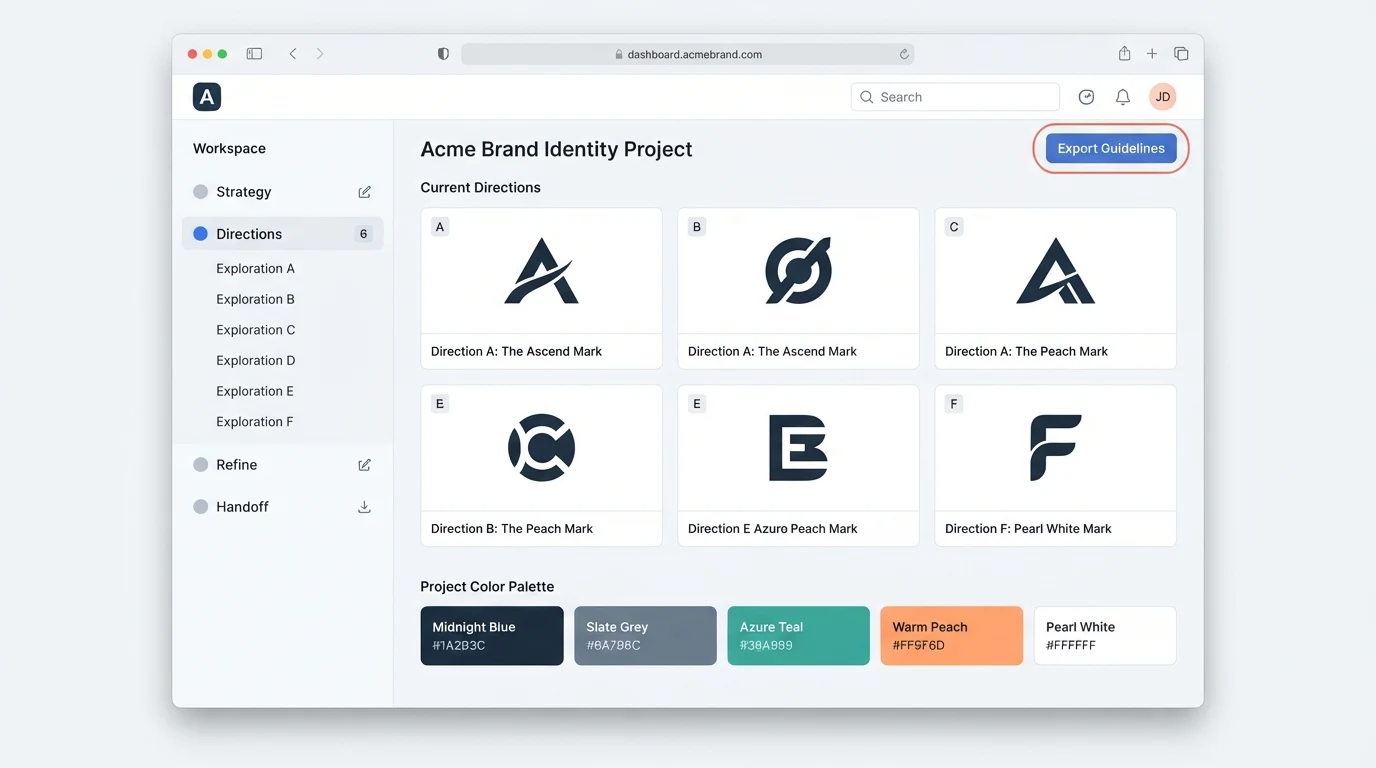
Here is where 2026 identity work diverges most from the old process. Instead of a single logo lockup with rigid clear-space rules, we build an adaptive system: a responsive mark that simplifies at small sizes, motion variants for video and social, voice-tuned copy variants per channel, and a set of modular layouts that recombine across formats. The deliverable looks less like a logo file and more like a kit.
This matters because the brand will live in formats nobody can predict at launch: new social surfaces, new ad units, new product categories. A system that bends gracefully is worth more than a single beautiful lockup. Our social ad creative work routinely depends on identity systems that were designed to flex this way.
Stage 7: Guidelines, handoff, and the living brand
The final stage produces the guideline doc, the Figma library, and the asset handoff. AI helps draft the guideline copy and generate example applications, but a human editor reviews every page: AI tends to over-explain the obvious and under-explain the judgment calls. The Figma library ships with components, text styles, and colour tokens wired for easy export.
The handoff is where most engagements end. We treat it as a milestone, not a finish line. Every quarter we re-audit the system against campaign performance, channel changes, and anything the client wants to extend. The identity gets small adjustments as it learns what works in market. Teams running continuous content creation especially benefit from this cadence.
Where AI still fails
Four failure modes recur. The first is the generic AI aesthetic: soft, safe, derivative, instantly dated. The fix is strategic specificity in the prompt and ruthless culling. The second is trademark overlap: generative models have seen every mark in every database, and they will cheerfully produce something that already belongs to someone else. Every shortlisted mark needs a trademark search before it goes further.
The third is hallucinated typography: AI will render letterforms that look right at glance and fall apart on inspection. Never ship a mark with AI-rendered type without rebuilding it in vector. The fourth is cultural nuance: colour meaning, symbol associations, and language register vary by market, and a model trained mostly on English-language visual culture will miss things a human strategist catches.
Timeline and cost: traditional vs. AI-hybrid
| Factor | Traditional agency | AI-hybrid studio |
|---|---|---|
| Timeline | 12 to 16 weeks | 2 to 4 weeks |
| Concept volume | 3 to 6 directions | Dozens of directions, hundreds of marks |
| Revision cycles | 2 to 3 rounds | Continuous, same-stage iteration |
| System output | Static logo lockup + guideline PDF | Adaptive system, motion variants, Figma library |
| Post-launch | Project closes at handoff | Quarterly re-tuning against performance |
| Pricing model | Fixed project fee | Quoted per scope after a brief review |
The compression is real, but it is not the main story. The main story is that the AI-hybrid output is a different kind of product: a system that keeps working rather than a document that gets filed. Studios shipping commercial creative at pace need identities that behave like software, not like posters.
Frequently Asked Questions
Can AI design a logo on its own?
It can generate hundreds of marks, but it cannot decide which one is right. The decision depends on strategic context, audience fit, trademark risk, and system behaviour, none of which the model understands. Treat AI output as raw material, not finished work.
How many logo concepts should a client see?
Three refined contenders per direction, not fifty raw outputs. Showing a client the full generated set shifts the taste burden onto them and almost always produces a worse final result than curated options.
What tools do you use for AI identity work?
Midjourney and Lovart for moodboards and divergence, Recraft for native vector output, Vectorizer.AI for cleanup, Fontjoy and Monotype AI for type pairing starts, Figma for the system build, and Perplexity and Claude for research. The toolset changes every quarter.
How long does an AI-hybrid identity project take?
Typically two to four weeks from kickoff to handoff, depending on scope. Strategy takes a week, divergence and selection another week, and system build and guidelines the rest. Large brands with multi-market rollouts take longer.
Does an AI-generated identity feel generic?
It will, if the prompts are generic and the culling is lazy. The output quality tracks the strategic specificity of the brief and the taste of the person culling. Both are human responsibilities.
What about trademark risk?
Every shortlisted mark gets a trademark search before it moves to refinement. Generative models have seen most existing marks and will reproduce them unintentionally. Skipping this check is the single biggest legal risk in AI identity work.
Can an adaptive identity system be maintained in-house?
Yes, if the Figma library is set up with proper components and tokens and the team has someone who can run prompt-based asset generation. Most of our clients split it: in-house for day-to-day, studio retainer for quarterly tuning and new system components.
Where does photography fit into the identity system?
Photography direction is defined during Stage 5 and then produced as an ongoing stream rather than a one-off shoot. For product-led brands, our guide to how AI product photography works covers how this integrates with the identity system.
The method behind the pipeline
This seven-stage workflow is the method behind every identity engagement at Absolutely AI, and it is also the backbone of our creative brief automation. If you are evaluating an identity partner or thinking about rebuilding your own brand system, start a conversation through our branding practice and we will walk you through how the stages map to your specific scope.