AI Content Retainer Pricing (2026): What Agencies Charge and How to Structure Yours
AI content retainer pricing moves with channel mix, editing depth, and brand-voice complexity, which is why almost nobody publishes a rate card. At Absolutely AI we see clients confused less by the numbers and more by what those numbers actually buy. This guide breaks down the five pricing models, what each client tier actually buys, a worked sample bundle, and a checklist to evaluate any quote you receive.

TL;DR: AI content retainers span a wide band, from boutique single-channel programs through mid-market multi-channel work with human editing, up to enterprise builds. The number itself matters less than what sits inside it: strategy, brand-voice setup, generation, editing, publishing, and reporting. Absolutely AI structures retainers around cost-per-published-asset rather than credits or word counts, which is where AI content creation pricing tends to break down for buyers.
What an AI content retainer actually includes
A real retainer is not a subscription to a generation tool. It is a monthly bundle of strategic and production work where AI compresses the middle of the process. The deliverable stack usually covers content strategy, prompt and system setup, generation across formats, human editing, brand-voice tuning, publishing, and reporting. Agencies running proper AI commercial workflows also bundle in creative direction and asset governance.
When you strip a quote back to line items, the honest question is which of those seven layers the agency is actually doing. A cheap retainer that skips human editing and brand-voice tuning is not actually cheaper than a fuller one that includes both. It is a different product. Buyers evaluating an agency versus a freelancer usually find the freelancer covers three of the seven layers, at best.
The five pricing models you will see
Almost every AI content retainer in the market uses one of these five structures. Each has a use case where it is genuinely the right fit, and each has a failure mode.
- Flat retainer. Fixed monthly fee for a defined scope. Clean and predictable. Fails when scope drifts or when the client wants to flex volume month to month.
- Tiered retainer. Bronze / Silver / Gold packages with escalating deliverable counts. Easy to sell, easy to compare. Fails when tiers are drawn around vanity metrics like "number of images" rather than published outcomes.
- Usage or credit-based. Client buys credits, credits burn against generations. Good for pilots. Fails at scale because unlimited generation invites unlimited revision and margin collapses.
- Hybrid base plus performance. Reduced base fee plus a bonus tied to traffic, conversions, or published volume. Aligns incentives well for growth-stage clients. Fails when the performance metric is outside the agency's control.
- Equity or rev-share. Rare, mostly used with early-stage brands where cash is tight and upside is large. Fails often, works spectacularly when it works.
The market is quietly consolidating toward flat and tiered structures with a credit rollover mechanic bolted on, because pure credit models proved unworkable once brands started asking for genuine AI branding polish rather than raw output.

What each client tier actually buys
This is the shape of scope we see across the Australian and US markets in 2026 for genuinely-staffed AI content retainers, not tool subscriptions dressed up as services. Every tier assumes a human editor is in the loop and a brand-voice document exists.
| Client tier | Typical deliverables |
|---|---|
| Boutique / SMB | 4-8 articles, 20-30 social posts, 2-4 ad concepts |
| Mid-market | 10-15 articles, 60+ social assets, 6-10 ad concepts, 1-2 video scripts |
| Growth / DTC | Full content calendar, 3-5 short-form videos, product photography, paid social variants |
| Enterprise | Multi-brand, multi-market, governance, custom model tuning, dedicated pod |
DTC brands specifically tend to sit at the upper end of mid-market because they need weekly creative refreshes for paid social, which is where AI content for DTC brands earns its keep versus a traditional production schedule.
Deliverables usually priced one by one
If you would rather buy per output than per month, these are the formats most agencies will quote à la carte. AI compresses cost most heavily where the traditional bottleneck was production time rather than judgement, so the savings are uneven across the list.
- SEO article, 1,500-2,000 words, edited and published
- Ad concept, single static, 3-5 variants
- Product photography frame, against $400 to $1,500 for the traditional equivalent
- Short-form video script and storyboard
- 30-second AI-generated video, edited
- Podcast episode edit and repurposing pack
The compression is most obvious on AI product photography, where a single frame that used to require a studio, stylist, and post is now a two-hour job for a senior operator.
What drives the price up or down
Two retainers with identical deliverable counts can be priced 3x apart, and usually the gap is justified. The variables that actually move the number are brand-voice complexity, editing depth, channel count, review cycles, exclusivity, and whether the agency is passing through API costs or absorbing them. A regulated brand with a 40-page style guide and legal review on every asset is a different job to a scrappy DTC brand shipping fast.
Exclusivity in a vertical is the most under-priced variable. If you ask an agency not to work with your competitors, expect a 30-50% premium, because you are asking them to turn down the pipeline that funds their AI consulting team.
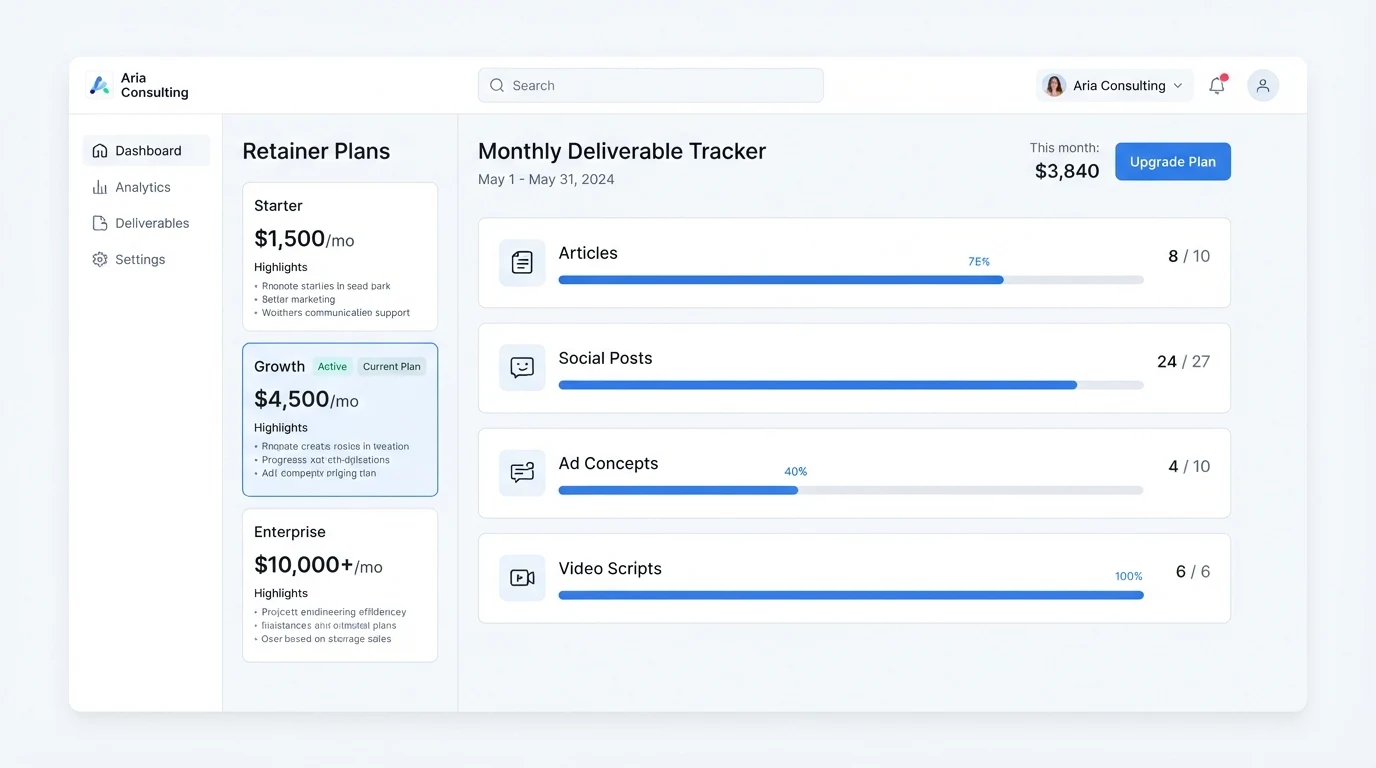
How to structure your own retainer (agency POV)
If you are on the agency side, the structuring math is cost-plus with a target gross margin between 55% and 70%. Add up your true monthly cost to service the account (senior time, editor time, API pass-through, tooling, project management overhead), divide by (1 - target margin), and that is your floor. Below that, you are subsidising the client, which nobody in an AI automation agency should be doing at scale.
Three guardrails matter more than the number. First, define "published asset" not "generated asset" as the unit of delivery, because generation is cheap and publishing is not. Second, cap credit rollover at one month so scope does not compound. Third, write a scope-creep clause that names the specific triggers (new channel, new brand, new market) and their pricing, so the conversation is contractual not emotional.
How to evaluate a retainer quote (client POV)
On the buyer side, headline price is the least useful number in the quote. The five things that actually predict whether a retainer will work are below, and any agency worth hiring will answer them without hedging.
- Cost-per-published-asset. Divide the retainer by the number of assets that will actually reach an audience. An agency that cannot state that figure for your scope is not thinking about your outcome.
- Revision policy. How many rounds are included, and what triggers a new scope conversation.
- IP ownership. You should own the final assets outright. Anything less is a red flag.
- Model and tool transparency. The agency should tell you which models are in the pipeline and where humans intervene.
- Kill fee and offboarding. 30 days notice, brand-voice document handed over, no ransomware on your prompts.
A quote that dodges any of these five is not necessarily a bad agency, but it is a bad contract. Buyers comparing AI content studios against traditional studios should run both sides through the same five questions.
Red flags
Pattern-match these and walk away. Pure per-word AI pricing (the model was retired in 2024 for a reason). No named human editor on the account. No brand-voice document produced in the first 30 days. No reporting cadence. Refusal to disclose which models sit in the pipeline. Credits that expire monthly with no rollover. Any language suggesting the agency retains rights to the assets it produces for you.
Sample retainer: what a growth-stage DTC bundle contains
To make the scope concrete, here is the shape of a bundle built for growth-stage DTC clients.
- 8 SEO articles, 1,500-2,000 words, edited and published
- 40 social assets across Instagram, TikTok, LinkedIn (static and short-form)
- 6 paid social ad concepts with 3 variants each
- 1 short-form video (15-30s) per month
- Monthly brand-voice tuning session and quarterly strategy review
- Reporting dashboard updated weekly
- Credits roll over 30 days, capped at 1x monthly volume
Priced against everything that reaches an audience, the cost per published asset is where this model becomes genuinely hard to beat with either a freelancer stack or a traditional agency. Brands typically step up a tier within six months once paid social starts pulling volume.
Frequently Asked Questions
Is AI content cheaper than hiring a freelancer?
Per asset, usually yes, once you include the freelancer's revision cycles and project management overhead. Per month, not always, because a proper AI content retainer includes strategy and editing layers a single freelancer would not provide.
Should I pay per credit or per month?
Per month for anything ongoing. Credits are useful for one-off pilots or seasonal campaigns, but they invite scope creep on retainer work because generation is functionally unlimited.
How long is a typical retainer term?
6 or 12 months is standard. Anything shorter than 3 months is a project, not a retainer, and should be priced accordingly.
Who owns the AI-generated assets?
You should, in full, with no ongoing license back to the agency. Any other structure is a red flag.
Do I need to disclose AI use to my audience?
In most jurisdictions, no, but transparency is trending upward and many brands are starting to disclose voluntarily. Ask your agency what their default position is.
What is a fair setup fee?
Enough to cover the initial brand-voice document, prompt library, and workflow setup, and no more. A setup fee that runs well past that should include custom model tuning or a dedicated integration.
Can I bring my own tools and API keys?
Some agencies allow it and discount the retainer accordingly. Most prefer to run their own stack for consistency and support.
What happens if I want to end the retainer?
30 days notice is standard. The agency should hand over the brand-voice document, prompt library, and all final assets. Anything less is contractual friction you do not need.
Closing
AI content retainer pricing looks confusing from the outside because the market is still settling on structure. Once you strip a quote back to cost-per-published-asset, editing depth, and IP ownership, the comparisons become straightforward. If you are structuring a retainer or evaluating one, Absolutely AI is happy to walk you through the math on either side of the table.