AI Branding Agency: What They Do and When to Hire One
An AI branding agency embeds generative AI across positioning, identity, and rollout as the operating system of the studio, not as a decorative shortcut. Absolutely AI works this way. The gap between a studio that has rewired its process and one that occasionally prompts ChatGPT is wider than most marketing directors realise. Here is what these agencies actually do, and how to vet one before you sign.

An AI branding agency builds and evolves brands using generative AI as the studio's operating system rather than as a decorative afterthought. Positioning research, identity exploration, digital rollout, and long-tail governance all run through pipelines that were rebuilt around the technology, with senior creative direction sitting on top. The best studios in this category ship more identity directions per review cycle, iterate faster after launch, and hand you tools you own on the way out. The worst just paste stock AI outputs into a keynote deck. This guide breaks down the difference and shows you how to tell which one is pitching you.
What an AI branding agency actually does
Branding is not a logo. It is five connected layers of work: positioning, messaging, visual identity, digital application, and governance. An AI branding agency compresses each of them without collapsing the craft. On the research side, voice-of-customer transcripts, review scrapes, and category audits feed structured prompts that surface positioning tensions in hours rather than weeks. A senior strategist still writes the positioning statement, but the raw material arrives faster and with more coverage of the category.
On the identity side, the shift is even more visible. Instead of presenting three logo directions at week four, a properly wired studio can put dozens of coherent identity worlds in front of a founder in the first review, each one carrying typography, colour, motion behaviour, and photographic tone. That density of exploration is only useful if the studio can also cull it, which is where experienced creative direction matters more, not less. The agencies to avoid are the ones that mistake volume for judgement.
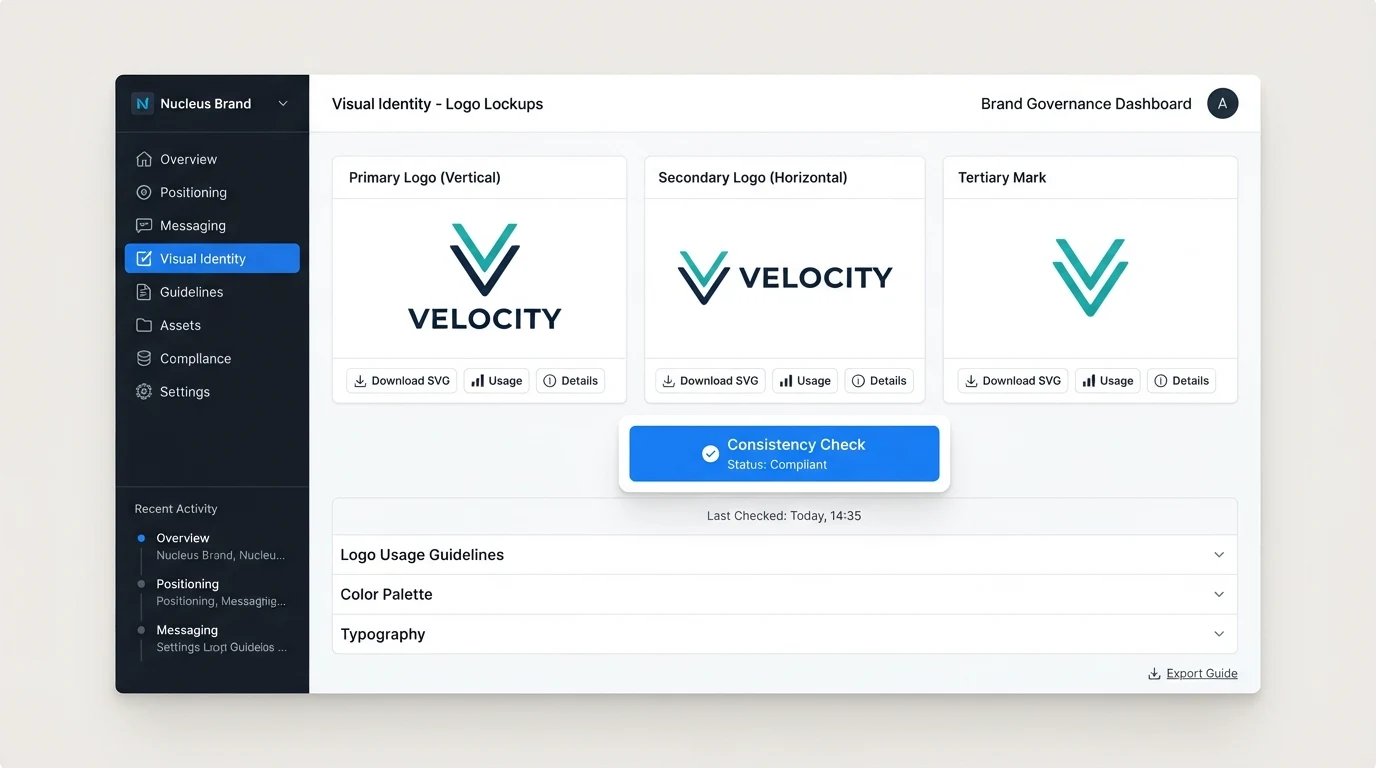
Messaging architecture, campaign lines, and naming shortlists follow the same pattern. Generative tools produce coverage; humans decide what is on-brand. Digital application is where AI earns most of its keep, generating on-brand social frames, product cards, ad variants, and web imagery at the scale a modern channel mix actually demands. Governance closes the loop with brand-guideline agents that review new assets against the identity system before they go live, so the brand stays coherent even when it is shipping ten times more work.
AI-native, AI-assisted, or AI-cosmetic
Most agencies that describe themselves as AI branding partners sit at very different points on the ladder, and the labels blur it on purpose. The clearest way to think about it is three tiers, each with practical tells you can spot in a first pitch. An AI-cosmetic studio uses ChatGPT for first-draft copy and Midjourney for moodboards, then executes the rest of the work the way it always did. An AI-assisted studio has embedded AI inside some workflows but still quotes traditional timelines. An AI-native studio, like a modern AI-first creative agency, has rebuilt its process around the technology and hands you artefacts you can keep using.
| Layer | AI-cosmetic | AI-assisted | AI-native |
|---|---|---|---|
| Research | Manual, AI used for summarising notes | AI-supported synthesis, human-run interviews | Structured VOC-to-prompt pipelines feeding positioning |
| Identity exploration | Three directions at first review | Six to ten directions, some AI-composed | Dozens of coherent worlds, culled by a creative director |
| Content rollout | Traditional shoots and design | Some AI-generated variants for social | End-to-end on-brand asset generation across every ratio |
| Governance | Static PDF guidelines | PDF plus a shared library | Living brand model, prompt library, QA agents |
| Handover | Files and fonts | Files, fonts, some templates | Model of brand, prompt library, and generation tooling |
The single most reliable tell is what you walk away owning. If the handover is a PDF and a Figma link, you hired a traditional studio that sprinkled AI on the process. If the handover includes a custom GPT or brand model, a documented prompt library, reference asset sets, and a governance workflow, you hired an AI-native partner. That difference determines whether your team can keep shipping on-brand work six months after launch, or whether the brand starts drifting the moment the agency leaves the room.
When to hire one, and when not to
The strongest hire signals are structural rather than aesthetic. A rebrand or category entry is the obvious one. So is a positioning drift you can feel in the market but cannot articulate internally. Scaling content volume by five to ten times without a matching headcount plan is another, since traditional production breaks well before that curve. A pre-fundraise polish or a founder handover often triggers the same need. In each of these cases the leverage of an AI-native process is real, because the work is genuinely more, faster, and needs to stay coherent.
There are also honest reasons to skip. Heavily regulated industries with strict copy review, such as financial services under FCA-equivalent regimes, medical devices, and legal, need a partner with an explicit regulated-industry playbook. That does not rule out AI, but it does rule out any studio that cannot show you how prompts, generations, and human sign-off get logged for audit. Commercially sensitive training data is another red flag: if your differentiator is proprietary insight, understand what leaves your environment before you brief anyone. And if your in-house team is already fluent, a lightweight consulting engagement may be a better fit than a full identity sprint.
What the engagement actually looks like
A well-run AI branding engagement moves through four phases that will feel familiar in shape and unfamiliar in speed. Discovery covers stakeholder interviews, competitive audit, and category research, compressed by prompt pipelines but still ending in a human-authored strategic point of view. Positioning translates the discovery into a defensible statement, an audience architecture, and a messaging house. Identity turns that into typography, colour, logo, motion, photography, and a first pass at digital application. Governance packages the model, the prompt library, and the review workflow your team will use after launch.
Deliverables should include the strategic documents you would expect, plus artefacts that only an AI-native studio can hand over. A model-of-brand, whether a fine-tune, a custom GPT, or a shared style dossier, encodes voice and visual behaviour so future generations stay consistent. A prompt library gives your content team working starting points for social, web, product, and campaign work. A generation and QA workflow shows how new assets get produced and reviewed. If your content operation is going to scale, this handover is the point of the engagement.

Ten questions to ask before you sign
The vetting conversation matters more than the pitch deck. Use these ten questions to separate genuine AI-native studios from ones running the traditional playbook with AI garnish. Answers should be specific, uncomfortable in places, and easy to verify. Vague answers here are a signal.
- Where exactly does AI enter the process, layer by layer, and where does it not?
- What data do we hand over, where does it live, and what happens to it after the engagement?
- Who owns the prompts, fine-tunes, and any custom models produced during the work?
- How is brand consistency enforced across generated assets after handover?
- Show us a governance workflow you have shipped, not a slide describing one.
- What does your team do differently on regulated accounts, and can we see the audit trail?
- Which parts of the identity are hand-crafted, and which are AI-composed, on your recent work?
- How many review cycles fit inside the first four weeks, and how many directions per cycle?
- What does the post-launch content operating rhythm look like with your tooling in place?
- Can we speak to a client whose brand is still running on the model you built for them?
The last question is often the most revealing. Traditional studios sell you a launch; AI-native studios sell you an operating model that keeps working. If the agency cannot point to a live brand that is still using their prompt library or model-of-brand a year in, treat the pitch as aspirational rather than proven.
Pricing models and what shapes them
Pricing conversations get easier when you separate the engagement shape from the number. Most AI branding work is scoped in one of three ways. Project-based sprints cover a fixed set of deliverables inside a defined window, usually a rebrand, a category entry, or a specific launch. Retainers cover ongoing identity evolution, campaign rollout, and content operations after launch. Hybrid arrangements pair an initial sprint with a lighter monthly commitment to keep the model, prompt library, and governance workflow current. A good studio will quote per scope after a brief review, not from a rate card.
What shapes the number, in every model, is the breadth of the identity system, the number of channels the brand needs to ship across, the volume of generated assets you expect to move each month, and the level of governance your category requires. Regulated work costs more because the audit and review overhead is real. High-volume ecommerce work costs more because the asset system has to be built for scale from day one. If a studio quotes without asking about any of that, the number they gave you is a guess, not a scope. A conversation with the team here starts with the scope, not the invoice.
Frequently asked questions
What is the difference between AI branding and traditional branding?
The strategic craft is the same. What changes is coverage and speed. An AI branding process explores more positioning angles, more identity worlds, and more application scenarios in the same window, and hands you a governance model that keeps those decisions coherent as your team scales output. The taste calls still belong to a human creative director.
Do we still need a strategist if the agency is AI-native?
Yes, and arguably more than before. AI produces coverage; strategists decide what is true about the brand, the customer, and the category. The studios that skip strategy and go straight to generation are the ones producing the wallpaper you are trying to avoid.
Who owns the AI models and prompts built during the project?
Ownership terms vary and should be negotiated up front. Reasonable defaults grant the client full ownership of any custom model, prompt library, or brand-tuned tooling created during the engagement, with the agency retaining rights to reusable process IP. Get it in writing before kickoff.
Can an AI branding agency work under regulated review?
Yes, if the studio has an explicit playbook for it. That means logged generations, human sign-off at defined checkpoints, controlled inputs, and a review workflow your legal or compliance team can audit. If the studio cannot describe this in detail, it has not done regulated work at scale.
How long does an AI branding sprint take?
Faster than a traditional identity sprint of the same scope, because exploration and iteration cycles are compressed. Actual duration depends on the number of stakeholders, the breadth of the identity system, and the depth of the governance handover. Ask the studio to plot the phases against your launch date rather than quoting a fixed window.
What should we own after the engagement?
Strategic documents, the identity system in editable formats, a model-of-brand or custom GPT, a prompt library, a reference asset set, and a documented governance workflow. If any of these are missing from the handover proposal, you are buying a traditional identity with AI decoration.
How do we stop brand drift once the agency leaves?
Governance tooling is the answer. A brand QA agent, a documented prompt review process, and a small internal team fluent in the tools will hold the line. The alternative, a static PDF guideline, cannot keep up with the volume of generated work a modern content operation ships.
Is our team too small to justify hiring one?
Not necessarily. Small teams often benefit most, because an AI-native handover gives one or two marketers the leverage of a much larger content function. The question is whether your output ambition justifies the up-front investment in the system.
Is this you?
If you are entering a new category, scaling content across more channels than your team can handle, feeling positioning drift you cannot fix internally, or preparing the brand for a raise or handover, an AI branding partner is worth a conversation. If you are in a heavily regulated category with no audit playbook, or you already have a fluent in-house team and just need extra hands, a different shape of engagement will serve you better. Absolutely AI runs AI-native branding work with senior creative direction on every project, and the vetting questions above are the same ones we expect you to ask us.