AI Video Production in Sydney: A 2026 Buyer's Guide
Sydney has quietly become the busiest AI video production market in Australia, and the questions marketing leads are asking have shifted from 'is this real yet?' to 'how do I scope my first project without getting burned?'. This is the honest buyer's guide Absolutely AI wishes existed a year ago: what the term actually means, how the toolchain works, what to ask a studio, and where the technology still falls over.
If you are a Sydney marketing lead scoping your first AI video project in 2026, most of the pages you will land on are thinly disguised service brochures. They gesture at speed, gesture at savings, and skip the parts you actually need to make a decision. This guide takes the opposite approach: we treat AI video production as a spectrum with real trade-offs, name the tools worth knowing, and describe the places the technology still falls over, so you can walk into a scoping call already knowing what to ask.
What 'AI video production' actually means in Sydney right now
The term is doing a lot of work. In practice, Sydney studios today are delivering three quite different things under the same banner, and the confusion between them is where most bad briefs begin. It helps to think of the market as a spectrum, with fully generative output at one end and AI-assisted traditional filmmaking at the other.
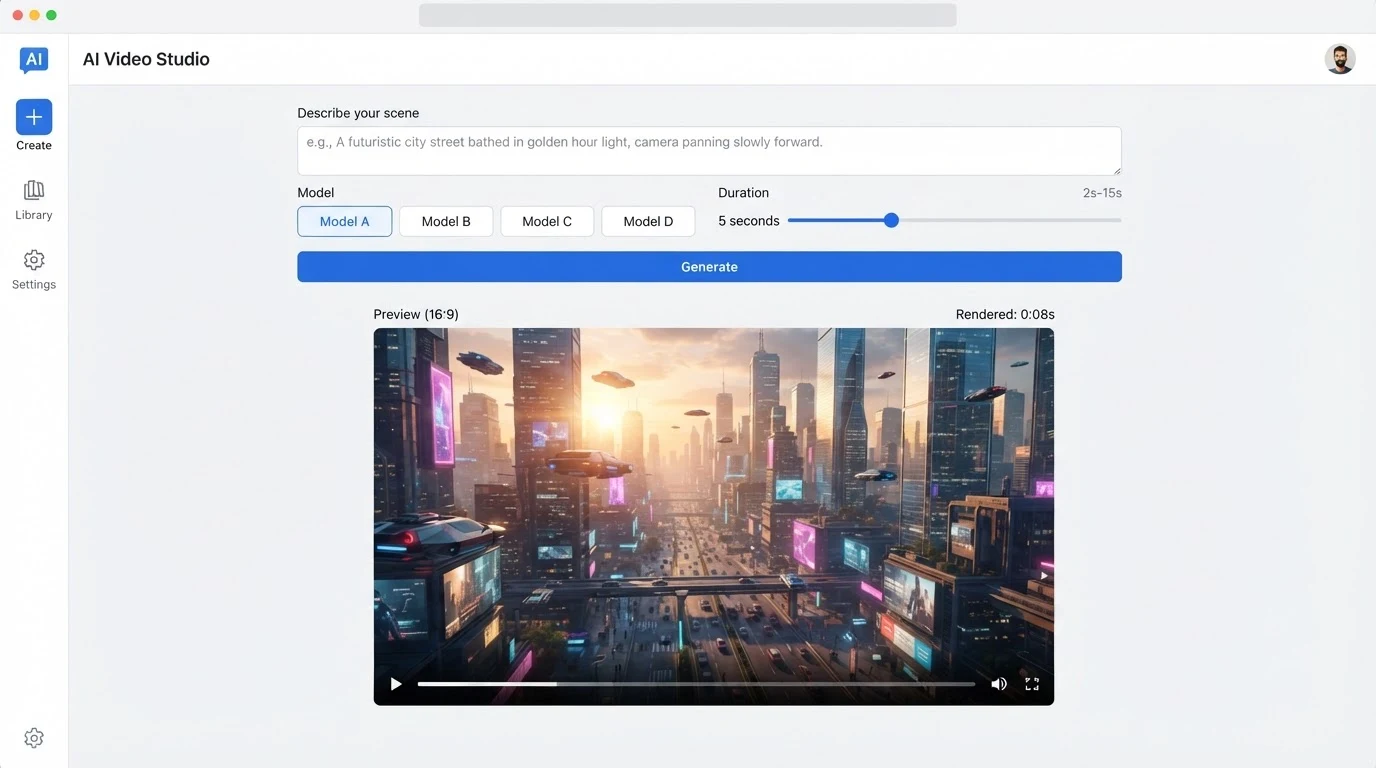
At the generative end sit ads and short films built entirely from text-to-video and image-to-video models: Veo 3, Kling 2.5, Runway Gen-4, Sora 2. There is no camera, no location, no on-set crew. In the middle, and this is where most Sydney work actually lives, sits hybrid production: live-action plates married to generative extensions, digital environments, AI-composited product hero shots, and voice or lip-sync work driven by tools like ElevenLabs. You can see the shape of this middle band in our note on AI pre-visualisation for commercials, where the AI layer sits inside an otherwise conventional workflow.
At the other end sits AI-assisted post: traditional shoots that lean on generative tools for VFX, colour, roto, and delivery variants. A brand film crewed by humans, but with a post pipeline that would have taken twice as long two years ago. When a Sydney agency says 'AI video', they could genuinely mean any of these three, and the cost, timeline, and creative control profile of each is quite different.
Why Sydney sits at the centre of Australia's AI video shift
The geography matters more than people expect. Sydney concentrates a disproportionate share of Australia's post-production talent, brand agency HQs, and the performance marketing teams who are the loudest buyers of variant creative. Fox Studios Australia in Moore Park anchors a broader ecosystem of colourists, sound engineers, and finishing houses, and that pool is now being retooled around generative pipelines rather than replaced by them.
Screen NSW's rebate programs continue to underwrite live-action production in the state, which keeps the traditional infrastructure healthy while the AI layer matures on top of it. For performance marketing teams the calculation is simpler: their platforms reward creative volume, their briefs demand many variants across aspect ratios and audiences, and the traditional TVC production model was never built to keep up. That pressure is what pushed the local social ad creative category into AI-first workflows first.
The result is a Sydney market that has quietly leapfrogged most of the Southern Hemisphere. Brisbane and Melbourne are catching up, but the density of generative-capable studios per square kilometre inside the M4 is not matched anywhere else in the country.
How to think about cost without a spreadsheet
We do not publish price bands, and any Sydney studio that quotes you a rate card before understanding your brief is telling on themselves. Cost in AI video is a function of four things: the length and complexity of the finished piece, the number of variants you need at the end, how much live-action feeds the pipeline, and how many revision cycles the concept goes through before lock. Get those four right in the brief and the number becomes reasonable to quote against.
What has genuinely shifted is the shape of the cost curve rather than any single number on it. Traditional TVC production is dominated by fixed costs: talent day rates, location fees, crew, insurance, catering. Generative workflows compress the fixed layer and shift the spend into concept development, direction, and iteration. A useful reference is our breakdown of the cost drivers in AI video ad pre-production, which unpacks where the money actually goes now.
For scoping conversations, the more useful question is not 'how much' but 'what does the finished piece need to do?'. A hero brand launch that will run on connected TV for a quarter deserves a different budget shape than fifteen paid-social variants that will run for a fortnight. Any credible Sydney studio, including our own marketing team, will scope from outputs backwards rather than from a rate card forwards.
Turnaround: fast, faster, and still not instant
Speed is where AI video's reputation has run ahead of the reality. Yes, a single generative ad can move through concept to finished cut in a fraction of the traditional timeline. No, that does not mean you can brief on Monday and expect a broadcast-grade brand film on Wednesday. Compression happens, but it happens unevenly across the pipeline, and where it happens depends heavily on which of the three production types your project actually is.
The parts that compress most are shot acquisition, environment build, and variant generation. The parts that do not compress are concept development, creative direction, brand alignment, sound design, and grading for delivery. A studio that promises you a specific number of hours or days before seeing the brief is either not doing the concept work properly or is planning to skip the grade. Our note on AI storyboards for TVCs covers where the front half of the timeline actually collapses.
The Sydney AI video toolchain worth knowing
You do not need to operate these tools to brief well, but knowing what each is good at makes scoping conversations far shorter. The list below is the working stack in most serious Sydney studios as of 2026.
- Veo 3: strong for cinematic realism, natural motion, and native audio. The default choice for hero brand pieces and premium ad spots.
- Kling 2.5: excellent for character motion, dance, and physically grounded action. Popular for beauty, fashion, and lifestyle.
- Runway Gen-4: workhorse for image-to-video, style transfer, and controllable camera moves. Common in hybrid pipelines.
- Sora 2: high on narrative coherence across longer shots, useful for short-form storytelling.
- Flux: image model used upstream to lock look, palette, and hero frames before video generation.
- ElevenLabs: voice, voice-cloning with consent, and multilingual VO.
- HeyGen: presenter-led talking-head video and lip-sync at scale.
- DaVinci Resolve: still the finishing environment, now with AI-assisted roto, upscale, and colour.
No serious project uses a single tool. The craft, and it genuinely is craft, is in the sequencing: which model handles which shot, how plates are handed between them, how continuity is preserved across the cut. Studios that offer only one tool are usually offering only one look.
Eight questions to ask any Sydney AI video partner
The scoping call is where most projects are quietly won or lost. Ask these before you talk price, and you will avoid almost every common failure mode we see on rescue jobs.
- Who owns the final output and the underlying assets? Rights, licensing, and re-use terms should be explicit in writing before the SOW is signed.
- Which models are in the pipeline, and are they licensed for commercial use? Not all generative outputs are cleared for paid media.
- How many revision cycles are included, and what triggers a re-scope? AI iteration is fast but not free, and vague revision language is where budgets bleed.
- Do you own the render pipeline, or is it outsourced? Studios that operate their own stack tend to have more control over quality and delivery timing.
- What delivery formats are included? HDR, broadcast-safe masters, and platform-specific variants should be named, not assumed.
- How is actor or voice likeness handled? Consent, releases, and provenance need a clear answer.
- Where does the edit live? On-shore Sydney finishing gives faster feedback loops than offshore-only pipelines.
- What does 'done' look like? A clear definition of completion, tied to the deliverable list, prevents the endless-tweaks trap.
If any of those answers arrive as a shrug, keep looking. The team you want is the one that has already thought about them. Our consulting practice exists partly because so many first briefs go out without these questions being answered internally either.
The shape of the Sydney AI video market
Rather than rank named competitors, it is more useful to describe the four broad categories of studio you will meet in Sydney, because your project will fit one of them more naturally than the others. Match the studio type to the work.
| Studio type | Sweet spot | Watch out for |
|---|---|---|
| Traditional production houses adding AI | Broadcast-grade brand films, hybrid live-action projects | AI is often bolted on rather than native to the pipeline |
| AI-first creative studios | Concept-led ads, campaigns, worlds you cannot shoot | Ask how they handle finishing and broadcast delivery |
| Performance marketing shops | High-volume variant creative for paid social | Less suited to hero brand pieces or premium storytelling |
| Freelance generalists | Fast experimental one-offs, proof-of-concept | Rights, revision, and delivery discipline can vary |
A hero brand launch and a paid-social variant sprint are different jobs, and the studio that is genuinely good at one is rarely the best fit for the other. Be honest with yourself about which side of the line your project sits on before you send the brief.
Where AI video still fails, and when to book a traditional crew
The technology has moved fast, but it still has known weak points, and pretending otherwise is how you end up with a hero shot that cannot go to air. Hands, on-screen text, precise product fidelity, and continuous fine detail across long takes remain difficult. Talent likeness needs consent and careful provenance work. Regulated categories, from finance to therapeutic goods, still require the compliance discipline of a traditional production, regardless of how the frames were made.
For campaigns where authority depends on visibly real talent, where the product must appear pixel-accurate for a legal reason, or where the deliverable is a single hero piece that will run for a year, a traditional crew, or a hybrid pipeline that respects both worlds, is still the right call. Our commercial work increasingly sits in that hybrid space rather than at either extreme.
How Absolutely AI approaches Sydney AI video briefs
Our own process starts before any model is opened. Every brief goes through a concept exploration phase in our internal Wireflow environment: four concept grids per deliverable, anchored to the brand references we agree in the kickoff, plus alternate directions that stretch the brief. That gives the client something concrete to react to before a single frame is generated at full quality. It also protects the revision budget, because most of the debate happens on concept boards rather than finished cuts.
From there, direction is human. Model choice, shot design, pacing, and grade are all decisions made by a creative director, not a model. The AI layer is the production department, not the creative department. That distinction is what separates a piece of work you would put on air from one you would only ever ship to a test audience. Our films practice is built around that principle.
Frequently asked questions
How much does AI video production cost in Sydney?
It depends on length, complexity, variant count, and how much live-action feeds the pipeline. Any studio that quotes before understanding those four inputs is not scoping seriously. Expect a proper quote after a short scoping conversation, not before it.
How fast can a Sydney AI video project actually ship?
Faster than a traditional shoot, but not instantly. Concept development, creative direction, and finishing still take time. The parts that compress most are shot acquisition and variant generation. Speed is a range, not a promise.
Who owns the finished video and the underlying assets?
This should be spelled out in your SOW. Different studios and different tools carry different licensing implications. If you cannot get a clean answer in writing before signing, treat it as a red flag.
Will paid social platforms approve AI-generated creative?
Generally yes, provided the creative complies with the platform's disclosure and content rules and, in Australia, the AANA code of ethics. Regulated categories carry additional obligations that apply regardless of how the frames were made.
What is AI video best used for right now?
Paid social variants, concept-led brand ads, environments and worlds that cannot be shot practically, product content at scale, and pre-visualisation for larger productions. Talent-heavy hero pieces and precision product hero shots still often benefit from a hybrid or traditional crew.
If you are scoping a Sydney AI video project and want a plain-spoken read on what fits your brief, that is exactly the conversation Absolutely AI is set up for. Send the brief, or the fragment of a brief you have, and we will tell you honestly which of the studio types above is the right fit, even when it is not us.