Can AI video run on Australian broadcast TV in 2026?
AI-generated commercials can air on Australian free-to-air television, but they go through the same clearance and the same rules as any other ad. Here is what that means in practice, from the review and classification step to the technical delivery spec the networks accept.
Yes. An AI-generated ad can run on Australian broadcast TV if it passes the same checks any other commercial does. The sources used here do not state that any Australian regulator has issued a TV-advertising-specific AI rule. What they do say is that ads, however they are made, go through the same review and classification step, follow the same advertising rules, and arrive at the network as a file that meets a published delivery specification.
That one-line answer needs unpacking, because the legal half and the technical half are often covered separately and an AI build has to clear both. If you want the production side of this covered in one place, see our AI commercial service page.
Who reviews and classifies a TV ad in Australia
The Advertising Council Australia describes ClearAds as the service that reviews and classifies ads for agencies, advertisers and production houses. On the same page, the Advertising Council notes a Fast Track option for tight deadlines and an online portal called Oasis, which agencies use to submit ads, apply for pre-checks, track the progress of a review, upload substantiation documents and communicate with the reviewer in real time.
The Advertising Council Australia also flags a requirement to avoid disclaimers in TVCs that are not clear or are on screen for less than 0.2 seconds per word.
What rules apply to an AI-made commercial
The clearest statement from the regulator side comes from Ad Standards. Reported by SmartCompany in February 2026, Ad Standards' Wallace said there is no blanket rule requiring disclosure of AI in advertisements and that "regardless of how the content is created, AI or otherwise, the advertising rules still apply". An AI tool does not remove any of the rules a human director would be held to.
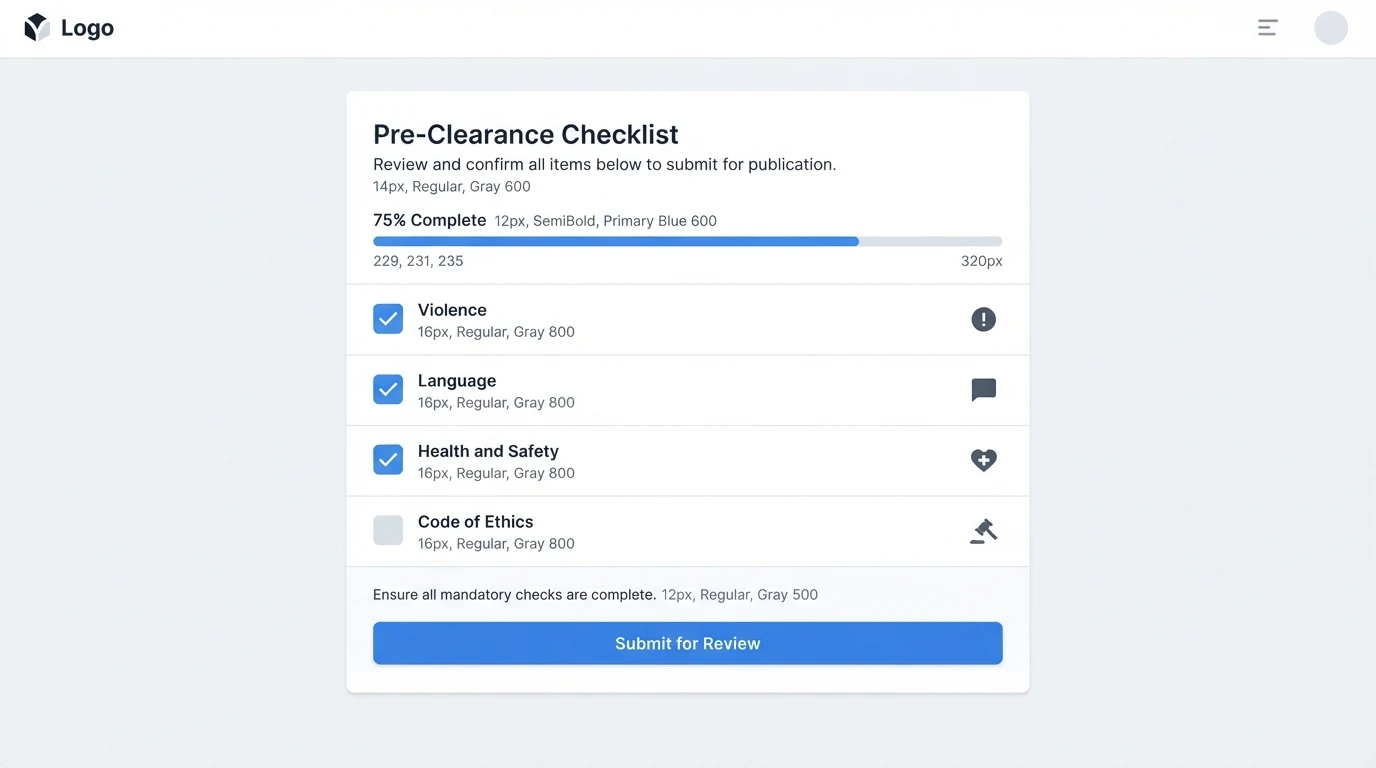
The best real-world illustration is a recent Ad Standards panel decision on an AI clip. SmartCompany reported in August 2026 that according to the panel, the clip "depicted unjustifiable violence, used strong or offensive language, and depicted behaviour that would likely be considered contrary to community standards on health and safety".
For where an AI-specific rule might come from, SmartCompany also reported that an AANA consultation paper asked whether the code should be updated to include a "specific rule or guidance dealing with AI in advertising". On the pages used here, that is still a consultation.
The industry's voluntary AI guidelines
In September 2025 the AANA, the Advertising Council of Australia and the Media Federation of Australia released a draft set of Industry Guidelines on Ethical AI Use in Marketing for public consultation, as reported by the Advertising Council. The draft covers transparency, accuracy, bias mitigation, privacy, copyright and sustainability.
These are industry guidelines released for consultation, not code clauses. A clearance decision turns on the codes; the guidelines are what the industry's own bodies expect producers to work toward on top of that.
Technical delivery: OP-29 and OP-52
A clean clearance is only half the job. Free TV's delivery specifications set what the file has to look like, and a network's traffic team will reject a file that does not meet them.
Free TV's OP-29 states that "television commercials / advertisements for broadcast in Australia must comply with the Commercial Television Industry Code of Practice that has been registered by the Australian Communications and Media Authority (ACMA)". The spec lists the file parameters HDTV commercials must meet, including 1920x1080/50i resolution, 50 video bit rate, MPEG-2 LongGOP video codec, PCM audio at 768kbps per channel, eight audio channels, 16:9 aspect ratio and an MXF OP1a wrapper. OP-29 also caps the true peak audio level at -2dBTP measured on a BS-1770 compliant loudness meter.
Free TV's OP-52 requires each commercial to carry identification, such as an associated XML file, and lists the metadata fields it must contain, including duration in seconds, CAD number or CAD number pending, classification, video format (SDTV and HDTV), audio loudness level and compliance with Free TV OP-48, audio format (stereo and 5.1 surround), aspect ratio (always 16:9) and closed captions.
None of this changes because the pictures were made in a model. The upscale, the codec, the wrapper, the loudness, the metadata file: they all have to be right. This is the part where a lot of AI work falls over, and planning the finish before the first generation saves rebuilds later.
The ACMA radio code is not a TV rule
A separate recent change is often read as broader than it is. Variety Australia reported in February 2026 that under the revised commercial radio code, "commercial radio stations must clearly inform audiences when a regularly scheduled program or news broadcast is hosted by a synthetic voice", and that this was the first time artificial intelligence had been explicitly addressed in an Australian broadcasting code of practice.
The scope is commercial radio. The sources used here do not state that the radio rule covers commercial television or television advertising.
On the television side, the ACMA announced in June 2025 that "after careful consideration the ACMA has decided not to register the revised code", saying it was "not satisfied that the revised code would provide appropriate community safeguards".
Community TV runs on its own rules
If the plan is community television rather than a commercial network, the posture flips. CTV Australia's AI usage policy, dated April 2026, states that "the default position of C31, C44 and CTV+ is that generative AI must not be used to create program content. Programs in which generative AI is used to produce core narrative elements, performances, or visual sequences will generally not be suitable for broadcast or distribution".
The same policy requires producers to disclose generative AI use to the broadcaster at the time of submission, regardless of scale, and requires all AI-generated material to be reviewed and approved by human creators before submission and broadcast. This policy binds C31, C44 and CTV+ only; the sources here do not say it applies to commercial free-to-air networks.
Planning an AI-made TV ad: the questions worth asking early
None of what follows is law. It is the ordering that makes the review and the delivery less painful.
Before generation starts, be clear on:
- Who or what does the ad depict. Real people, public figures, athletes, musicians and brands that are not yours all need rights before they appear. The advertising rules apply whether a human or a model drew the picture.
- What claims the ad makes. Any superlative, comparison or category-specific claim will need substantiation. The Oasis portal is where substantiation documents are uploaded, so plan the evidence file early.
- Where the content risk sits. Violence, strong language, sexualised imagery and anything near health and safety are where panel decisions have landed against AI-made work.
- Where it will air and when. Classification decides the timeslot an ad can run in, so the creative brief should name the slot it is being built for before the first render.
- The delivery path. If the networks need an MXF OP1a at 1920x1080/50i with the right audio bed and a complete metadata file, the generator and the finish have to produce one. The AI step is one scene in a longer post-production.
Keep a record of the model used, the prompt, the reference material, the human sign-off and any licences relied on. If an AI-specific rule is added to the codes later, that record is the first thing an advertiser will be asked for. Our article on AI commercial production in Australia covers the production side of the same pipeline, and AI video production cost in Australia covers where broadcast finish sits in a budget.
Frequently Asked Questions
Is AI video allowed on Australian broadcast TV?
The sources used here do not state an Australian regulator ban on AI in TV commercials. Ads go through the same review and classification step and are held to the same advertising rules, and the file is expected to meet the published Free TV delivery specification.
Do I have to disclose that an ad was made with AI?
SmartCompany reported in February 2026 that Ad Standards' Wallace said there is no blanket rule requiring disclosure of AI in advertisements and that the advertising rules apply regardless of how the content was made. The draft Industry Guidelines on Ethical AI Use in Marketing, released by the AANA, ACA and MFA for consultation in September 2025, cover transparency among other things, and are industry guidance rather than code clauses.
Has Ad Standards ruled against an AI-made ad?
Yes. SmartCompany reported that according to the panel, an AI clip "depicted unjustifiable violence, used strong or offensive language, and depicted behaviour that would likely be considered contrary to community standards on health and safety".
Does the ACMA AI disclosure rule apply to TV ads?
Variety Australia reported that the revised code requires commercial radio stations to inform audiences when a regularly scheduled program or news broadcast is hosted by a synthetic voice. The sources used here do not state that this rule covers commercial television or television advertising.
Does the community TV AI policy apply to a commercial campaign?
CTV Australia's policy binds C31, C44 and CTV+ and sets a default position that generative AI must not be used to create program content there. The sources used here do not say the policy applies to commercial free-to-air networks.
What to do with this
An AI-made TV commercial is treated as a TV commercial. The route is review and classification, the advertising rules, and the delivery spec, and the file at the end is an MXF at the right audio level with a complete metadata set. Read the current codes with the ad in front of you before anyone hits render, keep a clean record of what the model made and what a human directed, and pick a production partner who can finish to the delivery standard the network will accept. If a creative is in planning and you want to talk it through, get in touch via our contact page.
This article is general information and not legal advice. The rules change, codes are reviewed, and a specific campaign should get its own advice before it airs.