AI Commercial Production in Australia: The 2026 Buyer's Guide
Australian brands are commissioning full AI commercials in 2026, not pilots or test spots. Veo 3, Runway Gen-4 and Luma Ray have crossed the threshold where a finished broadcast cut can be made without a shoot day. This guide, written by the team at Absolutely AI, is the buyer's view: what counts as an AI commercial, which Australian studios ship to air, how the pipeline actually runs, and when you should still book a crew.
The shift happened quietly between the 2025 and 2026 cycle. Veo 3 arrived with cinematic coherence long enough for a 30-second spot, Runway Gen-4 brought directable camera moves, and Luma's Ray models solved the 3D camera orbit that used to require a jib. Australian marketing teams noticed, and by Q1 2026 several national brands had TVCs on air whose principal photography was entirely generative. The team at Absolutely AI has watched the volume of serious procurement briefs climb accordingly: this is now a line item, not an experiment.
That change creates a procurement problem. Studios calling themselves "AI commercial production" range from a freelancer with a Midjourney subscription to full creative teams with proprietary pipelines and senior directors. The rest of this guide is written for the marketing director, head of brand, or agency producer who has to tell the two apart and brief the right one.
What counts as an AI commercial in 2026
The category covers a spectrum, not a single technique. On one end sits AI-assisted traditional production: generative concepting, previz, storyboard frames, and post-production cleanup around a live shoot. On the other sits end-to-end generative work where every frame on screen was synthesised. Most of what ships to air in Australia right now lives between those poles, blending generative hero shots with practical plates, VFX cleanup, and traditionally recorded sound.
The important distinction for a buyer is whether the studio can run the full pipeline or only part of it. A team that can only prompt Veo 3 will struggle with lip sync, continuity across cuts, aspect-ratio reversioning, and the finishing work that separates a social teaser from a finished broadcast commercial. Ask for the pipeline, not the prompts.
Why Australian brands are moving now
Three forces made 2026 the inflection year. The tools finally render human faces, hands and product surfaces at a standard that passes broadcast QC. Timelines compress because iteration happens in hours rather than reshoot cycles. And the format problem solves itself: once a spot exists as a generative asset set, you can output 16:9, 9:16, 1:1 and 4:5 without reshooting coverage, which matters when a single campaign now feeds dozens of social placements.
There is also an Australian-specific regulatory layer that buyers often miss. The AANA Code of Ethics applies to AI-generated advertising the same way it applies to live-action, and the ACCC's guidance on deceptive imagery extends to synthesised performers and product demonstrations. MEAA has published its position on AI-generated likenesses of real performers, and any studio pitching a generative replacement for a cast member should be able to explain how they handle that. These are not blockers, they are briefing inputs, and clearing them upfront is faster than fixing a complaint later.
The leading AI commercial production studios in Australia
The Australian market is small enough to summarise honestly. The studios below are the ones a procurement team is likely to encounter in a 2026 pitch list, with the caveat that the roster is moving quickly as agencies spin up internal AI units.
| Studio | City | Specialty | Typical turnaround |
|---|---|---|---|
| Absolutely AI | Brisbane | End-to-end generative commercials, brand films, campaign systems | Days, scope-dependent |
| AiCandy | Sydney | Short-form social commercials, product-led spots | Fast turnaround |
| AI Labs Agency | Melbourne | Agency-side AI production support, campaign scale-out | Project-based |
| Apostle | Sydney | AI-assisted traditional production, hybrid shoots | Standard production cycles |
| Unicam | Regional/offshore | Volume generative content, lower-tier social | Volume-focused |
The genuine filter when evaluating this list is the presence of senior creative direction on the account. A generative pipeline without a director is a render farm, and the output reads that way on screen. The team you brief should be able to show you finished films under their own direction, not just tool demos.
The production pipeline, step by step
A credible AI commercial production flow in 2026 looks roughly like this. Each stage uses different tools, and the handoffs between them are where most amateur pipelines break.
- Brief and concept. Brand bible, reference frames, usage rights, aspect ratios, and the single-minded proposition. Concept and storyboard work follows, often in lockstep with brand guidelines.
- Generative previz. Still frames in Midjourney or equivalent lock the look before any motion is generated. Cheaper to iterate here than downstream.
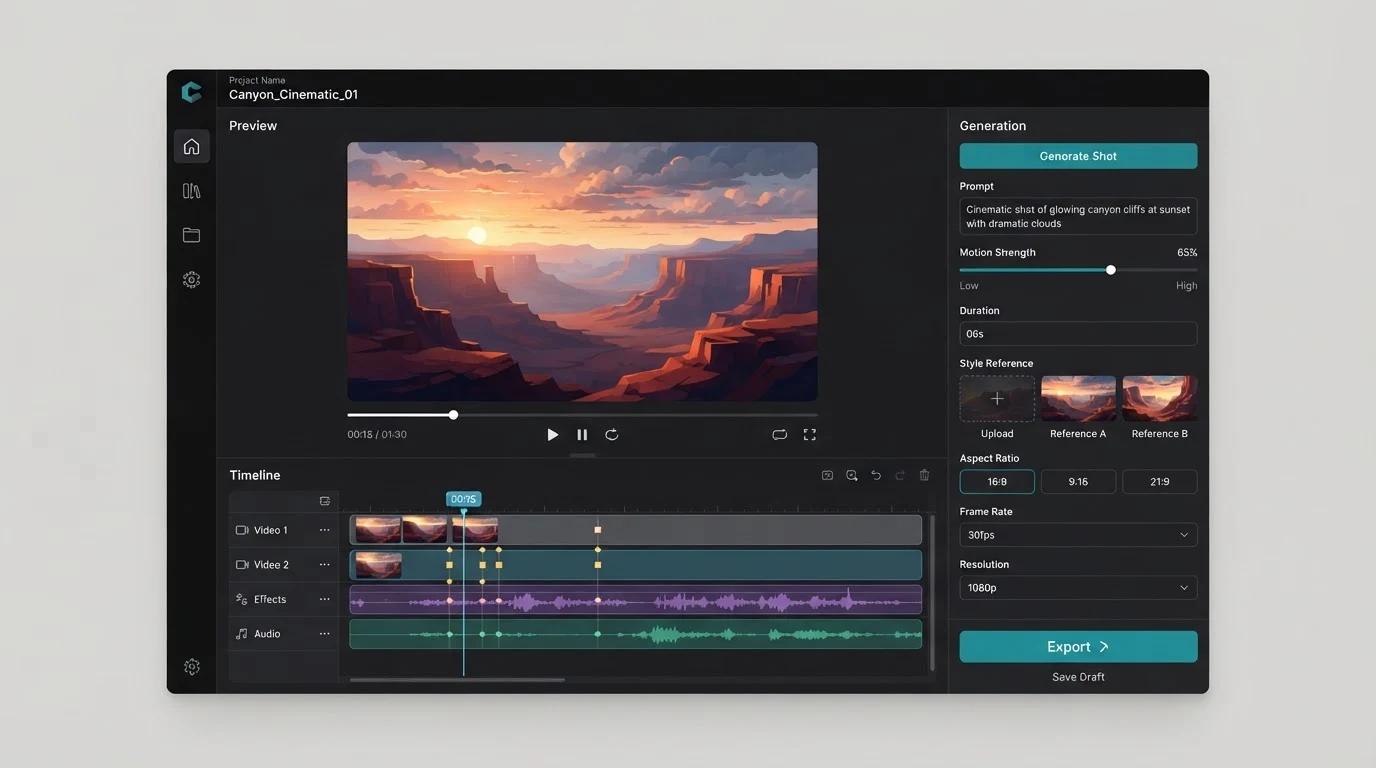
- Shot generation. Veo 3 for cinematic coherence and dialogue-adjacent beats, Runway Gen-4 where directable camera control matters, Luma for 3D orbits and parallax, Kling for lip sync when a performer is on screen.
- Compositing and VFX cleanup. Hands, product labels, continuity between cuts, logo placement, and any element the model got close but not right.
- Sound design and music. Still largely traditional. Voiceover, foley, score, and any licensed music clear the same way they always did.
- Reversioning and delivery. Broadcast masters, platform cuts, aspect-ratio variants, captions, delivery specs.
Topaz Video AI typically appears at the end for upres and clean-up, bringing generative output up to broadcast resolution. The pipeline is less a sequence of tool clicks than a creative decision chain, which is why the commercials that stand out tend to come from teams with directing experience rather than tool experience.
Realistic timelines, and how to think about budget
Timelines compress but do not vanish. A short-form social commercial can be concepted, generated and delivered in roughly a working week when scope is tight and references are strong. A 30-second TVC with multiple hero shots, dialogue, and broadcast QC lands closer to three weeks, including revisions. A hero brand film with campaign extensions and multiple reversions runs longer, because the finishing work and sound design scale with ambition even when the shoot cost is zero.
Budget is best treated qualitatively at this stage of the market. The real variables are scope (duration, number of hero shots, dialogue, reversioning), the seniority of creative direction, and the finishing standard required. Studios should quote per scope after a brief review rather than publish rate cards, because an entry-level social cut and a national TVC are not the same product. For a frame on how these two shapes of job differ, our breakdown of AI commercial versus traditional TVC economics covers the structural cost drivers.
When AI commercial production is the right call, and when it is not
The honest answer is that AI is the right call for most brand, campaign and social commercial work in 2026, and the wrong call for a specific set of categories where the risk is not worth the saving. Use this as a rough filter.
Strong fit
- Brand films where the world is stylised, impossible to shoot, or built around a visual concept rather than a performance.
- Social commercials needing many aspect-ratio and length variants from one creative concept.
- Product-led spots where the hero is the object and the environment is dressing.
- Campaign systems where the creative needs to extend across many markets or SKUs.
Still shoot traditionally
- Hero food. Generative models still produce food that looks wrong under scrutiny, and food advertising lives or dies on appetite appeal.
- Named talent and celebrity likenesses. The MEAA position and the client's own talent agreements make this a legal problem, not a creative one.
- Regulated categories where every claim is scrutinised: pharmaceutical, finance, gambling, infant formula. A traditional shoot carries clearer evidentiary provenance.
- Documentary and testimonial work where authenticity is the point of the ad.
How to brief an AI commercial production studio
The inputs that unlock good output are not the ones most briefs include. In order of impact: a clear brand bible with typography, colour and tone of voice; six to twelve reference frames showing the look you want, not the ads you admire; the full list of aspect ratios and durations the final asset must deliver; usage rights and territories; and the single creative proposition you want the audience to walk away with. Rate cards for stock photography are not useful here, but brand photography systems that already exist can anchor the look.
Skip anything that locks the studio into a shot list before the generative previz stage. Half the value of this pipeline is the speed of iteration between concept and finished frame, and a locked storyboard throws that away. Agree the proposition and the look, then let the studio run the look through the tools before committing.
Frequently asked questions
Who owns the rights to an AI-generated commercial produced in Australia?
Rights are set by the production agreement, the same as a traditional shoot. The relevant layers are the output rights the studio grants, the licence terms attached to any underlying model, and the music and voice rights handled separately. Confirm these in the contract before kickoff rather than at delivery.
Does MEAA cover AI-generated performers?
MEAA has published its position on AI and performer likeness, and the practical answer is that if your spot replicates a real person, you need their consent and typically a performance agreement. A fully synthetic character with no real-world referent is a different conversation and should still be documented in the production agreement.
Will the ACCC treat an AI commercial differently?
The ACCC's rules on misleading and deceptive conduct apply regardless of how the imagery was made. Product demonstrations must be truthful, before-and-after representations must be substantiated, and any synthesised element that could materially mislead the viewer carries the same risk as a traditional reshoot would.
How does the AANA Code of Ethics apply?
The AANA Code of Ethics applies to the finished advertisement, not the production method. The sections on truthfulness, honesty, and portrayal of people are the ones most relevant to AI-generated work, and a credible studio will raise them during the briefing stage rather than at legal review.
How many revisions should I expect?
Revision cycles are faster but not infinite. A well-briefed project typically needs one or two rounds of look revisions during previz and a round of fine revisions after shot generation. If a studio promises unlimited revisions, treat it as a signal that the pipeline is not planned.
Can an AI commercial actually air on Australian television?
Yes. Broadcast QC concerns itself with technical specification and content compliance, not production method. The finished file must meet the delivery spec of the network, and the content must comply with the AANA Code and category rules. Generative origin is not itself a disqualifier.
What about music and voiceover?
Music and voiceover remain largely traditional in credible pipelines. AI music tools are improving but licensing clarity still favours commissioned score or properly cleared library tracks. Voiceover is often a live record, both for performance quality and for rights clarity.
How do I compare quotes between studios?
Compare scope, not price. Match the deliverable list, the number of hero shots, the aspect ratios, the revision rounds, the finishing standard, and the seniority of the creative lead on the account. Two quotes with the same number attached can describe two very different products.
Where this leaves the 2026 buyer
The market has matured enough that AI commercial production is a procurement decision rather than an experiment, and immature enough that the gap between the best and worst studios is still enormous. The brands getting the most out of the shift are the ones treating it as a creative question first and a tooling question second: the pipeline is only as good as the direction running through it. If a formal buyer's conversation would help, the team at Absolutely AI is set up to walk through scope, approach and timing against a specific brief.