How Much Does AI Video Production Cost in Australia?
AI video production in Australia spans a wide spectrum, from self-service tools a marketer can run in an afternoon to full agency brand films built with hybrid AI and live-action craft. At Absolutely AI we get asked for a single number every week, and the honest answer is that the price sits wherever your ambition, rights, and revision appetite meet. This guide breaks down the tiers, the cost drivers, and the brief you need to get an accurate quote.
AI video production in Australia has fractured into distinct tiers, each with its own quality ceiling, turnaround, and rights profile. Understanding which tier fits your brief is more useful than chasing a single number, because the same 60-second explainer can be produced five different ways with wildly different outputs. Absolutely AI works across the top end of this spectrum, and the framework below is what we walk clients through before we quote anything.
AI video production cost in Australia at a glance
Pricing in this category sits on a ladder rather than a single price point. At the entry level, DIY generative platforms let a marketer produce short clips on a subscription basis, with quality and control that reflect a template-driven workflow. One rung up, a freelance AI editor stitches generative outputs into a finished piece, quoted per project. Boutique AI studios sit in the middle, delivering brand-calibrated short-form assets with senior creative direction. Agency-produced AI brand films sit above that, and hybrid productions that blend AI-generated worlds with live-action plates sit at the top of the market. The gap between a generator and an agency is not just polish, it is the strategy layer around the pixels.
The right tier is a function of what the video has to do, not what it costs to make. A one-off internal training clip is a different problem to a national brand campaign, and the tier that suits each is obvious once the objective is on the page. When you brief our team, this is the first conversation.
What actually drives the price
Once you have picked a tier, price movement inside that tier is driven by a predictable set of variables. Length is the obvious one, but it is rarely the biggest lever. The number of AI-generated characters in a piece matters more, because every additional character multiplies the direction, consistency, and revision load. Style is next: a photoreal cinematic look demands significantly more iteration than a stylised or illustrated treatment, and stylised worlds often move faster through review because the bar is aesthetic rather than photographic.
Voice cloning and lip-sync add cost when the script is dialogue-heavy or when a founder or spokesperson needs to appear in scenes they were never filmed for. Licensed music, hybrid live-action inserts, rights buyouts, and revision rounds all sit on top. On social-first ad work the biggest cost driver is usually the number of aspect ratios and cut-downs, not the hero edit itself.
AI vs traditional video production in Australia
The comparison most clients want is against a traditional production house. A traditional corporate video of two to three minutes carries a crew, location, talent day rates, post, and colour, all of which scale with ambition. A cinematic brand film with a full traditional crew sits at the top of that market and is quoted per scope. AI-led film production compresses most of those line items into creative direction, generation, and post, which is why the delivered cost for a comparable output typically lands well below the traditional benchmark for the same brief.
| Factor | Traditional production | AI-led production |
|---|---|---|
| Crew and location | Full crew, permits, catering, transport | Not required for AI-generated scenes |
| Talent | Day rates plus usage buyout | Optional, for voice or hybrid inserts only |
| Turnaround | Six to ten weeks typical | Two to three weeks typical |
| Revisions | Costly once shot | Cheaper before final render |
| Reach for impossible worlds | VFX line item | Native to the medium |
| Pricing model | Quoted per scope | Quoted per scope |
Pricing by deliverable type
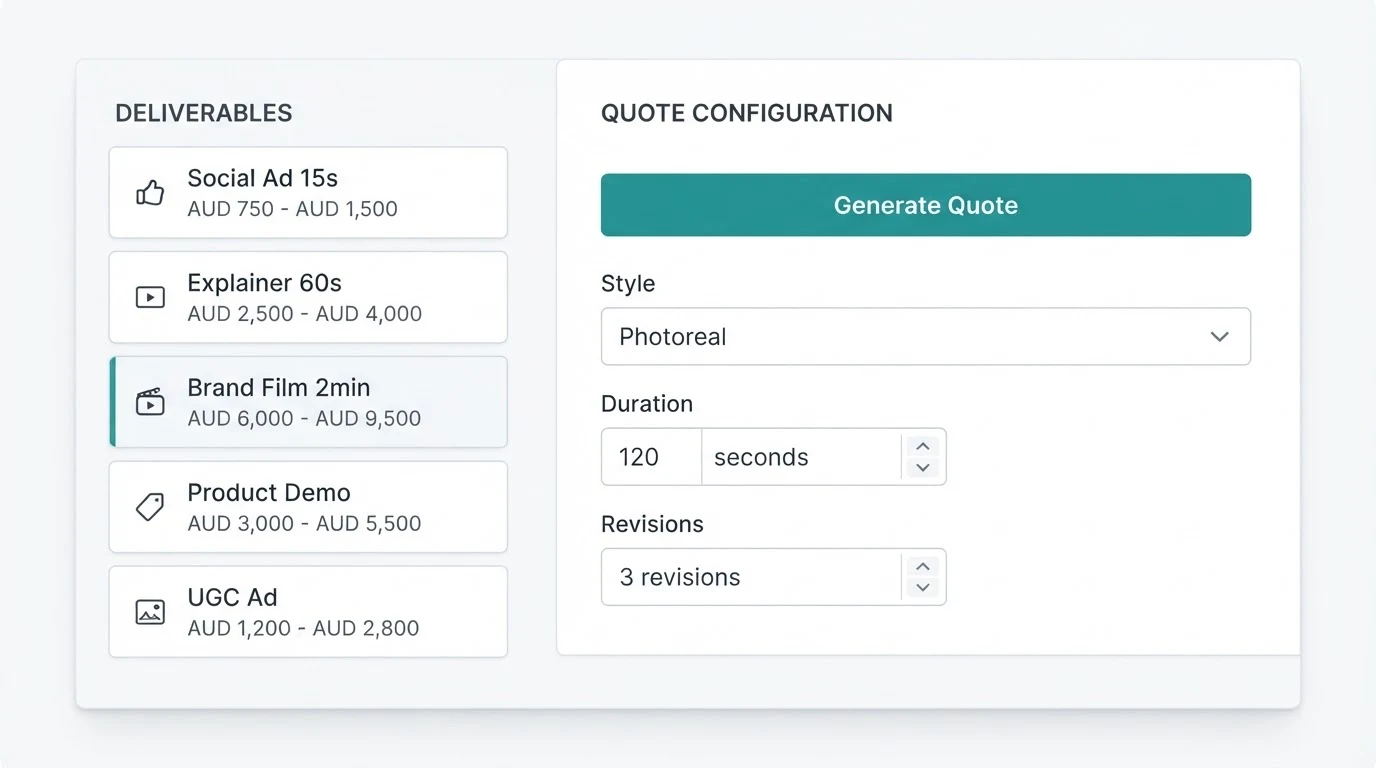
Different deliverables move through the pipeline at different speeds, and that shapes the quote. A fifteen to thirty second social ad is the fastest, especially when it lives inside an already-established brand system. A sixty to ninety second explainer adds scripting, pacing, and often a voice track. A two to three minute brand film adds narrative structure and multiple hero scenes. A product demo can be efficient when the product is a hero object, and more involved when it needs to appear in multiple contexts. A UGC-style ad trades polish for authenticity and moves quickly. A training or learning module sits on volume, where the unit cost drops as the module count rises.
- Social ad, fifteen to thirty seconds: fastest turnaround, quoted per scope
- Explainer, sixty to ninety seconds: script plus voice plus visual system
- Brand film, two to three minutes: narrative arc, multiple hero scenes
- Product demo: complexity scales with the number of contexts the product appears in
- UGC-style ad: authenticity over polish, quick turn
- Training or learning module: unit cost drops with volume
DIY versus agency: when each makes sense
The decision framework is simpler than most people expect. DIY tools are the right answer when the video is disposable, the audience is internal or small, and brand safety is not at stake. An agency is the right answer when the video carries the brand externally, when rights and consistency matter, or when the concept demands craft that a template cannot produce. Storyboarding a brand video is often the moment this becomes obvious: if the storyboard needs a creative director in the room, so does the finished piece.
Volume also tips the balance. A brand producing one film a quarter is not the same buyer as a brand producing forty social cuts a month, and the right partner for each is different. A retained relationship makes sense once the pipeline is continuous.
What a typical AI video project timeline looks like
A typical AI campaign timeline runs brief, concept, generation, review, post, delivery. Concept usually lands within days of the brief. Generation and internal review sit in the middle of the schedule and account for most of the elapsed time, because this is where creative direction earns its keep. Post and final delivery close out the project.
- Brief and objectives locked
- Concept and treatment approved
- Generation and internal review
- Client review and revisions
- Post, sound, and colour
- Final delivery in every required aspect ratio
Hidden costs to budget for
Three things catch first-time buyers. GST is the first, and it is a line item worth flagging in your internal budget from the start. Reference and licensed content is the second: stock plates, music sync licences, and any voice talent buyouts sit outside the generation cost and are quoted separately by the licensor. Revisions beyond the agreed scope are the third, and the answer is usually a change-order agreed in writing before the work starts. Platform subscriptions passed through are minor but worth checking on the invoice.
How to get an accurate quote
The fastest way to turn a vague brief into a real number is to answer six questions before the call. If you can hand these to an agency at the start, you will get a tight quote back in days rather than weeks. Send us these six answers and we will come back with a scoped proposal.
- What is the objective, and how will you measure it?
- How long is the finished piece, and how many cut-downs and aspect ratios do you need?
- Where will it run, and what are the rights and usage terms?
- What is the visual style, and do you have references?
- What is the delivery date, and is it fixed?
- How many rounds of revision are you expecting?
Frequently Asked Questions
Is AI video cheaper than a freelancer?
Not always. A freelance AI editor can be competitive on a single short piece, especially when the brief is tight. An agency wins on strategy, consistency across a campaign, and the ability to deliver every aspect ratio and cut-down without a scramble. The right choice depends on volume and stakes, not on the sticker on a single asset.
Do Australian agencies charge in AUD?
Australian agencies quote in Australian dollars and invoice with GST. Any pass-through cost in another currency, such as a US-hosted platform subscription, is converted and shown on the invoice.
Who owns the output?
Ownership is a contractual question and should be spelled out in the statement of work. Most reputable agencies assign full commercial rights in the final delivered piece to the client on payment. Underlying model weights and generation platforms remain with their vendors, which is not usually relevant to a brand using the output.
Can I mix AI with real footage?
Yes, and it is one of the most powerful uses of the medium. Hybrid productions combine AI-generated worlds and characters with live-action plates, product footage, or a real spokesperson. This is common on commercial pre-visualisation work where a live shoot is booked but the environment is AI-built.
How long does an AI video take from brief to delivery?
Two to three weeks is typical for a single deliverable, with faster turns possible on tight social briefs and longer schedules for multi-piece campaigns.
Do AI videos work for TV commercials?
Yes. AI-led TVC production is now standard for brands that want cinematic reach without the traditional overhead. Broadcast delivery specs are handled in post the same way they always have been.
What is the biggest mistake buyers make?
Under-scoping revisions. A crisp revision plan agreed at the start of the project protects both sides and keeps the final number close to the original quote.
Where to go from here
The honest answer to the cost question is that AI video production in Australia is quoted per scope, and the scope is a conversation about ambition, audience, and rights. If you want a tight number for a real brief, Absolutely AI will scope it, quote it, and deliver it in weeks rather than months.