AI Historical Storytelling Films: The 2026 Playbook
When Darren Aronofsky's Primordial Soup partnered with Time Studios to debut 'On This Day... 1776' in February 2026, AI historical filmmaking crossed from novelty into prestige. Months later, a 40-minute Kutuzov documentary and PMC Egypt's October War short pushed the format further. This is a working guide from Absolutely AI for filmmakers, educators and brand studios navigating the craft, the ethics, and the opportunity.
Historical storytelling has always wrestled with a tension between archival evidence and dramatic reconstruction. Generative video has pulled that tension into sharp focus. In 2026, AI historical storytelling films stopped being a curiosity on YouTube and started screening with prestige partners, state broadcasters and museum programmers. For studios like Absolutely AI, the question is no longer whether the format is viable; it is how to make it with the editorial bar a historical subject deserves.
What Counts as an AI Historical Storytelling Film in 2026
The term covers a wider spectrum than most vendor pages admit. At one end sit fully AI-generated shorts, where every frame, voice and ambient layer is synthesised. The Kutuzov documentary and PMC Egypt's October War piece fall here. At the other end sit hybrid docudramas that weave AI avatars, animated period paintings and photoreal reenactments into otherwise conventional documentary grammar.
Between those poles is a growing middle: brand films, museum pieces and classroom series that use generative tools for the sequences physical production cannot reach, while keeping interviews, archival footage and location work intact. That hybrid approach is where most commissioned work for education and heritage clients currently lives.
Defining the spectrum matters because the ethical weight shifts with the ratio. A fully generated recreation of a named historical figure carries a different responsibility than an animated painting illustrating a battle a historian already described on camera.
The Three Landmark 2026 Releases
Three projects anchor the conversation this year, and no competitor piece has stitched them into a single comparative frame. Each tested a different model of production, scale and audience.
On This Day... 1776 (Primordial Soup x Time Studios)
Darren Aronofsky's Primordial Soup announced its Time Studios partnership in 2025, and the first release landed in February 2026. The project leaned on historical consultants and prestige editorial oversight, framing itself less as a technology showcase and more as a new idiom for Time's historical reporting. The production approach echoes the editorial rigour we discuss in our guide to AI documentary production.
The Kutuzov Documentary
Russian filmmaker Konstantin Kuznetsov released a roughly 40-minute film on Mikhail Kutuzov, with reporting indicating more than 50 period paintings animated into motion sequences. The project was notable not only for its scale but for the regulatory discussion it triggered around theatrical release of fully AI-generated films, a precedent other markets are now watching.
PMC Egypt's October War Short
PMC Egypt's October War piece showed how a national production company could deploy generative tools for commemorative content at speed. It is the clearest signal that AI history films are not a Western or English-language phenomenon, and that state and institutional commissioners are moving into the space on their own terms.
The Toolchain Filmmakers Are Actually Using
Toolchains vary by studio, but the practical stack in 2026 has consolidated. Each tool slots into a specific stage of production rather than replacing the whole pipeline.
- Scripting and research: ChatGPT and Claude for first-draft structure, historical fact-checking against primary sources, and dialogue drafting that a historian then redlines.
- Style frames and look development: Midjourney for mood, lighting and period costume references that lock the visual language before generation begins.
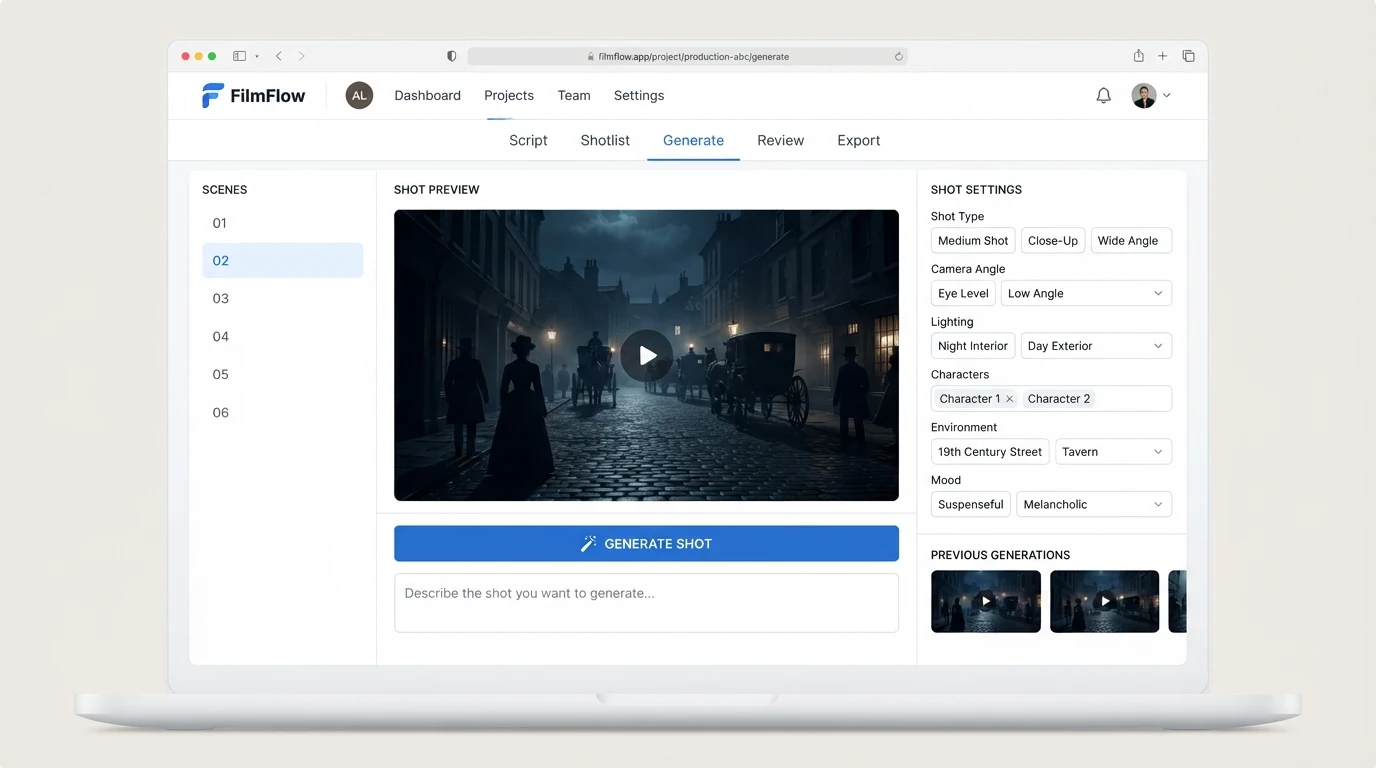
- Shot generation: Runway and Kling for photoreal and stylised motion, with careful prompt libraries built per character to hold likeness across scenes.
- Voice: ElevenLabs for narration and, where ethically defensible, for dialogue, usually paired with a sensitivity pass by the editorial lead.
- Finishing: Topaz for upscaling and temporal smoothing, with a conventional NLE handling edit, grade and sound design.
None of this stack is novel in isolation. What has changed is the editorial muscle required to orchestrate it, which is why the script-to-storyboard phase now carries more weight than it does in live-action work.
The Accuracy Problem
Photoreal AI of George Washington or Mikhail Kutuzov reads to a viewer as evidence. That is the core problem, and it is not solved by a disclosure card at the start of the film. The brain archives a convincing moving image of a historical figure the same way it archives documentary footage, and that archival weight persists after the viewer has forgotten the disclaimer.
Responsible productions in 2026 are drawing a line between emotional truth and literal truth. The Time project retained historical consultants with authority to challenge any generated frame that overstepped the record. Where a scene depicts something no source confirms, it is either staged in a visibly interpretive style, framed as reconstruction in the narration, or cut.
This is where the format most often fails. Studios chasing engagement will generate speculative close-ups of famous faces delivering invented dialogue because the tools make it trivial. Studios building a durable practice, including those we work with on commissioned commercial projects, treat every photoreal frame of a named person as a claim that needs sourcing.
A Production Workflow for a 5 to 10 Minute AI History Short
Most studios approaching the format for the first time underestimate the pre-production load. The generation itself is fast; the work that makes the generation defensible is not. A workable sequence looks like this:
- Research pack: primary sources, scholarly consensus, contested claims flagged, consultant engaged before scripting begins.
- Locked script: narration and any dialogue reviewed by the historian, with every assertion traceable to a source in the pack.
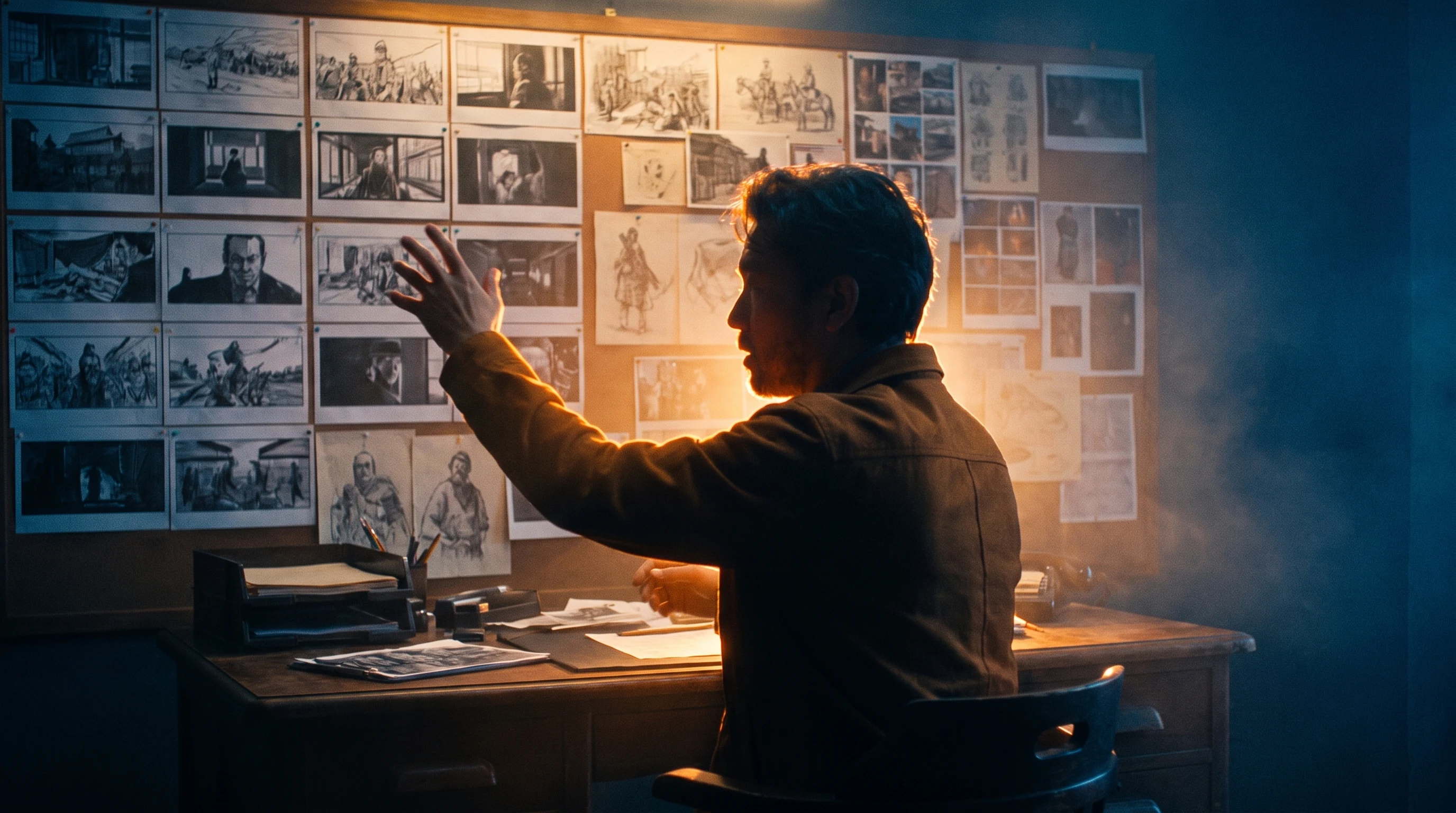
- Shotlist and style frames: each scene broken into shots, each shot assigned a visual reference. This is the stage where our team leans hardest on storyboard practice to pre-visualise continuity.
- Character and location libraries: prompt sets and seed references per named figure and per key setting, so generation holds consistency across the piece.
- Generation passes: first pass for composition, second for performance and continuity, third for finishing-ready plates.
- Continuity and sanity review: a dedicated pass checking anachronisms, costume accuracy, geography and timeline against the research pack.
- Sound design and score: period-appropriate ambience, careful use of voice synthesis, score written or licensed to carry emotional weight the visuals cannot overstate.
- Labeling, citations and credits: onscreen or end-card disclosure of generative methods, named consultants credited, source bibliography available on request.
Ethics, Labeling and Distribution
Distribution shapes the ethics as much as the production does. A festival with a disclosure policy is a different context than an uncredentialed social feed, and the same film can be responsible in one and reckless in the other. Festival rules in 2026 increasingly ask for clear labeling of generative methods at submission, and platform disclosure requirements continue to evolve on YouTube, Meta and TikTok.
The Russian regulator's handling of theatrical release for fully AI films set a precedent other markets are examining, and museum and education partnerships are emerging as a cleaner distribution channel. Institutions bring their own editorial oversight, their own audience expectations and, usefully, their own historians.
For brand studios, the practical rule is simple: match the disclosure to the strongest venue the piece will reach. A museum-grade label does no harm on social; a social-grade label fails on the museum wall. We walk clients through this calibration during consulting engagements before the first frame is generated.
Where This Goes Next
The commercial opportunity is clearer in 2026 than it was a year ago. Museums commissioning anniversary pieces, heritage brands with centenaries to mark, classroom series pairing animated primary sources with teacher-facing study guides, broadcaster strands blending archival research with generative reconstruction. Each of these is a format where generative production reaches worlds a shoot cannot, provided a historian is in the room.
Studios that pair AI generation with named editorial oversight will take this market. Studios that treat it as a volume play will burn trust faster than they can rebuild it, and the format will carry the reputational cost on their behalf.
Frequently Asked Questions
Are AI historical films considered documentaries?
It depends on the ratio of generated to archival material and on the disclosure. A piece built mostly from AI reconstructions is more honestly described as a docudrama or an interpretive history film, with the generative method labeled clearly. Industry bodies and festivals are still codifying terminology, so most studios lead with explicit descriptions rather than category claims.
How do you keep a historical figure's face consistent across scenes?
Teams build a character library: a locked set of reference images and seed prompts per figure, iterated until likeness holds across lighting, angle and emotion. Continuity passes catch drift, and shots that fail the likeness bar are regenerated rather than smoothed over in post.
What is the biggest mistake first-time productions make?
Skipping the historian. Studios assume the generation phase is the hard part and under-resource research. The accuracy failures that get a project pulled apart publicly are almost always failures of the pre-production stage, not the tools.
Can you make an AI history short without photoreal faces of named figures?
Yes, and in many cases it is the stronger creative choice. Animated period paintings, stylised silhouettes, environmental storytelling and voiceover-led structures sidestep the evidentiary problem entirely while still using generative tools where they add value.
What labeling is required on platforms?
Requirements vary by platform and jurisdiction and are changing through 2026. The safest practice is to disclose generative methods clearly in the piece itself, in the description, and at festival submission, rather than relying on platform-level flags that may or may not surface to the viewer.
How long does a 5 to 10 minute AI history short take to produce?
Shorter than a comparable live-action piece, but longer than studios new to the format expect. Research, scripting and consultant review are the dominant costs; generation and finishing move quickly once the pre-production load is cleared.
Who owns the output?
Rights, provenance and commercial usage questions are specific to the tools used, the commissioning contract and the jurisdiction. Studios should resolve these with legal counsel before production rather than at delivery, and we point clients to our team for an early conversation on scope.
Is the format suitable for classroom use?
Yes, with the right editorial frame. Classroom series work best when the generative method is itself part of the lesson, with teacher-facing notes explaining what was reconstructed and why, so students learn to read generated imagery critically rather than passively.
Working With a Studio on an AI Historical Film
AI historical storytelling films reward studios that treat the format as a historical craft first and a technology project second. The releases that defined 2026 share that posture. If you are planning a museum piece, a heritage brand film, a classroom series or a broadcaster commission, Absolutely AI builds these projects with named editorial oversight, a historian in the room, and the production discipline the subject deserves.