AI Documentary Production: A 2026 Workflow Guide for Filmmakers
AI documentary production has moved from novelty reel to working pipeline. In 2026, non-fiction filmmakers are weaving models into research, rushes logging, synthetic B-roll and voice restoration, often cutting per-scene costs to around $60. At Absolutely AI we work alongside directors and producers who want the speed without surrendering editorial judgement, and this guide lays out the workflow honestly.
Documentary has always been a craft of constraint. Small crews, thin budgets, missing footage, subjects who died before the camera arrived. In 2026 a working non-fiction filmmaker has a new set of tools that address exactly those constraints, and the smart ones are folding AI into every stage of the pipeline rather than treating it as a gimmick. This guide is written for directors, producers and editors who want a clear-eyed workflow, and it draws on the same production thinking we use at Absolutely AI when we help teams ship long-form work.
What 'AI documentary production' actually means in 2026
The phrase collapses three very different things. First, documentaries about AI, the cultural anchor being The AI Doc (2026), which sits alongside a growing shelf of festival titles interrogating the technology. Second, documentaries made with AI-assisted workflows, where human filmmakers use models across research, production and post. Third, fully synthetic docs generated end-to-end by models with minimal human capture. This guide is squarely about the middle category, with a nod to the third where it matters.
Most working documentarians will spend the next few years in category two. That is where the craft still lives, and where the questions of authorship, verification and consent are most productive. If you are exploring the fully synthetic edge, the same rigour we apply to AI brand film production applies: treat the model as a department head, not the director.
The new economics of non-fiction
The number circulating among editors this year is roughly $60 to generate a three-minute synthetic scene at broadcast-adjacent quality using tools like Veo 3, Runway Gen-4 or Kling. Compare that to a traditional archival licence for the same three minutes, which can land anywhere from $3,000 to $30,000 depending on the rights holder, or a period recreation shoot that easily runs into five figures once you cost cast, wardrobe and location.
The economic unlock is not that AI replaces a shoot. It is that AI makes stories viable that were previously impossible. A regional history doc with no surviving footage of its 1930s protagonist is now producible. A science film that needs to visualise a molecular process no camera can capture is now producible. Producers we work with on AI video projects report the biggest budget shift is not line-item savings, it is greenlighting films that would previously have been shelved.
Pre-production: research and story mining
The pre-production stack has quietly become the highest-leverage part of an AI documentary workflow. NotebookLM has become the default for interrogating large corpora of source material, letting a director load hundreds of pages of court transcripts, oral histories or academic papers and cross-examine them for through-lines. Perplexity handles live web research with citations attached, and ChatGPT with the deep research mode is now standard for building subject dossiers before an interview.
For visual pre-viz, Midjourney and Runway are the two tools most directors reach for when building a treatment deck. A well-crafted AI script to storyboard pass can turn a written treatment into a fully illustrated pitch document in an afternoon, which materially changes how documentary financiers respond in a room.
Interview prep benefits too. Feeding a subject's public writing, prior interviews and body of work into a model and asking it to surface contradictions, unasked questions and thematic gaps produces sharper conversations. It does not replace a producer's instinct, but it removes the excuse of an under-prepared interview.
Production: what changes on set
On set, AI shows up in less spectacular but more useful ways than the marketing suggests. Modern camera bodies ship with AI autofocus that reliably holds an eye through a moving interview, real-time transcription tools like Whisper running on a laptop next to the sound recordist give producers a searchable record of the day, and continuity apps use vision models to flag wardrobe and prop drift across setups.
Remote interview capture has matured. Riverside and its peers now deliver isolated 4K tracks with AI-assisted framing that make hybrid shoots viable for international subjects without flying a crew. The compromise on image quality is real but shrinking each quarter.
Synthetic B-roll is the loud part of the conversation. Veo 3, Sora and Kling are all viable for short inserts, particularly for historical recreations, abstract visualisations and scenes that would be dangerous, expensive or physically impossible to shoot. The discipline is to shoot everything you can shoot, and only reach for synthetic footage when the alternative is no footage at all. Treat it like a specialist VFX department, not a substitute for cinematography, the same rule we apply to AI commercial work.
Post-production: where AI earns its keep
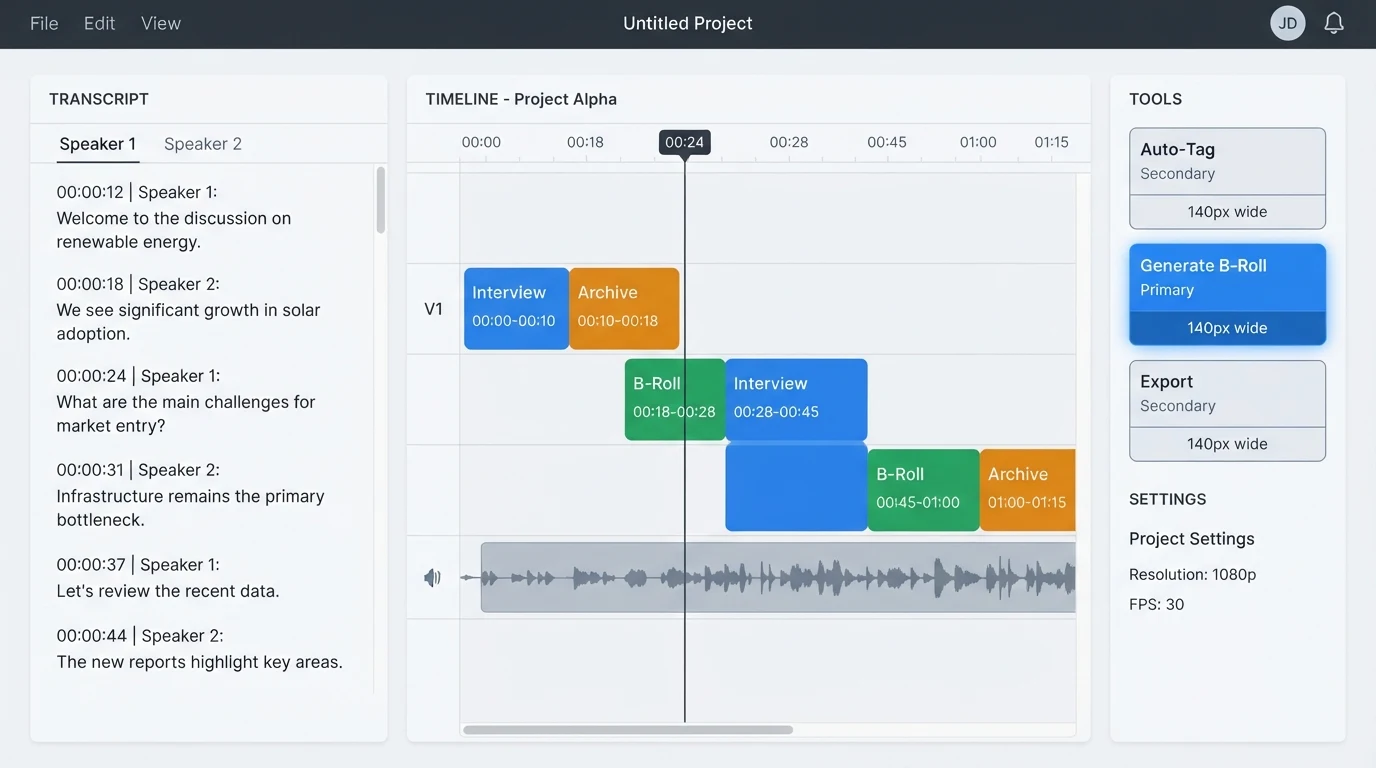
Post is where AI delivers the largest and least controversial gains in a documentary workflow. Whisper and Descript have collapsed the transcription step from a week of paid work to an overnight batch. AI logging tools now tag rushes by speaker, topic, emotion and shot type, giving editors a searchable database rather than a wall of clips.
Inside the timeline, Adobe Premiere Pro and DaVinci Resolve both ship native AI features that matter: text-based editing pulled directly from transcripts, automatic scene detection on long interviews, magic mask for rotoscoping, and voice isolation that rescues field audio you would previously have thrown away. Editors we speak to report assembly-edit timelines shortening by 30 to 50 percent on interview-heavy films.
ElevenLabs has become the quiet workhorse of the sound department. It is used for voice restoration on damaged archival audio, ethical translation dubs that preserve the subject's vocal identity, and, with proper consent, voice reconstruction for deceased subjects working from surviving recordings. Suno and its peers are useful for temp score in the assembly cut, though most films still commission a human composer for the final mix.
Ethics, disclosure and festival eligibility
The ethical terrain is where documentary diverges hardest from commercial work. Sundance, IDA and POV have all published disclosure guidelines in the last eighteen months that filmmakers should read before locking a picture. The consistent through-line is that audiences deserve to know when they are watching generated imagery presented as record.
Practical rules most working documentarians now follow: label synthetic visuals clearly in the film itself, not just in the credits; obtain explicit consent for any voice cloning of a living subject and estate consent for deceased ones; never use AI to fabricate footage of a real event that did not happen; and disclose training data provenance where possible using emerging standards like C2PA content credentials.
Festival eligibility rules are tightening. Several tier-one festivals now require disclosure forms detailing AI use, and a small number of competition strands exclude films with generated imagery in load-bearing scenes. Broadcasters, particularly BBC and public service networks, apply stricter internal standards than most streamers. Check the terms of your commissioning agreement before you generate a single frame.
A sample end-to-end AI-augmented documentary workflow
- Research. Load source corpus into NotebookLM, run Perplexity for live-web context, build subject dossiers in ChatGPT deep research mode.
- Treatment. Draft in a standard doc, then generate a visual treatment deck with Midjourney or Runway for financiers.
- Interview prep. Feed subject material into the model, surface contradictions and thematic gaps, hand producer a tailored question list.
- Production. Shoot conventionally. Run Whisper live on set for searchable transcripts. Log continuity with a vision model between setups.
- Ingest and log. Batch-transcribe rushes with Whisper. Auto-tag with an AI logging tool. Load transcripts into your NLE for text-based editing.
- Assembly. Cut in Premiere Pro or DaVinci Resolve using transcript-based editing. Identify visual gaps.
- Synthetic B-roll. Where no archival exists, generate with Veo 3 or Runway Gen-4. Label internally as synthetic in your bins.
- Sound. Restore damaged archival with ElevenLabs. Draft temp score in Suno. Commission human composer for final.
- Disclosure pass. Add on-screen labels for synthetic imagery. Prepare festival disclosure forms.
- Deliver. Grade in Resolve. Embed C2PA credentials where the workflow supports it.
Where AI still fails documentarians
The failures are real and worth naming. Verification is the deepest problem: models will confidently produce hallucinated 'archival' footage that looks convincing enough to slip into a rough cut if an assistant editor is not paying attention. Establish a rule that any generated frame is tagged in project metadata from the moment it enters the bin.
Faces remain the uncanny valley. Generated humans in mid-ground and background work; generated humans in close-up almost never survive a broadcast QC pass. Rights on training data are unresolved, and the safest posture is to assume any generated imagery may need to be replaceable if a rights claim emerges later. Insurance and E&O policies are only just beginning to price this risk, and premiums are moving.
Finally, the tools are seductive in a way that erodes editorial discipline. It is easier to generate a scene than to find the real thing, and every documentary that leans on that shortcut loses something the audience can feel even when they cannot name it.
Getting started: a five-step checklist
- Pick one film in your slate where AI genuinely unlocks the story, ideally one blocked by missing archival or unshootable material.
- Adopt Whisper or Descript for transcription this week. It is the lowest-risk, highest-return step.
- Write a one-page internal AI policy covering disclosure, consent and synthetic-asset tagging. Share it with every crew member.
- Run a synthetic B-roll test on a 30-second sequence before you commit to it for the film. Grade it, cut it in, watch it on a real screen.
- Talk to your commissioning editor and E&O insurer before you shoot. Surprises at delivery are expensive.
Frequently Asked Questions
Is AI-generated footage allowed at major documentary festivals?
Most tier-one festivals allow it with disclosure, though rules vary and are tightening. Sundance, IDA and POV have published guidelines; check the specific festival's submission terms before locking your cut.
How much does it cost to generate a synthetic documentary scene?
Roughly $60 for a three-minute scene at broadcast-adjacent quality using current-generation tools, though costs vary with resolution, iteration count and post work. Compare that to archival licensing at $3,000 to $30,000 per three minutes.
Can I use AI to recreate the voice of a deceased subject?
Technically yes with tools like ElevenLabs, ethically only with estate consent and clear on-screen disclosure. Most reputable broadcasters and festivals require both.
Which AI tool is best for documentary transcription?
Whisper for accuracy on a budget, Descript for an integrated transcript-to-edit workflow. Both are now standard in professional documentary post.
Do I need to disclose AI use in the credits or the film itself?
Increasingly yes. Best practice in 2026 is on-screen labelling for any generated visual that could be mistaken for archival, plus a disclosure statement in the end credits detailing which tools were used and where.
What is C2PA and why does it matter for documentaries?
C2PA is an emerging content credentials standard that embeds provenance metadata into image and video files. For documentaries it offers a technical way to signal authenticity and generated-content status to downstream viewers and platforms.
Will AI replace documentary editors?
No. It compresses the mechanical parts of the job, transcription, logging, first-pass assembly, so editors spend more time on the parts that require judgement: structure, tone, story. The good ones are getting more valuable, not less.
Can synthetic B-roll pass broadcast QC?
Mid-ground and background inserts, yes, reliably. Close-up faces and complex human motion, usually not yet. Test on a real broadcast monitor before you commit.
The documentaries that will define the next decade of non-fiction are the ones whose makers treat AI as a serious craft tool with serious ethical weight, not a shortcut and not a threat. At Absolutely AI we work with directors and production companies building exactly those pipelines, and the best conversations always start with the story, not the tool. If you are planning a doc where AI genuinely unlocks the film you want to make, that is the conversation worth having.