The AI Creative Direction Process: A 7-Step Operational Playbook
AI creative direction is not prompt engineering. It is the discipline of translating brand strategy, taste, and intent into structured direction a generative model can execute at scale. At Absolutely AI we run this as a repeatable seven-step process, and this guide breaks down exactly how in-house creative leads and agencies past the novelty phase can adopt it Monday morning.
Most teams still treat generative AI as a prompt problem. Type the right words, get the right image. That framing collapses the moment you need a coherent campaign across twelve deliverables, three aspect ratios, and a brand that already has ten years of visual equity. What actually scales is a documented AI creative direction process, one that treats the model as an executor and the creative director as the source of taste and accountability. This is the operational spine our team uses on every engagement.
What AI Creative Direction Actually Is (and Isn't)
Prompt engineering is a syntax skill: knowing which tokens a specific model responds to. Art direction is a visual craft: knowing what a composition should feel like. AI creative direction sits above both. It is the work of defining the brand intent, the deliverable specification, and the guardrails so that any competent operator, or any model, can produce output that lands inside the brand. Read our breakdown of AI studios versus traditional production for the wider context on how this role is evolving.
The creative director's job does not shrink under AI. It expands. Where a CD once approved three comps from an illustrator, they now shape the direction that generates three hundred candidates across five models. Taste, judgment, and accountability stay with the human. The option space, and the speed of exploration, is what changes.
When to Use an AI Creative Direction Process
This process replaces the sketch and comp phase, not the strategy phase. Strategy still starts with the brand, the audience, and the message. Where AI creative direction earns its keep is in campaign concepting, moodboards, storyboards, product visualisation, and the endless social variants a modern brand needs across formats. If your team is producing commercial content at pace, the process below is the difference between output that feels on-brand and output that feels like a stock library raided by a model.
Use it when you need volume without dilution: hero shots plus twenty crops, storyboards for a launch film, seasonal product worlds, or a full-funnel content system that has to feel like one brand across every touchpoint.

The 7-Step Process
This is the operational meat. Every step exists because skipping it produces predictable failure downstream. The order matters.
1. Extract a Structured Brand Profile
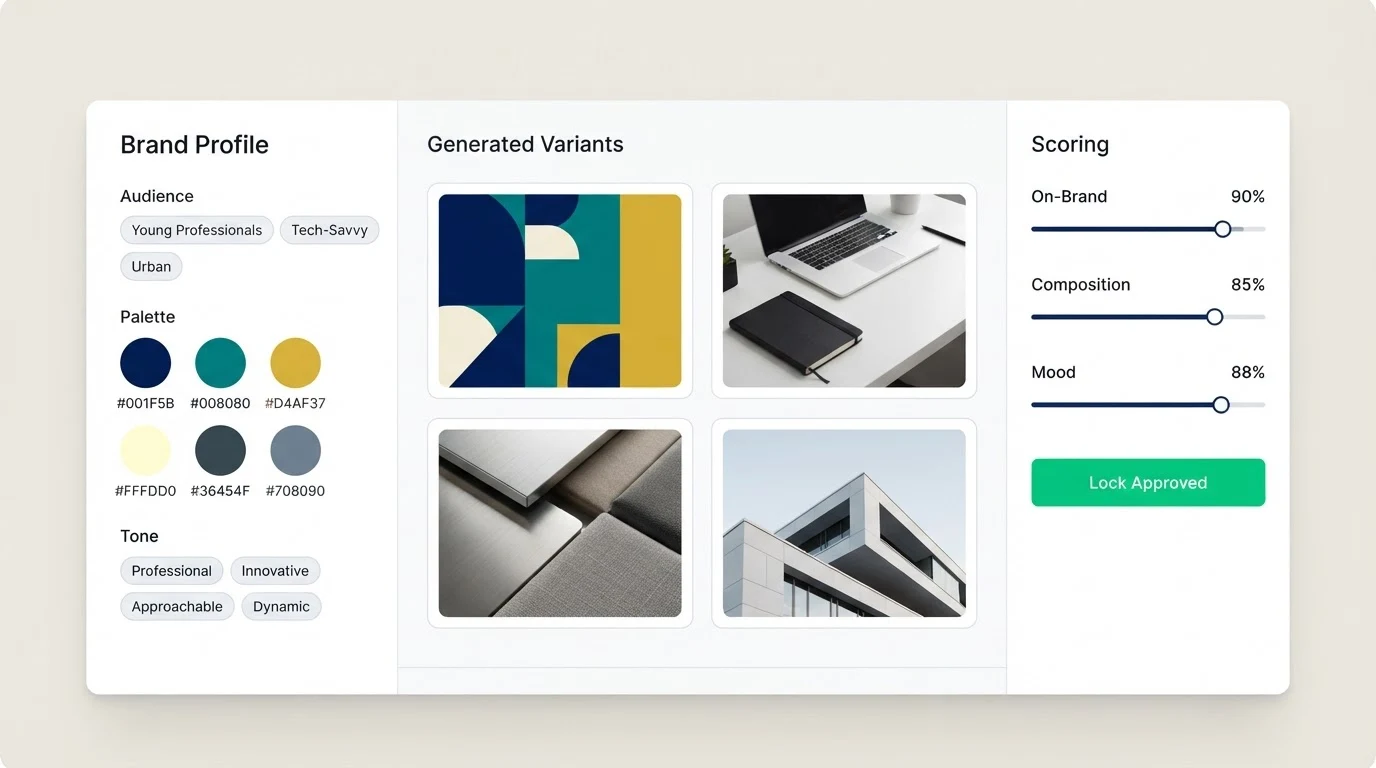
Before any model touches the work, the brand gets documented as structured data: audience, tone descriptors, palette with hex values, typographic feel, permitted and forbidden imagery, competitor references, and any legal restrictions. This becomes the reference every downstream decision is measured against. Vibes are not a brief. A one-page brand profile is.
2. Define the Deliverable Spec
Direction changes by deliverable. A 16:9 hero, a 9:16 social cut, a square product tile, and a storyboard frame need different compositional logic even when the brand is identical. The spec captures aspect ratio, medium (still, motion, illustration), hierarchy of subject and message, and where the deliverable sits in the funnel. This is where most in-house teams cut corners and pay for it in revisions.
3. Build a Reference Set and JSON Context Profile
Pick one to three anchor images. Not a Pinterest wall of fifty. Then translate what makes them work into a JSON context profile: lighting direction, camera language, material palette, subject framing, colour temperature, grain. A structured profile beats a mood collage because it is transferable across models and stable across sessions.
4. Write the Direction, Not the Prompt
This is the reframing that changes everything. Direction describes intent: composition, lighting, materials, mood, and the imperfections that make an image feel real. Prompts are the model-specific translation of that direction. Write the direction once. Translate it into Midjourney syntax, Firefly parameters, or Flux weights as needed. Teams that skip this step end up rewriting the same brief five different ways for five different models and losing coherence in the process.
5. Generate in Parallel Across Models
Fire the direction at Midjourney, Adobe Firefly, Flux, Ideogram, and Sora in parallel. Not because you'll ship from all of them, but because parallel generation pressure-tests the direction. If four models converge on the same feel, the direction is strong. If they diverge wildly, the direction is ambiguous and needs a rewrite before you burn hours curating noise.
6. Curate With a Scoring Rubric
Vibes-picking is the enemy. Build a five-point rubric tied back to the brand profile: on-brand palette, compositional integrity, subject accuracy, mood alignment, and technical quality. Score every candidate against it. This turns curation from taste theatre into a defensible decision that survives a client review.
7. Lock Approved Elements and Iterate Only What's Unresolved
Once a composition, palette, or subject is signed off, lock it. Iterate only the unresolved layer: swap the background, adjust the lighting, refine the wardrobe. Regenerating from scratch each round is how teams end up thirty revisions deep with nothing approved. Structured locking is how retainer-model AI production actually delivers on time.
The Direction Document
A good brief to a model looks nothing like a good brief to a photographer. It is denser, more parametric, and less poetic. Here is a real example block for a beverage hero:
- Subject: a single unbranded amber glass bottle, condensation on the shoulder, cap slightly angled
- Composition: centred, hero-left third, negative space upper-right for typography
- Lighting: single soft key from camera left, gentle rim from behind, warm colour temperature at 3200K
- Materials: matte concrete surface, condensation as small discrete droplets not sheet, subtle wood grain in soft focus behind
- Mood: considered, editorial, closer to a Kinfolk still life than a beverage ad
- Imperfections: one droplet mid-slide down the glass, faint fingerprint on the cap
Every element in that block is a decision the creative director owns. The model just executes. For teams building this muscle, our AI creative consulting engagements walk through direction documents for the exact deliverables you're shipping this quarter.
Governance: Version Control, Model Registry, Provenance
The part most teams ignore until it bites them. Prompts and direction documents belong in version control, same as code. Each project needs a model registry that records which model version produced which asset, so results are reproducible six months later when a client asks for a variant. Rights and provenance sit on top: C2PA metadata for anything shipped externally, and clear review gates before public release.
Governance is what separates a hobby workflow from something a legal team will sign off on. If you're producing at any scale, this layer is non-negotiable. Working with an experienced agency is often the fastest path to inheriting the governance patterns rather than building them from scratch.
Common Failure Modes
Four patterns account for most bad AI output on brand work. Recognise them early and the process self-corrects.
- Vague vision: starting to generate before the brand profile and deliverable spec exist. The model can only be as clear as the direction.
- Over-prompting: stuffing thirty adjectives into one prompt in the hope of control. Models weight the first tokens most; long prompts produce mush.
- Model-hopping without a rubric: switching from Midjourney to Flux to Firefly chasing a feeling, with no scoring system, ending up with two hundred options and no decision.
- No lock step: approving nothing along the way, then trying to hold the whole campaign in your head at the end. Lock as you go or drown.
Team Shape
The team that runs this process well is smaller than the traditional equivalent but differently shaped. You need a creative director who owns taste and the direction document. You need an AI creative technologist who owns model behaviour, prompt translation, and the tooling stack. And you need a producer who owns the deliverable spec, version control, and client review gates. Three roles, tight loop, no illustrator or retoucher in the middle.
The CD's job changes in one specific way: less time drawing on other people's comps, more time writing precise direction and scoring output against it. If that shift feels uncomfortable, it is the actual work of the transition. Our wider write-up on the AI agency landscape in Australia covers how the leading teams are structuring around this shape.
Frequently Asked Questions
How is AI creative direction different from prompt engineering?
Prompt engineering is model syntax. AI creative direction is the strategic work of defining brand intent and deliverable specification so any prompt, or any model, produces output that lands on brand. Prompting is a tactic inside the process, not the process itself.
Do I still need a creative director if I have AI tools?
More than ever. Models expand the option space; someone still has to define the intent, score the output, and hold accountability for what ships. The CD role gets more strategic, not less necessary.
Which model should our team standardise on?
None of them. Parallel generation across two or three models pressure-tests the direction and hedges against any one model's blind spots. Standardise the direction document and the scoring rubric, not the tool.
How long does the 7-step process take for a single campaign?
Brand profile and deliverable spec are one-off, roughly a day. Per campaign after that, direction and reference set take half a day, parallel generation and curation run in another day, and lock plus iteration closes inside a third. Compared to a traditional shoot timeline, the compression is significant.
What is a JSON context profile and why does it matter?
A structured object capturing the visual grammar of your anchor references: lighting, palette, materials, framing, grain. It matters because it is transferable across models and stable across sessions, unlike a mood collage which lives in one person's head.
How do we handle rights and provenance for AI-generated brand assets?
Embed C2PA provenance metadata on anything shipped externally, keep a model registry recording which version produced which asset, and add a review gate before public release. Treat it with the same rigour you'd apply to stock licensing.
Can this process work for video and motion, not just stills?
Yes. The seven steps map cleanly to motion: the deliverable spec expands to include duration and pacing, the reference set includes motion references, and generation runs across Sora, Runway, and Kling in parallel. The scoring rubric picks up temporal criteria like pacing and cut logic.
What's the fastest way to adopt this if we're starting from zero?
Write the brand profile this week, pick one live campaign, and run the full seven steps on it end to end. One real project teaches more than three months of theory. If you need pattern-matching from teams already running it, that's what an outside partner is for.
Where to Go From Here
The teams pulling ahead on AI creative work are not the ones with the best prompts. They are the ones with the most disciplined process, the tightest direction documents, and the clearest scoring rubrics. Everything else follows from that. If you'd like to see how Absolutely AI runs this end-to-end on a live brand, our team can walk you through the direction document template, the model stack, and the governance layer on a real deliverable from your current roadmap.