How to Hire an AI Content Agency: A 2026 Buyer's Guide
The real question in 2026 is not whether to use AI for content, it is who runs the AI system on your behalf. Absolutely AI put together this decision framework for founders and marketing leads weighing an agency against in-house hires, freelancers, or DIY tools. Inside: what to look for, red flags, how the pricing models actually work, and a 30-day pilot template you can use before signing anything.

Every marketing lead we speak to in 2026 is asking a version of the same question: should we hire an AI content agency, expand the in-house team, or keep patching things together with freelancers and ChatGPT tabs. The honest answer is that the choice is no longer AI vs humans. It is who runs the AI system, applies editorial judgement, and takes accountability for the output that ships under your brand.
This guide is the decision framework we wish existed when clients first come to us. It covers what these agencies actually do, when hiring one makes sense, how to compare the alternatives, what real pricing buys, and a paid pilot template you can run in 30 days instead of committing to a 12-month retainer up front.
What an AI Content Agency Actually Does in 2026
The label covers four fairly distinct service shapes, and conflating them is the fastest way to hire the wrong partner. Managed AI writing agencies produce editorial, blog, and long-form content using a governed model stack with human editors in the loop. AI creative and visual production shops focus on brand imagery, product photography, and video, often replacing traditional studio work with AI commercial production.
The third shape is programmatic and AI SEO programs: agencies that build content velocity engines targeting hundreds of long-tail keywords with human QA at the top of the funnel. The fourth is workflow automation: teams that build the internal AI systems your staff use daily, closer to AI automation consulting than to a content shop. A good partner will tell you which of the four they actually are. A weak one will claim all four.
The key differentiator from a traditional content agency that has bolted ChatGPT onto old workflows is the operating model. Modern AI content agencies design prompt libraries, brand voice training layers, model routing logic, and QA scorecards as first-class deliverables, not afterthoughts. If a prospective partner cannot show you their prompt library or their editorial QA process, they are reselling what a freelancer with a Notion dashboard would sell you at three times the markup.

Signals It Is Time to Hire One
Five signals show up repeatedly in the discovery calls that convert. First is a velocity gap: you need more than eight publish-ready assets a week and the current team is missing cadence. Second is thin in-house AI literacy, where the marketing team is capable but has no time to become prompt engineers on top of their day job.
The remaining three are governance-driven. If you need brand safety controls, legal review of AI outputs, or IP clarity on training data, an agency with an established policy is far cheaper than building one from scratch. If you have a founder-led team that keeps missing publishing cadence because leadership becomes the bottleneck, an agency removes that dependency. And if you are running a full-funnel pipeline that needs writing, imagery, and video in sync, a partner with a unified AI content creation stack beats stitching three vendors together.
Agency vs In-House vs Freelance vs DIY Tools
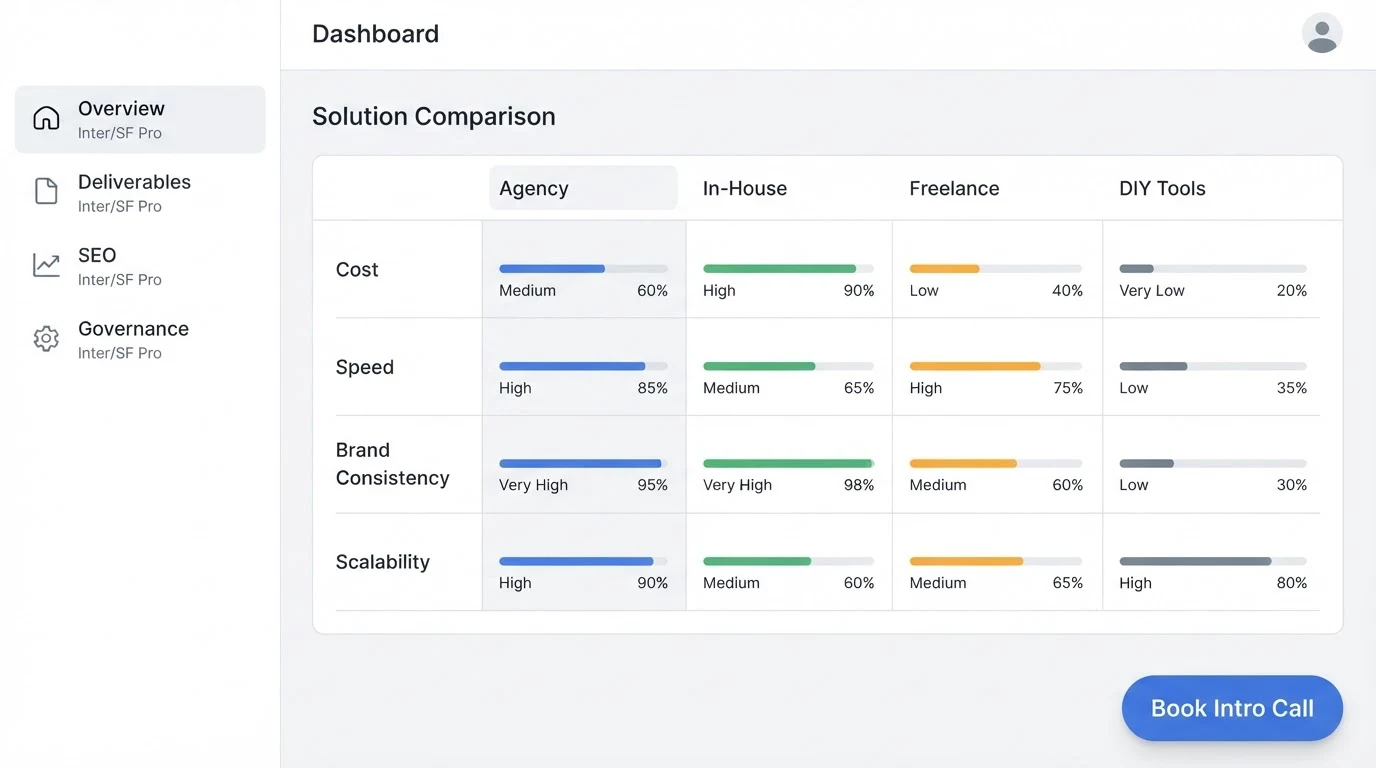
The comparison below is what we walk prospects through when they are genuinely undecided. The numbers reflect Australian and US market ranges we see in 2026, loaded costs where relevant.
| Option | Typical annual cost | Speed to first output | Brand consistency | Governance | Scalability |
|---|---|---|---|---|---|
| AI content agency | Retainer, quoted per scope | 1–2 weeks | High (with brand training) | Included | High |
| In-house AI content manager | $140k–$185k loaded | 2–3 months to ramp | Very high | You build it | Limited by headcount |
| Freelancer pool | $40k–$120k variable | 1–4 weeks per project | Low to medium | Rare | Medium |
| DIY tools only | $2k–$8k in seats | Immediate | Depends on operator | None by default | Low until you hire |
The honest read is that DIY tools plus a strong in-house operator wins on cost when your volume is low and your brand voice is simple. Once you are past ten assets a week or need consistent brand imagery across formats, the operating overhead of running the stack yourself starts eating the savings.
What to Look For in an AI Content Agency
Six criteria matter more than the sales deck. A human editor in the loop on every deliverable, not just spot-checks. A model-agnostic stack that routes between GPT-5, Claude, Gemini, and specialist models rather than being locked to one vendor. A published prompt and QA process you can actually inspect during due diligence.
The remaining three are commercial. Measurable SEO or conversion outcomes in prior case studies, ideally with traffic or revenue screenshots. A clear IP and training-data policy that confirms your content is not being used to train third-party models. And a sample of governed deliverables so you can see what their B-tier looks like, not just their portfolio hits. This is the same bar we hold ourselves to when clients evaluate our AI consulting engagements.
Red Flags to Screen Out Fast
- Pure AI output with no editorial layer, presented as a feature rather than a warning sign.
- Opaque per-word pricing that hides how thin the human review actually is.
- No case studies with traffic, ranking, or revenue screenshots you can verify.
- Refusal to disclose which models power the workflow, or vague answers about vendor lock-in.
- Reliance on a single tool such as Jasper or Copy.ai as the entire production stack.
- No named editor on the account, only a project manager forwarding files.
- Twelve-month minimum contracts with no paid pilot option.
Any two of these together should end the conversation. All five together describe a reseller, not an agency. For a longer breakdown of the freelancer trap in particular, our comparison of AI content agencies versus freelancers covers the accountability gap that shows up in month three.
Pricing Models Explained
Four pricing models dominate the market, and each has a realistic outcome band. An entry-tier retainer typically buys four to eight polished long-form assets a month plus light social repurposing, with one editor splitting attention across several accounts. This tier suits early-stage brands with a clear voice already established.
The mid tier buys a dedicated editor, weekly production cadence, brand voice training, and light SEO strategy. The top tier buys a full pod: strategist, editor, prompt engineer, and either a visual production lane or a programmatic SEO engine. Per-deliverable and sprint pricing sit alongside these tiers for one-off launches, and performance-based pricing is rare and usually a red flag unless the agency also has strategic control.
Questions to Ask on the Intro Call
- Which models are in your production stack today, and how do you decide when to swap them?
- Who is the named editor on my account, and how many other accounts do they touch?
- Can you walk me through your QA scorecard on a real deliverable from last month?
- What does your prompt library look like, and do we get access to ours at offboarding?
- Who owns the IP on the outputs, and is any of my content used to train external models?
- What is your typical revision cycle, and how many rounds are included per asset?
- How do you report performance, and on what cadence?
- What is your paid pilot structure, and what does a successful pilot look like?
- Show me a project where the AI output was rejected internally: what changed?
- If we end the retainer, what do we keep: prompts, brand voice model, assets, source files?
The answers to questions three, five, and ten separate operators from resellers faster than any other part of the conversation. If the agency dodges any of them, keep looking.
A 30-Day Paid Pilot Framework
Rather than signing a twelve-month retainer on the strength of a sales call, scope a paid pilot. A useful pilot has four ingredients: a fixed fee scoped to the work, a defined deliverable set of six to twelve production-ready assets, a written success scorecard agreed before work starts, and an exit clause that lets either side walk cleanly at day 30.
Score the pilot on five axes: brand voice accuracy, editorial quality, on-time delivery, responsiveness on revisions, and strategic input beyond the brief. Anything above four out of five on all axes is a green light. Anything below three on two axes is a signal to try a different partner rather than assume it will improve at scale. Pilots are how we start most engagements at Absolutely AI, and the ones that convert to retainer almost always score high on strategic input, which is the axis that predicts long-term fit.
Frequently Asked Questions
How much does an AI content agency cost per month in 2026?
There is no rate card, because the number follows scope. The entry tier covers a handful of long-form assets a month with a shared editor. The mid tier, where most mid-market brands land, adds a dedicated editor and a weekly production cadence. The top tier funds a full pod with a strategist, editor, and prompt engineer, and is quoted per program.
Do I still need an in-house content person if I hire an agency?
The hybrid model works best for most brands: the agency runs the AI system and production cadence while you keep one internal owner for strategy, approvals, and brand judgement. A full in-house AI content manager loaded at $140k to $185k a year only makes sense once volume exceeds what a single agency pod can handle.
Who owns the IP on AI-generated content?
You should own the outputs outright, including source files, prompts developed for your brand, and any custom brand voice model. Any agency that muddies this in the contract is a red flag.
Is AI content bad for SEO in 2026?
Search engines penalise low-quality content regardless of how it was made. Well-edited AI content with genuine expertise and human review performs on par with fully human-written content, and often better on velocity-sensitive long-tail topics.
What is the difference between an AI content agency and a traditional agency that uses AI?
The operating model. AI-native agencies design prompt libraries, model routing, and QA scorecards as first-class deliverables. Traditional agencies with AI bolted on tend to charge legacy rates for output that a modern stack could produce in a quarter of the time.
Should I sign a long-term contract?
Not before a paid pilot. Scope 30 days with a written scorecard, then decide whether to convert to a retainer with a three-month rolling term rather than a twelve-month lock-in.
When should I not hire an AI content agency?
If your volume is under four assets a month, if your brand voice is highly technical and lives inside one founder's head, or if you have no internal owner to approve work, the agency spend will not pay back. Fix the volume, voice, or ownership gap first.
The Short Version
Hire an AI content agency when you have real volume, a clear internal owner, and enough governance risk that DIY tools start feeling exposed. Screen ruthlessly on the six criteria above, run a paid pilot before any long-term commitment, and treat the pricing tier as a signal of what you will actually receive rather than a negotiation surface. If you would like to see how this framework applies to your specific pipeline, the team at Absolutely AI is happy to scope a pilot with the scorecard baked in.