AI Creative Direction for Brands: The Operator's Playbook
AI creative direction is not prompt engineering. It is the discipline of translating brand strategy into a system that generative tools can execute consistently, across every channel, without diluting the work. At Absolutely AI we treat it as the load-bearing layer between strategy and output, and this playbook is how we run it.

Most articles on AI and creativity are written for people watching the shift, not running it. This one is written for the marketing lead, brand manager, or creative director who has to ship a campaign next week and wants AI in the pipeline without losing the brand. If that is you, the useful frame is not "can AI make the asset," it is "what direction system makes the AI reliable." That system is what an AI creative agency like Absolutely AI actually sells.
What AI creative direction actually means in 2026
AI creative direction is the discipline of encoding brand voice, visual system, and audience insight into repeatable briefs, reference libraries, and QA rules that generative models can execute against. It is closer to art direction and design systems than to "AI marketing" or "AI content generation," both of which describe outputs rather than the intelligence that produced them.
The distinction matters commercially. Generic AI content is cheap and forgettable. Directed AI content carries the same weight as a proper studio shoot because the brand codes are baked in before the model ever runs. That is why the work coming out of a mature AI branding practice looks nothing like the default midjourney feed.
The role of the creative director does not disappear in this model, it moves upstream. Instead of directing a photographer on set, the CD is directing the system: the references, the constraints, the tone rules, the failure conditions. The output is downstream of that architecture.
Why brands are hiring (or upskilling) AI creative directors
Four forces are pushing this hire onto the org chart. First, cost compression: a single directed AI pipeline replaces a stack of freelancers, stock buys, and small production days. Second, speed to concept: what used to take three weeks of moodboarding and pre-pro takes an afternoon. Third, channel volume: a launch now needs fifteen aspect ratios, not two. Fourth, consistency: without a direction layer, every asset drifts.
The shift most senior marketers name is going from designing touchpoints to designing the intelligence behind them. You are no longer approving hero images one at a time, you are approving the system that will produce two hundred hero images on brand. Buyers weighing this against traditional retainers should read our breakdown of AI content studios versus traditional studios before making a call.
The 5 inputs every AI creative direction system needs
A working system is not a clever prompt. It is a corpus. If any of these five inputs are missing, the output regresses to the mean and starts to look like everyone else's AI, which is the fastest way to devalue a brand.
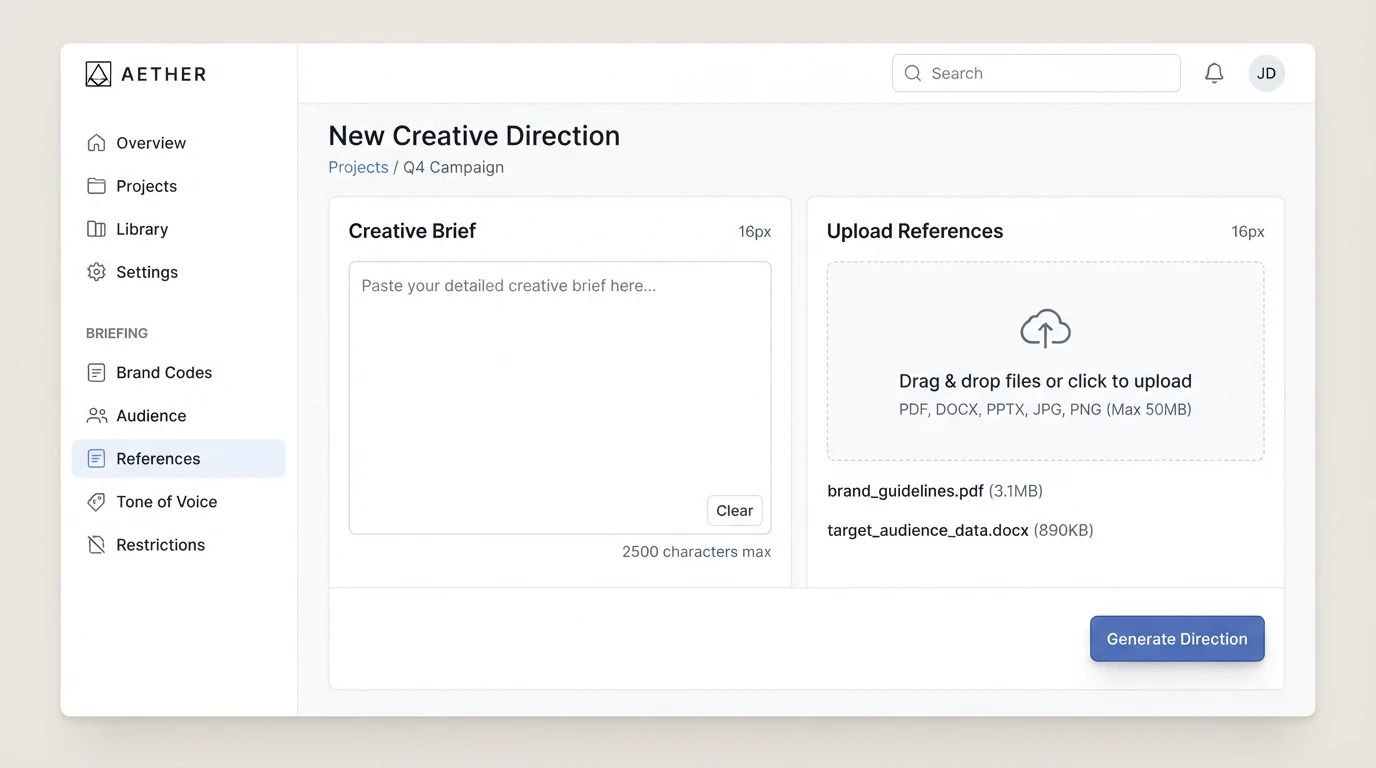
- Brand codes. Palette, typography, motion signatures, camera language, composition rules. Documented visually, not just in words.
- Audience psychographics. Not demographics. What the audience aspires to, what they reject, what cultural cues read as premium to them specifically.
- Reference and moodboard corpus. A curated library of on-brand imagery, competitor negatives, and stylistic anchors that the model can be pointed at directly.
- Tone-of-voice rules. Warm or clinical, plain-spoken or ornate, first-person or observational. Applied to copy, captions, and any typography inside the frame.
- Restrictions and legal guardrails. Talent likeness, competitor references, category regulations, cultural sensitivities, claim substantiation.
When we onboard a new client, most of the first week is spent building this corpus rather than generating anything. Teams that skip this step end up in an expensive loop of revisions, which is the pattern we describe in our hiring guide for AI content agencies.
A workflow that actually ships
Here is the sequence we run internally. It is deliberately linear, because parallelising it too early is what causes the drift that makes AI work look cheap.
- Brief intake. Deliverables, channels, aspect ratios, deadline, distribution plan.
- Structured brand profile. The five inputs above, written to a schema the pipeline can read.
- Reference library assembly. Curated image and motion refs, tagged by concept and role.
- Concept generation. Midjourney, Sora, Runway, Firefly, or our own Wireflow orchestration, seeded with the refs and the profile.
- Art-direction QA. Senior CD passes the grids, kills the AI tells, selects the survivors.
- Human polish. Retouch, colour grade, motion cleanup, typography lock.
- Delivery in every channel format. Aspect crops, safe zones, platform specs, versioned assets.
The step most in-house teams underestimate is step 5. It is where taste actually shows up, and it is why teams building this capability alone often come back to a partner. Our AI content creation service exists specifically to run this workflow end to end.
Where AI creative direction breaks
Knowing the failure modes is half the job. A senior director rejects rather than accepts, and the rubric is fairly consistent across categories.
- Hands, teeth, and micro-anatomy. Still the most reliable tell. Zoom in before signing off anything with people.
- Brand-inconsistent lighting. The model defaults to soft, cinematic, warm. If your brand is hard-flash editorial, defaults will fight you.
- Generic "AI look." Iridescent shimmer, glossy skin, floating particles, symmetrical hero framing. When you see it, you are looking at zero direction.
- Cultural blind spots. Models trained on western reference sets misread local cues, wardrobe, and gesture. Regional QA is not optional.
- Text inside the frame. Improving fast, still unreliable. Reserve for hero typography where you can verify letter by letter.
- Continuity across a set. Same subject, same product, same location, drifting frame to frame. Solved by reference locking and seed control, not by prompting harder.
The philosophical version of this is simple: a good CD edits. A bad one prompts and posts. The commercial version is that this rubric is what protects a brand's equity while its output volume goes up tenfold, which is the thesis of our AI commercial production offering.
Case-style examples across categories
The pattern holds across verticals, but the failure surfaces differ. A quick tour of three we see often.
CPG. A skincare brand needs 40 SKU-level lifestyle frames a quarter. Without direction, the model gives back forty variations of the same beige bathroom. With a direction layer keyed to the brand's editorial reference set, each frame carries the same lighting language, the same skin tone treatment, and the same negative-space rhythm. Traditional shoot equivalent would be a two-day booking per drop.
Fashion. A ready-to-wear label wants campaign concepting in worlds that are literally uneconomic to build: 1970s Milan, a snowbound observatory, a red-clay salt flat. The direction layer defines the wardrobe silhouette, the model's poise, the film stock, and the colour grade. What the AI enables is scope; what the direction enables is that scope looking like one brand.
B2B SaaS. A workflow platform needs 60 abstract concept illustrations for lifecycle emails. Direction defines a proprietary visual system, colour rules, and level of abstraction. The output is instantly ownable, which is the opposite of the stock-illustration look most SaaS brands are stuck in.
DTC teams in particular tend to underestimate how quickly directed AI compounds. We wrote about that shift specifically in our note on AI content agencies for DTC brands.
Choosing tools and partners
There are three viable paths, and the right one depends on volume, brand risk tolerance, and internal appetite for pipeline work.
| Path | Best for | Watch out for |
|---|---|---|
| In-house build | High-volume brands with a mature creative team and a technical lead | Tooling churn, hiring drought, plateau at "good enough" |
| AI-native agency | Brands that want senior direction plus the pipeline, without building either | Fit and taste vary widely, ask to see raw grids not just finals |
| Legacy agency plus AI add-on | Existing agency relationships you do not want to disrupt | AI often bolted on, not directed, output frequently generic |
A quick buyer's checklist worth running: ask to see the reference library, ask how brand codes are documented, ask what the QA rubric looks like, ask who the senior director on your account is, ask for the raw pre-selection grid not the polished three. If any of those questions produce a shrug, keep looking. Australian buyers can start with our shortlist of AI content agencies in Australia.
Metrics that prove it is working
Direction without measurement collapses back into taste arguments. Four numbers are worth tracking from day one.
- Concept-to-approval time. Days from brief received to first approved concept. A directed AI pipeline should compress this by 60 to 80 percent versus traditional.
- Cost per finished asset. All-in, including direction, generation, polish, and delivery. Watch the trend line quarter over quarter.
- Brand-consistency score. Blind panel or rubric-based, scoring each asset against brand codes. If the score drops as volume rises, the direction layer is thin.
- Campaign performance lift. CTR, CVR, watch time, whatever your channel measures. Directed AI should meet or beat traditional creative, not underperform it.
Teams evaluating retainer structures against these metrics should read our breakdown of AI content retainer pricing so the commercials line up with the workload.
What is next
The near horizon is autonomous brand systems: pipelines that take a brief, reason about the brand corpus, generate, self-critique against the QA rubric, and hand a senior CD only the survivors. Agentic creative work is already usable for the middle of a campaign, though the top and bottom of the funnel still need human direction on every frame.
The role that emerges from this is the CD as system architect. Less time in Figma, more time defining what "on brand" means in a way a model can enforce. That is the job worth training for, and the capability worth buying if you cannot build it fast enough in-house, which is broadly the argument we made in AI content agency versus freelancer.
Frequently Asked Questions
Is AI creative direction the same as prompt engineering?
No. Prompt engineering optimises a single output. Creative direction defines the entire system: brand codes, references, tone, restrictions, and QA rules that make outputs consistent across hundreds of assets and multiple channels.
Do we still need a human creative director if we use AI?
Yes, and arguably more of one. The CD role moves upstream from directing individual shoots to directing the system that produces the work. The taste bar is set by the human, always.
What tools sit at the centre of a modern AI creative direction stack?
Midjourney, Sora, Runway, and Adobe Firefly for generation, layered with reference-locking and orchestration tooling. The specific tool matters less than the direction layer sitting on top of it.
How long does it take to build the direction system for a brand?
For a mid-sized brand with existing guidelines, one to two weeks of intensive work to build the corpus, plus ongoing refinement as the model evolves and new campaigns land.
Can we build this in-house?
If you have a senior creative director with appetite for pipeline work and a technical partner comfortable with generative tooling, yes. Most brands find the ramp faster with an external partner running the first two or three campaigns.
How do we measure whether it is actually on brand?
A rubric-based brand-consistency score run by a blind panel, tracked over time. It should stay flat or improve as asset volume rises. If it drops, the direction layer is thin.
Is AI creative direction cheaper than traditional production?
The right question is capability, not cost. Directed AI reaches worlds and volumes traditional production cannot, at speeds traditional production cannot match. The economics follow from that, not the other way round.
What is the single biggest mistake teams make?
Generating before directing. Every team that skips the corpus build ends up with output that looks generic and needs endless revision. The five inputs are non-negotiable.
The takeaway
AI creative direction is the load-bearing capability of the next decade of brand work. It is not a tool decision, it is an operating model, and the brands that treat it seriously will pull away from the ones still asking whether AI can make a hero image. Absolutely AI runs this system every day through our creative agency practice, and if you are building the capability yourself or looking for a partner to run it with you, that is the conversation worth having.