How to Generate Creative Concepts From a Brief Using AI
Most AI creative tools help you write the brief. That is the easy part. The hard part, and the one Absolutely AI has spent the last year systemising, is turning an approved brief into concept imagery a client can actually react to. This piece walks through the workflow, the prompt structure, and the failure modes nobody else documents.

Every AI creative tool on the market seems to want to help you write the brief. Input three bullet points, get back a polished document. That is not the bottleneck. The bottleneck sits one step later: taking an approved brief and producing enough concept imagery for a client to point at something and say yes. That middle step, brief to concept, is where a modern AI creative practice earns its fee.
What 'creative concepts from a brief' actually means
A concept is not a finished asset. It is a testable hypothesis about the emotional idea and visual direction that will move the audience the brief describes. Historically an art director produced three of them, one 'safe', one 'stretch', one 'wild', and defended them in a room. The client picked one and paid for execution. The economics of that model only worked because concepting was scarce.
AI changes the arithmetic. You can produce eight to twelve concepts per deliverable in the time one used to take, which means the conversation shifts from 'defend the three' to 'sort the twelve'. That is a healthier place to be with a client, and it is what senior creative direction looks like now: less about pushing a single vision, more about curating a wide field down to a sharp shortlist.
The old workflow versus the AI workflow
The delta is not just speed. It is the number of shots on goal per dollar, and the ability to test alternate-world ideas that a human AD would never bother sketching because the ROI was too low.
| Stage | Traditional agency | AI-assisted flow |
|---|---|---|
| Time to first concepts | 1 to 2 weeks | Same afternoon |
| Concepts per deliverable | 3 | 8 to 12 |
| Cost per concept | Senior AD day rate | Junior operator plus reviewer |
| Revision loop | Days per round | Hours per round |
| Alternate-world exploration | Rare, expensive | Baked into every batch |
The catch is that the AI workflow only produces useful output if the brief is actually structured. Vague briefs produce mood-board slop at eight times the volume, which is worse than three defensible drawings. Structure is the price of admission, as any agency that has run this at scale will tell you.
The five-part brief AI actually needs
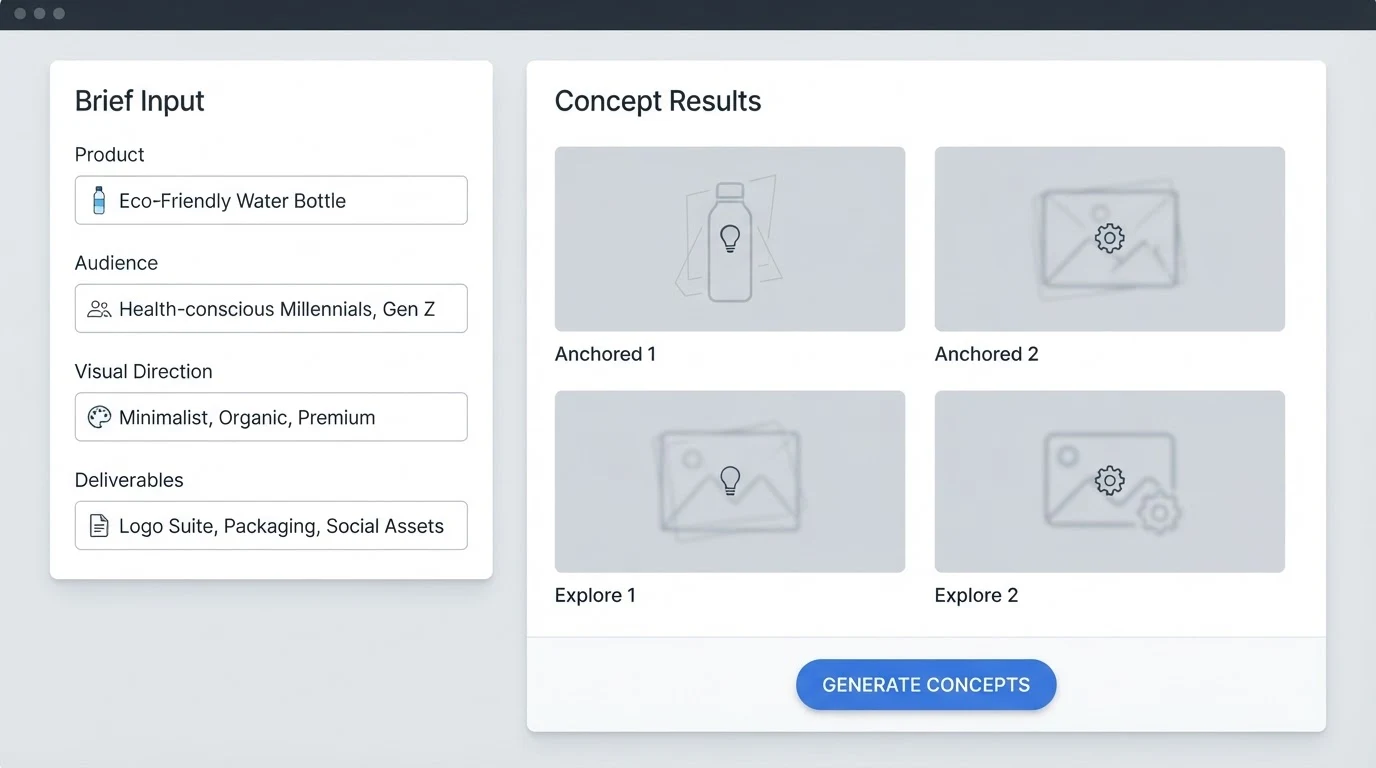
Every deliverable in the pipeline gets fed the same five sections. If any one is missing the model fills the gap with its own priors, which is where off-brand output starts. The five parts:
- Product or service. What it is, what it does, what problem it solves. Two sentences.
- Target audience. Demographic, psychographic, the specific aspiration or pain the campaign is speaking to.
- Visual direction. Style, lighting, mood, setting, whether people appear, colour palette cues. This is the section that most briefs skimp on, and it is the one the image model reads hardest.
- Key messages. The three to five things the imagery must communicate, ranked.
- Deliverables list. Hero shot, lifestyle, ingredient detail, vertical social, storyboard frames, each with an intended aspect ratio and channel.
Restrictions sit alongside as a sixth block: competitor references to avoid, category cliches the client has banned, anything legal has flagged. This is non-negotiable for DTC work where a single off-brand frame in a Meta ad can cost a week of trust.
Step by step: brief to concepts in one afternoon
The workflow we run internally has five stages, and it maps cleanly onto any content operation of reasonable scale:
- Extract a structured brand profile. The raw brief becomes a machine-readable document with the six sections above filled in. A human confirms it before anything else fires.
- Infer aspect ratios per deliverable. Hero is usually 16:9 or 4:5, lifestyle is 1:1 or 4:5, vertical social is 9:16, storyboard frames are 16:9. Getting this wrong forces re-generation later.
- Build per-deliverable prompts. Each deliverable gets its own prompt string: the deliverable line, the aspect ratio, and the entire brand profile. Not a summary. The whole thing.
- Fan out image generation. Four grids per deliverable is the sweet spot. Two anchored to reference imagery, two alternate-world variants that deliberately break one constraint.
- Grid review with the client. Present as a contact sheet, not as hero renders. The client picks two or three to develop, and those go into a proper production pass.
The anchored-versus-exploration split
This is the part most tutorials skip. Every batch of concepts should be split roughly half and half between concepts that hug the reference imagery and concepts that deliberately depart from it. The anchored variants exist so the client can approve something safe on the first call. The exploration variants exist so someone in the room says 'wait, actually, what if we did that instead'. You need both, and the ratio matters more than the volume.
The exploration set is where AI genuinely beats a human AD on a time-per-idea basis. A human will not sketch a Mars-set version of a skincare hero because the opportunity cost is too high. An image model will, and one time in ten the client picks it. Those are the campaigns that get remembered.
Tools that actually do concept generation
Worth being precise about which tools do which job, because the market conflates them:
- Wireflow Concept Explorer. Purpose-built for brief-to-concept fan-out. Reads a structured brief, produces four grids per deliverable with anchored and exploration splits baked in.
- Midjourney plus custom GPT wrappers. Powerful but manual. You are writing the prompts yourself and stitching the grids. Good for one-off hero shots, painful across a full deliverables list.
- Omneky. Ad-focused, optimises against performance data. Concept variety is narrower because it is tuned for what converts, not what surprises.
- Jasper Creative Brief Agent. Writes the brief. Does not generate concepts. Useful upstream, not a substitute for the middle step.
What still breaks
Being honest about failure modes is what separates a working practice from a demo. Four things still break regularly:
- Hands. Extra fingers, melted knuckles, impossible grips. Fix: single edit pass with high input fidelity on the affected region.
- Brand-specific product accuracy. Logos wrong, packaging colours drifted, bottle silhouettes wrong. Fix: lock the product with a reference image and use edit rather than generate.
- Typography. Any text baked into the image is a coin flip. Fix: keep text out of generation and composite it in post.
- Continuity across a storyboard. Character face changes frame to frame, wardrobe drifts, lighting jumps. Fix: reference-lock the hero frame and edit subsequent frames from it, rather than generating each independently. This is where film and video work gets genuinely hard.
A repeatable agency SOP
The folder structure matters more than it sounds. Every client sits under a slug, with a brief.md, a brand.md (the extracted structured profile), and a concepts folder holding raw grids plus a results file. Deliverable slugs are consistent across clients, so a 'hero-product' folder means the same thing every time. Reviewers can walk into any client cold and know where things live, which is the difference between a retainer that scales and one that burns out.
Client review decks are contact sheets, not hero mockups. Twelve thumbnails on a page, numbered, with the deliverable and variant type labelled. The client circles the numbers they want to develop. Second call is the shortlist as hero renders. Third call is production.
When AI concepting is the wrong call
Three situations where the whole workflow does not apply. Luxury categories where the concept sale is the brand ritual, and speed of iteration is not a virtue. Regulated categories where every claim, every visual metaphor, has to clear legal, and the AI's willingness to experiment becomes a liability. And any project where the strategy itself is unclear, because AI concepting on a bad brief just produces confident nonsense faster.
Frequently Asked Questions
How many concepts should I generate per deliverable?
Eight to twelve is the range that consistently produces a shortlist without overwhelming the client. Fewer than eight and you are back in defend-the-three territory. More than twelve and the review meeting becomes a triage session.
Can I use one brief for multiple deliverables in a campaign?
Yes, and you should. The five-part brief stays constant across the campaign. Each deliverable adds its own line (hero, lifestyle, vertical social, storyboard frame) and its own aspect ratio. The brand profile is shared, which is what keeps the concepts coherent across channels.
Do I need reference imagery for AI concept generation?
For the anchored half of each batch, yes. For the exploration half, deliberately not. Reference imagery locks the model into a visual vocabulary, which is what you want when the goal is a safe approvable concept, and what you do not want when the goal is a genuine departure.
How long does the full brief-to-concept cycle take?
Extracting the structured brief is thirty minutes with a human reviewer. Prompt build is fifteen minutes per deliverable. Generation is roughly ten minutes per deliverable across four grids. A campaign with five deliverables comes in under an afternoon, from an approved brief to a client-ready contact sheet.
What is the difference between concept generation and final production?
Concepts are testable hypotheses at contact-sheet quality. Production is the shortlisted concept developed to broadcast standard, with product accuracy locked, hands fixed, typography composited, and continuity resolved. The workflows are separate and use different tools.
Who should run this workflow, a junior or a senior?
A junior operator drives the mechanics with a senior reviewing the grids before they go to the client. The senior time is spent on curation and defence, not on producing every concept. That inversion is the productivity gain.
Can AI replace the creative director?
No, and anyone selling that is misunderstanding the job. The AI generates volume. The creative director decides which of the twelve concepts actually says something, which two go in front of the client, and which one gets defended in the room. Judgement is still the scarce input.
Where to take this next
If the workflow above sounds like a lot to build from scratch, it is. The folder conventions, prompt templates, and reviewer discipline take a few campaigns to settle. Absolutely AI runs this workflow as a service for brands who want the concept-generation capability without standing up the internal practice. Either way, the direction is clear: the middle step, brief to concept, is where the next decade of creative work gets faster, wider, and more testable.