AI Campaign Concept Development: An Agency Playbook
AI campaign concept development is the practice of moving from strategic brief to testable creative concepts in hours, not weeks, using large language models and generative image and video tools. Done well, it compresses the ideation cycle without flattening the ideas. Done badly, it produces homogenised prompt-and-pray output. At Absolutely AI we run this workflow daily, and this piece is the practitioner view.
Most articles on AI concepting are shallow tool listicles. This one is written from inside the workflow, covering the frameworks, the prompt scaffolding, the honest failure modes and the shape of the creative director's new job. If you want to see the production side of the same stack, our AI content creation practice covers what happens after concepts are signed off.
What AI Campaign Concept Development Actually Means
The term gets used loosely, so it helps to separate three adjacent activities. Concepting is the generation of Big Ideas, territories and executions from a strategic brief. Production is the rendering of those concepts into finished assets. Personalisation is the variant-level tailoring of finished assets to segments, channels or audiences. AI is transforming all three, but the tools, prompts and quality bars are different at each layer. Concepting is where taste matters most and where senior creative direction earns its keep.
Traditional agency ideation runs on a two-to-three week cycle: brief interrogation, insight workshops, concept sprints, internal review, client presentation. AI concepting collapses the middle. A brief that used to yield three concepts in a fortnight now yields thirty in an afternoon, of which perhaps five deserve the client's attention. The delta is not just speed. It is the ability to explore territories a human team would have quietly de-scoped on day one.
The Five-Stage AI Concepting Workflow
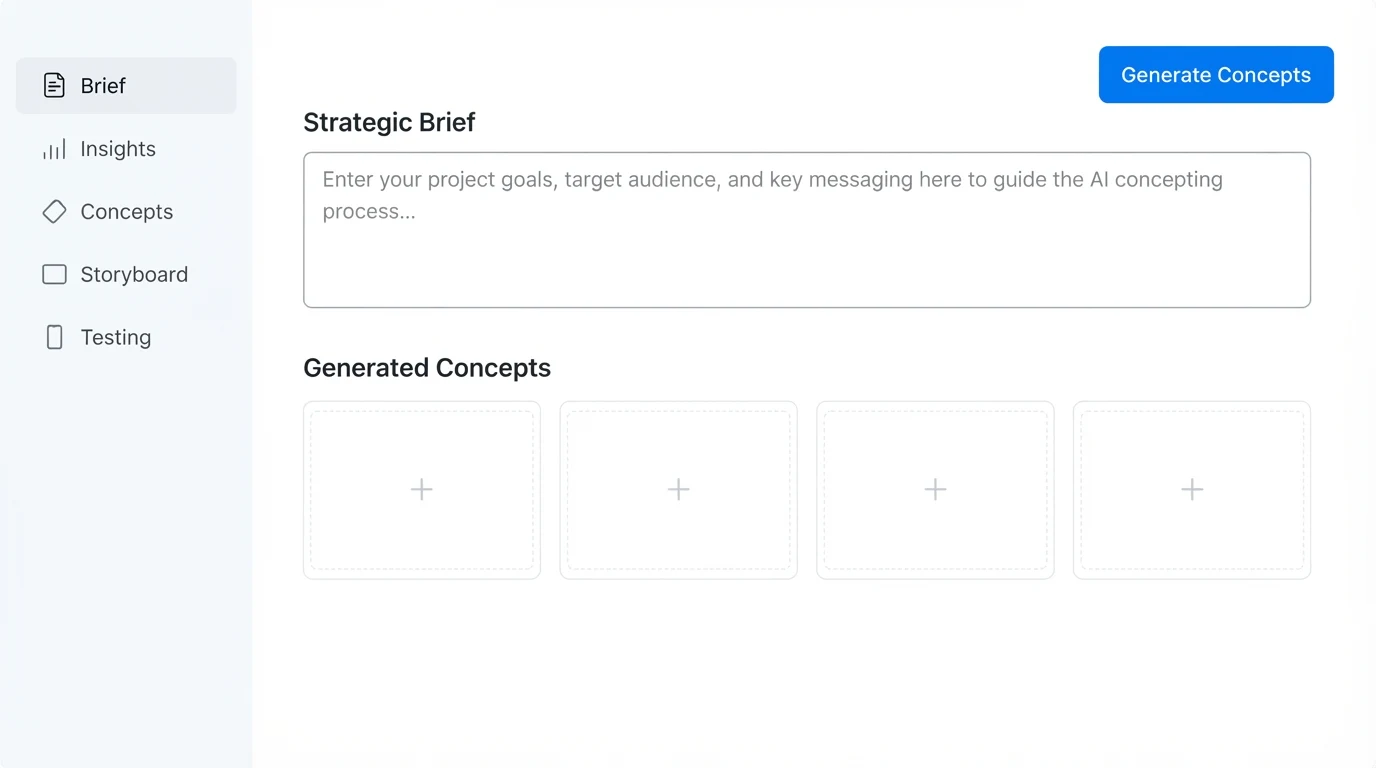
Every strong AI concepting workflow we have seen breaks into the same five stages. Skipping any of them is where teams get burned.
- Brief intake. Structured extraction of objective, audience, proposition, mandatories, tone and channel. This is where you convert a messy client document into machine-readable context. Our brand intake process lives here.
- Insight mining. LLMs (ChatGPT, Claude) used to interrogate cultural context, category conventions, audience tensions and adjacent whitespace. This is not the same as research, and treating it as research is the fastest way to hallucinate a persona.
- Concept generation. Prompted generation of territories, then executions inside the strongest territories. Volume first, judgement second.
- Visual and storyboard rendering. Midjourney, Firefly and internal pipelines to render key frames, moodboards and storyboards. Motion tools like Runway or Kling for animatics.
- Concept testing and selection. Multi-agent critique, internal review and, where budget allows, lightweight audience testing on rendered concepts before the client meeting.
The stack that supports this is not one product. It is a chain: an LLM for language, an image model for visuals, a motion model for animatics, and a review layer (human or agent-based) that stress-tests the output. Agencies building their own pipeline usually start with off-the-shelf tools and gradually replace pieces where their workflow demands more control, similar to the pattern described in our studio comparison piece.

Anatomy of a Strong AI-Generated Concept
The single biggest failure mode in AI concepting is confusing an image for an idea. A striking Midjourney render is not a campaign concept. A campaign concept has four load-bearing parts, and any AI output missing one of them should be rejected regardless of how beautiful the visual is.
- Big Idea. A one-sentence articulation of the creative thought, expressible without any visual.
- Audience insight. The specific human tension the idea resolves or amplifies.
- Channel-native execution. How the idea lives in the format it will actually run in, not a generic hero frame.
- Brand-safe visual system. A world that could be extended across ten assets, not one hero image that cannot be replicated. Our commercial work is built around this principle.
Prompt-and-pray output usually fails on the second and fourth criteria. It looks like a campaign but does not resolve a human tension and cannot be extended into a system. The creative director's job in an AI workflow is to be ruthless about these four checks before anything goes to a client.
Prompting Frameworks That Produce Campaign-Grade Ideas
Three prompting patterns do most of the heavy lifting in concept generation. They are not novel individually, but stacking them is what separates a usable AI concepting workflow from a chatbot fishing expedition.
Role, context and constraint prompting. Give the model a role (senior creative director, cultural strategist), the full brief context as structured data, and hard constraints (no puns, must work in nine-by-sixteen, budget under two hundred thousand dollars). Constraints do more for concept quality than any clever framing. Our DTC brand piece covers this pattern in a commerce context.
Brand guideline injection. Paste the full tone-of-voice document, the visual guidelines and three or four exemplar campaigns into context before asking for ideas. Models drift toward the mean without this anchor, which is where the homogenisation critique of AI creative comes from.
Multi-agent critique loops. Generate concepts with one prompt, then have a second prompt (or a second model) critique them as a hostile planner, a nervous brand lawyer and a cynical consumer. Feed the critique back and regenerate. Two rounds of this typically outperform ten rounds of solo generation.
Case Studies
Three campaigns worth studying, each showing a different pattern of brief-to-concept-to-execution using generative AI.
Coca-Cola, Create Real Magic. A platform, not a single execution, that invited consumers to generate branded artwork using GPT-4 and DALL-E within a controlled brand sandbox. The concept work was in defining the sandbox rules, the visual guardrails and the curation layer, not in generating individual images. The lesson: AI-native concepts often look like systems, not spots.
Heinz, Draw Ketchup. The concept tested a cultural insight (people draw Heinz when asked to draw ketchup) by prompting image models with the word ketchup and showing that the models, like humans, drew Heinz. Simple, cheap, cultural, and impossible without the tool. The lesson: sometimes the AI tool is the insight mechanism, not the execution layer.
Virgin Voyages, Jen AI. A generative AI Jennifer Lopez that let users create personalised invitation videos for friends. Concept development involved defining the persona system, the consent and IP framework, and the fallback paths for off-brand output. The lesson: personalisation-heavy concepts require as much time on guardrails as on the creative itself. This is the pattern behind our AI film work.
Where AI Concepting Breaks
The honest failure modes are worth naming, because most articles on this topic pretend they do not exist. Any team adopting AI concepting will hit at least three of these in the first quarter.
- Legal and IP risk. Training data provenance, style mimicry of living artists, and use of brand-owned imagery in prompts all sit in unresolved legal territory. Concepts that lean on a recognisable artist's style are a liability, not a shortcut.
- Brand-voice drift. Without injected guidelines, models default to a competent but generic voice. Three campaigns in, this shows up as a house style that is no house style.
- Homogenisation. Every team using the same base models arrives at similar visual territories. Distinctiveness now comes from prompt craft, custom pipelines and reference libraries, not the base model.
- Hallucinated insight. LLMs will confidently invent audience behaviours, statistics and cultural trends. Any insight that will appear in a client deck must be independently verified.
- Model bias. Image models systematically under-represent certain body types, ages, cultural contexts and settings. Concepting sets need to be audited for this before selection, not after.
Human-in-the-Loop: The Creative Director's New Job
The creative director role does not disappear in an AI workflow. It shifts from generation to curation, editing and stress-testing. The specific new responsibilities are choosing which of thirty concepts deserve a second round, rewriting the prompts that produced the near-misses, catching the four-part checks above, and holding the taste bar when the model produces something competent but boring. This is what our agency team spends most of its time on.
The failure pattern here is delegation without judgement. Junior teams handed AI tools without a senior curator ship the third-best idea because it looked finished. The new creative director job is to make sure the third-best idea never leaves the studio.
Choosing a Stack: Build Versus Buy
Most teams face a build-versus-buy decision within the first month of serious AI adoption. The trade-offs are real and depend on volume, control needs and in-house engineering capacity. Our agency hiring guide covers this from the client side.
| Approach | Best for | Trade-off |
|---|---|---|
| Off-the-shelf SaaS (Jasper, Adobe Firefly, Runway) | Small teams, low volume, generalist use | Limited control over visual system, harder to enforce brand consistency at scale |
| Specialist AI creative agency | Brands wanting concept-to-delivery without building internal capability | Pricing quoted per scope after a brief review; less internal capability build |
| DIY pipeline (custom LLM chains, fine-tuned image models) | Large agencies, high volume, strong engineering | Significant build time; requires ongoing maintenance as base models evolve |
A Thirty-Day Pilot Plan
The best way to adopt AI concepting is a scoped pilot, not a top-down rollout. A thirty-day plan that consistently works: week one, pick one live brief and run it in parallel through both the traditional and AI workflow, keeping honest time logs. Week two, run the same brief through three different prompting frameworks and compare output quality with a blind review. Week three, layer in the multi-agent critique loop and measure the lift. Week four, present both sets of concepts (traditional and AI) to the client without labelling which is which, and let the response guide the roadmap. Teams that skip the blind review step almost always overestimate the quality of their AI output.
Frequently Asked Questions
Is AI campaign concept development replacing creative directors?
No. It is changing what creative directors spend their time on. Generation is faster and cheaper, so the value shifts to curation, taste, prompt craft and stress-testing. Senior judgement matters more, not less.
How many concepts should an AI workflow produce per brief?
Volume varies by brief, but a useful benchmark is thirty explored territories reduced to five worth developing and two or three worth presenting. The reduction ratio is the important number, not the raw volume.
What is the biggest risk in adopting AI concepting?
Shipping the third-best idea because it looks finished. AI output has a competence floor that can mask a taste ceiling. Without a senior curator, teams stop pushing past the first acceptable concept.
Which tools should a small agency start with?
Claude or ChatGPT for language and insight, Midjourney or Firefly for visuals, Runway for motion, and a spreadsheet for tracking prompts that worked. Custom pipelines can wait until the workflow is stable.
How do you protect brand voice in AI-generated concepts?
Inject the full tone-of-voice document and three or four exemplar campaigns into every prompt as context. Do not rely on the base model's default voice. Audit outputs against the guidelines before selection.
Can AI concepts be tested with real audiences?
Yes, and this is where the speed advantage compounds. Rendered concepts (key frames, animatics) can be put in front of small audience panels within the same week they are generated, giving evidence before the client meeting.
How does AI concepting change agency pricing?
Pricing shifts away from hours-on-concept and toward outcomes, retainers or scoped project fees. See our retainer pricing piece for how this plays out in practice.
What is the single highest-leverage prompt improvement?
Adding hard constraints. Budget, channel, format, mandatories, do-not-use list. Constraints force the model out of the generic middle and into ideas that could actually run.
Conclusion
AI campaign concept development is not a shortcut. It is a different discipline that rewards structured briefs, injected context, multi-agent critique and senior curation. Teams that treat it as prompt-and-pray produce homogenised work. Teams that treat it as a compressed version of the traditional cycle, with taste and judgement kept firmly in the loop, produce more ideas, better ideas and testable concepts faster than any traditional workflow can match. If you want a partner running this stack end to end, Absolutely AI is a creative agency built around it.