AI Brand Campaign Development: The Modern Agency Workflow
AI brand campaign development is no longer a novelty pitch deck slide. It is the working method of the fastest creative teams in the market, including Absolutely AI, where full campaigns move from brief to in-market assets in days rather than months. This guide walks through the actual workflow, the 2026 tool stack, the governance layer, and the honest limits marketers should plan around.
Most articles ranking for AI brand campaign development are either tool landing pages or listicles of famous 2024 stunts. Neither shows a marketing director what the workflow actually looks like inside a working AI-native agency. This piece does. It maps the end-to-end development process, names the 2026 stack, and flags where the work still breaks without senior human oversight.
What AI Brand Campaign Development Actually Means in 2026
The phrase is often collapsed to mean AI-generated visuals, which undersells it. A genuine AI brand campaign development process covers strategy, concept exploration, asset production, channel adaptation, and measurement, with generative models woven into every stage rather than bolted onto the visual layer. The output is a full campaign system: hero film, still imagery, social cutdowns, localised variants, and copy, all built from a single locked creative direction. Studios like Absolutely AI's branding practice treat the workflow as a pipeline, not a prompt.
The shift matters because campaigns are no longer a single artefact. A modern brand launch needs dozens of aspect ratios, multiple language cuts, and constantly refreshed creative for paid media rotation. AI is what makes that volume possible without diluting the idea, provided the strategy and craft layers are still handled by people who can hold a brand in their head.
The Modern AI Campaign Stack
There is no single tool that runs a campaign end to end. Working teams stitch together specialised models at each layer, and the choice of stack is itself a creative decision. A 2026 reference stack looks roughly like this.
| Layer | Tools | Job |
|---|---|---|
| Strategy and briefing | Claude, GPT-5, Gemini | Brand profile extraction, audience mapping, narrative frameworks |
| Concept and moodboard | Midjourney, Wireflow, Ideogram | Rapid visual exploration, storyboard grids, style tests |
| Video generation | Sora, Runway, Google Veo, Luma Dream Machine | Hero films, motion tests, social cutdowns |
| Copy and script | Claude, GPT-5 | Scripts, taglines, long-form, localisation |
| Brand consistency | Custom LoRAs, brand.ai style guides, reference libraries | Locking look, character, product fidelity across assets |
| Adaptation and resize | Runway, in-house automations | Aspect ratios, language variants, platform cuts |
The interesting layer is brand consistency. Off-the-shelf image and video models drift wildly between generations, which is fine for exploration but fatal for a campaign that has to look like one thing. Teams building serious work invest in reference libraries, fine-tuned LoRAs, and locked prompt templates so a hero shot in week one still matches a social edit in week six. This is the difference between a demo and a shippable campaign, and it is a core reason clients hire an AI content agency rather than assembling the stack themselves.

A Step-by-Step Development Process
The workflow inside a working AI-native studio is more disciplined than the tooling makes it look. Here is the shape of it, from brief in to campaign live.
- Brief intake. The client brief is parsed into a structured brand profile: product, audience, tone, visual direction, key messages, deliverables, restrictions. This is the document every downstream stage reads from.
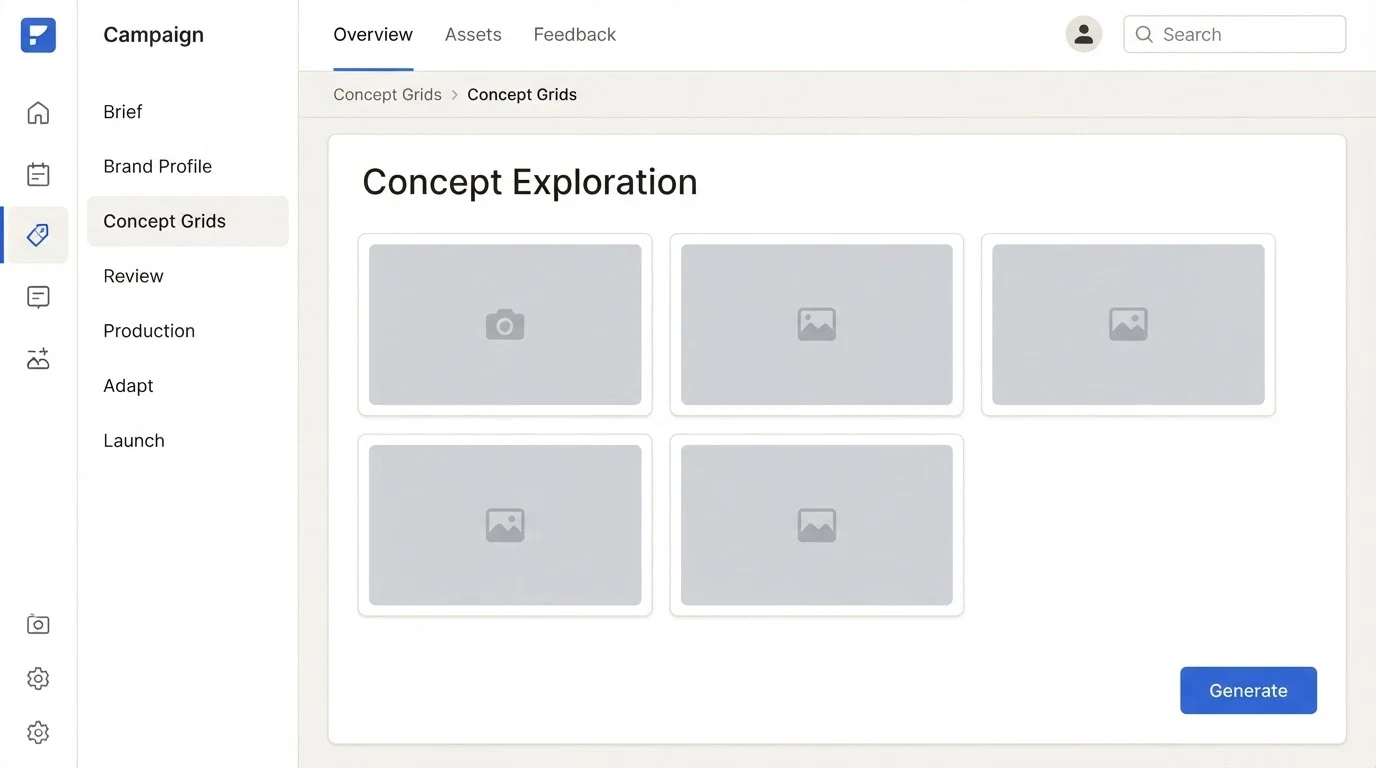
- Concept exploration. The brand profile is fed into concept generators to produce storyboard grids, often four to eight variants per deliverable. Some are anchored to supplied references, some deliberately explore adjacent territory.
- Creative director review. A senior human picks the direction, kills the weak variants, and writes the notes that lock the look. This gate is non-negotiable and is where most DIY workflows quietly fail.
- Asset production. The chosen direction is executed at scale across image and video, using consistent references and prompt templates so every asset feels like one campaign.
- Adaptation. Hero assets are resized, recut, and localised for every channel and market the campaign runs in.
- In-market testing. Variants are launched into paid media, performance data comes back, and the winning creative feeds the next round.
The economics are real but often overstated. In our own work we see campaigns come in around five times faster and roughly forty percent lighter on total cost, once you count review time, revisions, and adaptation. The caveat is that those numbers depend entirely on the human oversight layer. Strip out the creative director and the savings disappear into rework. The full comparison against a traditional production model is broken down in our AI content studio vs traditional studio piece.
Case Studies Worth Learning From
The most instructive AI campaigns of the last few years share a pattern: a generative engine paired with a genuine human insight. Nutella Unica used an algorithm to produce seven million unique jar labels, turning packaging into a collectible. Coca-Cola's Create Real Magic invited consumers to co-create ads with generative tools, folding the audience into the campaign itself. Heinz Draw Ketchup asked an early image model to draw ketchup and used the fact that it kept drawing Heinz as proof of brand dominance. Hettich's Roast the Room used generative models to critique interior photos submitted by consumers.
None of these campaigns were about the technology. Each one used generative variance to express an insight that would have been impossible or uneconomic to produce at that scale by hand. That is the bar. If the AI is doing something a stock photo library and a good copywriter could have done, the campaign is not really using it. The teams building AI commercial work at this level are chasing insight-plus-scale, not novelty.
Where AI Still Fails Without a Human Creative Director
Anyone selling a fully autonomous campaign is selling something that does not work yet. The failure modes are consistent across every stack we have tested.
- Brand nuance. Models can approximate a look, but they do not understand why a brand rejects a particular shade of blue or a particular kind of smile. That knowledge lives in the creative director.
- Cultural context. Localisation is more than translation. A tagline that lands in Sydney can be inert or offensive in Jakarta, and no current model reliably catches that.
- Narrative arc. Video models are strong on individual shots and weak on story. Multi-shot sequences with emotional build still need human editing and scripting.
- Legal and IP risk. Generated imagery can accidentally echo copyrighted work, real faces, or competitor trade dress. A review gate that flags this before publication is essential.
- Hallucinated product features. Generative models routinely add buttons, textures, or ingredients that do not exist on the real product. This is a legal problem, not just an aesthetic one.
Every one of these is manageable, but only inside a workflow that treats human review as a first-class stage rather than a rubber stamp. For teams weighing the trade-offs, our breakdown of AI agency vs freelancer covers where the oversight layer tends to live in each model.
Building Your Own AI Campaign Workflow
If you are building this capability in-house, the shape of a working system is fairly consistent. The checklist below is roughly what we would set up on day one for a brand serious about running AI content creation as an ongoing capability rather than a one-off experiment.
- A locked brand profile document that every generation stage reads from, versioned and owned by marketing.
- A reference image and video library covering products, environments, talent, and mood, hosted somewhere durable.
- A prompt library of tested templates for each deliverable type, treated as brand IP.
- Explicit review gates at concept, asset, and pre-launch stages, with named humans responsible for each.
- A measurement loop that ties creative variants back to media performance, so the next campaign starts from data.
- A legal and IP checklist covering likeness, trademarks, and generated product accuracy.
Most in-house programmes stall on the reference library and the review gates, because both require sustained effort rather than a tool purchase. This is usually the point at which brands look at partnering with an AI content agency in Australia or elsewhere to shortcut the infrastructure build.
Choosing Between DIY Tools and an AI-Native Agency
The honest answer is that both models work, for different brands. The decision usually comes down to volume, brand sensitivity, and whether creative is a core capability the brand wants to own.
| Factor | DIY tool stack | AI-native agency |
|---|---|---|
| Setup time | Weeks to months | Days |
| Brand consistency | Depends on internal discipline | Handled by senior creative direction |
| Volume capacity | Limited by internal team size | Scales with the agency |
| Best for | Always-on social, internal content, testing | Hero campaigns, launches, high-stakes work |
| Ongoing cost | Tool subscriptions plus salaried team | Retainer or per-campaign, see retainer pricing |
Most brands we work with end up running both. The internal team handles velocity work with a DIY stack, and the agency handles the hero campaigns where brand risk is highest and the creative bar has to be non-negotiable.
What Comes Next: Agentic Campaign Lifecycles
The next shift is already visible in the more advanced media agencies. Campaign lifecycles are becoming agentic loops, where media planning, creative generation, and performance measurement operate as one feedback system. An underperforming ad variant triggers a new generation, the new variant is launched, the loop closes. Humans still set the strategy and the guardrails, but the day-to-day rotation runs itself. Teams exploring this pattern often start with AI consulting engagements to map where the loops can safely close.
This is where campaign development stops being a project and becomes an operating model. Brands that get there first will run more creative experiments in a quarter than their competitors run in a year, and the compounding advantage will show up in performance data long before it shows up in trade press.
Frequently Asked Questions
How long does an AI brand campaign take to develop?
A full hero campaign with film, stills, and social cutdowns typically runs two to four weeks inside an AI-native studio, compared with two to four months for a traditional shoot-based production. The variable is revision cycles, not generation time.
Is AI-generated campaign work safe from a legal and IP perspective?
It can be, but only with active governance. That means using models with clear commercial licences, avoiding real people and copyrighted works in prompts, reviewing outputs for accidental likeness, and keeping generation logs. A serious agency will have this workflow documented.
Can AI campaigns match the quality of traditional production?
For most brand and social work, yes, and often faster. For narrative film with dialogue and complex human performance, traditional production still has the edge, though the gap is closing quickly with each new video model release.
What does an AI campaign cost compared with a traditional one?
Total campaign cost typically lands thirty to fifty percent below a comparable traditional production, but the more meaningful gain is volume: the same budget produces far more finished assets, which matters more than headline savings for performance-driven brands.
Do we still need a creative director if we are using AI?
Yes, more than ever. The tools have flattened execution, which means the differentiator is strategy, taste, and judgement. A campaign without a creative director tends to look generically competent and fail to stand out.
How do we measure whether an AI campaign is working?
The same way you measure any campaign: brand lift, engagement, conversion, and cost per outcome. The advantage with AI is that you can run far more creative variants, so the measurement loop feeds directly back into the next round of generation.
Wrapping Up
AI brand campaign development is a discipline, not a tool purchase. The teams doing it well have built a workflow with locked brand profiles, tested prompt libraries, senior creative direction, and a measurement loop that closes back into the next campaign. If you want a partner that already runs this system end to end, Absolutely AI builds full campaigns this way for brands that need cinematic quality at AI speed.