What Does an AI Digital Marketing Agency Actually Do?
An AI digital marketing agency runs the daily execution of content, ads, SEO, creative and reporting through AI agents and automation, with human strategists steering brand and judgment. At Absolutely AI we see brand leads ask this weekly, so here is a plain explainer of the services, the operating model, and when a traditional shop still wins.

An AI digital marketing agency is a marketing shop where the daily execution loop, content, ads, SEO, email, reporting and creative production, runs on AI agents and automation, with human strategists steering brand, positioning and judgment. The category has moved fast since 2024, and by 2026 the hybrid model of human direction plus AI operators is the norm across performance-led brands rather than a novelty. This piece walks through what the work actually looks like inside a modern AI marketing agency, the services on offer, the operating model behind them, and the places where a traditional agency is still the right call.
What an AI digital marketing agency actually is
The simplest definition: a human strategist sets direction, an AI operator layer executes, and a review gate keeps the brand safe before anything ships. Strategy, positioning, creative concept, offer design and measurement remain human decisions. Copywriting variants, image and video production, media buying optimisation, dashboards and lifecycle sequencing are handled by models and agents wired into the agency's stack. Think of it as an orchestra where senior humans hold the score and AI plays every instrument at once, with a conductor listening for wrong notes at each handoff between studio and delivery.
Because the execution layer is machine-driven, output scales differently. A traditional shop measures a campaign in a handful of hero assets and a dozen cutdowns. An AI-native shop treats the campaign as a system that can produce hundreds of on-brand variants per week, then routes budget toward whichever ones the data rewards. That shift is what people mean when they say the agency model has flipped from craft-bottlenecked to system-bottlenecked.

The services they actually run
Most competitor pages stop at "we use AI for content" and leave the reader guessing. Here is the concrete list of services a full-service AI digital marketing agency typically delivers, and what sits behind each one.
- AI-generated content and copy. Blog articles, landing pages, product descriptions, thought leadership and social captions produced through LLMs like Claude, ChatGPT and Gemini, tuned to a brand voice document and reviewed by a human editor before publish. See our take on AI content creation for how the review loop works.
- Programmatic and AI-optimised paid media. Meta, Google, TikTok and programmatic display where creative rotation, bidding and audience selection are handled by platform AI, and the agency's job is to feed the algorithm enough variants, signal and budget guardrails to work with.
- SEO and topical authority at scale. Keyword clustering, brief generation, on-page optimisation and internal linking driven by retrieval-augmented models against a live site index.
- Creative production. Image, video and ad variants produced with generative image and video models, then finished by a senior designer. This is where AI social ad creative lives.
- Lifecycle email and CRM automation. Segmentation, trigger design and copy generation across HubSpot, Klaviyo or Salesforce Marketing Cloud, with AI writing variants for every branch of the flow.
- Social media planning and scheduling. Content calendars written and scheduled by agents against a rolling brand brief.
- Predictive analytics and attribution. Media mix modelling and marketing attribution powered by ML rather than last-click, giving a defensible read on channel contribution.
- Conversion rate optimisation. Continuous test design, variant generation and analysis on landing pages and checkout flows.
- Lead scoring and qualification. Predictive scoring on inbound leads plus agent-run enrichment before a human sales rep touches the record.
- Always-on reporting. Dashboards refreshed on live data, with narrative summaries generated automatically each week.
How the work actually gets done
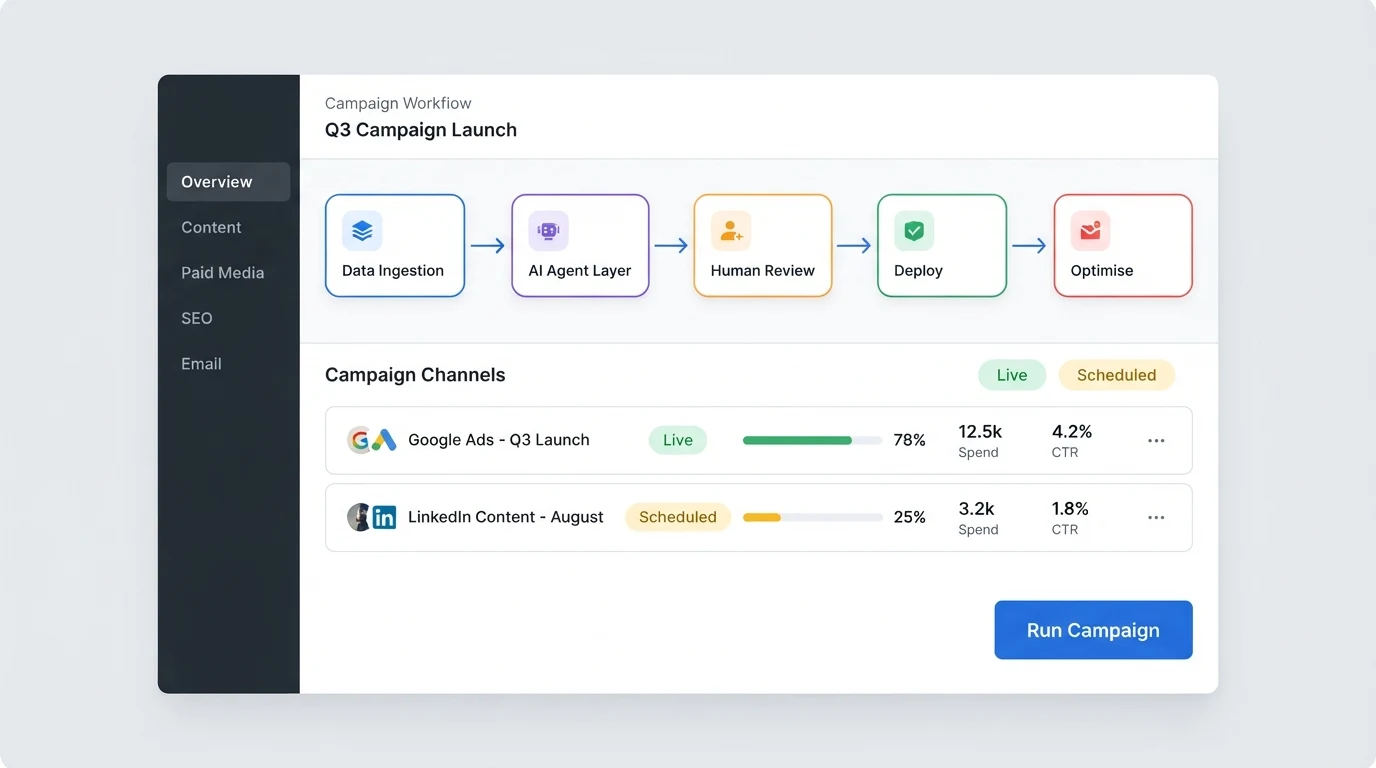
The operating model inside a modern shop follows a repeatable loop: data ingestion, then an LLM and agent layer, then human review, then deployment, then real-time optimisation. Data ingestion pulls from the client's CDP, ad platforms, analytics, CRM and content library. The agent layer, built on frameworks like LangGraph or custom orchestrators, breaks briefs into sub-tasks that call the right specialist model for each job. Human review sits at every publish gate. Deployment pushes to the ad platform, CMS or ESP. Real-time optimisation feeds performance data back into the next generation cycle, closing the loop that a freelancer or a traditional shop simply cannot run at the same cadence.
The stack under the hood is a mix of foundation LLMs (Claude, ChatGPT, Gemini), generative image and video models (Midjourney and the current wave of video generators), agent frameworks, a customer data platform, an attribution or MMM tool, and the martech the client already runs. Prompt engineering and retrieval-augmented generation are the two techniques that keep model output tied to the brand's real facts rather than plausible-sounding hallucinations.
AI agency vs traditional agency
The comparison below reflects the industry pattern we see across briefs, not a promise for any single engagement. Both models can produce great work; they optimise for different constraints.
| Dimension | AI-native agency | Traditional agency |
|---|---|---|
| Speed to first draft | Roughly 3x faster on content and creative rounds | Human-paced, gated by studio capacity |
| Creative variant volume | 10 to 50x more variants per campaign | A hero plus a handful of cutdowns |
| Operating cost | Typically 30 to 60 percent lower on execution | Higher, weighted toward senior time on production |
| Where humans still win | Brand strategy, positioning, senior creative concept, crisis response | Same, plus deep studio craft on flagship work |
| Pricing model | Project-based, retainer, or hybrid quoted per scope | Retainer weighted, quoted per scope |
The honest read: an AI-native shop is a production and iteration engine. A traditional shop is a craft and concept engine. The best agencies now blend both, with senior humans on concept and machine execution on the long tail.
When an AI agency is the right fit, and when it isn't
An AI digital marketing agency is the right call for production-heavy, high-velocity, testing-driven brands: DTC ecommerce with weekly launches, SaaS with content-led acquisition, marketplaces running dozens of ad cohorts, retail brands shipping seasonal creative constantly. If the brand's growth depends on shipping more, testing more and iterating faster than the competition, the model fits. See how this plays out for DTC brands specifically.
A traditional agency still wins for brand launches where positioning has to be discovered rather than executed, crisis communications where reputational judgment outweighs speed, and one-off flagship creative like a Super Bowl spot or a global rebrand where the whole point is craft that cannot be systemised. Handing those jobs to an AI-native shop is asking the wrong tool to do the wrong job through a consulting lens.
What to look for when hiring one
The category has enough noise now that hiring criteria matter more than pitch decks. Before signing, get honest answers on the following.
- Governance. What is their brand-safety review gate? Who signs off before anything ships? What happens when a model hallucinates a fact?
- Human-in-the-loop points. Which decisions stay human, and where exactly do humans review AI output? A shop that cannot draw this diagram is winging it.
- Tool transparency. Which LLMs, image and video models, agent frameworks and martech do they use? Any refusal to answer is a red flag.
- Data ownership. Who owns the training data, the fine-tuned models, the prompts and the generated assets when the engagement ends?
- IP on generated creative. Understand the current position on copyright for AI-generated images and video in your jurisdiction, and confirm the contract reflects it.
- Case studies with real numbers. Cost per acquisition, incremental revenue, time to publish. Vanity metrics are not evidence.
Common misconceptions
Three misreads come up in almost every first call. First, "AI replaces creatives." It doesn't. It replaces the mechanical parts of production so senior creatives spend their time on concept and direction rather than resizing banners. Second, "it's just ChatGPT with a markup." A serious shop runs orchestration, retrieval, brand guardrails, review gates and measurement on top of the model layer, and the value is in that scaffolding, not the model itself, as any honest hiring guide will tell you.
Third, "quality drops." Quality drops when nobody reviews the output. In a well-run shop, senior humans review every publish, the brand voice is documented and enforced through prompts, and the variant count is a feature rather than a shortcut. The failure mode is agencies that skip the review layer to hit a margin target, and that is a hiring problem, not an AI problem.
Frequently Asked Questions
How much does an AI digital marketing agency cost?
Pricing sits across three shapes: project-based for defined scopes, retainer for ongoing execution, and hybrid retainer-plus-performance for brands with clear conversion goals. Numbers depend entirely on scope and channel mix, so any shop quoting a public rate card without seeing the brief is guessing.
What tools do AI marketing agencies use?
The common stack: Claude, ChatGPT and Gemini for language, current-generation generative image and video models for creative, a CDP like Segment or the client's own, HubSpot or Salesforce Marketing Cloud for lifecycle, and an attribution or MMM tool for measurement. Agent frameworks orchestrate the pieces.
Does it work for small business?
Below a certain marketing spend, tooling plus a good freelancer often beats hiring an agency of any kind. The break-even sits roughly where you need more than one full-time person's worth of execution across multiple channels. Below that, buy the tools and hire the freelancer.
Does an AI agency replace my in-house team?
No. It replaces the execution bottleneck. In-house teams keep owning brand, product marketing, customer insight and the strategic calls. Agencies handle production velocity and specialist capability the team cannot staff for.
How is this different from marketing automation?
Marketing automation runs pre-defined workflows on rules. An AI agency runs generative and agentic workflows that make decisions inside the workflow, produce net-new creative, and adapt based on live data. Automation is plumbing. AI agencies are the operators using the plumbing.
Closing thought
The category has settled into a clear shape: humans on strategy and judgment, AI on execution and iteration, with review gates in between. If your growth depends on shipping more and testing faster than the competition, an AI-native partner is the right structural fit. If you are building a brand from zero or navigating a crisis, hire the traditional shop and keep the AI work for the season after. When you're ready to scope what that looks like for your brand, Absolutely AI runs the model end-to-end as an AI marketing partner, and pricing is quoted per scope after a short brief review.