AI Training for Marketing Teams in Australia: A Director's Guide
Every provider in Australia will tell you their AI training will make your marketing team 40 to 60 percent faster. That number is real, and it is also the wrong thing to optimise for. At Absolutely AI we spend our days inside marketing teams after the workshop ends, which is where the actual work begins. This guide is for directors choosing between four very different kinds of training.

If you are a marketing director in Sydney, Melbourne or Brisbane right now, you are being pitched AI training weekly. The decks all look the same: a cycle-time stat, a logo wall, a two-day agenda, a price. What they rarely tell you is which training fits your team, what the Monday after looks like, or how to prove the productivity claims on your own org. This piece walks through how to choose, drawing on the kind of in-house creative work we do at Absolutely AI with marketing teams around the country.
Why Generic AI Courses Fail Marketing Teams
The widely quoted 40 to 60 percent reduction in campaign production time is real in controlled conditions. It is also a vanity metric when read in isolation. Shaving two days off a brief turnaround means nothing if the output drifts off brand, if your legal team blocks the deliverables, or if the team quietly reverts to old habits inside a month. The right KPI is not speed, it is sustained throughput of on-brand work that ships.
Generic prompt-engineering courses teach the mechanics of talking to ChatGPT or Claude. That is a starting point, not a marketing capability. A performance marketer needs different patterns to a copywriter, who needs different patterns to a creative director. Treating the marketing team as one persona is the single biggest reason training fails to stick, and it is why most public short courses underdeliver for teams larger than six.

What Marketing-Specific AI Training Should Cover in 2026
A serious curriculum in 2026 covers four territories, each with role-specific depth. The first is prompt systems for briefs: reusable scaffolds for creative briefs, campaign concepts, channel adaptations and headline variants, with a library the team contributes to rather than one-off prompts that live in individual chat histories.
The second is brand voice calibration. This is where tool-agnostic training matters, because the technique of feeding brand guidelines, tone samples and negative examples into a model is portable across ChatGPT, Claude, Gemini and Microsoft Copilot. Teams that only learn one tool are stuck when the model landscape shifts, which it does every quarter.
The third is image and video generation workflows, which bleed into production decisions your team may not have made before. If you are evaluating this layer, a related read on how AI product photography works covers the practical mechanics most workshops skim over.
The fourth is measurement and attribution: how to baseline cycle time and output quality before training, so you can prove the productivity delta on your own team rather than inheriting a provider's benchmark. Without this layer, you cannot defend the training spend to a CFO twelve months later.
Four Delivery Models Compared
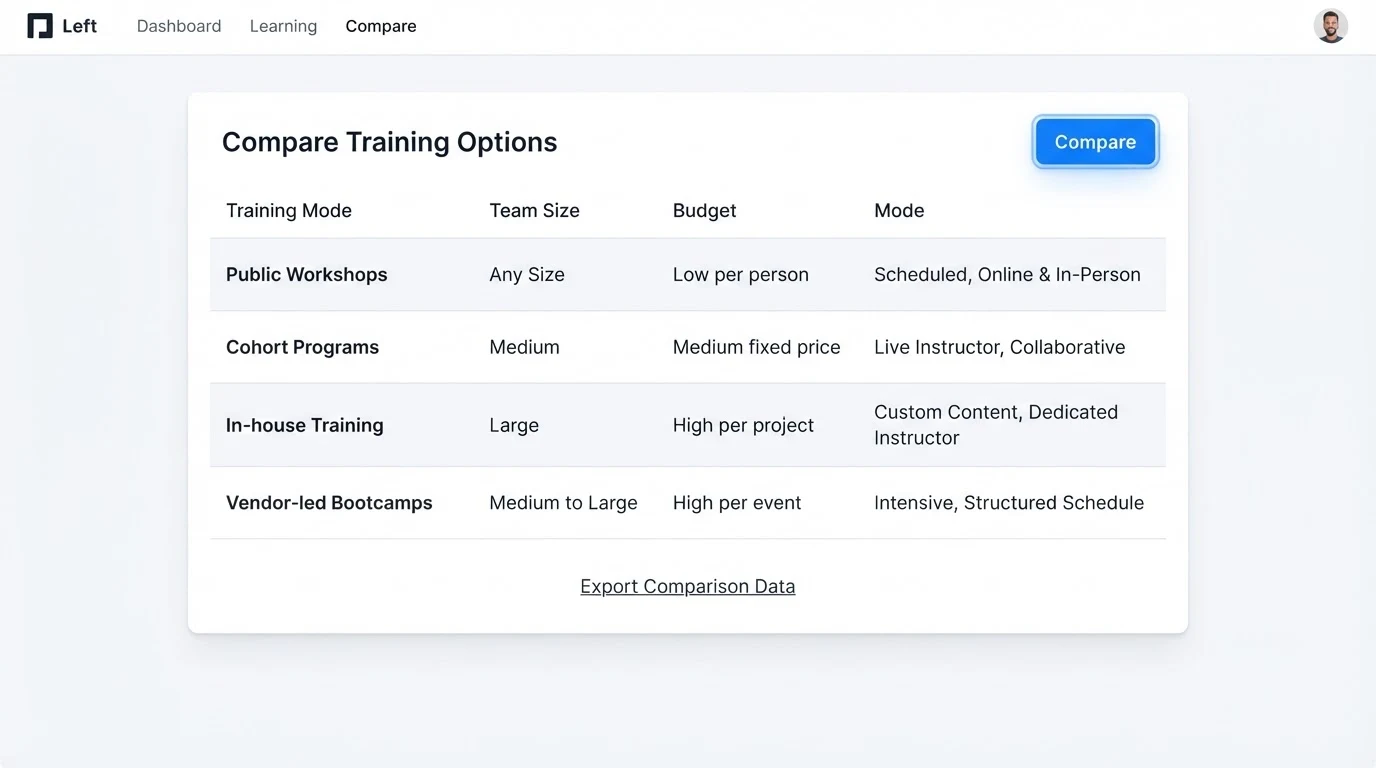
There are broadly four ways Australian marketing teams buy AI training. Each solves a different problem and misreads the others.
| Model | Best for | Typical format | Pricing shape |
|---|---|---|---|
| Public short course | Individuals, small teams testing the water | 1 to 3 days, mixed cohort, in-person or hybrid | Per-seat, mid four figures |
| Cohort program | Marketers wanting a peer network and homework structure | 4 to 8 weeks, online, live sessions plus community | Per-seat, project-based |
| Private in-house workshop | Teams of 6 to 30 solving a specific workflow problem | 1 to 2 days on site, tailored to your tools and briefs | Quoted per scope |
| Vendor-led training | Enterprises standardising on a specific platform | Platform-specific, often tied to licence rollout | Bundled with software |
Public short courses from providers like ADMA, Sydney Uni Centre for Continuing Education and Monarch Institute are strong for individuals building personal capability. They are weak at changing how a team works together, because your copywriter and your performance marketer learn in a room full of strangers from unrelated industries.
Cohort programs such as Rocket Agency's AI Marketing Mastery add peer accountability and homework. They suit mid-career marketers who want structure and a network. They are harder to justify when you need a whole team moving in lockstep by a specific launch date.
Private in-house workshops, run by studios like Antelope Media, AI Avenue, Kliq and Laurel Papworth's practice, are tailored to your actual briefs. This is where the Monday-after retention is strongest, because the exercises use your campaigns, your brand guidelines and your tools. Vendor-led training from the likes of Jellyfish or NobleProg is efficient when you have already standardised on a platform, but it skews toward that platform's strengths and quietly ignores its gaps.
How to Pick: A Short Decision Framework
Four variables settle the choice. Team size: under five, go public or cohort; six to thirty, go private. Tool strategy: if you want portable technique, insist on tool-agnostic training that covers at least ChatGPT, Claude and Gemini, with Perplexity for research workflows. Delivery mode: in-person workshops outperform remote for team-wide behaviour change, remote wins for geographically split teams. Budget band: per-seat public courses add up fast past six attendees, at which point a private day usually wins on total cost and relevance. If you want help scoping the right mix, our AI consulting work often starts here.
Role-Specific Curriculum Matters
A copywriter needs voice calibration, variant generation and editorial review patterns. A performance marketer needs audience research, ad-copy iteration and creative testing systems. A creative director needs concept exploration, mood development and brief interrogation. A CMO needs governance, measurement and vendor evaluation. A workshop that treats these as one syllabus is a workshop designed for the brochure, not for your team.
The Post-Training Problem Nobody Talks About
Adoption decay is the quiet killer. Thirty days after a workshop, the energetic early adopters are still using the techniques; the rest of the team has slid back to pre-training habits. Sixty days in, the prompt library you built in the workshop is stale because nobody owns it. Ninety days in, your director is wondering why the cycle-time gains have evaporated.
The fix is not more training, it is operating structure. Nominate an internal AI champion with explicit time allocated to it, usually one half-day a week. Build a shared prompt library with contribution rules and quarterly audits. Set a cadence for reviewing new tools and retiring old ones. Attach AI usage to specific deliverable types in your workflow, so the technique has a home rather than floating as a general capability.
A 90-Day Rollout Plan
- Days 1 to 14: Audit. Map your current workflows for the top three deliverable types. Baseline cycle time, output volume and revision count. This is the number you will measure against.
- Days 15 to 30: Pilot. Pick one deliverable type and one small squad. Run the training against that specific workflow, not the whole marketing function.
- Days 31 to 60: Expand. Roll the proven patterns to adjacent deliverable types. Have the pilot squad teach the next cohort. Peer teaching entrenches the habit.
- Days 61 to 90: Measure and codify. Compare cycle time, volume and quality against the baseline. Write the internal playbook. Publish the prompt library. Lock in the AI champion role.
The Australian Compliance Layer
This is the section most providers skip. The Privacy Act 1988 governs what personal information your team can put into third-party AI tools, and the forthcoming reforms tighten this materially. Pasting a customer list or a brief containing client PII into a public ChatGPT window is a privacy incident waiting to be documented.
For teams working with government, finance or healthcare clients, data residency matters. Enterprise ChatGPT, Claude for Enterprise and Microsoft Copilot each offer different guarantees on where prompts are processed and whether they are used for training. Any serious workshop should walk your team through acceptable-use policy templates, a redaction habit for client data, and a decision tree for when retrieval-augmented generation on your own systems is more appropriate than a public model. The Industry.gov.au AI directory is a useful starting point for scoping local providers who understand this layer.
Frequently Asked Questions
How much does AI training for a marketing team cost in Australia?
Public short courses sit in the mid four figures per seat. Private team workshops are quoted per scope and depend on team size, tailoring depth, and whether delivery is in-person or hybrid. Enterprise rollouts bundled with platform licences are a different conversation again, usually negotiated through procurement rather than training budget.
What is the best AI tool for marketing teams in 2026?
There is no single best tool. ChatGPT, Claude and Gemini each lead on different tasks, Microsoft Copilot wins on Office integration, and Perplexity dominates research workflows. Tool-agnostic training is the only durable answer because the leaderboard shifts quarterly.
Is AI training available in Sydney, Melbourne and Brisbane?
Yes, with the deepest provider density in Sydney and Melbourne. Brisbane and Perth have fewer local options but most private workshop providers travel. Remote cohort programs cover the gap for regional teams.
How do I prove the ROI of AI training to my CFO?
Baseline cycle time, output volume and revision count on three deliverable types before training. Measure the same metrics at 30, 60 and 90 days. Attribute the delta to specific workflow changes rather than general productivity, which is what a finance team will push back on.
Can we run AI training without exposing client data?
Yes. The practical pattern is a redaction habit, enterprise tiers of your chosen tools with no-training guarantees, and retrieval-augmented generation on your own documents for anything sensitive. An acceptable-use policy signed by every team member closes the loop.
How long before we see a return on training spend?
Teams that pair training with the operating structure described above typically see measurable cycle-time gains within 30 days on the piloted deliverable type, with broader gains at the 90-day mark once peer teaching has spread the patterns.
Should we hire externally or train internally?
Both. External specialists accelerate the first wave; internal champions sustain it. Teams that only hire externally find the capability leaves when the contractor does. Teams that only train internally take twice as long to reach fluency.
What happens if we do nothing for another six months?
Your competitors will have shortened their creative cycles, your junior marketers will have taught themselves the tools in ways you cannot govern, and your acceptable-use policy will be running six months behind the actual behaviour on your network.
Choosing AI training is less about picking a provider and more about designing the twelve months around the workshop. If you want a sparring partner on that design, including the measurement baseline and the post-training operating structure, Absolutely AI works with marketing leaders on exactly this problem.