What Shapes the Cost of an AI Music Video in 2026
Ask ten producers what an AI music video costs in 2026 and you will get ten different answers, because the market has stretched into tiers that share almost nothing beyond the words in their name. A bedroom lyric video and a hybrid label release both technically qualify, and they sit at opposite ends of a very wide spectrum. Absolutely AI wrote this guide to lay out every tier honestly, what drives the numbers within each one, and how to plan a budget that survives contact with production.
Working out what an AI music video should cost in 2026 is genuinely difficult, because the pricing conversation lives on five very different ladders at once. Subscription apps, raw model APIs, freelance operators, boutique AI studios, and hybrid live-action productions each behave differently on quality, revision cycles, delivery pace, and licensing. The right one for a release depends on where the video will live, who it needs to convert, and how much creative direction you want handled for you.
The five real cost tiers
Before any deep dive, it helps to see the tiers side by side, because a lot of confusion in the market comes from mixing them up. Each tier serves a different kind of artist and each one carries a different set of assumptions about who does what work. Modern AI video craft spans all five, but no single tier is right for every release.
| Tier | Who it suits | What you actually get |
|---|---|---|
| DIY subscription tools | First singles, TikTok cuts, lyric videos | Preset templates, limited style control, personal-use rights |
| Per-clip API generation | Technical artists, batch producers | Direct model access, no interface, self-editing required |
| Freelance operator | Developing indie releases | One director-editor, moderate iteration, mixed model use |
| Boutique AI-native studio | Signed indie, mid-tier label | Full storyboard, brand-calibrated direction, licensed delivery |
| Hybrid AI plus live-action | Major label experiments | Real shoot day integrated with generated worlds and VFX post |
What actually drives the number
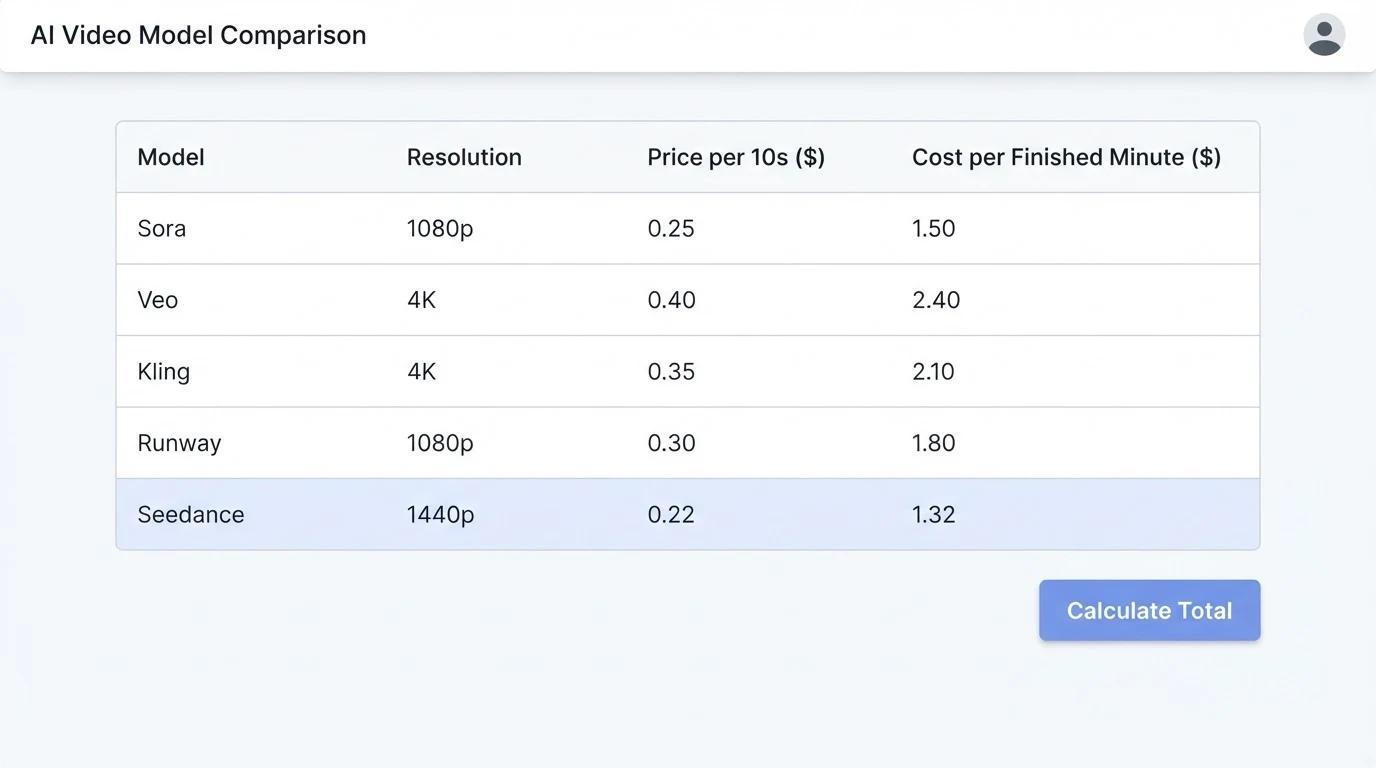
Everyone quotes cost in the wrong unit. The honest number is cost per finished minute, not cost per generated clip, because the ratio between the two is where every AI project lives or dies. Model choice matters, but iteration rate matters more; most usable shots take several regenerations before a director signs off, and character or wardrobe continuity across a full song multiplies that overhead again. Film work follows the same physics, but a music video is more forgiving on realism and less forgiving on rhythm, which changes which trade-offs make sense.
The other real drivers are resolution and duration, lipsync work when the artist appears on camera, audio-reactive editing where every cut lands on a beat, and the licence you need on the finished master. A private DIY tool licence and a full commercial exploitation licence sit at very different points on the ladder even when the pixels are identical.
The DIY route: subscriptions and self-driving
For a first single, a lyric video, or a fast social cut, subscription platforms will get you to a finished master for the cost of a modest monthly plan. Sora, Veo, Runway, Kling, FlyU and freebeat all sell recurring plans in a similar band, differentiated more by their credit allowances and preset library than by their headline sticker. Time cost is the real spend at this tier: expect a meaningful chunk of a weekend on prompting, culling, and stitching for a three-minute video that actually holds together.
Who this route suits: independent artists, first releases, personal projects, and cases where the goal is proof-of-life on the DSPs rather than a hero visual. The trade-off is that character consistency, mix-to-picture edit precision, and commercial licence status are all things you handle yourself. Content workflows at this tier reward artists who enjoy the tinkering; if you don't, jump a tier.
Per-clip API generation
Below the subscription layer sits the raw API, where you pay for each generated second directly. Every major model publishes a per-second rate that stacks up quickly once you factor in iteration. A ten-second clip generated cleanly on the first try is almost never how music videos actually get made; multiple regenerations per usable shot is the working assumption inside most AI-native production teams.
| Model | Character of the output | Best used for |
|---|---|---|
| Sora 2 | Narrative coherence, physical realism | Hero shots, story beats |
| Veo 3.1 | Native audio, cinematic camera moves | Music-synced sequences |
| Runway Gen-4 | Reference-image fidelity, character consistency | Artist-in-frame shots |
| Kling 3.0 | Stylised motion, expressive dance | Performance sequences |
| Seedance 2.0 | Fast turnarounds, high volume | B-roll, transitions |
The honest advice is to treat model choice as a portfolio decision rather than a monogamous one. Cheaper models handle B-roll and cutaways; premium models earn their keep on hero moments where the artist's likeness and lip movement matter. A well-run production spreads the generation across several models, matched shot by shot to what each one is best at.
Hiring a freelancer versus an AI-native studio
Marketplace platforms sit at the bottom of the assisted-production ladder, where individual operators will turn a brief around inside a week. Specialist AI directors, usually working solo, sit above that with proper storyboarding, revision passes, and taste-driven shot selection. Boutique AI studios sit above them again, delivering fully brand-calibrated productions with senior creative direction on every project.
What each tier actually delivers is very different. A marketplace freelancer will hand back a rendered file; a specialist will hand back a rendered file plus revision rounds and a story treatment; a studio will handle concepting, storyboarding, iteration, mix-to-picture editing, colour, and commercial delivery. An AI-native agency workflow compresses the same craft cycle a traditional production would run through, without the shoot-day overhead.
AI versus traditional production: an honest comparison
A traditional music video, shot on a real set with a real crew, sits in a completely different economic bracket for reasons that have nothing to do with the finished pixels. Location fees, day rates, gear rental, insurance, wardrobe, catering, and a post house all stack before a single frame gets colour-graded. The same structural comparison plays out in product work, where AI production reshapes the fixed-cost base rather than shaving a single line item.
AI production wins comfortably on speed, iteration room, and access to worlds you physically cannot shoot: outer space, historical eras, surreal product worlds, impossible camera moves. Traditional production still wins on physical realism when the story demands it, on subtle human performance where continuity is the point, and on rights clarity for the exact reasons that make AI licensing complicated. The right call is almost never one or the other and almost always which shots need which.
Hidden costs nobody quotes you
- Commercial licence upgrades. Most subscription tiers ship personal-use rights by default; a proper commercial licence is usually a separate line item.
- Credit overages. Iteration always eats more credits than the sales page implies, and top-up rates are rarely favourable.
- Upscaling. Most video models deliver at standard release resolution; a proper master pass adds a per-second fee at generation time.
- Mix-to-picture editing. The finished audio has to sit under the cuts precisely, which is real edit-suite time regardless of how the shots were made.
- Model-switch redo work. Changing the hero model mid-project usually forces a partial re-generation of shots that were already signed off.
- Rights clearance on training-adjacent outputs. Some outputs need a legal review before public release, and that time is real even when the sticker was cheap.
A realistic 2026 budget template by artist stage
Budgets look very different depending on where an artist sits in their career, and matching the tier to the stage matters more than matching it to a genre. Bedroom and first-single artists live on the DIY subscription tier, running the whole pipeline themselves and treating iteration as time rather than cash. Developing indie artists usually graduate to a freelance operator for their next few releases, buying back time and getting one round of proper revisions.
Signed indie releases typically move to a boutique AI-native studio, where the creative direction, character consistency, and licensed delivery justify the step up. Major label experiments and hero singles sit at the hybrid tier, blending a real shoot day with generated worlds for a finished piece that reads as a proper release. Brand-side campaigns often adopt the same laddered thinking, matching the tier to the moment rather than the annual plan.
How to cut cost without cutting quality
- Lock the storyboard before you start generating. Every regenerated shot that a good storyboard would have flagged is money and time you did not need to spend.
- Batch prompts. Group similar shots into one generation session so the model settles into a consistent look.
- Mix models by role. Premium models on hero shots, cheaper models on B-roll and transitions.
- Reuse seeds. Anchoring on a consistent seed keeps a character recognisable across scenes without expensive retraining.
- Edit outside the AI tool. DaVinci Resolve or a proper NLE will always beat editing inside a generation platform's timeline.
- Negotiate a scoped project rate with your studio. Per-shot pricing invites scope drift; a scoped project rate keeps the incentives aligned.
Frequently Asked Questions
What is the cheapest way to make an AI music video in 2026?
An entry-level monthly subscription to a tool like freebeat, FlyU or an equivalent, driven yourself, is the lowest-cash route. Expect to spend real time on prompting, culling and editing in exchange, and expect commercial licence status to be your own responsibility. Self-driven content workflows at this tier suit artists who enjoy the craft.
How much does a professional AI music video actually cost?
Pricing for boutique studio work is quoted per scope after a brief review, because a stylised performance video, a narrative story piece, and a hybrid live-action integration all sit at very different points on the effort curve. The right move is to ask for a scoped quote against your treatment rather than a headline number.
Do I own the video if it was made with AI?
Ownership and licensing depend on the model used, the tier of subscription you were on, and the jurisdiction the release is exploited in. This is genuinely one of the more complex areas of the current market and worth a direct conversation. Talking through the rights position before generation starts is much cheaper than sorting it after.
Which AI model produces the best music video results?
There is no single answer because each model has a different strength: Sora 2 on narrative and physicality, Veo 3.1 on cinematic camera moves, Runway Gen-4 on reference-driven character consistency, Kling 3.0 on stylised motion, Seedance 2.0 on volume and speed. Serious productions use several, matched to the shot.
How long does an AI music video take to produce?
Faster than traditional production and much faster than most people expect, though the honest answer depends on iteration count and the complexity of the treatment. Speed at this tier is described relatively rather than as a fixed promise, since a stylised performance piece and a narrative hybrid live in very different rhythms.
Is AI music video production cheaper than traditional?
Generally yes on the fixed-cost base, because a shoot day, crew, and location all sit outside the pipeline. The gap narrows on hybrid productions that still include a live shoot, and closes on high-end hero work where the same senior creative direction applies either way.
What about lipsync and character consistency?
Both have improved dramatically through 2025 and 2026 but still absorb the largest share of the iteration budget on any project that features the artist on camera. Reference-driven models handle likeness better than text-only generation. Animation-adjacent workflows that plan for likeness up front spend far less on regeneration.
Can I use an AI music video commercially?
Yes, but only on the right licence tier for the tool you used. Most DIY subscriptions ship personal-use rights by default, and commercial upgrades sit on a different plan. Confirming the licence covers your intended release channel before generation begins is basic hygiene.
The bottom line
The right budget for an AI music video in 2026 depends far more on where the release sits in an artist's career than on any headline figure. Match the tier to the moment, plan iteration honestly, and treat model choice as a portfolio rather than a loyalty decision. Absolutely AI produce music videos across the tiers and quote per scope after a brief conversation about the treatment.