AI Brand Film Production: The Agency Playbook for 2026
AI brand film production has moved from novelty reel to boardroom-approved deliverable. At Absolutely AI we've spent the last two years building a repeatable pipeline that turns a brief into a finished 60-second brand film in days, not months. This is the practitioner's guide: the workflow, the model stack, the failure modes, and the honest calls on when AI is the wrong choice.
An AI brand film is a narrative-led piece of marketing content produced using generative video, image, and audio models, guided by brand strategy. It is not the same as generic AI video generation. A brand film has a script, a shot list, a considered edit, and a point of view about the brand it serves. The tools are new; the craft is not. Teams like Absolutely AI treat generative models the way a traditional production company treats a camera and a crew: as instruments in service of the story.
What is an AI brand film?
The clearest way to separate an AI brand film from a random text-to-video clip is intent. A brand film is commissioned to move a specific audience toward a specific action, whether that is awareness, consideration, or conversion. It carries brand codes: palette, typography, tone, casting, world. Generative models handle the imagery, motion, voice, and score, but the film is planned in the same way a director plans a live shoot, with a beat sheet, a storyboard, and a shot list. Our storyboard examples show what that planning stage looks like in practice.
The output can range from a 15-second social cutdown to a 90-second hero film for a homepage. What separates it from a montage of AI clips is that every shot has been briefed, reviewed, and edited into a whole. When agencies talk about AI video as a serious deliverable, this is what they mean.
Why brands are moving to AI film production in 2026
The economics have flipped. A traditional 60-second brand film with a small crew, one location, and modest post can run six figures and six weeks. An AI brand film with a comparable creative bar can be produced for a four-figure budget in four to seven working days. That gap is now large enough that CFOs are asking about it, not just creative directors. Our marketing team now fields inbound from brands who have already run the maths.
Speed matters as much as cost. When storyboard-to-screen collapses from weeks to hours, iteration becomes cheap. Brands can test three tonal directions before committing, produce eight regional variants from one master, and refresh creative every campaign cycle instead of every fiscal year. The social ad teams we work with treat AI film as a volume play: same story, dozens of cuts, tuned per channel.
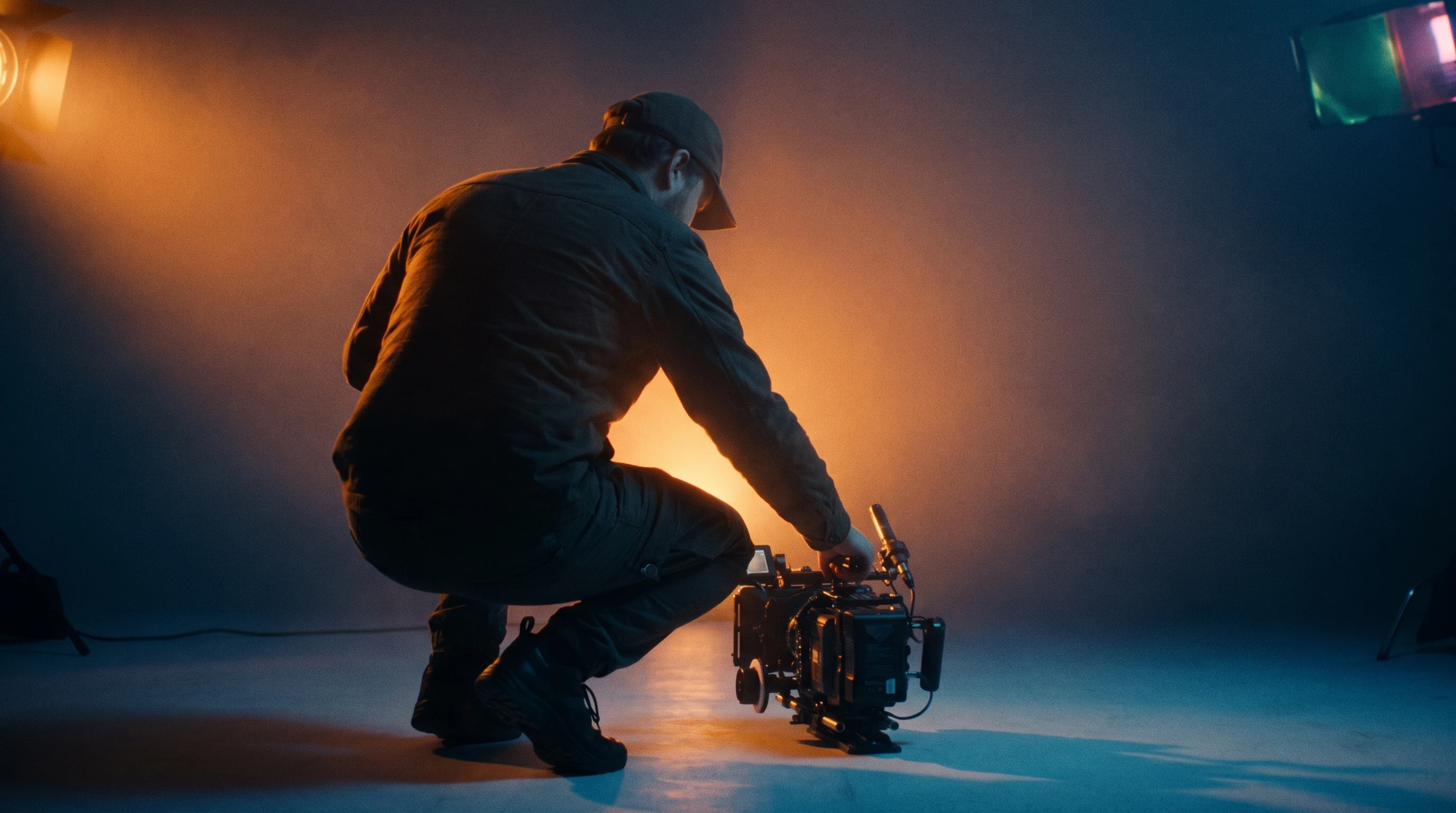
The AI brand film production workflow
Our pipeline has six stages. Each one mirrors a traditional production step, with generative tools slotted in where they earn their place. Skipping stages is the single most common reason AI brand films look amateurish.
- Creative brief and brand profile. Audience, objective, brand codes, do-not-do list. This document travels with every prompt.
- Script and beat sheet. Voiceover or on-screen text, timing per beat, emotional arc. Usually 8 to 14 beats for a 60-second film.
- Storyboarding with image models. Midjourney and Nano Banana for still frames, one per beat, locked before any motion is generated. See our guide on script to storyboard for the exact process.
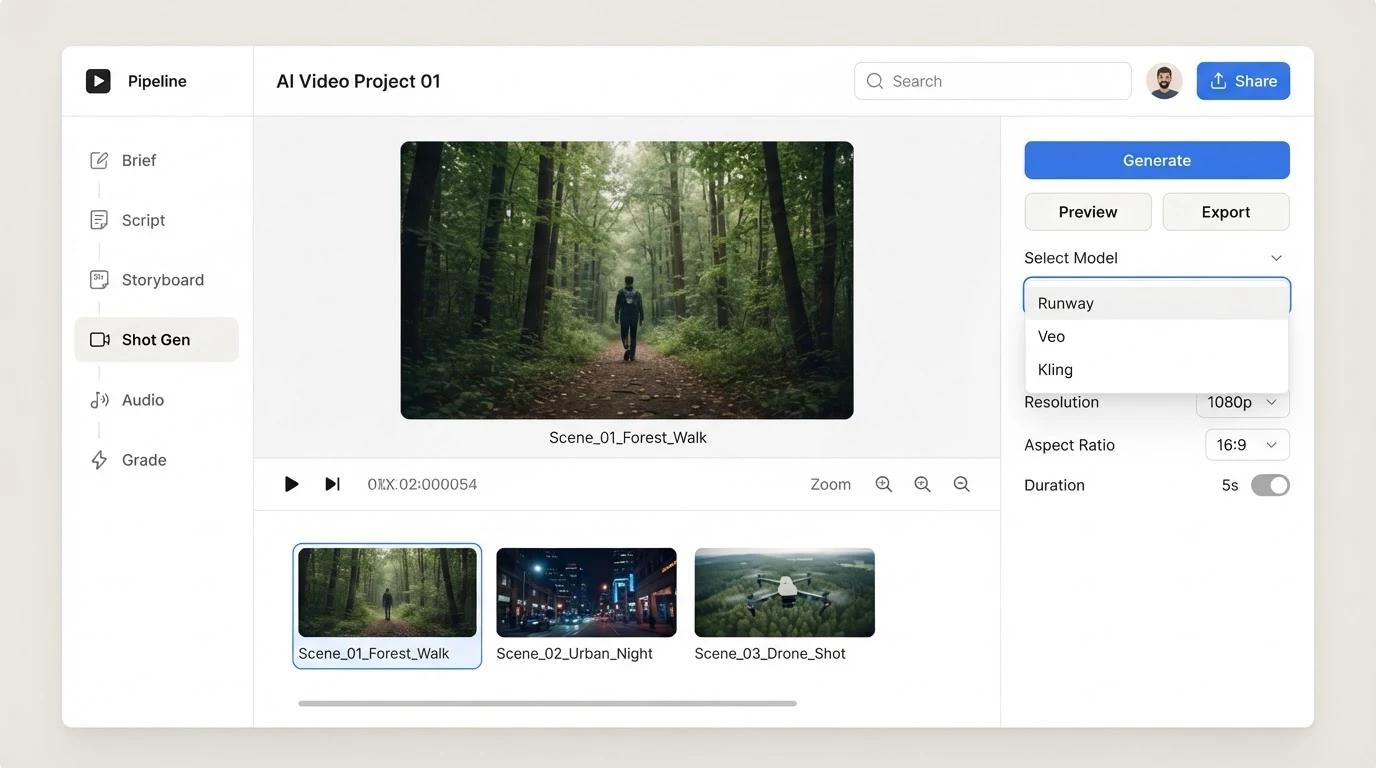
- Shot generation. Feeding approved stills into Runway Gen-4, Veo 3, Kling 2, or LTX Studio as first-frame references.
- Voice, score, and SFX. ElevenLabs for voiceover, Suno for original score, licensed libraries for SFX and stems.
- Edit and grade. DaVinci Resolve or Premiere for assembly, colour, sound mix, and final delivery specs.
Choosing your model stack
No single video model wins every brief. The stack we reach for depends on shot type, character requirements, and how much camera control the storyboard demands. The table below reflects how we deploy each model on live brand work in 2026.
| Model | Strengths | Best used for |
|---|---|---|
| Runway Gen-4 | Character consistency, reference-to-video, motion brush | Talent-led shots, recurring characters, controlled camera moves |
| Google Veo 3 | Photoreal quality, native audio, physics | Hero establishing shots, product-in-world, ambient scenes |
| Kling 2 | Long-form motion, expressive faces | Emotional beats, longer takes, subtle performance |
| Sora | Complex scene composition, world coherence | Wide narrative shots, transitions, dream sequences |
| LTX Studio | Storyboard-native workflow, shot-to-shot control | Full film assembly, consistent style locks |
| Luma Dream Machine | Fast iteration, natural motion | Rapid concepting, social cutdowns, B-roll |
In practice we blend. A single 60-second brand film might use Midjourney for storyboarding, Veo 3 for four hero shots, Runway Gen-4 for the two shots featuring a recurring character, Kling 2 for one emotional close-up, and Luma for connective tissue. The edit is where the seams disappear. This mirrors how our content team approaches every brand build.
Maintaining brand and character consistency across shots
Consistency is the technical problem that separates polished AI films from obvious ones. A character whose face shifts between shots, or a product whose label morphs, breaks the illusion instantly. There are four techniques we lean on, usually in combination.
- Reference images. Every shot inherits a locked still from the storyboard as its first frame, ensuring the model starts from a consistent visual seed.
- Character references and LoRAs. Runway's character reference and custom LoRAs trained on approved brand assets keep faces, wardrobes, and hero products stable across shots.
- Style locks. A short, rigid style prompt block appended to every generation, covering palette, lens, film stock, grade, and lighting language.
- Prompt libraries. A shared document per project with the exact language used for each recurring element, so the third editor to touch the film uses the same words as the first.
For product-heavy films the same discipline applies. Our product photography pipeline generates a master reference sheet before any motion work begins, and every shot references it.
Where AI still fails and how to hide it
Being honest about failure modes is what separates an agency from a tool reseller. In 2026, five things still routinely break.
- Hands. Extra fingers, fused knuckles, dropped objects mid-motion. Fix: keep hands out of frame, use tighter compositions, or regenerate the offending frames as stills and reinsert.
- Text. On-pack copy, signage, and UI still garble. Fix: composite real type in post, never trust rendered text for anything a viewer will read.
- Lip sync. Native lip sync is improving but still uncanny for long dialogue. Fix: prefer voiceover over on-camera dialogue, or use dedicated lip-sync tools on a locked base clip.
- Physics. Liquids, cloth, and collisions can drift. Fix: shorter clips, cut on the beat before physics unravel, use Veo 3 for anything with real-world simulation demands.
- Continuity. Model drift across shots. Fix: reference images, LoRAs, and a ruthless editor who is willing to cut a beautiful shot that does not match the ones around it.
The editor's chair is where most of these failures get resolved. A confident cut, a well-timed sound design element, or a graphic overlay can hide a multitude of generative sins. This is why we never treat the edit as an afterthought.
Costs, timelines, and team
For a 60-second brand film to a professional standard, expect a four-day to seven-day timeline from approved script. Day one is storyboarding and stack selection. Days two and three are shot generation and iteration. Day four is voice, score, and rough cut. Days five to seven are refinement, grade, and delivery. Compressing further is possible but usually costs in polish.
The team is smaller than a traditional crew but not zero. You still need a director or creative lead who owns the story, a prompt and generation lead who runs the model stack, an editor who assembles and grades, and a sound designer or composer if the score is bespoke. Four people, one week, one film. Pricing for a bespoke brand film is quoted per scope after a brief review, and depends on shot count, character work, and licensing. Our branding team scopes each project against the brief rather than a rate card.
When to hire an AI brand film agency vs DIY
DIY works for internal culture films, quick social experiments, and founder-led content where roughness reads as authentic. If you have a curious in-house creative and a week to burn, you can produce something usable with a Runway and ElevenLabs subscription.
Hire an agency when the film represents the brand at hero level, when character or product consistency is non-negotiable, when the deliverable needs to sit next to traditionally produced work without dropping quality, or when you need it delivered on a real timeline. Agencies bring the pipeline, the taste, and the editorial bar. They also bring the discipline to say no to a shot that will not hold up. Our agency page covers where we typically pick up the phone.
There are also briefs where AI is the wrong choice. Hero product close-ups where the label must be pixel-accurate, talent-led ads featuring a real spokesperson, and heavily regulated categories like pharma or financial services still belong on a live set or in a hybrid pipeline. A good agency will tell you when to spend the money on a camera instead.
Frequently Asked Questions
How long does an AI brand film take to produce?
From approved script to final delivery, a 60-second AI brand film typically takes four to seven working days. The bulk of the time sits in storyboarding, iteration on hero shots, and the edit rather than the raw generation.
Can AI brand films maintain character consistency?
Yes, with the right techniques. Reference images, character LoRAs, and models like Runway Gen-4 with dedicated character reference features can keep a person recognisable across dozens of shots. It requires planning at the storyboard stage rather than trying to fix it later.
What is the difference between AI video generation and AI brand film production?
AI video generation is the raw output of a model. AI brand film production is the discipline of using those outputs inside a briefed, storyboarded, edited piece of work that serves a specific brand objective. One is a clip; the other is a film.
Which AI video model is best for brand work?
There is no single winner. Runway Gen-4 leads for character-led shots, Veo 3 for photoreal hero shots with native audio, Kling 2 for emotional performance, and LTX Studio for full storyboard-to-film workflows. Most professional brand films blend three or four models across the edit.
How much does an AI brand film cost?
Pricing is quoted per scope after a brief review. The variables that move the number are shot count, character complexity, whether the score is bespoke or licensed, and the number of channel-specific cutdowns required.
Can I use an AI brand film in a paid media campaign?
Yes. Platforms including Meta, TikTok, YouTube, and LinkedIn all accept AI-generated creative in paid placements, provided you follow their disclosure requirements and any category-specific rules. Regulated categories still need legal review before running.
What deliverables do we receive at the end?
A typical package includes the master film in your primary aspect ratio, cutdowns for 9:16 and 1:1, a silent version, a version with burnt-in captions, stills pulled from hero frames, and the full project file for future revisions.
Do we own the final film?
Yes. On a bespoke engagement the brand owns the delivered film outright, including all cutdowns and stills. Underlying model licenses and any third-party music or voice licenses are handled and disclosed per project.
Where to take this next
AI brand film production in 2026 is a real discipline with a real pipeline, real failure modes, and real economics. The brands winning with it are the ones treating it like production, not like magic. If you want to see the pipeline applied to your brief, the Absolutely AI films team is where that conversation starts.