AI Creative Services for Brands: A 2026 Buyer's Guide
AI creative services have moved from novelty pilots to line items on brand marketing budgets, but the category is crowded, the pricing opaque, and the quality wildly uneven. This guide is written for the brand manager, marketing director, or head of content who needs a clear-eyed view before signing a scope. It draws on how studios like Absolutely AI actually work, without the sales gloss.

The phrase "AI creative services" now covers everything from a solo freelancer running Midjourney to a full studio delivering broadcast-grade films with human art direction on every frame. For a brand marketer trying to compare quotes, that ambiguity is the whole problem. This guide walks through what the category actually contains, how the work gets made, where the sharp edges are, and how to evaluate a partner without relying on the sales deck. Where useful, it points at how a modern AI-first creative studio structures the work.
What Counts as an AI Creative Service
An AI creative service sits between two adjacent categories that brands already understand. On one side is the traditional creative agency, where senior humans concept and produce work, often on multi-week timelines with location shoots and post houses. On the other side is the pure SaaS tool, where the brand's own team logs in and generates assets themselves. AI creative services combine the two: human creative direction, generative production, and a delivered asset the brand can actually run.
The useful distinction is who carries the creative judgement. A software subscription hands the brand a canvas and expects the brand to be the art director. A service, done properly, keeps that judgement inside the studio and hands back finished work. For a fuller breakdown of how this compares to a physical shoot model, see the piece on AI content studios versus traditional studios.
Read the fine print of any scope of work. If the deliverable is "credits" or "access", it is a tool. If the deliverable is "finished assets in your brand system", it is a service.
The Seven Service Pillars Brands Actually Buy
Across dozens of active vendors in 2026, brand buying tends to cluster around seven distinct pillars. Most agencies specialise in two or three, so a shortlist that spans all seven is rare.
- Ad creative at scale, where the same core concept is versioned into dozens or hundreds of platform-native cuts. This is the closest thing to a mature product category, and it is where AI social ad creative earns its keep.
- Brand image libraries that replace the traditional stock and shoot workflow with a bank of on-brand imagery generated to a defined visual system.
- Motion and video, from short social edits through to fully directed AI films with cinematic pacing and sound design.
- Product visuals, either replacing packshot photography or extending it with worlds, contexts and seasonal variations that would be uneconomic to shoot.
- Lifestyle photography replacement, where model, location, wardrobe and post are collapsed into a single generative brief.
- Storyboarding and concepting, using generative tools to move from brief to visualised concepts in hours instead of weeks.
- Localisation and translation, adapting a single master creative into multiple languages, cultural contexts and formats.
A brand rarely needs all seven from one vendor. It usually needs one done exceptionally well, with a partner who understands the other six well enough not to break them.

How the Human and AI Workflow Actually Works
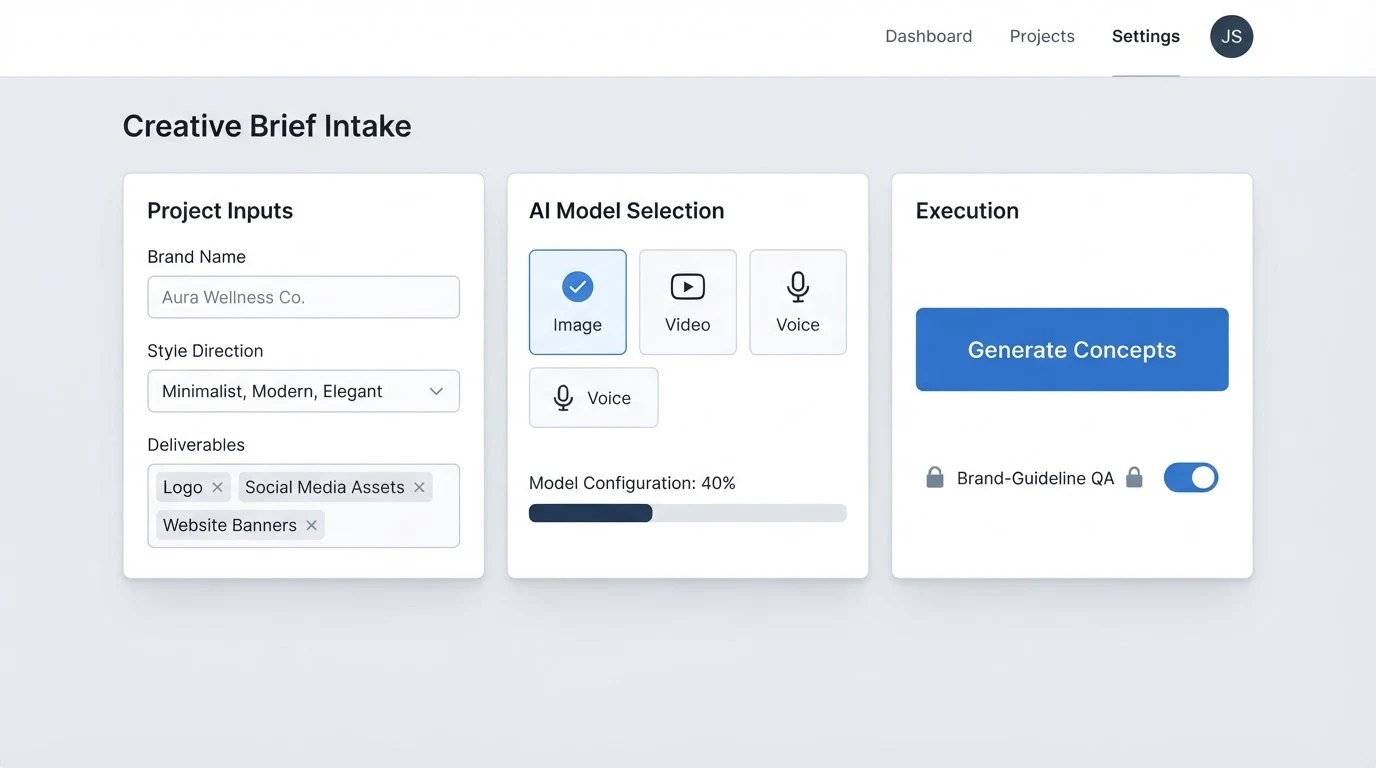
The workflow inside a serious AI creative studio has more in common with a traditional agency than the marketing suggests. It starts with a brief intake, where a creative lead pulls apart the objective, the audience, the brand system, and any hard constraints. This is the step buyers most often underestimate, and it is where the eventual quality is largely determined.
Model selection follows. A modern studio has half a dozen image models, several video models, and a handful of voice and music tools it actively works with, and it chooses combinations based on the aesthetic target rather than defaulting to one stack. That toolchain evolves month to month, which is one reason a studio can hold a quality bar that in-house teams struggle to match.
An art direction pass shapes the raw generations into work that reads as brand rather than as AI. Brand-guideline QA checks palette, typography, tone, and the small details that break a piece: reflections, hands, product accuracy, letterforms. Iteration loops with the client close out the process, in cycles measured in hours rather than the days a physical reshoot would demand. Studios focused on brand photography tend to publish this workflow openly; treat vagueness here as a warning sign.
What Brands Should Expect in Cost, Turnaround, and Quality
Public benchmarking is thin, and honest answers are thinner. What the reputable vendors describe qualitatively is a meaningful compression of both timeline and budget compared with equivalent live-action production, with the largest savings appearing on projects that would otherwise require multiple locations, talent, or reshoots. Simple product photography sees smaller gains; ambitious campaign concepts see larger ones.
Quality follows the direction, not the model. The gap between the best and worst output from the same underlying tools is enormous, and it maps almost entirely to the seniority of the humans running the brief. A studio that discounts its rate by cutting the creative direction step is not selling the same service at a lower price, it is selling a different service.
Pricing itself is quoted per scope after a brief review in the reputable end of the market, because the cost drivers depend on the concept, the number of variants, and the delivery formats required. Fixed price sheets tend to indicate a templated approach that is fine for volume ad units and poor for anything with brand-defining stakes.
Brand Safety and IP Considerations
This is the section every competitor page glosses over, and it is now the first question procurement teams ask. There are four areas worth pressing a vendor on before signing.
- Training data provenance. Which models are used, and what is publicly known about how they were trained. A studio that cannot answer this at all is a risk.
- Likeness and talent rights. If a generated image resembles a real person, who is responsible. Serious studios have a policy and can describe it.
- Competitor mimicry. Whether the studio will accept a brief that references a competitor's visual system, and how it handles that request.
- Indemnification. What the vendor's contract actually says about defending the brand if a claim arises. Most standard SaaS terms exclude this.
None of this is settled law in 2026, and any vendor that pretends otherwise is overselling. The right posture is a clear description of the studio's practices, a willingness to talk through edge cases, and a contract that reflects the risk allocation both parties actually agreed to. For sensitive categories, walk any specific rights question through your own counsel before the shoot, not after.
How to Evaluate an AI Creative Partner
A useful shortlist can be built with a short checklist that filters out most of the noise in the market. Work through it during discovery calls rather than after the pitch.
- Does the studio demonstrate brand-guideline adherence on real work, not just showcase pieces.
- How are revisions scoped, and what triggers a change order.
- Is the model and tool stack transparent, or treated as a trade secret.
- What is the ratio of human oversight to generated output on a typical project.
- Who art directs, and what is their background before AI tools existed.
- What are the IP and indemnification terms in the standard contract.
- How is quality controlled across variants and localisations.
- Can the studio show unedited work-in-progress from a comparable project.
- Is the pricing model tied to scope or to seat licences.
- What happens if the first round of concepts misses the brief.
Buyer-side reading on this evaluation process is thin, but the guide to hiring an AI content agency covers the same ground from the RFP angle and is worth a look before you write one.
When AI Creative Services Beat In-House or Freelance
The choice is rarely binary. Most brands end up with a hybrid, and the right split depends on volume, team size, and how much of the work is brand-defining versus channel-filling. The table below is a rough decision matrix.
| Situation | Best fit | Why |
|---|---|---|
| Low volume, brand-defining campaigns | AI creative studio | Senior direction, cinematic ceiling, worlds you cannot shoot |
| High volume, templated social ads | Studio plus in-house | Studio builds the system, in-house runs the variants |
| One-off, tightly scoped asset | Freelancer | Lowest overhead, fastest kickoff |
| Everyday internal graphics | SaaS tool with in-house designer | Cheapest per asset, quality bar is low |
| Multi-market localisation at pace | AI creative studio | Model stack and QA process built for it |
The freelancer question specifically comes up often, and the piece on AI content agency versus freelancer is a more thorough treatment.
The 2026 Landscape
The vendor set has consolidated around a small number of visible names. Superside operates a large subscription design service that has added generative capacity. Omneky focuses on performance ad creative with an optimisation layer. Delesign and Designity sit closer to the traditional flat-rate design service model with AI augmentation. Directories like DesignRush aggregate the long tail. Each occupies a different point on the spectrum from templated volume to bespoke direction.
Absolutely AI's approach differs on one specific axis: the studio productises the brief-to-concept step itself, so a brand can see visualised directions in a fraction of the time a traditional concept round takes. A closer comparison against one of the incumbents is written up in the Superside versus Absolutely AI piece.
Frequently Asked Questions
Are AI creative services suitable for regulated industries?
Yes, with care. Financial services, healthcare and pharma buyers should press harder on IP, likeness and provenance questions, and expect the studio to work inside the same review workflows a traditional agency would.
Can an AI creative service work inside our existing brand guidelines?
A capable studio treats brand guidelines as the primary input, not an afterthought. If a vendor cannot describe how they encode a brand system into their workflow, they are not ready to be your partner.
Where does AI creative still fall short?
Hands and complex human interaction remain fragile. Long-form video coherence is improving but not solved. Very specific product accuracy, especially typography on packaging, still needs human QA. Any studio claiming otherwise is not being straight with you.
How do we protect our brand from AI drift over time?
Version-controlled prompts, reference libraries, and a named human owner of the visual system inside the studio. Ask how the vendor handles model updates that change output character.
What is a realistic first project?
A contained campaign or a defined asset library, with clear success criteria, is the right shape. Avoid opening with a rebrand or a hero film until you have seen how the studio actually works on a smaller brief.
Do we still need a creative agency of record?
Many brands keep one for strategy and platform-level thinking, and add an AI creative studio for production and iteration. The two roles are complementary more often than they are competitive.
How is success measured?
By whatever the brief said it would be measured by. Beware vendors who steer the conversation toward vanity metrics or model-specific outputs rather than the business objective the work is meant to serve.
What should be in the contract?
Scope, revision model, delivery formats, IP terms, indemnification, model and tool disclosure, and a clear off-ramp. Anything vague at signing becomes a dispute later.
Closing Thought
AI creative services are not a discount version of traditional creative production, and they are not a replacement for human judgement. Treated as a category of their own, with the right diligence and the right partner, they let a brand produce more, iterate faster, and reach visual territory that a physical shoot cannot. If you are scoping a project and want to see how a brief-first workflow looks in practice, Absolutely AI's team is set up for exactly that conversation, and the agency overview is the right starting point.