AI Content Strategy for Brands: A 2026 Playbook
Most brands don't need more AI content. They need an AI content system, one that protects voice, enforces quality, and scales output without flattening what makes the brand recognisable. At Absolutely AI we build these systems for brands shipping daily creative across every channel, and the pattern that works has very little to do with picking a model. It has everything to do with the layers around the model: brand truth, demand signals, routed generation, and tiered governance.

Most brands don't need more AI content. They need an AI content system, one that protects voice, enforces quality, and scales output without flattening what makes the brand recognisable. At Absolutely AI we build these systems for brands shipping daily creative across every channel, and the pattern that works has very little to do with picking a model. It has everything to do with the layers around the model: brand truth, demand signals, routed generation, and tiered governance. This piece is a practitioner's playbook, written from inside an agency running this stack every week, with the decision trees, routing rules, and anti-patterns we see brands repeat.
Why 'AI content strategy' means something different in 2026
Two years ago an AI content strategy meant a workflow doc, a few prompt templates, and a decision about whether to disclose. In 2026 it means an orchestration system. The volume play is over: synthetic saturation has pushed generic AI prose past the point of diminishing returns, and audiences, platforms, and language models themselves now actively discount undifferentiated output. Google's helpful content guidance, Perplexity's citation preferences, and the growing weight of brand entity signals in LLM answers have all shifted the ground. Brands that are winning are not producing more, they are producing recognisably. Our comparison of AI content studios and traditional studios covers the broader shift in detail.
The strategic question has moved from "can we use AI to make content" to "what parts of our content system should AI run, under what constraints, measured how". That reframing is the whole game. It is also where most strategy decks still fail, because they treat AI as a tool rather than a layer in a system that already includes humans, brand assets, and governance.
The 4-layer AI content stack for brands
Every durable AI content program we have built or inherited resolves into four layers. Skipping one is why pilots stall at month three. The layers run in order, each feeding the next.
Layer 1: Brand truth. The voice document, the visual system, and the proof assets (case studies, product data, founder POV) encoded as embeddings or retrieval sources. Without this, every generation starts from the model's default voice, which is the voice of the internet averaged. Our work on AI branding systems starts here because nothing downstream matters without it.
Layer 2: Demand signals. SERP data, LLM-answer monitoring across ChatGPT, Perplexity, and Google AI Overviews, zero-click intent patterns, and category share-of-voice. Generative engine optimisation (GEO) is the demand-side discipline here: understanding not just what people search, but what answers the models already give about your category.
Layer 3: Routed generation. Different tasks go to different models. Strategy, briefs, and editorial judgment calls route to a reasoning model. Image and film route to specialised visual models. Variant production (ad copy permutations, metadata, alt text) routes to a cheap fast model. Routing is the single biggest cost and quality lever in the stack and most teams ignore it entirely.
Layer 4: QA and governance. Brand-fit scoring, hallucination checks on factual claims, legal review for regulated categories, and human sign-off tiered by content weight. We cover the agency-side execution of this layer in our guide to hiring an AI content agency.

Mapping AI to the content lifecycle
A useful way to pressure-test any AI content strategy is to walk the content lifecycle end-to-end and mark each stage honestly. Who or what owns it today, and what is the acceptable ownership target? The table below reflects where we land for most mid-market brands running a mature program.
| Lifecycle stage | Humans still own | AI runs (with guardrails) |
|---|---|---|
| Ideation | Category POV, campaign narrative, risk calls | Trend surfacing, SERP gap analysis, variant angles |
| Briefing | Strategic intent, brand-fit constraints | Structured brief population from source material |
| Drafting | Hero narrative, founder voice, sensitive claims | Hub and hygiene drafts, outlines, variant copy |
| Visual concepting | Art direction, hero concept selection | Moodboards, iteration, format adaptation |
| Localisation | Cultural nuance, legal review per market | First-pass translation, format and length adaptation |
| Distribution | Channel strategy, paid budget calls | Metadata, alt text, platform-native resizing |
| Measurement | Interpretation, next-cycle decisions | Data pipeline, anomaly flags, citation tracking |
The honest reading of this table is that AI has moved up the value chain into briefing and concepting, but the strategic bookends (ideation intent and measurement interpretation) remain human. Brands that invert this, letting AI set strategy and humans do the typing, consistently underperform. For visual-heavy categories, our AI brand photography service is a working example of this split applied to one creative discipline.
The brand voice problem, and how to actually solve it
The question we get asked more than any other is how to make an AI write like the brand instead of like a generic LinkedIn post. There are three real options, and the right answer is almost never the one people reach for first. Here is the decision tree we use.
- Voice-card prompting. A tightly structured system prompt describing voice attributes, lexical preferences, sentence-length targets, and ten to twenty exemplar passages. Cheap, fast to iterate, and works for most hub and hygiene content. Start here. For teams exploring this discipline, our AI content creation page describes how we apply it in practice.
- Retrieval-augmented generation (RAG). A vector store of brand-approved content that the model retrieves from before drafting. The right choice when voice depends on specific proof assets, product knowledge, or a large back catalogue that cannot fit in a prompt. Add this layer when voice-card alone starts hallucinating facts or when the brand voice is tied to specific case studies and data.
- Fine-tuning. A custom-trained model weighted toward the brand corpus. Rarely the right first move. Reserve for very large corpora, highly idiosyncratic voice, and programs with the budget and operational maturity to retrain as the brand evolves.
The rule of thumb: if voice-card plus three exemplar passages cannot pass a blind brand-fit test, the problem is usually that the voice document itself is vague, not that the model needs fine-tuning. Fix the voice doc before you spend on training.
Content velocity without quality collapse
Velocity is the headline promise of AI content. Quality collapse is the quiet failure mode. The three guardrails that keep velocity honest are tiered review, structured briefs, and a scored brand-fit rubric before publish.
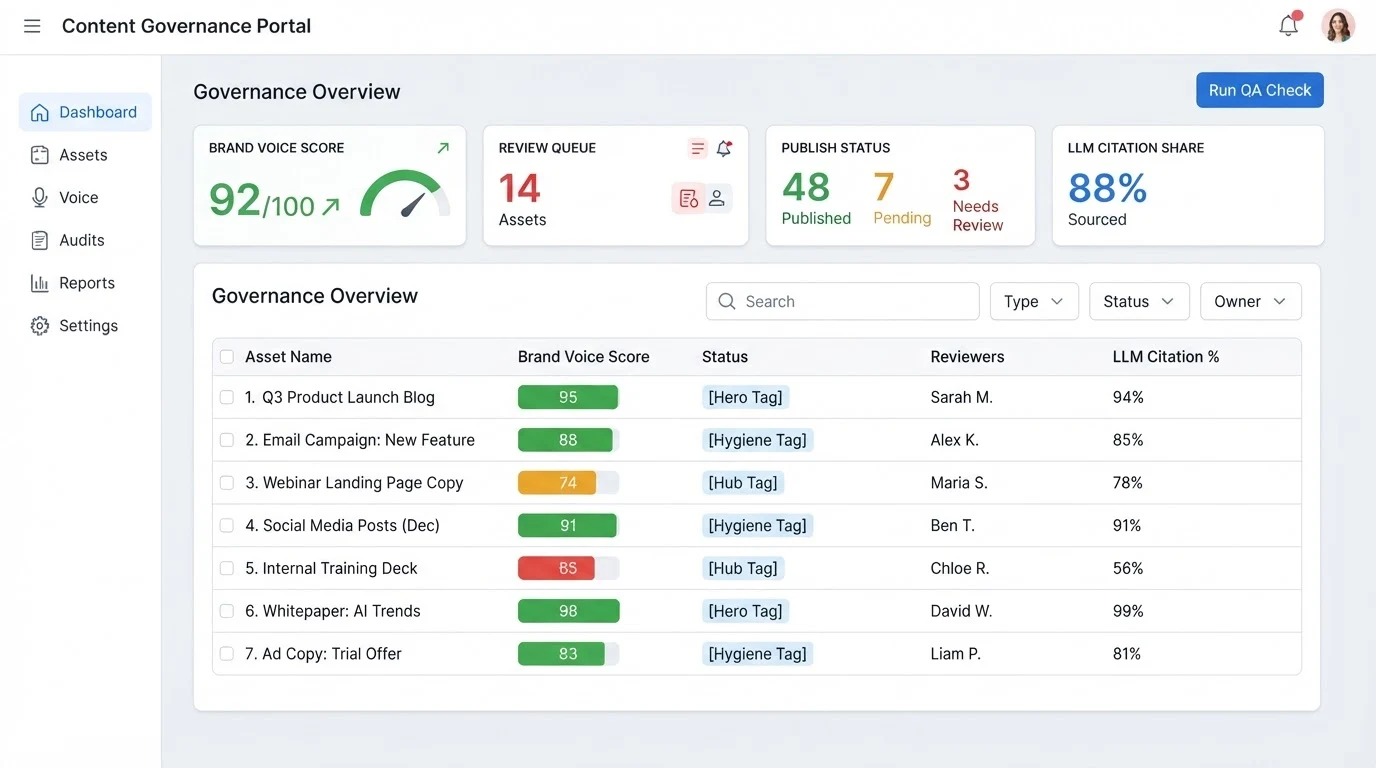
Tiered review (hero, hub, hygiene). Not all content deserves the same QA load. Hero content (campaigns, founder POV, category-defining pieces) gets full human authorship with AI assist. Hub content (ongoing editorial, product pages, thought leadership) gets AI draft with senior human edit. Hygiene content (metadata, alt text, variant ad copy, FAQ expansions) gets AI draft with light sampling review. Applying hero-tier review to hygiene content is why programs stall. Our piece on AI content for DTC brands walks through how this tiering plays out for high-SKU catalogues.
Structured briefs. The model is only as good as the brief. A structured brief constrains the output surface: target audience, key message, must-include entities, forbidden claims, tone sliders, length, format, call to action. Freeform prompts produce freeform drift.
Brand-fit rubric. A short scored checklist run against every draft before publish: voice match, factual accuracy, visual-system adherence, strategic intent met, and legal cleared. Score it one to five on each. Anything below a threshold goes back to edit. This is the single most effective lever for keeping an AI content program recognisably on-brand at scale.
Measuring an AI content program
Traditional content KPIs (rankings, sessions, bounce rate) still matter, but they miss the three dimensions that actually determine whether an AI program is working. The brands getting this right are instrumenting new metrics alongside the old ones.
- Cost per published asset. Not cost per generation, cost per asset that cleared the brand-fit rubric and shipped. This is the real efficiency metric and it will often be a multiple of raw generation cost once review time is included. Tracking it honestly is what separates a program from a demo.
- Brand-consistency score. The average rubric score across published content, trended monthly. If velocity goes up and consistency goes down, the program is quietly degrading the brand. If both rise together, the system is working. Our AI marketing agency work treats this as a weekly reporting metric.
- LLM citation share. How often ChatGPT, Perplexity, Google AI Overviews, and Claude cite the brand or quote its content when answering category questions. This is the GEO equivalent of share-of-voice and it is where a growing share of discovery already happens.
- Zero-click answer coverage. For target queries, is the brand's content surfaced in the answer box or AI overview, even without a click? Impressions in a zero-click world are a leading indicator for citation share.
Measuring the wrong thing is the quiet killer of AI content programs. A team that only tracks rankings will miss the entire shift toward LLM-mediated discovery and will optimise for a surface that is shrinking.
A 90-day rollout plan for a mid-market brand
The rollout we recommend to brands with no existing AI content program runs ninety days, structured in four phases. The point is to prove the system on one content line before scaling, not to boil the ocean.
Weeks 1 to 2: Audit and voice capture. Inventory existing content, score a sample against a brand-fit rubric to establish baseline, write or refresh the voice document, and assemble exemplar passages. If a voice doc does not exist, this phase builds it.
Weeks 3 to 6: Pilot one content line. Pick a single hub-tier content stream (product pages, category editorial, or recurring campaign variants) and run the full stack: brief, generate, rubric-score, edit, publish. Keep the surface narrow enough to iterate the system weekly.
Weeks 7 to 10: Instrument. Stand up the measurement layer. Cost per published asset, consistency score, citation share, and zero-click coverage. Fix the dashboard before scaling, not after. Our AI consulting engagements often sit inside this phase for teams building the measurement discipline from scratch.
Weeks 11 to 13: Scale. Expand to a second content line, formalise the tiered review model across the team, and set the next-quarter targets based on the first ninety days of data.
Five anti-patterns to avoid
Across the brands we audit, the same five mistakes come up again and again. Any one of them is enough to stall a program. All five together guarantee it.
- Volume dumping. Shipping high quantities of generic AI content on the assumption that more is better. Synthetic saturation makes this actively negative for brand equity.
- No voice document. Starting generation before the brand has written down what its voice actually is. The model defaults to internet-average and the output reads that way.
- One model fits all. Routing every task to the same model. Reasoning tasks and variant tasks have radically different cost and quality profiles. Not routing is leaving both quality and budget on the table.
- No human in the loop on hero content. Applying hygiene-tier automation to hero-tier content. The brand's most strategically important assets need the most human authorship, not the least.
- Measuring the wrong thing. Reporting on rankings and sessions while ignoring citation share and consistency. Optimising for the shrinking surface rather than the growing one.
Frequently Asked Questions
What is an AI content strategy, in one sentence?
An AI content strategy is the system of brand assets, routing rules, review tiers, and measurement that governs where AI runs in a brand's content lifecycle and where humans still own the decision.
Is AI content bad for SEO in 2026?
Unstructured, undifferentiated AI content is penalised in practice by both search engines and audiences. Structured, voice-anchored, fact-checked AI content performs comparably to human-written content and increasingly better in LLM-mediated discovery because it is produced at the velocity needed to cover entity graphs properly.
Should we fine-tune a model on our brand voice?
Usually not as a first move. Voice-card prompting plus retrieval over an approved content corpus solves the voice problem for the vast majority of brands at a fraction of the operational cost. Fine-tune only when a large corpus, idiosyncratic voice, and operational maturity all line up.
What is generative engine optimisation (GEO)?
GEO is the discipline of optimising a brand's presence in LLM-generated answers (ChatGPT, Perplexity, Google AI Overviews, Claude) rather than or alongside traditional search rankings. It overlaps with SEO on entity signals and schema but diverges on content structure and citation patterns.
How do we measure brand consistency across AI content?
Score every draft against a short rubric (voice, accuracy, visual adherence, strategic intent, legal) and trend the average over time. A declining consistency score alongside rising velocity is the clearest signal that the system is drifting and needs intervention.
What is a tiered review model?
A model where hero, hub, and hygiene content receive different review intensities. Hero content is human-authored with AI assist. Hub content is AI-drafted with senior human edit. Hygiene content is AI-produced with sampled review. Applying one review intensity to all three is the fastest way to stall a program.
How long before an AI content program shows results?
A disciplined ninety-day rollout, scoped to one content line, typically produces enough signal to make a scale decision. Scaling before instrumentation is in place is a common failure mode; instrumenting before piloting is a common form of procrastination. Do both in order.
What does an AI creative agency actually do differently?
A credible AI creative agency owns the full stack: voice capture, model routing, tiered review, and measurement, alongside the creative output itself. Our overview of the Australian AI content agency landscape covers how to evaluate the market.
Conclusion
An AI content strategy worth having is less about the models and more about the system around them. Brand truth encoded as retrievable assets, demand signals read across both search and LLM answers, generation routed by task, and review tiered by content weight. Get those four right and velocity and quality stop being a trade-off. If you want help building this stack for your brand, Absolutely AI runs it every day for the brands we work with, and the door is open.