AI Animated Explainer Videos for Brands: The 2026 Playbook
AI animated explainer videos have moved from novelty to core brand marketing in 2026. The tools are faster, the output is broadcast-ready, and the workflow no longer looks like a prompt lottery. This is how the format actually works when a studio like Absolutely AI runs it end to end: script, storyboard, style frames, generation, and human polish, delivered in days instead of months.
Two years ago, an animated explainer video meant an eight-week retainer, a rotating team of illustrators, and a five-figure invoice. In 2026, the same 60-second film can be scripted on Monday and delivered by Friday, without sacrificing the story arc, brand system, or finish that makes a video actually convert. The catch is that most brands still think about AI animation the way they thought about it in 2023, as a prompt-in, video-out gimmick. The reality is a proper hybrid pipeline where AI does the heavy lifting on generation and human animators handle the polish, the brand rails, and the moments that need taste. This is the format we build most often at Absolutely AI, and the playbook below is the one we hand to brand teams evaluating it for the first time.
What Counts as an AI Animated Explainer Video in 2026
The category is broader than it sounds. An AI animated explainer is any short-form film, typically 30 to 90 seconds, that explains a product, service, or idea using motion generated or heavily assisted by AI models. It covers six distinct formats that behave very differently in production and on channel.
- 2D motion explainers built from AI-generated style frames animated in After Effects, closest to classic motion graphics.
- 3D product explainers where AI renders photoreal product shots and human animators sequence them.
- Kinetic typography pieces that lean on voiceover and animated type, with AI generating background plates.
- Avatar-led explainers using synthetic presenters from tools like Synthesia or ElevenLabs voice.
- Hybrid live-action plus AI where founder footage is intercut with generated worlds.
- Fully generated narrative films built entirely inside Runway, Kling, Veo, or Sora.
The distinction matters because each format has a different tell when it goes wrong, a different cost floor, and a different suitability for the brief. A SaaS onboarding walkthrough almost never wants a fully generated narrative film. A luxury skincare launch almost never wants a Synthesia avatar. Choosing the wrong format is the single biggest reason first attempts at AI explainers look cheap, an issue we cover in more detail in our comparison of AI animation studios versus traditional animation.
Why Brands Are Moving From Traditional Studios to AI Workflows
The economic case is what pulls brand teams into the conversation. A traditional animated explainer from a legacy shop typically runs six to eight weeks and lands somewhere between mid four figures and low five figures depending on scope, complexity, and revision rounds. The AI-native version compresses timeline to under a week and costs a fraction of that, without cutting revisions. Because iteration on AI-generated frames is near-zero cost, the client actually gets more creative exploration, not less.
The second driver is creative range. Traditional animation is locked to the visual system your illustrator can draw. AI generation is locked to what you can describe, which in 2026 is essentially anything. Brands with a photographic identity can now get animated films that look like extensions of their brand photography rather than a cartoon detour. Brands with a stylised identity can get consistent character rigs across a full campaign in days.

The Five Explainer Formats That Actually Convert
Not every explainer is a hero brand film. The formats that pay their way for brands are boringly consistent across categories. If you are commissioning one, you are almost certainly commissioning one of these five, and each has a different weight of AI versus human craft in the pipeline.
- Hero product explainer (60 to 90s). The one that lives on the homepage. High production value, full brand system, usually a hybrid of live-action product and AI-generated worlds.
- Onboarding walkthrough (30 to 60s). UI-heavy, screen recordings intercut with kinetic type and simple 2D motion, often lightly AI-assisted rather than fully generated.
- Category education film (45 to 90s). Explains a concept or problem the brand solves. Highest creative range and where AI generation earns its keep.
- Founder story film (60 to 120s). Live-action interview cut with AI-generated illustrative moments, closest to a documentary short.
- Paid-social cut-down (15s vertical). A ruthlessly tight edit of the hero film reformatted for feed. See our approach to AI social ad creative for how these get cut.
The AI Production Stack We Use
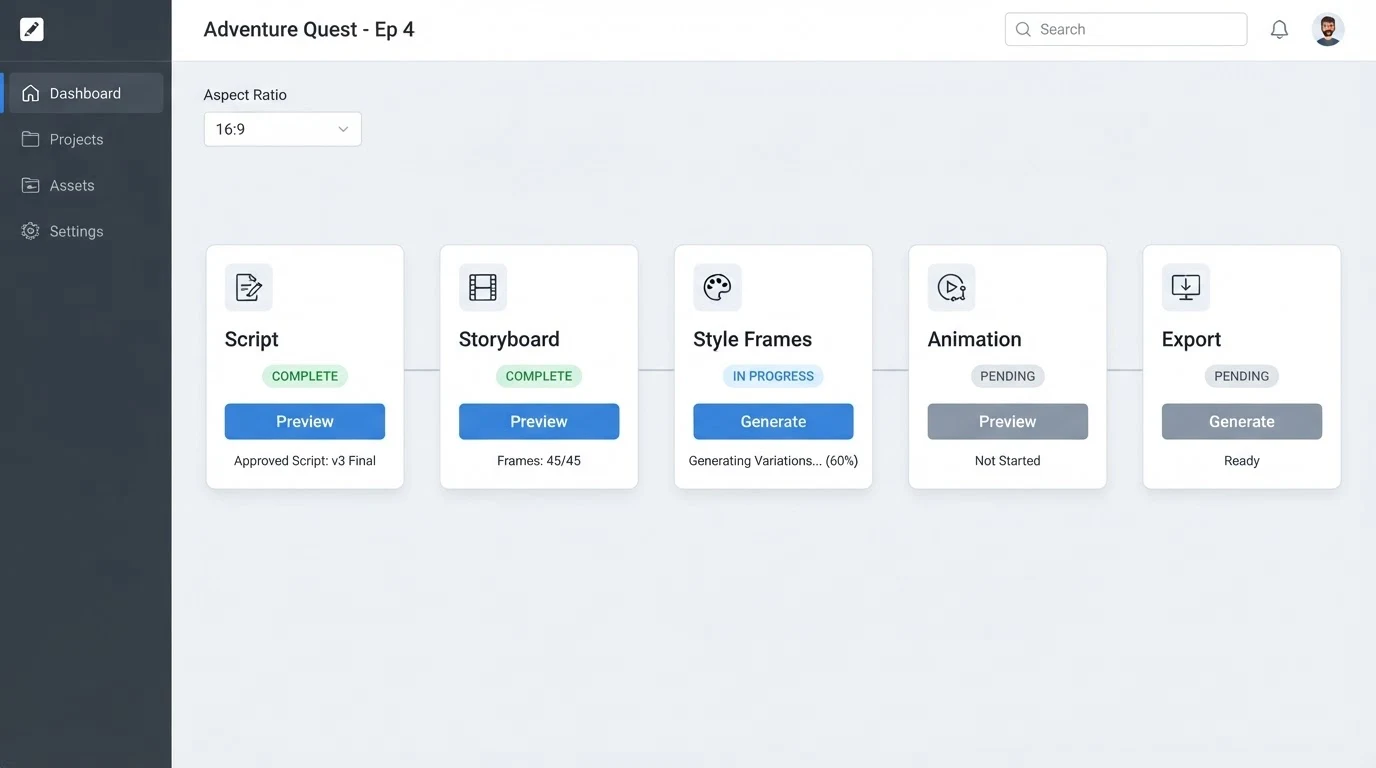
The reason AI explainers look either brilliant or terrible is entirely down to stack choice and pipeline discipline. There is no single model that does everything well, and anyone who tells you otherwise is selling a SaaS subscription. A working 2026 stack looks like this, roughly in the order it runs.
- Script and structure. Written by a human strategist against a defined conversion goal, not a language model on autopilot.
- Storyboard. Traditional shot list, one frame per beat, sketched or blocked out before any generation begins.
- Style frames. Midjourney or Flux for still frame concepts that lock the visual language before motion is generated.
- Motion generation. Runway Gen-4, Kling 2.0, Google Veo 3, or OpenAI Sora depending on the shot. Different models win different shots. A photoreal product spin might go to Veo. A stylised character beat might go to Kling. A camera-move on a generated environment might go to Runway.
- Voiceover. ElevenLabs for synthetic voice or a booked human VO, depending on the brand and the ethical rails.
- Comp, grade, and sound design. After Effects, DaVinci Resolve, and a human sound designer. This is the polish layer that separates studio work from prompt-lottery output.
The pipeline itself is the product. A brand paying for a proper AI animation engagement is paying for the sequencing of these steps and the human judgement at each handoff, not for access to the models. The models are commodity. The taste and the workflow are not.
Where Pure-AI Tools Like Synthesia and Invideo Fall Short
Round-up articles love to rank SaaS explainer tools as if they compete with a studio. They do not. Tools like Synthesia, Invideo, Animaker, Powtoon, and Knowlify solve a real problem, which is producing volume internal or L&D video without a creative team. The moment the brief requires a proper brand system, a story arc, a bespoke visual language, or a conversion outcome on paid media, the template ceiling shows up fast. You can see the shape of that tradeoff in our teardown of the best AI production tools for brand work.
The three signals that a brand needs a studio pipeline rather than a SaaS tool are simple. First, the video will be seen by paying customers or prospects, not employees. Second, the brand has design guidelines that require adherence, not just a logo drop. Third, the CFO expects the video to be attributable to a business outcome. If any of the three are true, you are past the point a template can serve you.
Anatomy of a 60-Second AI Explainer
Cost transparency is almost entirely absent from top-ranking pages, so here is the honest line-item shape of a hero AI explainer at studio bar. The numbers vary by scope, but the proportions are stable across most engagements we run. Pricing for a specific project is always quoted per scope after a brief review at contact, so the table below shows the effort split rather than dollar figures.
| Stage | What it covers | Share of effort |
|---|---|---|
| Strategy and script | Audience, promise, proof, CTA, script draft | 15% |
| Storyboard and style frames | Shot list, visual language lock, brand rails | 20% |
| Motion generation | Model-by-model shot generation and selection | 25% |
| Voice and sound | VO record or synth, music, SFX | 10% |
| Comp, grade, polish | After Effects clean-up, colour, animator fixes | 25% |
| Cut-downs and delivery | Vertical, square, and horizontal masters | 5% |
The interesting number is the 25% on comp and polish. That is where the AI-slop signals get removed, morphing hands get repainted, inconsistent characters get re-rendered, and lipsync gets nudged into place. It is also the line item that most cheap AI explainer offers skip entirely, which is why they look like AI explainer offers.
The Brief That Gets a Great AI Explainer
A good AI explainer brief is not longer than a traditional one, but it is more decisive. Because iteration is cheap, the temptation is to skip the strategic work and rely on rounds. That is the fastest way to burn a week and end up with a beautiful film that does not sell anything. A brief that produces strong work covers five points and stops.
- Target audience. One primary viewer, described in a sentence.
- One core promise. The single thing the film has to communicate, not five.
- Proof. What makes the promise believable, in one line.
- Call to action. What the viewer should do next, on which surface.
- Brand rails. Fonts, colours, tone, and any assets that must appear.
How to Evaluate an AI Animation Studio
The AI animation category is crowded, and portfolio decks are easy to fake with cherry-picked shots. Four checks separate a studio that can actually deliver from one that is prompting its way through the process. Portfolio depth in your category, ideally more than a highlight reel. A model-agnostic stack, because anyone locked to a single model will underperform on shots that model handles badly. In-house animators for polish, because comp is where AI films are won. Clear positions on asset ownership and commercial usage rights, which for AI-generated frames sit in a genuinely grey area worth resolving in the contract, not after delivery.
The wider brand ecosystem matters too. A studio that can hand off cleanly into your brand film work or plug an explainer into your ongoing content pipeline will produce better results than a one-off vendor with no visibility into the rest of your marketing.
Frequently Asked Questions
How long does an AI animated explainer take to produce?
A hero 60-second explainer typically moves from brief to first cut inside a week for a focused engagement, with final delivery a few days after that once revisions and cut-downs are complete. Traditional pipelines for equivalent output usually run six to eight weeks.
How much does an AI animated explainer cost?
Cost sits well below traditional animation studios for equivalent scope, but the range is wide because it depends on length, complexity, live-action components, and number of cut-downs. Pricing is quoted per scope after a brief review rather than off a rate card.
How many revisions are included?
Because iteration on generated frames is cheap, most engagements build revision rounds into the timeline rather than metering them. The bigger constraint is decision speed on the client side, not generation cost.
Who owns the AI-generated frames?
Asset ownership and commercial usage rights for AI-generated video sit in a category that is still settling. Reputable studios contract clear ownership and usage terms up front rather than leaving them ambiguous. This is worth raising in the first call.
Is synthetic voice ethical to use for brand work?
Synthetic voice from tools like ElevenLabs is broadly accepted for narration where no specific person is being cloned. Cloning a real voice, including a founder or celebrity, requires explicit consent and a clear rights structure. The default position for brand work is a synthesised voice or a booked human VO, not an unlicensed clone.
Can an AI explainer match our existing brand system?
Yes, and this is where the pipeline earns its keep. Style frames locked against your existing brand assets, colours, and typography before generation begins is what keeps the output on-brand rather than looking like a generic AI film with your logo pasted on the end.
What formats and aspect ratios do we get?
A standard delivery includes a horizontal master, a vertical 9:16 cut for social feeds, a square 1:1 version, and shorter cut-downs sized to the paid media plan. Building the cut-downs into the initial edit is far cheaper than commissioning them later.
When does an AI explainer look cheap?
Three tells give it away: morphing hands and faces in close-up, inconsistent character design across shots, and lipsync that lands half a syllable off. All three are fixable in comp, but only if the pipeline includes a human animator on the polish pass. Studios that skip that step deliver the tells.
The short version is that AI animated explainer videos in 2026 are not a cheaper substitute for traditional animation. They are a different production model that, run properly, produces stronger work for brand teams than the eight-week retainer ever did. The studios winning in the format are the ones treating AI as a generation engine inside a real creative pipeline, not as a replacement for the pipeline itself. If you are considering commissioning one, the team at Absolutely AI runs this playbook end to end and is happy to walk through your brief.