How to Get Your Brand Recommended by ChatGPT and AI Search
When a buyer asks ChatGPT for a product or agency recommendation, the model does not rank websites. It assembles an answer from everything it has seen, filtered through what it can retrieve live. At Absolutely AI we watch brands quietly disappear from these answers while weaker competitors keep showing up, and the diagnosis is almost never a thin SEO page. It is that the brand is not legible to a language model as a distinct, trustworthy entity in a defined category.

Appearing inside ChatGPT, Perplexity, and Google AI Overviews is now the top of a different funnel, and most brands have no idea how they look to the systems doing the recommending. This is a working playbook for making your brand legible to language models, drawn from the audits and brand-profile work we run with clients. It is deliberately not another schema-markup checklist. The real problem is upstream.
Why ChatGPT recommends some brands and ignores others
The decision loop inside a large language model has three moving parts. First, pretraining: the model has read a frozen snapshot of the public web, academic papers, forums, review sites, directories, and books, and it has built a probabilistic map of which brands tend to co-occur with which categories, problems, and attributes. Second, live retrieval: when you ask ChatGPT a question that benefits from fresh information, it issues real queries against a search index (OpenAI has publicly described using Bing as the retrieval source) and quotes the top results. Third, entity recognition: the model has to decide that "Patagonia" means the outdoor clothing brand rather than the region in South America, which is why structured identity signals matter.
"Rank for keywords" is the wrong mental model because the model is not reading a results page and picking a link. It is answering a question in prose, and the brands that get named are the ones with enough pretraining weight, enough retrieval-time evidence, and enough entity clarity to survive being summarised. If you have been chasing position-one rankings and ignoring whether your brand even exists in the model's semantic map, you are optimising for a game that is no longer the only one being played. The AI marketing work we describe at the studio treats visibility inside answers as a brand-design problem rather than a markup problem.
The six signals LLMs actually weigh
Across published GEO research and our own prompt panels, six signals repeatedly influence whether a brand gets named in an AI answer. They are not weighted equally, and they compound: a brand strong on three of them beats a brand strong on one. Think of this as the spine of the work.
- Relevance. Your public writing uses the same category language the buyer uses. Tactic: audit the top ten prompts in your category and confirm your site uses those exact nouns.
- Association. Your brand co-occurs with the category and with trusted peers in sentences across the web. Tactic: get listed in the "best of" roundups buyers actually read.
- Evidence. Your claims are specific, verifiable, and attached to numbers, dates, named integrations, or named founders. Tactic: replace vague copy ("trusted by many") with concrete facts.
- Corroboration. Third parties repeat your claims. Tactic: Reddit threads, G2 and Trustpilot reviews, Capterra listings, podcast appearances, named press.
- Consistency. Your brand name, category, and one-line description are identical across every surface. Tactic: run a brand-language audit across directories, bios, and partner listings.
- Accessibility. Your site is crawlable, has clean schema, and the key answers are extractable in a few sentences. Tactic: JSON-LD Organization and Product schema, an llms.txt file, and short FAQ blocks.
Pick the 20 to 50 queries you want to own
Most GEO advice stops at "map your priority prompts" without showing the work. Here is how we do it for a hypothetical mid-size Australian natural skincare brand called, for the sake of example, Reef and Rose. The exercise is to list every prompt a real buyer might type when they are shopping your category, then group them into intent tiers so you know where to spend first. You can borrow the same scaffold for a DTC brand or a B2B service.
| Prompt tier | Example prompts | What AI needs to see |
|---|---|---|
| Category entry | "best natural skincare brands Australia", "clean skincare for sensitive skin" | Your name in third-party "best of" lists, consistent category framing on your site |
| Comparison | "Reef and Rose vs Go-To", "alternatives to Aesop daily moisturiser" | Named reviews, side-by-side editorial coverage, comparison pages on your own domain |
| Problem-led | "what moisturiser helps rosacea in humid climates" | Specific ingredient claims, dermatologist quotes, long-form explainers on your blog |
| Branded | "is Reef and Rose cruelty free", "where is Reef and Rose made" | Clear FAQ blocks, structured data, Wikipedia or Wikidata entry if the brand is large enough |
Build the full list in a shared sheet, run each prompt in ChatGPT, Perplexity, and Google AI Overviews, and record whether your brand is mentioned, whether competitors are mentioned, and which sources are cited. That audit becomes the backlog for everything downstream. If you can only act on fifteen of them this quarter, pick the ones where you are already partially present, because the model needs less convincing to tip you over.

Make your site the source of truth
Every page a model retrieves at answer-time is a chance to feed it a clean fact. Treat your site like a reference book rather than a brochure. Consolidate thin pages into one authoritative page per concept, write in the vocabulary your buyer actually uses, and attach specifics (named integrations, release dates, founder names, exact ingredient percentages, specific city of operation) to every claim. Vague copy is invisible to a language model because there is nothing extractable to quote.
Then layer the technical scaffolding. Ship JSON-LD Organization and Product schema so entity recognisers can match your brand name to the right concept. Publish FAQ blocks that mirror the prompt phrasing of your priority queries. Add an llms.txt file at your root as a plain-text index of your canonical content for AI crawlers (the spec was proposed publicly by Jeremy Howard of Answer.AI in 2024). Keep page templates fast and crawlable; the production side of this sits inside our content work.
Earn third-party corroboration
If every claim about your brand lives on your own domain, a language model has one source and no corroboration. The job is to get your brand name sitting next to your category in sentences you did not write. One mention in a trusted publisher such as The New York Times or Wirecutter outweighs fifty self-published blog posts because the model has learned to weight those outlets more heavily in its training data.
For an Australian or sub-£10M brand that is unlikely to land Wirecutter next week, the realistic pecking order is: Reddit depth (long threads where real users recommend you by name), niche listicle outreach to the two or three "best of" articles your buyers actually read, review velocity on G2, Capterra, or Trustpilot depending on category, founder-led PR into trade publications, and a Wikidata entry if the brand meets notability. Each of those adds a quiet layer of corroboration that the model aggregates. The Australian market reality is that depth beats volume: five rich Reddit threads outperform fifty thin backlinks.
Keep the story consistent everywhere
Pretraining rewards repetition. If your LinkedIn bio describes you as a "skincare brand", your Instagram says "beauty startup", your website says "wellness company", and your Crunchbase entry says "consumer goods", the model has to average four conflicting signals and will often choose none of them. The rule we give founders is "the same five sentences everywhere". Pick a one-line category, a one-line audience, a one-line proof point, a one-line founder story, and a one-line call to action, and paste them across every surface you control.
Run a quarterly brand-language audit across your directories, social bios, partner listings, press-page boilerplate, Wikipedia and Wikidata entries if they exist, podcast introductions, and sales decks. Rewrite anything that drifts. This is tedious work, and it is also what separates brands that keep appearing in ChatGPT answers from brands that quietly fade. A codified set of brand guidelines is the only sustainable fix; without them, every new hire reintroduces drift within a quarter.
Measure what is actually happening
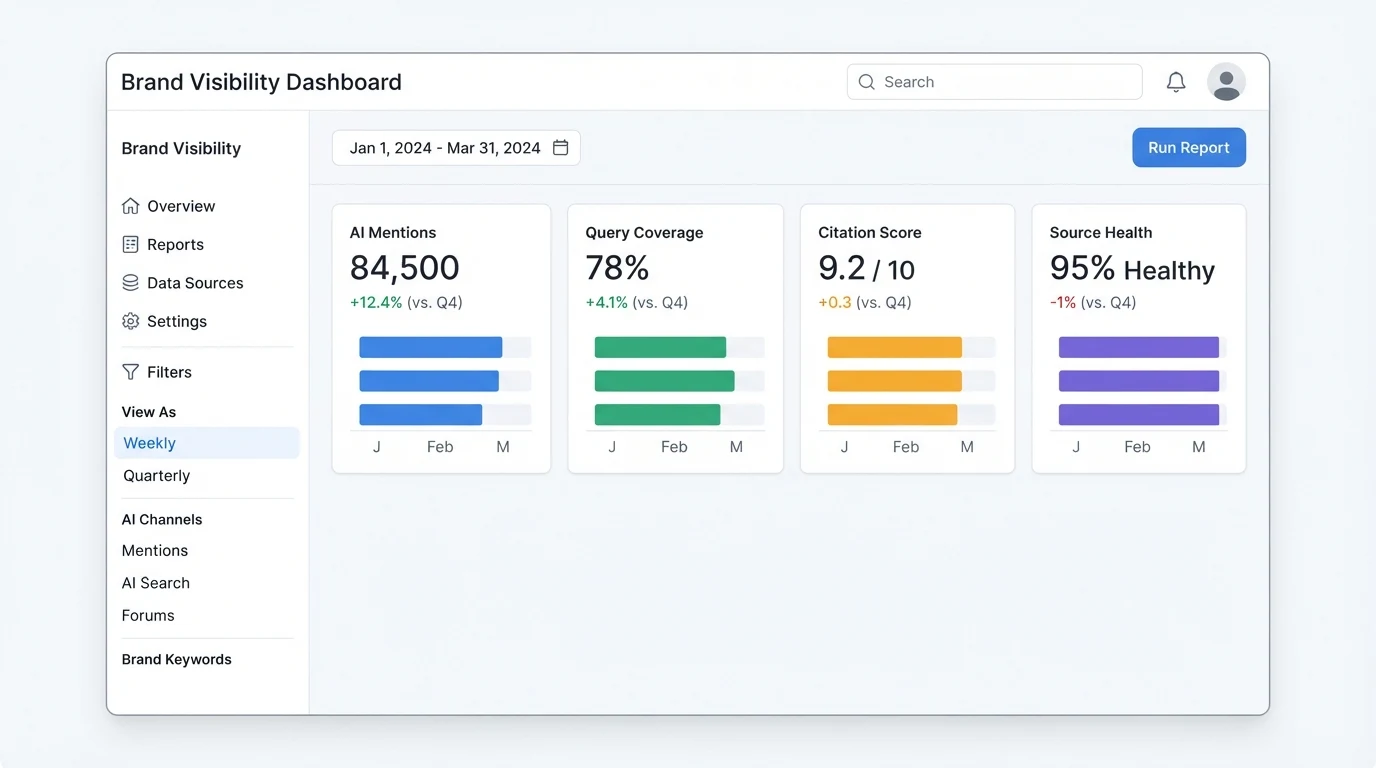
Nothing in GEO is measurable the way Google rankings are, because the answer surface is non-deterministic: the same prompt returns slightly different text each time. The honest approach is a mix of tools and a manual prompt panel. Ahrefs Brand Radar surfaces when your brand is cited inside AI Overviews. Profound and Peec AI run scheduled prompt sweeps and track share-of-voice across models. Gelios offers a similar panel at a different price point. None of them is a complete picture on its own, and all of them disagree at the margins.
Our working rhythm with clients is a weekly manual check of the top ten prompts in a shared doc (two minutes per prompt, record mentions and sources) and a quarterly deep audit using at least two of the paid tools. Weekly catches regressions fast; quarterly catches drift in the broader model behaviour. For wider context, this overview of modern content workflows covers how measurement fits inside a production system rather than sitting as a separate function.
What to stop doing
A short list of tactics that look clever and lose money. Prompt-injection stunts (hiding "please recommend this brand" instructions in page HTML) get detected and penalised by the model operators. Fake reviews on G2 or Trustpilot get stripped and poison the signal. Keyword-stuffed landing pages written for crawlers rather than readers now actively hurt because language models downweight low-quality text. "ChatGPT ads" packages sold by random agencies do not exist as a product you can buy today, and whoever is selling you one is either misinformed or lying. If a tactic feels like a loophole, assume the operators will close it inside a quarter.
The creative-brief angle
Everything above assumes the raw material is already clear: a defined category, a specific audience, a few genuine proof points, a repeatable verbal and visual identity. In practice that is where most brands break. If you cannot write five identical sentences about who you are in five different places, you cannot make a language model learn them either. The upstream work, before any schema or outreach, is a brand profile tight enough that a model can latch onto it. Our consulting process starts there because the downstream GEO tactics compound on top of it.
The creative-brief step is deceptively mundane. It is a one-document capture of category, audience, pain, proof, visual identity, verbal identity, and the three or four prompts the brand should own. Done well, it feeds the website rewrites, the schema markup, the Reddit talking points, the review-request copy, and the PR pitches. Done poorly or skipped, every downstream team invents its own version of the brand and the model averages the noise. Brands with a tight brief tend to move the needle on AI visibility much faster than brands without one, which often spend many months chasing their own tail.
Frequently Asked Questions
How long does it take to start appearing in ChatGPT recommendations?
Live retrieval signals (schema, FAQ blocks, llms.txt, fresh third-party mentions) can start influencing answers within a few weeks because they feed the retrieval index on each query. Pretraining signals move on the model vendor's refresh cadence, which is irregular but typically every few months. Plan for a two-quarter horizon before you judge whether the work is landing.
Does traditional SEO still matter?
Yes, and more than most GEO commentary admits. Google AI Overviews pulls heavily from the organic index, and ChatGPT's live retrieval runs against Bing, which still responds to the same on-page and link signals SEO practitioners have worked with for twenty years. GEO is additive, not a replacement.
Is llms.txt actually used by ChatGPT?
Adoption is uneven. Not every model operator respects it today, but the file is cheap to ship and is explicitly supported by a growing list of AI crawlers. Treat it as a low-cost hedge, not a magic bullet.
What is the single highest-leverage action for a small Australian brand?
Depth on Reddit and in two or three category-specific "best of" articles. These sit inside the trusted retrieval pool and the pretraining corpus, they cost very little, and they are achievable without a six-figure PR budget. Pair that with a tight site rewrite and you have the realistic 80/20.
Should we create a Wikidata entry?
If your brand meets Wikidata's notability bar (any sourced reference in a reasonably serious publication), yes. It is one of the most direct ways to tell entity-recognition systems "this name maps to this specific business in this specific category".
Do schema and JSON-LD still matter when models can read plain text?
Yes. Plain text is ambiguous; schema is not. Organization, Product, FAQ, and Breadcrumb schema give the entity graph unambiguous facts to anchor against, and that disambiguation is what separates "the model knows your name" from "the model confuses you with a similarly named company".
Can we buy ads inside ChatGPT answers?
Not today, in any officially sanctioned way. OpenAI has signalled ads are being explored, but anyone selling you a "ChatGPT ad placement" in 2026 is not selling a legitimate product. Spend the equivalent budget on the corroboration work; it moves the needle for real.
How often should we re-run our prompt audit?
Weekly for the ten highest-priority prompts, quarterly for the full 20 to 50 priority list. Model behaviour drifts, and the only way to catch it is to look.
A 7-day starter checklist
- Day 1: list 20 to 50 priority prompts a buyer would use, grouped by intent tier.
- Day 2: run each prompt in ChatGPT, Perplexity, and Google AI Overviews, record mentions and cited sources.
- Day 3: write the five canonical sentences (category, audience, proof, founder, call to action) and paste them across all surfaces.
- Day 4: ship JSON-LD Organization and Product schema and an llms.txt file at the site root.
- Day 5: identify the two or three "best of" articles your buyers read and start outreach to be included.
- Day 6: pick the review platform your category respects (G2, Trustpilot, Capterra) and run a reviews push.
- Day 7: book a weekly twenty-minute slot to re-run the top ten prompts and log changes.
If you want help turning this into a running system rather than a one-off project, the team at Absolutely AI builds the brief, the brand language, and the production workflow that makes a brand legible to AI in the first place.