AI Upskilling for In-House Creative Teams: A 90-Day Playbook
Ninety-six percent of creative leaders expect AI to speed production, yet only two percent of in-house teams have folded it into daily workflow. At Absolutely AI we see the gap close when training moves from curiosity to operating system. This is the operator's playbook: role-specific curricula, a 90-day program, and the governance to keep the work on-brand.

Most in-house creative teams are stuck in the same place. A few designers have played with Midjourney on a Friday afternoon, a copywriter has a ChatGPT tab permanently open, and the art director has quietly asked whether Firefly is "the safe one" for client work. Meanwhile the brief backlog grows, the CMO wants more variants, and the leadership deck says the team is "leaning into AI." The honest answer is that playing with tools and shipping branded work at pace are two different disciplines, and most upskilling programs confuse the first for the second. At Absolutely AI we run the second one every day, and the gap is almost always structural rather than talent-based.
This article is the operator's version: what a serious in-house AI upskilling program actually looks like, with role-specific curricula, a weekly 90-day cadence, a governance layer, and an ROI framework that does not rely on vanity metrics. It assumes you are responsible for creative output, not for selling a course.
Why Generic AI Training Fails In-House Teams
The usual pattern is a one-day workshop, a Slack channel, and an expectation that the team "experiments." Three months later nothing has changed in the Monday brief review, because experimentation without integration never survives contact with a live deadline. A survey this year found seventy-four percent of designers are self-teaching AI on their own time, which tells you the appetite exists; what is missing is the scaffolding.
The failure modes repeat across every studio we audit. Tool sprawl: six subscriptions, no shared library of what each tool is actually best at. Brand drift: strong raw outputs that look nothing like the brand after revision. The junior-senior divide: juniors adopt tools quickly, seniors feel their craft is under threat, and nobody owns the handshake between them. A good program solves all three at once, which is why training a single tool in isolation almost always fails. For a lighter entry point, we also run AI workshops for creative teams that seed the vocabulary before a full program.
The Four Capability Tiers Every Team Needs
Before writing a curriculum, agree on what capability actually means. We use a four-tier model because it maps cleanly to review gates and promotion criteria later.
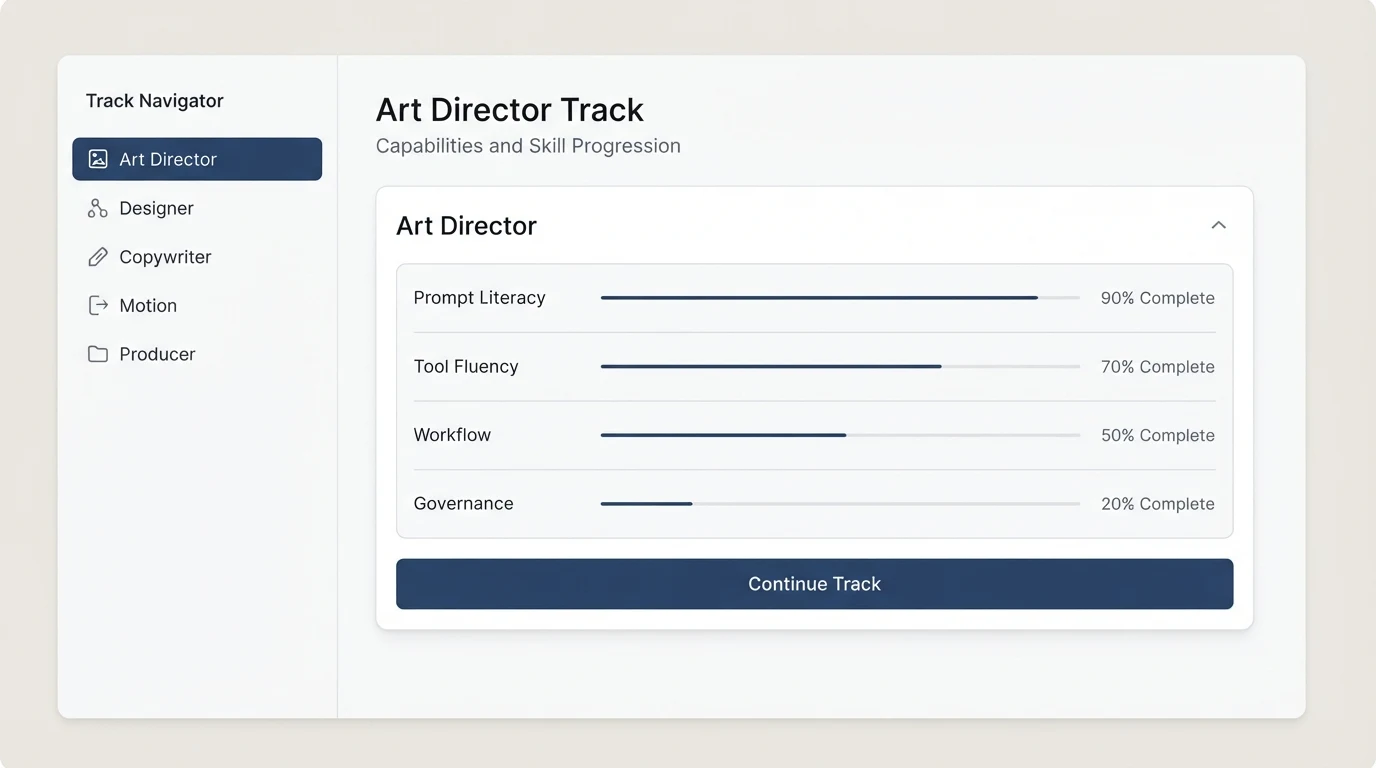
- Prompt literacy. The ability to describe intent, constraint, and reference in a way a generative model can act on. This is a writing skill before it is a technical one.
- Tool-stack fluency. Working knowledge of the current stack: Firefly for brand-safe generation, Midjourney for concept exploration, Runway and the current wave of Veo and Sora models for motion, ChatGPT for structured ideation and copy variants, DALL-E for quick ideation. Fluency means knowing which tool to pick, not using all of them.
- Workflow integration. The ability to slot generative steps into the real pipeline: brief, concept, finish, approval, delivery. Nothing counts until it lands in the file the client sees.
- Governance and brand guardrails. Knowing what can go to a client, what needs human finishing, and what cannot be shipped at all. This is where senior creatives earn their keep.
Every role in the team will sit at a different tier for a while, and that is the point. The program's job is to move people up the tiers in the order the business needs, not all at once. The approach echoes the sequencing we use when running AI training for marketing teams in Australia, where capability tiers are mapped to measurable deliverables rather than curiosity.

Role-Based Learning Paths
A copywriter learning Runway is a waste of a week. A motion designer learning the nuance of structured prompting is a career unlock. Separate the paths; share the governance layer.
Art Directors
Focus on concept exploration at speed. The job is to generate twenty valid directions in the time it used to take to brief one. Deliverable: a mood exploration done entirely in generative tools, defended in the same review the team already runs. KPI: directions-per-hour and the percentage of generative concepts that survive to the first client round.
Designers
Focus on the handoff from generative asset to finished layout. Most "AI output" fails because the designer treats the generation as the end state. Train the opposite: the generation is a sketch, the finish is still the designer's craft. Deliverable: three finished layouts whose provenance is partly generative but whose brand expression is indistinguishable from current work. KPI: revisions per deliverable.
Copywriters
Focus on structured prompting for variants, not for first drafts. ChatGPT writing the hero line is the easy, obvious, and usually wrong application. ChatGPT producing forty platform-sized variants from an approved hero line is the one that saves a day a week. KPI: variants shipped per approved concept.
Motion and Video
Focus on Runway, Veo, Sora, and the integration of generative frames into traditional edits. The win here is the shot you cannot shoot. The failure is treating the model as the whole pipeline. Deliverable: one social cutdown where generative b-roll is used deliberately and reviewers cannot tell. KPI: cost per finished second, honestly measured.
Producers
Focus on scoping, governance, and the new rhythm of review. Producers often get skipped in AI training and then end up as the bottleneck. Give them the tool-stack map, the licensing cheat sheet, and the new approval language. KPI: approval cycle time.
A 90-Day Upskilling Program You Can Actually Run
Three months is enough to move a team from curiosity to shipping, provided the weeks are specific. Vague "journeys" are what sink these programs. The following is what we run with in-house teams who want results tied to the next quarter's work, and it slots in alongside the production support we offer through AI content creation.
| Phase | Weeks | Focus | Output |
|---|---|---|---|
| Audit and baseline | 1 to 2 | Map current workflow, document brand standards, baseline hours and revision counts on five live deliverables. | Baseline report and tool-stack decision. |
| Workshops and sandbox | 3 to 6 | Role-based workshops, sandbox briefs run in parallel to real work, no client exposure. | Role playbooks and a shared prompt library. |
| Shadow-shipping | 7 to 10 | Generative steps inserted into live briefs under senior review. Every output ships, nothing hidden. | Ten shipped deliverables with provenance notes. |
| Codification | 11 to 12 | Lock the new workflow into the brief template, the review gates, and the producer's checklist. | Updated operating manual and KPI dashboard. |
Time commitment is roughly four hours per team member per week in the first month, dropping to two in the shadow-shipping phase. Budget is dominated by senior time rather than software; the subscriptions are the small line.
Building the Internal AI Champion Model
Perpetual external vendor dependence is the quiet failure mode of most upskilling programs. The teams that make AI stick, Superside, R/GA, and Dept among them, train internal facilitators who own the ongoing operating system after the external partner has left. The pattern is consistent: one champion per discipline, protected time to maintain the prompt library and the tool-stack decision log, and a quarterly review that updates the stack as models change.
The champion is not the best prompter in the team. The champion is the person willing to document, teach, and defend decisions in review. Pick for temperament. Our AI consulting engagements almost always include building the champion role explicitly rather than leaving it to emerge.
Measuring ROI Without Faking It
The temptation is to count hours saved and move on. Hours saved is a real metric, Superside has publicly reported around 1,600 hours saved in under a year on internal work, but on its own it rewards activity rather than quality. Use a four-metric panel instead.
- Hours saved per deliverable type. Measured against the baseline captured in week two.
- Concept-to-approval ratio. How many of the concepts shown to the client survive the first round. If this gets worse, you are generating faster but not better.
- Revisions per deliverable. Rising revisions is the leading indicator of brand drift.
- Brand-consistency scoring. A rubric the creative director signs off, scored on a sample of outputs each sprint.
Report all four every month. Hiding any one of them is how measurement theatre starts.
The Governance Layer
This is where upskilling programs blow up in production, and it is the single area most training skips. The checklist a creative director should actually have on the wall:
- Model licensing status for every tool in the approved stack, with the commercial-use clause noted.
- IP and training-data posture for each tool, reviewed quarterly as providers update terms.
- Client-approval language in the SOW: what disclosure, if any, is contractually required.
- Human-in-the-loop gates: which steps require a named reviewer before anything ships.
- A kill-list of outputs that cannot be used regardless of how good they look: likenesses without release, references to living people, pastiches of identifiable artists.
If any of these are unclear, pause and get them written down. We are happy to review a draft governance pack over a call via our contact page.
Common Failure Modes and How to Avoid Them
Four patterns kill otherwise good programs. Tool fatigue, where the team subscribes to everything and masters nothing; fix by picking a stack of four and defending it. Generic outputs, often called slop, where speed outruns taste; fix by raising the review bar, not lowering it. Senior resistance, usually a signal that seniors have not been given a path up the tiers themselves; fix by investing in them first, not last. Measurement theatre, where only the flattering metric gets reported; fix by publishing all four KPIs even when one is going backwards. The teams we work with on AI education engagements usually hit at least two of these in the first quarter, and the ones that recover are the ones that name the failure out loud.
Frequently Asked Questions
How long before a trained team is faster on live work?
Realistically, week seven. Weeks one through six build the capability; shadow-shipping is where the speed shows up. Expect the first live deliverables to be slower than before, because the new workflow is still being learned under real conditions.
Do we need to buy every tool on the market?
No. Four is usually the right number: one brand-safe generator, one concept-exploration tool, one video and motion tool, one language model. Add tools when a specific capability gap appears, not when a new launch is in the news.
Should we train seniors or juniors first?
Seniors. Juniors will self-teach anyway. The strategic risk is seniors who feel displaced and quietly resist the shift. Train them first and give them the champion role to own.
How do we stop outputs looking generic?
Treat generations as sketches, not finishes. Keep the designer's craft on the back end. Score brand consistency on every sprint and feed the scores back into the prompt library so the team is learning from its own best work.
What about client disclosure?
Check the SOW. Some clients require explicit disclosure of generative use, some do not. The safe default is to document provenance internally for every deliverable so that whatever a client later asks, you can answer.
Can a small team of five run this program?
Yes. The 90-day cadence scales down more easily than up. For a team of five, one champion covers all disciplines, the sandbox phase shortens, and the governance pack is lighter but still written.
Is any of this worth doing if we outsource most production?
Yes, and arguably more. If you outsource production, the in-house team's job becomes brief writing, review, and brand defence. Each of those is directly improved by the prompt literacy and governance tiers above.
How often does the program need updating?
Quarterly for the tool stack, annually for the curriculum, continuously for the prompt library. The champion owns the cadence.
Upskilling an in-house creative team is a workflow problem dressed up as a training problem. The teams that get it right treat the three months as a redesign of how briefs move through the studio, not as a crash course in software. If you want a partner to run the program with you, or to plug into the shippable end of it, Absolutely AI's education practice runs this playbook with in-house teams across Australia and takes the production pressure off while the team is still learning.