Pebblely vs Photoroom vs Agency: Which Wins in 2026?
Pebblely, Photoroom, and a creative agency all promise product imagery, but they solve wildly different problems. One swaps backgrounds for $9 a month, one runs a full editing suite with 150M+ downloads, and one builds the campaign your brand launches on. At Absolutely AI, we field this question weekly, so here is the honest breakdown, including the hybrid option nobody is talking about.
Pebblely, Photoroom, and a creative agency all promise product imagery, but they solve wildly different problems. One swaps backgrounds for a few dollars, one runs a full editing suite with 150 million downloads, and one builds the campaign your brand launches on. Every roundup on this topic treats the agency option as an expensive strawman, so at Absolutely AI we wrote the version that actually respects all three.
Before the deep dive, the decision-first snapshot. The real question isn't Pebblely versus Photoroom versus agency. It's whether you're generating a catalog fill or building a brand asset. Everything downstream flows from that one call.
| Option | Best For | Cost Range | Output Type |
|---|---|---|---|
| Pebblely | Solopreneurs, marketplace listings | $9 to $39/mo | Themed background swaps |
| Photoroom | Teams needing speed and templates | $7.50 to $20.83/mo | Editing suite + Virtual Model |
| Traditional agency | Hero campaigns, brand launches | $2k to $10k per campaign | Creative direction + assets |
| AI-powered agency | Hybrid: strategy + AI production | ~30 to 40% of traditional | Concepts, storyboards, hero shots |
What Each Option Actually Does
Pebblely is a themed background generator. You upload a product cutout, pick a scene template (marble, kitchen, beach, holiday), and it drops your product into a rendered environment. It's fast, cheap, and calibrated for Shopify sellers who need 500 catalog thumbnails without shooting a single one. It does not do concepts, storyboards, or brand voice, and it doesn't pretend to. Compare that scope with what a full creative content workflow actually needs.
Photoroom is a broader editing and staging suite. Background removal is genuinely best-in-class, batch editing is fast, and the Virtual Model feature (AI models wearing your apparel) is a legitimate leap for fashion sellers. With over 150 million downloads it's the volume leader, but volume is the tell: it's built for teams processing thousands of listings, not directors approving a hero. For an agency-tier alternative that treats visuals as a system, see how we approach graphic design.
An agency delivers something categorically different: strategic creative direction. That means a brief interrogated for tension, a moodboard that argues a point of view, hero shots calibrated to a brand book, and cross-deliverable consistency so your hero on Vogue, your storefront banner, and your paid social all feel like the same brand. Tools give you images. An agency gives you a campaign.
Cost Per Image, Honestly Compared
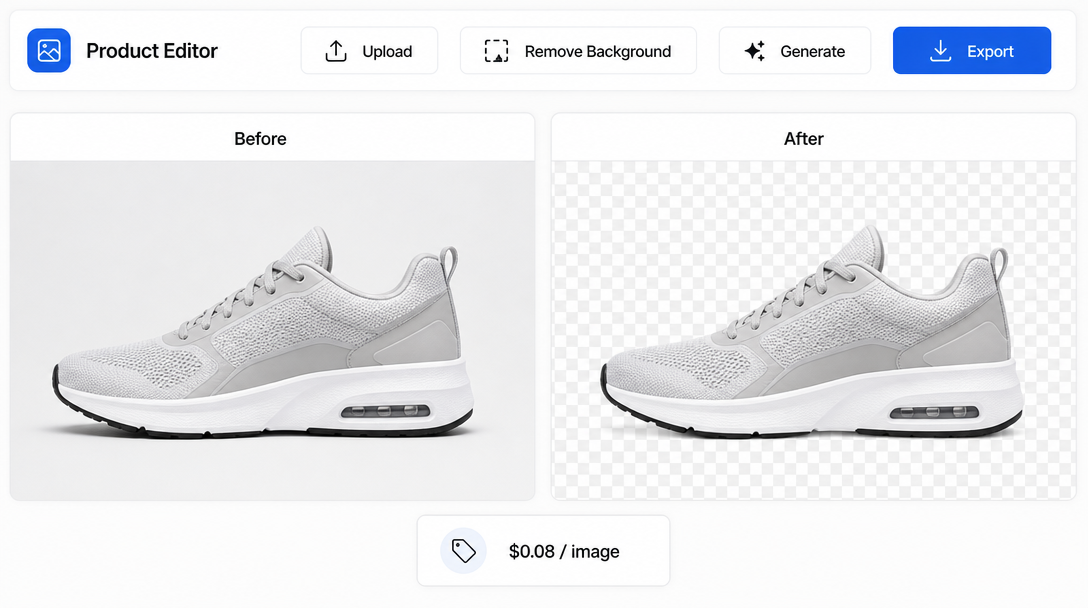
The pricing gap between these three is real, and worth stating plainly rather than dressed up. Pebblely at $9 to $39 a month lands around $0.08 to $0.30 per image depending on plan and volume. Photoroom Pro to Max sits at $7.50 to $20.83 a month, and at batch volume the effective cost per image drops as low as half a cent. A traditional agency is a different universe: $20 to $150 per image on volume work, or $2,000 to $10,000 per campaign when creative direction, casting, and licensing are involved. Our own product photography service is built for the campaign end of that spectrum and is scoped per project.
The benchmark that matters: a 500-SKU catalog shot traditionally runs $125,000 to $250,000 per year. The same catalog run through AI production sits closer to $500 to $2,000. That gap is why SaaS tools exist, and why they win the catalog-fill fight decisively. But that gap only matters if catalog fill is the problem. For a campaign hero, cost per image is the wrong metric entirely. What you're paying for is the concept, not the pixels. That distinction shapes every commercial project we scope.
What Pebblely Wins At
Pebblely is the right tool for a specific shape of business: solopreneurs and micro-brands under 30 SKUs, phone-shot products, marketplace listings (Amazon, Etsy, eBay), and Shopify sellers who need the app-integrated convenience. If your customer is scrolling a marketplace grid and never sees your brand outside a thumbnail, Pebblely does the job for the price of a coffee. Brands playing at that volume rarely need branding-tier work, and pretending otherwise wastes money.
Where Pebblely stops working is the moment your product needs to sit in an actual scene with people, story, or brand cues. The templates are recognisable. Two Shopify stores in the same category can end up with identical marble backdrops. For catalog it's fine. For a launch, it's brand-damaging. Read that risk carefully before you commit to a tool-only stack across a full visual campaign.
What Photoroom Wins At
Photoroom's win is workflow. Background removal accuracy is the best in the SaaS category, batch editing across hundreds of images is legitimately fast, and the Virtual Model feature quietly solves a real fashion problem: showing apparel on bodies without booking talent. For DTC teams with a marketing manager and a listings backlog, Photoroom is the correct answer. It's also where teams outgrow the tool: when a launch demands a concept, not just a clean cutout, they call an agency that speaks concepts.
What an Agency Wins At (The Part Everyone Skips)
This is the section every SaaS-authored comparison buries. An agency wins the work that defines your brand. Hero campaigns, category launches, ambiguous briefs where the client says "make it feel expensive" without knowing what that means, cross-channel consistency across paid social, retail, OOH, and film. Licensing conversations, talent releases, model rights, music sync. The films work we produce lives in this space, because film demands storytelling that no template can fake.
The other agency win, quieter but critical: brand-damage risk. AI-generated imagery goes wrong in specific ways, and those failures are more visible on a hero than a thumbnail. Uncanny hands, generic environments that read as competitor lookalikes, product proportions that shift between frames. On a catalog thumbnail nobody notices. On a launch billboard, it's the story. An agency's job is to catch those failures at the moodboard stage, not on the client's Slack after the ad is live. That editorial layer is what our commercial team sells above everything else.
The last agency win is workflow artefacts. Tools give you images. An agency gives you concepts, storyboards, moodboards, style bibles, and cross-deliverable consistency. When your CMO asks "can we cut a 15-second version, a static square, and a print for retail?" a tool user starts over. An agency ships all three from the same concept. See how that plays out in a full video-and-still campaign.
The Hidden Third Path: AI-Powered Creative Agency
Missing from every SaaS-vs-agency comparison is the hybrid: an agency that uses AI as its production layer, not as its differentiator. Strategic creative direction stays human. Concepting, moodboarding, and creative calls stay with a director. Production, iteration, and volume all run through AI. The output is agency-tier, the cost curve lands around 30 to 40% of a traditional shop. That's the category we operate in, and it's what our agency page exists to explain.
For most brands past the marketplace stage, this is the right answer. You get the strategic layer that tools can't fake and the production speed that traditional shops can't match. A launch campaign that used to be 8 weeks and $80k lands in 2 weeks at a fraction of the cost, without the "looks AI" tell that kills a hero. Book a scoping call if you want to see what that timeline looks like against a real brief.
Decision Flow: Which Should You Pick?
- How many SKUs? Under 30 and marketplace-only: Pebblely. 30 to 500 with a team: Photoroom. Above that, or brand-led: agency.
- Hero or catalog? Catalog fills go to tools. Hero assets go to an agency, every time.
- Do you have a brand book? If yes, tools can execute inside it. If no, you need an agency to build one before any imagery is worth making.
- Is this a launch? Launches need concept, storyboard, and cross-channel artefacts. That's agency work, hybrid or otherwise.
- What's the brand-damage cost of a bad image? If it's a thumbnail, minimal. If it's the campaign, hire creative direction.
Frequently Asked Questions
Can Pebblely replace a product photographer?
For marketplace listings under 30 SKUs, yes. For a hero campaign, category launch, or anything a customer will see outside a thumbnail grid, no. Pebblely's template library is recognisable and shared across thousands of sellers, so anything that needs a proprietary visual identity will read as generic. Use it for volume, not identity.
Is Photoroom good enough for a launch campaign?
Photoroom is excellent at execution and weak at concept. If your creative direction is already locked, storyboards signed off, and you just need clean production, Photoroom can carry the weight. If you're still working out what the campaign should say, Photoroom won't help you find it. That's a creative director's job, not a template's.
What does an agency give me that a tool can't?
Strategy, editorial judgement, and cross-deliverable consistency. An agency interrogates the brief, argues a point of view, and delivers a campaign that works across every channel from the same concept. Tools give you images one at a time with no memory. Agencies give you a system that scales across a full launch.
How much does an AI-powered agency cost compared to a traditional one?
Roughly 30 to 40% of a traditional shop, with faster turnaround. Traditional campaigns land at $10k to $80k depending on scope and talent. Hybrid agencies deliver the same strategic layer with AI production, so the same brief lands well below that, often in half the time. The ceiling on quality is set by the creative director, not the pipeline.
What if my brand outgrows a tool mid-launch?
This happens constantly. Teams start on Photoroom for listings, get funded, hire a marketing lead, and realise the launch campaign needs concept work no template can produce. The fix is not to abandon the tool, it's to layer an agency above it for hero and campaign work while keeping the tool for catalog. That's the stack most funded DTC brands settle on.
The Honest Answer
Pebblely and Photoroom are excellent at what they do. Agencies are excellent at what tools can't. The mistake most brands make is trying to force one to do the other's job, then blaming the wrong thing when the launch underperforms. Get clear on whether you're shipping catalog or building a brand, and the choice makes itself. When it's the second one, Absolutely AI is built for it: strategic creative direction, AI-accelerated production, and the editorial bar a hero asset actually needs.